
A virtual Visa Platinum that draws straight from your on-chain USDT — neat in theory, half-told in practice
 Available in US
The NAKA card is one of a small group of payment products that try to skip the usual step: instead of topping up a prepaid fiat balance, the card spends directly from a self-custody on-chain USDT wallet. Every payment is signed by a smart contract on the spot. The pitch is appealing to anyone who keeps crypto on a hardware or software wallet and resents giving it to a custodian. The reality, after spending time with NAKA’s own pages, the app store listing and what little third-party coverage exists, is more complicated. The product is real and the company behind it is a registered Slovenian firm with three ISO certifications, but the published material is thin on the points that matter most: who exactly can get the card, what it actually costs to use, and which entity is licensed to issue the Visa programme. This review walks through what I could verify, what I could not, and where NAKA fits if you are weighing it against other crypto cards.
The conditions described here are current as of October 28, 2026.
Verdict
NAKA scores 5.1 out of 10. That is a middling grade, and the reason is not that the product is broken — it is that for a card that asks you to trust your private keys to it, the public documentation leaves too many ordinary questions unanswered. The product itself is a virtual Visa Platinum paid from a self-custody USDT balance, with Apple Pay and Google Pay support and an app (NAKA Pay+) built around a quick KYC check. Where it loses marks is in the things that decide whether a card is usable day to day: a clear fee schedule, a public list of supported countries, named licensing for the card issuer, and any sign of how complaints or disputes are handled. The NAKA site is upfront that it is a Slovenia-based company targeting Latin America, but most of the rest has to be pieced together from a launch post, an app store listing and a third-party report.
If you are someone who already keeps USDT in your own wallet, lives in or has ties to Latin America, treats the card as a secondary spending tool and is comfortable reading between the lines of partial documentation, NAKA is a genuinely interesting idea. If you need a card you can fully understand before you sign up — clear fees, a defined issuer, a known dispute path — NAKA is not yet that card. The rest of this review goes through each of those points in detail.
| Criterion | Score | Reason |
|---|---|---|
| Who can get it | 5 / 10 | Targets Latin America; the app is listed as “worldwide” but no country list is published; US citizens are explicitly excluded |
| Cost | 5 / 10 | NAKA itself says pricing is “per user” rather than per transaction and publishes no fee figures |
| Top-up options | 3 / 10 | Only USDT from a self-custody wallet; the app store listing accepts USDT on the Avalanche C-Chain only |
| Reliability and complaints | 6 / 10 | NAKA GLOBAL d.o.o. in Ljubljana with three ISO certificates; no card issuer or licence named; no independent reviews found; App Store 5.0 from 11 ratings |
| Everyday use | 6 / 10 | Virtual Visa Platinum with Apple Pay and Google Pay; ATM mentioned but with no conditions |
| Total | 5.1 / 10 |
The NAKA card is essentially a way to spend USDT from a self-custody wallet with a Visa. That sentence is the whole product in one line, and it is both the most attractive thing about NAKA and the reason the cost section below is unusually short: there is almost nothing to compare it to in pricing, because so little pricing is published.
Who will they give you the card
NAKA is unambiguous about one thing: the product targets Latin America. The company’s own site says so in plain language, and the regional split goes deeper than marketing — the legal documents are organised by entity, with NAKA Slovenia, NAKA Switzerland and NAKA El Salvador each covering their own slice, and a note that “the specific provider depends on your jurisdiction and/or the product suite.” There is also a US-specific card agreement, suggesting the company does want to do business with US residents in some form, but the starting data when you begin the onboarding flow asks whether you are a United States citizen, and being one is treated as a disqualifier rather than a question to resolve later. If you are a US citizen, NAKA is not for you as it stands today.
Beyond that, the app is listed in the stores as available “worldwide,” but “worldwide” here is the developer setting on the store, not a published country list. There is no public roster of supported countries, and no published list of restricted ones. The three NAKA legal entities — Slovenia, Switzerland and El Salvador — give some hint, but they are corporate domiciles, not a coverage map. The practical effect is that you can download the app, set up the wallet and start the KYC check, but the only firm exclusion you can confirm before installing anything is US citizenship.
KYC itself is described as “a quick verification” after you set up the wallet inside NAKA Pay+. The pages I read do not say which documents you will be asked for, whether proof of address is required, or what the minimum age is. In the EU context, regulated firms typically ask for a government photo ID, proof of address and a sanctions/PEP screen; NAKA’s wording is consistent with that pattern but does not commit to it. There is no mention of needing a bank account, which is one of the few positives here — the card is positioned for people who do not have one.
Two things are worth flagging about who can actually get the card. First, the lack of a country list means the only way to know whether your country is supported is to go through the application and let NAKA tell you. Second, the Slovenian parent sits behind three separate legal entities, and which one you end up contracting with is not something you can pick: it depends on where NAKA decides you belong. For a reader in, say, the Philippines, there is no obvious signal from the public material whether the card is available at all.
How to get it
There is no physical card to wait for. NAKA’s product is a virtual Visa Platinum, tokenised for mobile wallets and usable online and in store through Apple Pay and Google Pay. The card’s BIN is part of the standard Visa Platinum range, and the company describes it as accepted in “over 150 million locations,” which is the standard network-wide figure for Visa.
The flow, as best as the public material describes it, runs in this order:
- Download NAKA Pay+ (available on the App Store; a Google Play listing exists but the rating is not public).
- Set up the on-chain wallet inside the app. This is where your private key is generated and held on your device.
- Pass a “quick KYC verification.” Documents, timing and any proof-of-address requirement are not stated in the pages I read.
- Once approved, the virtual card is issued and can be tokenised into Apple Wallet or Google Wallet.
There is no physical card mentioned in the product material, and no shipping step, so the typical “wait seven to ten business days” of physical crypto cards does not apply. NAKA does not publish a stated list of KYC tiers or document requirements, so what counts as a “quick” verification is unclear: minutes, hours, days? The launch post and the app store listing give no figure.
The app itself, NAKA Pay+, is at version 2.2 on iOS, with an App Store score of 5.0 from 11 ratings. Eleven is a small sample, and the absence of Google Play ratings is itself a signal: there are not many public voices commenting on this product. The card programme has no third-party Trustpilot page and no Reddit thread for NAKA card, NAKA+ and Visa reviews.
Fees: what it really costs
This is the section where NAKA is weakest, and it is worth being direct about it. NAKA’s own site says that pricing is “per user” rather than per transaction and that there are no published figures. I went through the public material looking for at least one number — an issuance fee, a monthly fee, a conversion percentage, an FX mark-up, an ATM charge — and the only thing the company will say is that the pricing is per user, not per transaction. The cost section of this review is therefore unusually short, because the cost side of the product is the part NAKA chooses not to publish.

What that means in practice is that you can sign up, set up the wallet and request the card without knowing what it will cost you to actually use. You may find the fees in the app after onboarding, or you may find them only on a per-transaction screen, or you may find out by being charged. None of that is unusual for fintech apps that price in-app, but it is unusual for a card that wants you to commit your private key to it.
Here is what I can put in a table, and what I cannot:
| Fee or limit | Amount or rule | Source |
|---|---|---|
| Card issuance | Not stated | NAKA site, no figure published |
| Monthly or annual fee | Not stated | NAKA site, no figure published |
| Crypto-to-fiat conversion | Not stated | NAKA site, “per user” pricing, no figure |
| Foreign exchange / non-USD spend | Not stated | Not disclosed |
| ATM withdrawal fee and allowance | Not stated | ATM use mentioned; conditions not given |
| Spending limits | User-adjustable in app; amounts not stated | NAKA self-custody page |
| Daily or monthly cap | Not stated | Not disclosed |
| Card currency | Not stated; settlement in USDT per NAKA site | NAKA self-custody page |
Three real-world examples show why this matters. Take a €40 dinner in Madrid paid through Apple Pay. You would not know, before tapping, what the conversion fee from USDT to euros is, whether there is a non-USD FX fee on top, or whether the merchant’s MCC is one of any that NAKA might block. Take a $200 online subscription paid to a US SaaS provider. Without a published FX mark-up, you cannot tell whether you are paying closer to 0.5% or 3% on the conversion. Take a $100 ATM withdrawal in Buenos Aires. There is no published ATM fee, no published ATM allowance, and no published daily ATM cap, so the only way to know is to try and watch your balance.
There is a single bright spot: the spending limits are user-adjustable in the app. That is genuinely useful — you can set a daily cap, a per-transaction cap and freeze or block the card yourself. It is also a partial substitute for the missing fee schedule, because it lets you limit how much an unknown charge can cost you.
Top up: how to add money to the card
NAKA is unusual in this respect. There is no “top up” button in the usual sense, because the card is not prepaid. Your USDT sits in the on-chain wallet inside the app, and each card payment is “settled via a smart-contract signature” at the moment of the transaction. The wallet is self-custodial: NAKA says the private key never leaves your device, and the cryptographic signature is what authorises the spend. Until a payment is signed, the funds remain in your wallet on the blockchain.
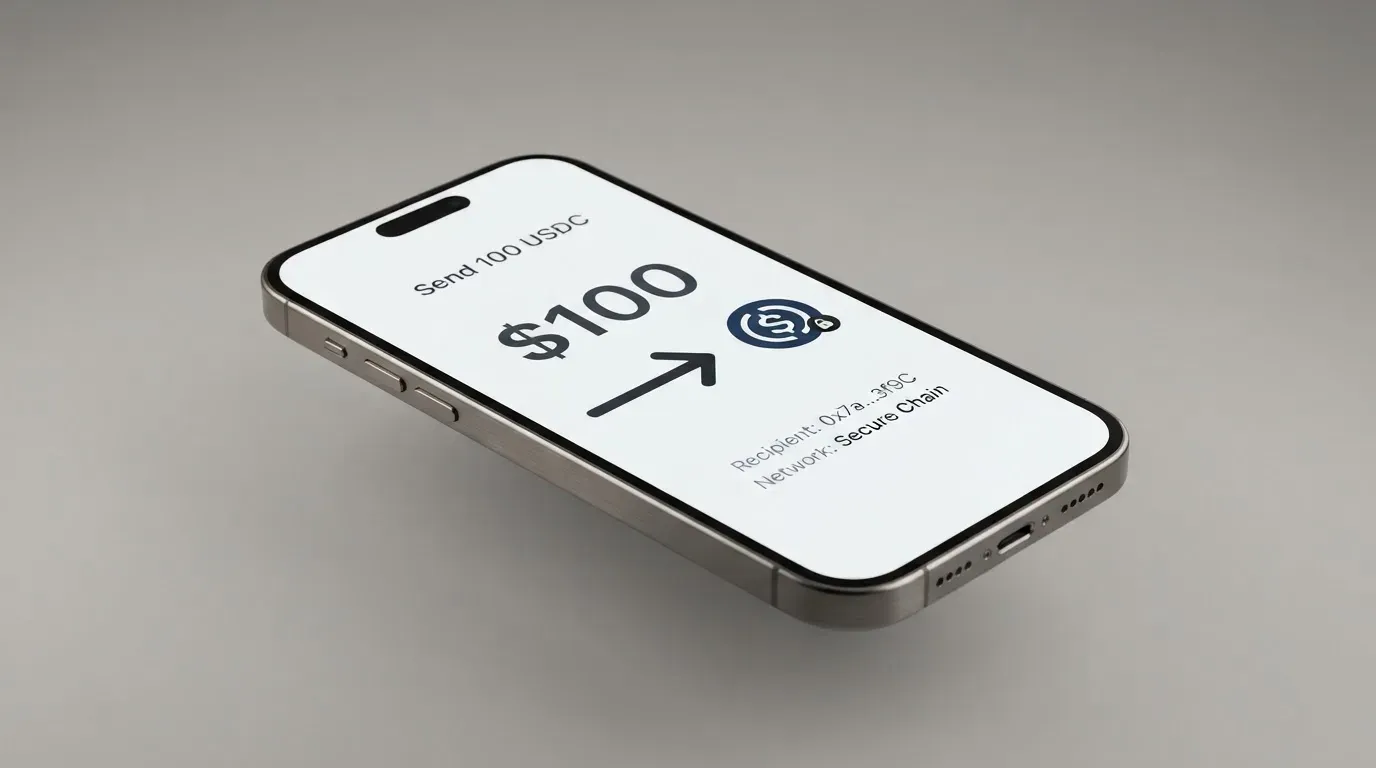
The store listing caption makes a tighter claim: the only token the app accepts for this flow is USDT, and only on the Avalanche C-Chain. That is a narrower specification than the rest of the marketing language suggests, and it is worth treating as a hard constraint. If you hold USDT on Ethereum, Tron, Solana, Arbitrum, Polygon or any other network, the app will not see it as a funding source for the card. You would have to bridge or swap it to Avalanche C-Chain USDT first, and bridging is itself a process with fees and a non-zero failure rate.
There is no published list of supported networks beyond that one, no list of supported tokens beyond USDT, no published deposit fee, and no published minimum or maximum top-up amount. On the withdrawal side, the public material says funds remain on-chain in your wallet until a payment is signed, but does not say how you would move them back out — what the on-ramp and off-ramp to and from a regular bank account looks like, and who provides it.
A practical way to think about it: the “top up” question for NAKA is really a question of which network your USDT is already on. If it is on Avalanche C-Chain, you are set. If it is anywhere else, you are looking at an extra step and an extra fee before the card can see your balance.
Paying with it every day
Once the card is set up and the wallet has USDT on Avalanche C-Chain, the day-to-day experience is meant to be ordinary. NAKA has integrated with Apple Pay and Google Pay, and the iOS listing mentions Apple Wallet tap-and-go support. For online payments, the virtual Visa number is used like any other Visa, and for in-store payments you tokenise it into your phone wallet and tap. The card is described as accepted in “over 150 million locations,” which is the same network-wide figure Visa uses for its global acceptance.
The product pages I read do not list which merchant categories are blocked. Some crypto cards exclude gambling (MCC 7995), adult content, or certain financial services, but NAKA does not say which, if any. If a particular type of purchase is important to you, the safest assumption is that the blocked list is whatever the card issuer decides at the time, and that you will find out by a decline at the till.
On the rewards side, the public material is equally thin. The card itself does not publish a cashback rate or points scheme. The NAKA blog talks about “programmable rewards” as a feature for partner-branded cards, not for the standard NAKA Spend card. So if a base-level cashback is a deal-breaker for you, NAKA does not currently offer one on the public material.
Two other points about day-to-day use are worth knowing. The first is that, because settlement is per-transaction on the blockchain, an authorisation is not instantaneous in the way it is with a regular debit card. You are signing a smart contract for each payment, and the network has to confirm it. In practice that tends to mean a one- to a few-second delay at the till, and the same delay online. The second is that 3-D Secure still applies for online payments, so on first use at a new merchant you may be asked for an additional confirmation in your banking app or by one-time code.
What can go wrong
The first risk is the one the company itself is most careful about: the private key. Self-custody is sold as a feature, and it is one — your USDT is not on NAKA’s balance sheet, and a NAKA insolvency would not give a liquidator access to your wallet. But the same feature cuts the other way. Lose the device without backing up the seed phrase, and the USDT is gone. Fall for a clipboard-hijacker that swaps the destination address on a withdrawal, and there is no central party to reverse it. Phish the seed phrase, and there is no one to call. NAKA mitigates this with an in-app freeze and per-card spending limits, which is a useful set of brakes, but the brakes do not protect the wallet itself.
The second risk is the missing paper trail. The card’s issuer and the licensing under which the card programme is run are not named on the public pages I read. That does not mean there is no licence — the company is registered in Slovenia and has three ISO certifications — but it does mean you cannot check the issuer on any public register before signing up. If the card programme is suspended by Visa (as happened with WaveCrest in 2018, and as Visa did with FTX in 2022), you would be relying on NAKA to give you a notice period, a way to stop spending, and a way to recover your balance. The public material does not describe that path.
The third risk is the lack of an independent review record. I could not find a Trustpilot page, a Reddit thread, or a meaningful app store discussion of the card. Eleven App Store ratings is not a sample from which to draw conclusions. If something goes wrong, the only public feedback channel the company points to is its own “Talk to our team” page. That is not, by itself, a red flag — but combined with the missing fee schedule and the unnamed issuer, it means you are going in with less outside information than you would with most other cards.
The fourth risk is the company structure. NAKA GLOBAL d.o.o. is a real company in Ljubljana, with a registration number (8106452000) and an address (Letališka cesta 33F, 1000 Ljubljana). The related entities in Switzerland and El Salvador suggest a deliberate geographic split, which can be a sign of regulatory arbitrage as much as a sign of careful compliance. The three ISO certificates (ISO/IEC 27001:2022, ISO 9001:2015, ISO 22301:2019) are real and current, but they cover information security, quality management and business continuity respectively, and they are not the same as a payment-services licence. The card issuer and its regulator are not stated in the public material.
The fifth risk is operational. The launch post is dated 24 October 2025, although the page metadata shows a conflicting 6 October 2026. The NAKA Pay+ app was first released on 9 October 2025 per the third-party report I read on 21 October 2026. So the product is roughly a year old in its current form. Early-stage programmes carry more risk than established ones: features change, fees change, programmes get wound down. The self-custody design protects your USDT in the wallet, but it does not protect the card programme itself.
A few smaller things to keep in mind:
- 3-D Secure challenges can be more frequent for prepaid and virtual cards, and some merchants decline foreign-BIN virtual cards outright.
- An authorisation hold can sit on your balance for up to seven days even if the merchant later releases it, which can be confusing on a balance that updates per signature.
- The NAKA self-custody model does not give you chargeback rights in the same way a regulated card does; the card terms (“NAKA Spend Card Terms”) are referenced but were not in the public material I could read.
What to take instead
If NAKA’s published material leaves you uncomfortable, three alternatives give you a more complete picture of what you are signing up for. None of them is a perfect replacement — NAKA’s self-custody funding model is genuinely different from all of them — but each scores higher on the dimensions where NAKA loses marks.
| Card | Score | Best for | Trade-off versus NAKA |
|---|---|---|---|
| MetaMask Card | 7.1 / 10 | People who already live in the MetaMask wallet and want cashback in mUSD | Custodial in the spend layer; cashback has caps; some country restrictions |
| KAST | 6.1 / 10 | Heavy stablecoin spenders who want high cashback and tiered membership | Higher annual fees for the better tiers; explicit blocked list of unsupported countries at KYC |
| TokenPocket Card | 5.8 / 10 | TokenPocket wallet users in the supported European and Asia-Pacific countries | Custodial; virtual-only card; 1% crypto deposit fee (refundable via rewards) |
The MetaMask Card is the one to look at first if you want cashback, an EU-friendly programme, and a card from a wallet you may already use. It is a Mastercard rather than a Visa, with a virtual card issued almost immediately and a Metal version that can be pre-ordered after approval. It is custodial at the spend layer — funds are loaded into a fiat balance — but it is open in 45 listed countries and territories, and the fee schedule is public. The 3% headline cashback on Metal is capped to the first $10,000 of spend, then drops to 1%, which is the kind of detail MetaMask publishes and NAKA does not.
The KAST card is the one to look at if you want the highest published cashback in this group. KAST publishes its tiers (Standard, Premium, Private), its annual fees, and a 0% mark-up on USD stablecoin spending. It supports multiple networks for USDT and USDC funding, and three Visa card designs including a metal Infinite and a gold-plated Infinite. The trade-off is that the membership is paid — $0, $1,000, or $10,000 per year — and the country list is hidden until you begin KYC, which can be frustrating if you are just shopping around.
The TokenPocket card is the closest comparison to NAKA in that it is a virtual-only card from a wallet provider, but it scores slightly higher because it publishes at least the structure of its fees (a 1% crypto deposit fee that is later refundable via rewards, no other stated fees) and supports a defined list of European and Asia-Pacific countries. The trade-off is that the Americas were “planned for Q2 2025,” so for a reader in North or South America the timing is uncertain, and there is no physical card.
If your reason for looking at NAKA is specifically the self-custody model — that is, you do not want anyone else holding your USDT at any point — then the honest answer is that none of these alternatives do exactly that. MetaMask and KAST both load fiat into a balance, and TokenPocket runs on Arbitrum with a custodial structure. For a true self-custody card you have to live with NAKA’s lack of a published fee schedule, or you wait to see whether a more transparent version of the same idea appears.
Who I would recommend it to
I would recommend the NAKA card to a fairly narrow kind of reader. The product makes most sense for someone who already keeps USDT in a self-custody wallet, lives in or has ties to Latin America, treats the card as a secondary spending tool rather than a primary account, and is comfortable accepting that a meaningful part of the fee and licence information is not public. If that is you, the NAKA card does something genuinely useful: it lets you spend your own USDT through a Visa tokenised in your phone, with the smart contract doing the settlement per purchase, and your private key never leaving your device. For that reader, NAKA is worth trying with a small balance and a low daily cap to start.
I would not recommend it to someone who needs to know what they are paying before they pay, who lives in a country not in NAKA’s Latin American focus, who holds USDT on a network other than Avalanche C-Chain, or who needs a clear path to a named and licensed card issuer. The cost section of this review is unusually short for a reason, and the issues section unusually long. As it stands, 5.1 out of 10 is fair.
Frequently asked questions
What is the NAKA card?
The NAKA card is a virtual Visa Platinum that spends directly from a self-custody USDT wallet managed inside the NAKA Pay+ app. Each payment is signed by a smart contract at the moment of purchase, and the private key never leaves the user’s device.
How does the NAKA card work?
You set up the on-chain wallet inside NAKA Pay+, pass a quick KYC check, and request the virtual card. The card spends your USDT on the Avalanche C-Chain, signing each payment via a smart contract. Tokenised versions can be added to Apple Pay and Google Pay.
Is NAKA a bank?
No. NAKA GLOBAL d.o.o. is a fintech company registered in Ljubljana, Slovenia. The card issuer and any banking or e-money licence behind the card programme are not named on the pages I read.
Who owns NAKA?
NAKA GLOBAL, finančne tehnologije, d.o.o. is the parent entity, with related entities NAKA CH SAGL in Switzerland and NAKA SLV, S.A. de C.V. in El Salvador. Beneficial ownership is not disclosed in the public material.
Is the NAKA card available in my country?
The app is listed as “worldwide” on the stores, but NAKA’s own product pages target Latin America and do not publish a country list. The only firm exclusion stated in the public material is US citizenship. The only way to confirm availability is to start the application and let NAKA decide.
Does the NAKA card require KYC?
Yes. The NAKA Pay+ app describes a “quick KYC verification” after the wallet is set up. The exact documents required, the timing, and the minimum age are not stated in the public material.
How do I top up the NAKA card?
You do not top it up in the usual sense. The card spends directly from the on-chain USDT balance in your self-custody wallet, and the app store listing specifies that only USDT on the Avalanche C-Chain is accepted for this flow.
How do I add the NAKA card to Apple Wallet?
Once the virtual card is issued in NAKA Pay+, you tokenise it into Apple Wallet (or Google Wallet for Android) and use tap-and-go in store. The NAKA Pay+ iOS listing mentions Apple Wallet support directly.
Is the NAKA card safe?
The self-custody design means your USDT is in your own wallet and the private key never leaves your device, which removes custodial counterparty risk for the funds. The trade-off is that any compromise of the seed phrase is unrecoverable, and the card issuer and its licence are not named in the public material.
Is the NAKA card worth it?
It depends on what you are comparing it to. If you specifically want a self-custody USDT card and you live in NAKA’s target region, the score of 5.1 out of 10 reflects an interesting product with thin public documentation rather than a broken one. If you want clear fees, a named issuer, or cashback, the alternatives in the section above are a better fit.
Wallet card fees and costs – cryptocardfacts
Content created by the «cryptocardfacts» team