
MiniPay reviewed: no fees, no plastic, spend from your own wallet
 Available in US
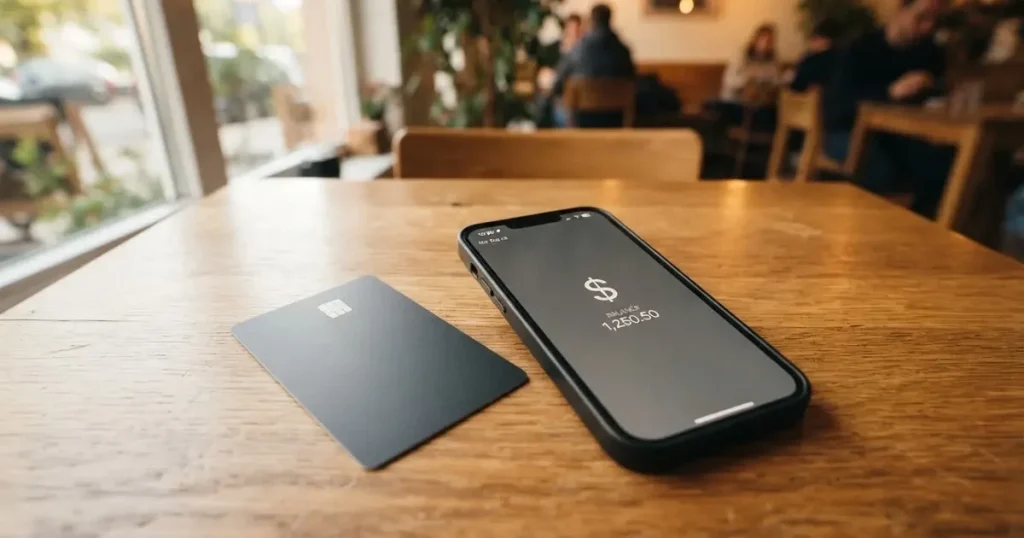
MiniPay is a Visa card that spends directly from a crypto wallet you hold yourself. There is no plastic to wait for, no issuance fee, no monthly fee, and no card fee of the sort most providers charge. The catch is equally plain: it exists only in your phone, it is offered in “selected markets” rather than a published country list, and the programme’s public track record outside the issuing banks is thin. My score is 7.4 out of 10.
Conditions are current as of October 28, 2026.
If you read that and want to know whether it fits your situation, keep reading. The questions you probably arrived with — will they even give it to me, what does it cost me, can I get cash out, what happens if I lose my phone — are the questions this page is organised around.
The score, criterion by criterion
| Criterion | Mark | Why |
|---|---|---|
| Who can get it | 7 / 10 | Selected markets in the EEA, Africa, Latin America and Southeast Asia; the sign-up form shows about 80 countries plus “Other” |
| Cost | 9 / 10 | No issuance fee, no monthly fee, $0 deposit fees, no card fee; Visa exchange rates may apply to non-USD purchases |
| Top-up options | 7 / 10 | Spends straight from a self-custody wallet; starting data names USDT, USDC and cUSD on Celo, not itemised on the page |
| Reliability and complaints | 8 / 10 | Issuers are named and regulated — Monavate Ltd (FCA, FRN 901097) and UAB Monavate (Lithuania) under a Visa Europe licence; programme manager Gnosis Pay sits at 2.1 out of 5 on Trustpilot from 24 reviews |
| Everyday use | 5 / 10 | Digital-only Visa, Apple Pay and Google Pay, no physical card, ATM not covered |
| Total | 7.4 / 10 | A clean, low-cost card for people already comfortable holding their own keys |
Read that table honestly rather than optimistically. The card is strong on price and on the regulatory footing of its issuers, weak on how you actually use a card day to day. That combination — excellent economics, thin everyday convenience — is the whole story of MiniPay.
Who you have to be to get it
You can get MiniPay if your country is one of the “selected markets” in the EEA, Africa, Latin America or Southeast Asia. The catch is that no country list is published. The sign-up form shows about 80 countries plus an “Other” option, and the stated rule is simply: if your country is supported, onboarding appears in the card tab of the app.
That is the honest answer to the most common question in this category — “is it available in my country?” — and it is unsatisfying. You will find out by opening the app, not by reading a table of eligible states. Whether the test runs on your citizenship, your residence, or both is not stated, and that matters: issuers screen citizenship and country of birth separately from address, for sanctions and risk reasons, so a resident address in a supported country does not by itself settle the question. If your country is missing from that list of about 80, or if you hold a passport from a restricted region while living elsewhere, expect the onboarding step not to appear at all.
I would rather tell you that than invent a country list the card does not publish.
How to apply
Applying happens in the app, and identity verification is part of it. The card states that verification depends on your country and the card programme’s requirements, and that the app walks you through it. What documents you need, whether proof of address is required, what age applies, and how many verification tiers exist — none of that is stated.
What you do get is the shape of the card itself: a digital Visa, no physical card, settling in USD. There is no shipping to wait for because there is nothing to ship. Once verification passes and onboarding appears, the card lives in the app.
So the honest summary of the application is: install, look in the card tab, and find out whether your country is one of the selected markets. The rest depends on checks the public pages do not describe.
Fees: what it really costs you
MiniPay’s cost story is the strongest part of the offer, and it is where the 9 out of 10 comes from. There is no issuance fee. There is no monthly fee. Funding from another wallet carries $0 deposit fees. And on the card side, the stated position is that MiniPay charges no card fee — but Visa exchange rates may apply to non-USD purchases. The programme manager’s blog describes this as a “low nominal FX fee” without giving an amount, so treat the direction as reliable and the size as unquantified.
| Item | What the card says |
|---|---|
| Issuance fee | None |
| Monthly fee | None |
| Deposit fee from another wallet | $0 |
| Card fee | None; “Visa exchange rates may apply to non-USD purchases” |
| FX fee | “Low nominal FX fee” per the Gnosis Pay blog, amount not stated |
| ATM withdrawal | A fee is mentioned in the Gnosis Pay blog, no amount; MiniPay’s own FAQ does not cover ATM |
| Spending limits | “Spending limits may apply”; amounts viewable in the app, none published |
| Tiers | One tier; no higher or lower levels described |
Now the part where your head does the arithmetic, because this is where people get surprised. The card settles in USD. If you are paid in euros, pounds or naira, every purchase goes through Visa’s exchange rate for non-USD spending. That is not a MiniPay markup, but it is a real cost, and it is the number that will decide whether the zero-fee headline means anything to you.
Three everyday payments, and which fees land on each:
- A coffee in your own currency, on a card funded with dollars you already hold. No MiniPay fee. The Visa exchange rate applies if your own currency is not the dollar — that is the whole cost, and it is set by Visa, not by MiniPay.
- A monthly subscription billed in dollars while you think in another currency. Same structure: no card fee, Visa exchange rate on the conversion, and you should check whether your app’s spending limit is comfortable with a recurring charge of that size, since the amounts are not published anywhere public.
- A transfer from your own wallet to fund the balance. $0 deposit fee from the wallet side. What the blockchain charges for the network itself is a separate matter — that fee belongs to the network, not to MiniPay — and neither the network-fee payer nor a minimum is stated, so you may or may not be the one paying it.
One more thing worth knowing about the zero-fee claim: it applies to a single tier. There is no premium version with better rates, and no free-tier bait with a paid tier behind it. What you see is the whole menu.
Top up: how money gets into the card
MiniPay spends directly from your self-custodial wallet balance. You do not convert into a separate account that the provider holds; the balance sits in your wallet until the moment you pay. The card describes topping up from the MiniPay balance or from any wallet, with funds spendable on arrival.
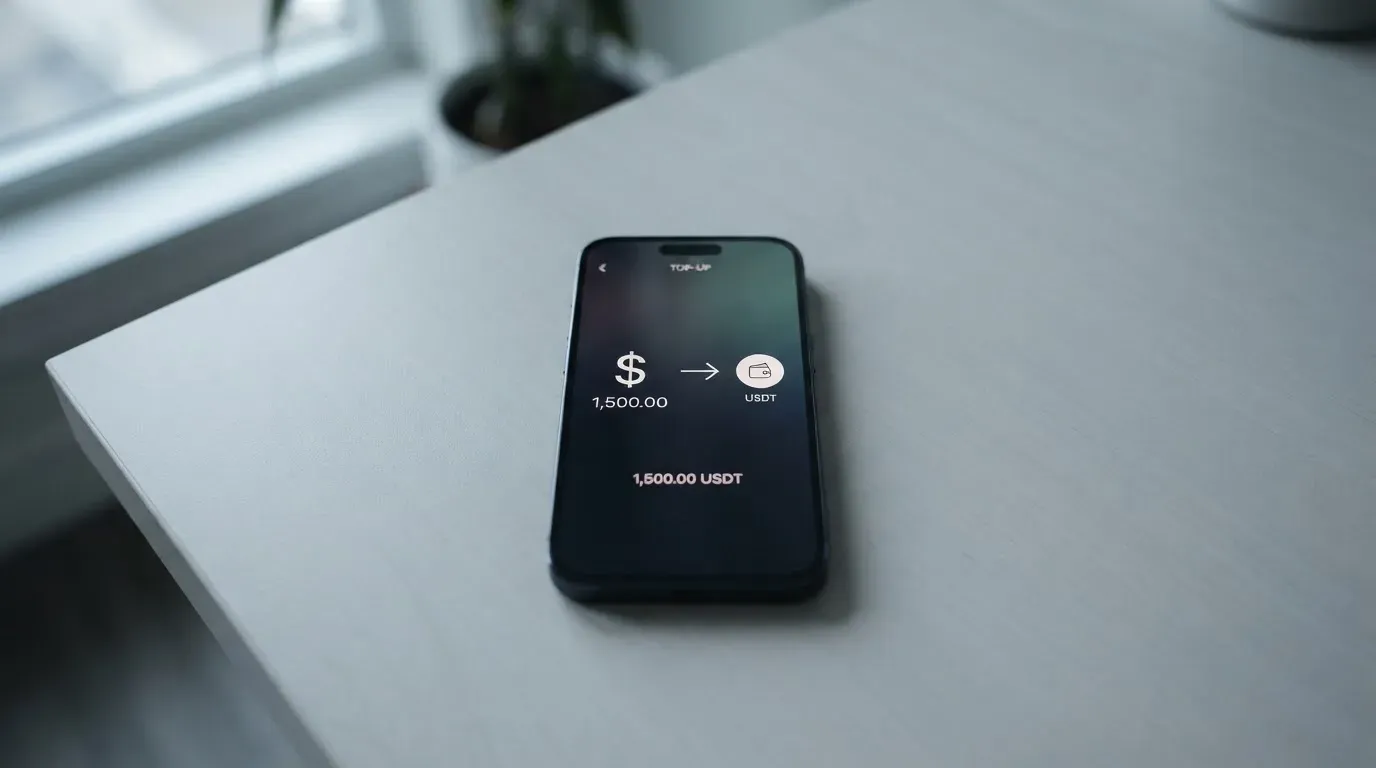
Which coins and networks, though, is where the published information runs thin. The starting data names USDT, USDC and cUSD on Celo, and those are not itemised on the page itself. That means the list you actually see in the app may be longer, shorter or different, and you should treat the app as the source of truth rather than any page.
The one number you can rely on is $0 deposit fees when funding from external wallets. Two things are not stated and are worth planning around: who pays the network fee for the transfer, and what the minimum top-up is. Both affect the real cost of putting fifty dollars in.
And a distinction people often miss: there are two different operations here. Loading the card is one thing. Getting money out of your wallet into local currency is another, and the card routes wallet withdrawals to local currency through third-party ramp partners. Their fees are not stated. If cash-out is part of your plan, that is a question to ask the support team before you rely on it, not after.
Paying with it day to day
Add the card to Apple Pay or Google Pay and the setup takes under a minute. That is the entire physical-card story: there is no plastic, so your phone is the card, and if your phone is gone the card is gone too.
At the till it behaves like a normal Visa. You pay, the balance in your wallet drops, and no third party held your money in between. That is the real appeal, and for someone who already keeps funds in a self-custody wallet it removes a genuine trust problem — there is no platform balance to be frozen or to disappear.
Rewards are worth reading closely. Up to 5% on qualifying purchases, paid in digital gold (Tether Gold) and stablecoins, and paid monthly. The FAQ says 5%. Three caveats sit under that headline: the payout can take 30 to 60 days; pending, refunded, excluded-category and over-cap transactions may not qualify; and terms and conditions apply. So the 5% is an upper bound with a slow clock attached, not a guaranteed rebate on your grocery bill. Which merchant categories are excluded is not stated.
Merchant categories that are blocked outright are also not stated. In this category that is rarely a matter of law and mostly a matter of issuer policy, so it is worth asking rather than assuming. The usual one to think about is gambling, which carries its own merchant category code and which many issuers refuse on specific cards.
If something goes wrong with a payment, the documented route is straightforward: freeze the card in the app, review the activity, contact support. Refunds usually return to the original card, and how long that takes depends on the merchant and the issuer. The app is the MiniPay wallet app from Opera; store ratings were not readable when I checked, so I have no useful verdict on how people rate it.
What can go wrong
Let me take the reassuring parts away first, because they are worth stating: I found no official incident involving this card, and no MiniPay-specific reviews exist to summarise. Neither is a clean bill of health — it mostly means the product is young and small.
The card was announced by the programme manager’s blog on June 23, 2026, with the page metadata showing September 7, 2026. Young, in other words. There is no long record yet, and the public feedback that does exist belongs to the programme rather than to MiniPay directly: Gnosis Pay shows 2.1 out of 5 on Trustpilot from 24 reviews, with complaints about support, identity checks handled by a third party, and a fraud dispute that one user reported as unresolved. Those are user reports on a third-party site, not confirmed findings, and no Trustpilot page for MiniPay itself was found.
Who is actually behind it matters more than most people expect. The wallet provider is Blueboard Limited, part of Opera. The programme manager is Gnosis Pay, which states plainly that it is not a bank or a regulated payment provider. The issuers are Monavate Ltd, an FCA-regulated e-money institution in England and Wales with FRN 901097, and UAB Monavate in Lithuania, authorised by the Bank of Lithuania under LB002139, issuing under licence from Visa Europe Limited. That is a real, regulated issuing structure rather than an offshore shell — and it is also the answer to the question people type into search most often, “is MiniPay a bank”. It is not. It is an e-money issuer’s card with a crypto front end.
Security has one genuinely nice property and one real hole. The nice property: your balance stays in your wallet until the moment you pay, so there is no pooled balance for a provider to mishandle, and you can freeze and unfreeze the card instantly in the app. The hole: everything depends on your phone. If you lose it, the documented procedure is to email the address given in the FAQ with the subject line “Lost Phone – Freeze Card” — which is a request, not an instant switch, and it depends on you having found that address in advance. Whether two-factor authentication is supported is not stated.
Then the risks that come with the category rather than with this card. Because you hold your own keys, nobody can restore a lost seed phrase for you, and crypto transfers do not reverse. A transfer sent on a network the provider does not support, or to an address belonging to a different network, can be lost outright with no guarantee of recovery. And stablecoins are stable in name more than in practice — they have depegged before, and Tether says it freezes tokens tied to illicit activity, so they are not censorship-proof either.
What to take instead
Three comparators, roughly the same idea — spend crypto through a card — with meaningfully different trade-offs. Scores are mine on the same scale, not the providers’.
| Option | Score | Availability | Card and cost | Fees |
|---|---|---|---|---|
| MiniPay | 7.4 / 10 | Selected markets in the EEA, Africa, Latin America, Southeast Asia; about 80 countries in the form | Digital Visa only, settles in USD; no issuance, monthly or deposit fee | No card fee; Visa rates on non-USD; FX size not stated |
| MetaMask | 7.1 / 10 | 45 listed countries/territories; other regions on a waitlist; US and UK sign-ups temporarily closed | Mastercard; virtual card free, metal $199/year | “Minimal fee for each transaction”, amount not stated; no foreign transaction fee, Mastercard rate used |
| KAST | 6.1 / 10 | Country shown at KYC, list not published; citizenship and ID also matter | Virtual and physical, up to 10 cards; Visa tiers from $0 to $10,000/year | Non-USD FX 0.5%–1.75%; declined transaction $0.50; stablecoin top-up and USD spend 0% |
| TokenPocket | 5.8 / 10 | Visa for European countries; Mastercard for a wider Asia-Pacific and other list | Virtual, runs on Arbitrum; an NFT creation fee partly covered by TokenPocket | 1% fee on depositing crypto, refunded later via rewards; no other stated fees |
Where MiniPay wins is cost transparency at the top of the range. No issuance fee, no monthly fee, no card fee, $0 deposit fees, one tier — and no membership structure to talk you into. KAST is the opposite shape: free at the Standard level, but tiers climb to $1,000 and $10,000 a year, with a $1 inactivity fee after twelve months and physical delivery that costs $40 on the standard card. If you are not going to spend thousands on membership, KAST’s headline numbers are not your numbers.
Where MiniPay loses is the same place it always loses: everyday use. No physical card, ATM not covered, and spending-limit amounts that are only visible inside the app. MetaMask also starts virtual-only, but it sells a metal card for $199 a year, spends from the connected wallet across named networks, and names its tokens and networks outright — Linea, Base, Monad, Solana, with mUSD, wETH, EURe, GBPe, USDC and USDT. Its catch is availability: sign-up is open in 45 listed countries and US and UK sign-ups are temporarily closed. TokenPocket charges a 1% fee on depositing crypto, which it says is refunded later through rewards or reduced transaction fees — a refund you wait for, on a product whose whole pitch is simplicity.
One structural point that applies to all four: none of them issues crypto cards directly. Visa and Mastercard license issuers and can suspend a programme — Visa terminated its global agreements with FTX in November 2022 — and programmes do close, typically stopping spending first, then asking users to withdraw. Building in the assumption that any of these might one day be wound down is not pessimism, it is how this category has behaved.
Who I would recommend it to
If you already hold crypto in a self-custody wallet, already understand what a seed phrase is, and want to spend stablecoins at ordinary shops without handing your balance to a platform, MiniPay is a good fit and the fee structure is genuinely the cleanest I found. Adding it to Apple Pay in under a minute, with no plastic to lose, works well for someone whose phone is already their main wallet.
If you need a card you can hand over, take money out at an ATM, or leave in a jacket pocket, this is the wrong card — those are not gaps that will close quietly.
If you are in the United States or the United Kingdom and a metal card or a broader country list matters to you, MetaMask may serve you better. If you want a published list of supported countries and tokens at the same time, MetaMask publishes both.
And if your reason for wanting one of these cards is that ordinary bank cards have become hard to get, that is the situation this whole category exists for — but check the fine print early. Whether your country is supported, what documents verification needs, and what an ATM withdrawal costs are all things you may have to discover by asking rather than reading.
Frequently asked questions
What is MiniPay card?
MiniPay is a digital Visa that spends directly from a crypto wallet you hold yourself. There is no physical card — the number lives in the app and in Apple Pay or Google Pay. Your balance stays in your wallet until the moment you pay, so no platform holds pooled funds on your behalf. It settles in USD, so non-USD purchases pass through Visa’s exchange rate.
Is MiniPay a bank?
No. The wallet provider is Blueboard Limited, part of Opera, and the programme manager is Gnosis Pay, which states that it is not a bank or a regulated payment provider. The actual issuers are regulated: Monavate Ltd in England and Wales, an FCA-regulated e-money institution with FRN 901097, and UAB Monavate in Lithuania, authorised by the Bank of Lithuania.
Is the MiniPay card free?
There is no issuance fee, no monthly fee, no card fee and $0 deposit fees when you fund from another wallet, and there is only one tier. The cost that remains is Visa’s exchange rate on non-USD purchases, described by the programme manager’s blog as a low nominal FX fee with no amount given.
Which countries can get MiniPay?
“Selected markets” in the EEA, Africa, Latin America and Southeast Asia, with no published country list. The sign-up form shows about 80 countries plus an “Other” option, and onboarding appears in the card tab only if your country is supported. Whether the test runs on citizenship or residence is not stated, which matters if you live in one country and hold a passport from another.
Does MiniPay require KYC?
Yes, identity verification is part of getting the card, and the card says it depends on your country and the programme’s requirements, with the app walking you through it. The documents required, any proof-of-address step, the minimum age and the number of verification tiers are all not stated. In this category generally, screening usually covers nationality and country of birth as well as address.
How do I top up the MiniPay card?
You fund it from the MiniPay balance or from any wallet, and the funds are spendable on arrival, with $0 deposit fees from external wallets. Starting data names USDT, USDC and cUSD on Celo, but those are not itemised on the page, so the app is the authoritative list. Who pays the blockchain network fee is not stated.
Can I withdraw money to my bank account?
Wallet withdrawals to local currency go through third-party ramp partners, and their fees are not stated. The card’s own FAQ does not cover ATM withdrawals at all, and the programme manager’s blog mentions an ATM withdrawal fee without an amount. If cash-out matters to you, ask about the ramp fee before you count on it.
Is MiniPay safe?
The design has one strong point and one weak one. Your funds stay in your own wallet until you pay, and you can freeze and unfreeze the card instantly in the app. But because the card exists only on your phone, losing it means emailing the address in the FAQ with the subject line — a request, not an instant block. Whether 2FA is supported is not stated.
Is MiniPay worth it?
For someone already holding stablecoins in a self-custody wallet, yes: no fees on the card side, no membership, no plastic to wait for. For anyone who needs a physical card, ATM access, or certainty about published country eligibility, no — MetaMask or KAST may fit better, depending on which of those you actually need.
What happens if a payment goes wrong or my phone is stolen?
For a payment problem, freeze the card in the app, review the activity and contact support; refunds usually return to the original card, with timing set by the merchant and issuer. For a lost phone, email the FAQ address with the urgent lost-phone subject line. Support runs through the app, and languages and hours are not stated.
Wallet card fees and costs – cryptocardfacts
Content created by the «cryptocardfacts» team