
A euro IBAN with a Visa card attached, minus the numbers you need to plan around
 Available in US
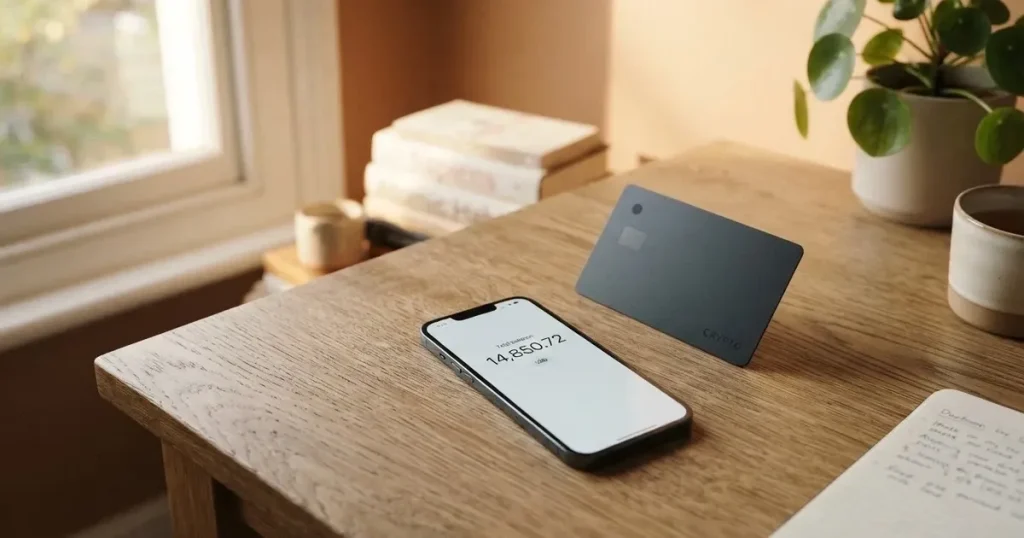
Wafee is one of those crypto-adjacent services that promises two things at once: a crypto wallet you can spend from, and a plain euro bank account with an IBAN attached. On paper that combination is genuinely attractive, especially for anyone who has spent years being refused an ordinary card. I went through the company’s public pages closely to see how much of that is documented and how much is left to the imagination. My honest summary: the pitch is clear and the Visa part is real, but the numbers you would need to actually plan a month with the card — fees, limits, minimums, ATM costs — are not on the site. That absence, more than any single negative finding, is what shapes this review.
I’m giving it 6.5 out of 10. That’s not a score for a bad product; it’s a score for a product described thinly. If you already hold an account and know your numbers, that score is too low. If you’re deciding from scratch, it’s about right.
This review is written for anyone, anywhere, who has trouble getting an ordinary bank card. Country and citizenship rules below are reported as Wafee states them, not as I’d have them stated — because that’s the only version I could verify.
The conditions described here are current as of October 28, 2026.
Verdict: 6.5 out of 10
| Criterion | Mark | Why |
|---|---|---|
| Who can get it | 9 / 10 | “Available in 160+ Countries” with no country list; the specific products available are decided by Wafee.co |
| Cost | 5 / 10 | Only “competitive exchange rates” — issuance, conversion and ATM fees are not published |
| Top-up options | 5 / 10 | You can spend crypto anywhere Visa is accepted, but no coins or networks are named; there is a EUR IBAN, SEPA and SWIFT |
| Reliability and complaints | 5 / 10 | Wafee Ltd (Nevis) and a card partner that appears to be Walletto; no licences named; no complaints found |
| Everyday use | 8 / 10 | Visa, physical and virtual cards, Apple Pay and Google Pay; ATM terms undisclosed, and the app buttons in the site go nowhere |
| Total | 6.5 / 10 | A good pitch, a thin file |
The 9 for availability is doing real work here, and I want to explain why it isn’t a rounding error. Almost every card in this category draws a line on a map. Some, like the US-issued Visa I looked at for comparison, exclude residents and registered companies in a sixteen-country list and block purchases in seven more. Wafee’s site says the service is “Available in 160+ Countries” and shows flags for Brazil, Argentina, Mexico, Egypt, Nigeria, Jamaica, Turkey and the UAE — which reads like a deliberately wide door. But no country list exists, and the footnote on that claim says that the availability of specific products is determined by Wafee.co itself. In practice that means the front door is open and the interior floor plan is theirs to change.
The 8 for everyday use reflects a card that behaves normally: Visa, physical and virtual, and both phone wallets. I hold back from higher because the ATM terms are simply not stated, and because the App Store and Google Play buttons on the site point to “#” — a placeholder. The web sign-in at app.wafee.co does work as a page, but the download links don’t lead anywhere a first-time user can follow.
The two 5s are the ones that matter most to anyone budgeting monthly. Wafee never publishes what a card costs to issue, what it costs to keep, what conversion takes, or what limits apply. “Competitive exchange rates” is a phrase every provider in this market uses; only one of them here has attached a number to anything.
So who does this suit? A crypto holder who wants a euro IBAN account with a Visa card attached, and who is willing to test the small stuff — one top-up, one small purchase — before trusting it with rent. Who does it not suit? Anyone who needs to know the exact cost of a payment, or who wants to know before opening the app whether their country is on the list.
Will they give you the card?
The short answer is: probably, but nobody can tell you from the outside.
The site says Wafee is “Available in 160+ Countries”. That’s the claim, and it’s a broad one. There is no country list attached to it. What sits alongside it is a row of flags — Brazil, Argentina, Mexico, Egypt, Nigeria, Jamaica, Turkey and the UAE — which are illustrations, not a specification. And the fine print matters: availability of the specific products is determined by Wafee.co. So a country can be inside the 160 and still not get you the card, the euro account, or a particular feature.
Nothing on the public pages describes who is eligible as a person. There’s no statement about minimum age, no mention of residency versus citizenship, no list of excluded jurisdictions, no note about sanctioned countries. When I searched for reviews under the card’s name on Trustpilot and Reddit, I found no pages about Wafee at all — only unrelated companies with similar spellings. That’s worth pausing on: a card with no visible user footprint is not the same as a card with no complaints. Early services and quiet ones both look like this.
Here’s the part that will decide whether you can open the account at all. The question readers search for most often — does Wafee require KYC? — is not answered anywhere on the site’s public pages. The card is an EU e-money-style product with a euro IBAN, and in practice a regulated provider must verify identity before opening an account like that. I’ll explain why in the risks section. But what I can tell you is not that Wafee does it; it’s that Wafee doesn’t say. You can only find out by trying.
My advice is unglamorous: before you send any money, sign up and see how far you get. An application that stalls at the verification step costs you nothing and tells you everything. What I would not do is assume “no KYC” from silence — plenty of services that look casual turn out to require documents as soon as money moves.
How to get it
The onboarding path is short, which is not the same as clear.
- The account. Web sign-in at app.wafee.co is the live entry point; the site’s App Store and Google Play buttons link to “#”, so there is no working mobile download link on the pages I checked.
- The cards. The site says you can “Seamlessly connect physical and virtual cards to your account”. Both are described; the card network is Visa. Which currency the card is denominated in is not stated.
- The money. EUR IBAN accounts are linked to the crypto wallet, with crypto-to-fiat exchange happening inside the app.
- The rest. Delivery time for a physical card is not stated. How many identity-check levels exist, or what documents each one needs, is not stated.
So the honest walkthrough is: find the site, create an account, work through whatever verification the app demands, then request a card. Everything after “create an account” is undocumented publicly, which means you’ll be following the product rather than reading it. That’s normal enough for a live service, but it means the first hour of your experience is the product’s real documentation.
One thing I noticed and would flag: no app-store ratings were available to read, since the store listings aren’t linked from the site. Reviews are often the only honest description of a young service, and there aren’t any I can point you to.
Fees: what it really costs
This is where I have to be blunt. Wafee does not publish its fee schedule. Not the card issuance fee, not a monthly maintenance fee, not a conversion percentage, not a foreign-exchange markup, not ATM withdrawal costs. There is no pricing page to compare against. The only statement about cost anywhere is “competitive exchange rates”, which is a comparative claim about competitors rather than a figure for you.

What I can lay out is what exists, what doesn’t, and what a missing number will cost you to guess.
| Item | What Wafee publishes |
|---|---|
| Card issuance | not stated |
| Monthly fee | not stated |
| Crypto-to-fiat conversion fee | not stated; “competitive exchange rates” only |
| Foreign exchange markup | not stated |
| ATM withdrawal | not stated |
| Daily limit | not stated |
| Monthly limit | not stated |
| Card currency | not stated |
| Tiers or plans | not stated |
| Top-up fees and minimums | not stated |
Where “not stated” appears, that means the card’s public pages don’t say — not that the charge doesn’t exist. Assume each of these exists until you’re shown otherwise.
Let me walk three ordinary payments through it, because the pattern of what could be charged is more useful than the blank table.
Paying for a coffee in euros. If your balance is already in euros and the card is euro-denominated, you may be paying only the merchant’s price — no conversion at all. But the card currency is not stated, so I can’t promise that. If your balance sits in crypto or in another currency, then a conversion happens at some rate the site calls competitive. What that costs in euros is exactly the number the site doesn’t give you. This is the cheapest and least risky of the three.
Paying for something in a currency that isn’t yours. Here a second layer usually appears: the network’s exchange rate plus whatever margin the issuer adds. Wafee publishes neither the rate source nor the margin. This is the payment where “competitive” is doing the most work and proving the least. In my experience, a 1–3% difference on a large monthly spend is the difference between a reasonable card and an expensive one, and I can’t tell you which end of that range Wafee sits at.
Taking money out of an ATM. Undisclosed, and typically the priciest thing on a card. The site mentions ATM nowhere, so I don’t know whether the card supports cash withdrawal at all, whether there’s a per-withdrawal fee, or whether there’s a daily cap. Plan on not needing an ATM until you’ve confirmed it yourself.
There’s a broader reason these gaps are uncomfortable, and it isn’t about Wafee specifically. On-chain network fees for your deposit are charged by the blockchain, not by the card provider — but the provider’s own conversion fee is entirely its own. A top-up cost in network gas is not the number that matters; the conversion spread is. And with nothing published, you’re comparing blind.
The only honest way to price this card is empirically: make one small top-up, note the crypto amount you sent and the euro amount that landed, and compare the difference. Do it again with a second, larger amount to see whether the margin is a flat fee or a percentage. That’s a five-minute test, and it will tell you more than the entire website.
How to top it up
Two routes, both real, neither fully specified.
From crypto. The site says you can spend crypto anywhere Visa is accepted, and you can “top up your payment cards”. Which coins and which networks are accepted is not stated. This is the single most consequential omission on the page, and here’s why: blockchain transfers are irreversible. If you send on a network the provider doesn’t support, or to an address belonging to a different network, the money can be gone or need manual recovery with no guarantee of success. Picking the wrong token is not a mistake you can undo.
From fiat. You get a EUR IBAN linked to the crypto wallet, and the app exchanges between crypto and fiat. You can send outgoing SEPA euro transfers, SWIFT transfers and P2P transfers from the account. Fees for those transfers are not stated. Minimum top-up amounts are not stated.
Getting money *out* is the feature I’d highlight. The site offers “instant conversion” to “cash out your crypto and convert it into traditional currency whenever you need it”. For someone who wants to move from crypto to spendable cash without going through an exchange, that’s the part worth caring about — again, with the caveat that the conversion rate and any fee behind it are not disclosed.
There’s a detail worth knowing about the network side of this. Most major stablecoins live on several networks. Circle, for example, lists USDC as natively supported on 38 networks as of 16 September 2026, including Ethereum, Solana, Base, Polygon PoS, Avalanche, Arbitrum and Stellar. Tether says USDT is a token built on multiple blockchains, with reserves intended to back it one-to-one, and that it has been issued on networks including Ethereum, Tron, Solana, Polygon and Avalanche. Those are the networks those tokens exist on — not the networks Wafee accepts. Different question entirely.
One more trap worth flagging, since it catches people out with cards built on euros and dollars. On Ethereum, fees are paid only in ETH, so a wallet holding USDT and nothing else cannot actually send: you need a small amount of ETH to pay for the transaction. Tron prices its transactions with bandwidth and energy resources, often burning TRX instead. And Circle stopped supporting USDC on Tron in February 2024, so “USDC over TRC20” isn’t a native option. Check the deposit screen for the exact network before you send, every time.
Paying with it every day
For normal spending, the design is ordinary in the best sense. It’s a Visa, so it works in shops, online, and at any terminal that takes Visa. Physical and virtual cards are both offered, which means you can keep the virtual one for online subscriptions and the physical one for everything else.
Apple Pay and Google Pay are supported — the site says contactless payments work “using Apple Pay or Google Pay”. That covers most in-person payments without touching the plastic. It’s worth knowing that tokenisation works like this: the card number is replaced by a device-specific number stored in the phone’s Secure Element, not on the vendor’s servers, and each payment carries a one-time code. Your issuer can also restrict the tokenised number to specific channels — blocking it on magnetic stripe, phone or website use — so a card that works everywhere in a shop can still fail online.
Not stated: which merchant categories are blocked. That matters more than it sounds. Many issuers block gambling (MCC 7995) by policy rather than by law, and the blocked list differs between issuers. Wafee publishes no list, so you’ll find out by trying.
Also not stated: any rewards, cashback or spend tiers. No loyalty programme appears anywhere. If a competitor offers you three percent back and Wafee offers nothing, that’s a real difference in cost over a year, though not a feature anyone documents in advance.
And two everyday things worth understanding, because they’ll bite someone eventually. Address verification — the automated comparison of the street number and postcode you type at checkout against the issuer’s records — is mainly available in the US, Canada and the UK, and generally not for foreign-issued cards. Some merchants also decline prepaid or foreign-issued cards outright, because the card’s issuing country and type are visible in a lookup at the merchant. Finally, a declined payment can still leave a hold on your money for several days, sometimes up to a week. If a large purchase is declined by mistake, the money may be unavailable to you for nearly a week even though you spent nothing.
What can go wrong
Let me separate the things I found from the things that follow from how this category works.
The company. Wafee Ltd (C 57790), Suite 1, A.L. Evelyn Ltd Building, Main Street, Charlestown, Nevis. That’s the registered entity. The FAQ page links “Walletto Terms & Conditions” and a “Walletto Annex Prohibited Activity List”. Walletto appears to be the card partner, though the page doesn’t explain the role — who issues the card, who holds the licence, who is liable to you. No licences are named on the pages I read.
That gap is the first real risk. In this category, the brand you see is often a front-end; the licence sits with a partner. The card network routes the payments and sets the rules, the licensed issuer holds the programme, and the crypto brand may only be managing it. If a partner relationship ends, your card can stop working — that has happened in this industry: Visa terminated its global agreements with FTX on 13 November 2022 and the FTX US debit card was wound down by its issuer, and WaveCrest, which supplied crypto card brands, was suspended by Visa in Europe in 2018, closing all its Visa programmes at once. Closures typically follow a pattern: a notice period, then spending and loading stop, then you’re asked to withdraw what’s left. One 2026 closure, reported by a single secondary source and unconfirmed, ended new loads on 8 July 2026 and spending on 8 August 2026. That’s the shape of the risk, not a prediction about Wafee.
The jurisdiction. Nevis is not an EU jurisdiction. The euro IBAN, the Visa card and the crypto wallet are almost certainly delivered by different licensed entities in different places. When something goes wrong — a frozen account, a disputed payment, a conversion you didn’t agree to — the question of who answers you is not answered on the site. An EMI in the EU must safeguard customer funds, segregating them or insuring them, but such funds aren’t bank deposits and may not sit under a national deposit guarantee scheme. I can’t tell you which protections apply to Wafee’s balance, because Wafee doesn’t say.
Custody. The site mentions cutting-edge encryption, multi-factor authentication and security audits, all in general terms rather than about your card specifically. A “Custody Note” PDF is linked, which suggests the question is at least acknowledged. Who holds your crypto — you or the provider — is not stated. This matters more than it looks. If the provider holds the keys, you must trust them completely, and crypto transfers are irreversible: a stolen key has no recovery mechanism, because the network cannot freeze or return funds. The record in this category is not encouraging. Mt. Gox reported about US$350 million stolen across 2011–2014; Coincheck about US$400 million in 2018; Ronin Network US$625 million in 2022. Self-custody moves that risk to you, along with key loss and clipboard-hijacking malware that swaps copied addresses. Either way, the risk exists; it just sits in a different pocket.
Identity checks. Wafee’s pages don’t say what verification applies. Here’s the backdrop. Under anti-money-laundering law, regulated businesses must verify customers and assess risk, monitor transactions and report suspicious activity. In the EU, customer due diligence covers name, address, date of birth, nationality and identity documents, a sanctions check, the purpose of the relationship, and whether you’re a politically exposed person. If due diligence can’t be completed, the institution must not proceed — and where necessary must end the relationship. That’s why accounts freeze or close pending documents; it’s the law, not bad manners. In the US, the customer identification programme requires name, date of birth, address and an identification number. And nationality is screened separately from residence, because sanctions screening often applies to citizenship and country of birth as well as address. Expect to be asked for documents. Expect it to be more than one round.
The regulatory clock. If you’re reading this from the EU, MiCA — Regulation (EU) 2023/1114 — took legal effect in June 2023, with rules on stablecoins applying from 30 June 2024 and the remaining provisions, including crypto-asset service provider rules, from 30 December 2024. E-money tokens may be issued only by a credit institution or an electronic money institution. Transitional arrangements let providers already operating under national law continue only until 1 July 2026 or until they receive or are refused a MiCA authorisation, whichever comes first. ESMA maintains an interim register of authorised providers, white papers and non-compliant entities — and that’s the first place I’d look before funding an account. Note also that a card is a payment service regulated separately; a crypto card often depends on two licences working at once.
Complaints. I found none — and no Trustpilot page for Wafee either. I searched for reviews and got no results about this company. Take that as absence of evidence, not evidence of absence. It’s genuinely ambiguous: a young service may have no complaints because nobody has used it enough to complain. The thing to do is check whether a complaints process exists and where it goes, before you need one.
Support. Email [email protected], a contact form, an FAQ page, and social links for X, Facebook, Instagram, Discord and Telegram — with the Telegram icon pointing, in fact, at the Discord invite. Hours and languages are not stated. There’s a small irony in an unmonitored support channel when the account is denominated in euros.
Then the generic risks everyone in this category carries. Stablecoins can and do lose their peg: TerraUSD collapsed in May 2022, USDC briefly lost its peg in March 2023 during the US banking crisis. Stablecoins are not censorship-proof either — Tether says it disables tokens in wallets on the OFAC sanctions list and has frozen funds tied to illicit activity. And your crypto balance is, in many jurisdictions, a taxable event on every card payment: the IRS treats digital assets as property, so exchanging them for goods, services or dollars generally produces a capital gain or loss, measured in local currency at fair market value on the transaction date. That means each purchase funded from crypto can be its own disposal. I’m not giving you tax advice — but you should find out what your own jurisdiction’s position is before you run a year of spending through this, because a card that converts crypto on every purchase can generate a lot of small taxable events.
What to take instead
I compared three. They’re not endorsements; they’re the closest shapes, and they show what documentation looks like when a provider chooses to publish it.
| Wafee | International Visa Card | UNi Card | Whop Cards | |
|---|---|---|---|---|
| Score | 6.5 / 10 | 6.7 / 10 | 6.1 / 10 | 5.2 / 10 |
| Network | Visa | Visa, US-issued Platinum | Mastercard, multicurrency | Visa |
| Form | Physical and virtual | Virtual (physical “coming soon”) | Not stated | Not stated |
| Issuance | Not stated | $5 one-time | Not stated | Not stated |
| Monthly | Not stated | Classic free, Pro $9.00, Max $19.00 | No annual fee | Page says “No extra fees” |
| FX | Not stated | Visa exchange rate + 2% FX fee | No foreign transaction fee | Not stated |
| Rewards | Not stated | No cashback stated | Up to 3% | 5% at select merchants, currently Uber |
| Load | Crypto or EUR IBAN, SEPA, SWIFT | USDC/USDT 1:1 free, plus USD, EUR, SEPA, SWIFT, FedNow | Not stated | Whop balance |
International Visa Card scores 6.7 — the closest thing here, and the most transparent. It publishes everything Wafee doesn’t: $5 issuance, no maintenance fee, three plans, and a foreign-exchange cost stated as “Visa exchange rate + 2% FX fee”. It also tells you exactly where it won’t work. The account and card are unavailable to residents or legal registrants of Belarus, mainland China, North Korea, Cuba, India, Iraq, Iran, Israel, Myanmar, Nepal, Nicaragua, Russia, Syria, Turkey, Ukraine, Venezuela and Vietnam, with FATF grey-list countries reviewed case by case subject to compliance approval; purchases are blocked in North Korea, Cuba, Iran, Russia, Syria, Ukraine and Venezuela. The rule runs on residence or registration, and citizenship isn’t mentioned. That’s a long exclusion list, and if you’re in one of those countries it ends the question. But if you’re not, you get a card priced to the cent. Note the two things it doesn’t do: the physical card is “coming soon”, and it’s USD-denominated.
UNi Card scores 6.1 and takes a different tack: fewer numbers, more reassurance. A multicurrency Mastercard spending from a UNi.Global balance, with no annual fee, no foreign transaction fee, conversion at “live OTC rates” and a stated absence of “hidden exchange fees”, plus spend-to-earn rewards up to 3%. What you don’t get is who can open one, how it’s funded, or whether it’s physical or virtual. It’s the tidier marketing but the thinner file.
Whop Cards scores 5.2 and is the narrowest. US-only in practice — 31 states for consumers, 41 for businesses, with a specific unsupported-country list including Belarus, mainland China, Cuba, Hong Kong, India, Iran, Iraq, Israel, Myanmar, Nepal, Nicaragua, North Korea, Russia, Syria, Turkey, Ukraine, Venezuela and Vietnam. It says “No extra fees” without listing any amount, offers 5% cashback at select merchants currently including Uber, and spends from a Whop balance backed by stablecoin collateral from a linked wallet. The basis for eligibility — citizenship or residence — isn’t stated.
The pattern worth drawing: the highest scores in this comparison aren’t the best products, they’re the best documented ones. Wafee at 6.5 leads UNi and Whop on the strength of its reach and its wallet support. International Visa edges it at 6.7 purely because it publishes a 2% FX fee. That’s the argument I’d make to anyone hesitating: between two cards that sound equally good, take the one that tells you what it charges.
Who I would recommend it to
I’d recommend Wafee to someone in this position: you hold crypto, you can’t get or don’t want a normal euro account, and you want a euro IBAN with a Visa attached, in a country that isn’t excluded. You’re technically confident enough to know that sending a stablecoin on the wrong network loses the money. And you’re willing to spend twenty minutes with a small amount figuring out the real conversion cost, because the site won’t tell you.
I’d hold back for anyone who needs certainty before committing: if you’re budgeting a fixed monthly sum and the exchange margin is unknown, you’ll find out the hard way. If your country might not be on the list, try the signup first. If you intend to use ATMs or specific merchants, check the categories before you depend on them. And if you’re moving anything you can’t afford to lose, understand first whether the balance is held by you or by them.
What convinced me to keep looking, rather than rule it out, is the euro IBAN with SEPA, SWIFT and P2P transfers attached to a crypto balance, physical and virtual Visa cards, and Apple Pay and Google Pay on top. That’s a real, coherent product for a person whose banking options are narrow. What’s missing isn’t the features; it’s the paperwork — the schedule of fees, the limits table, the licence names, the country list.
My practical sequence, then. Open the account and see what verification actually asks. Read the terms for the entity that issues the card, not just the brand you signed up for. Check ESMA’s register if you’re in the EU. Send one small test amount, record what arrived, and compute the actual cost. Send a second, larger one to see if the margin is fixed or proportional. Only then move anything you’d miss.
Frequently asked questions
What is Wafee?
Wafee is a financial platform that combines a crypto wallet with a euro bank account and Visa payment cards. Users get an EUR IBAN linked to the wallet, exchange between crypto and fiat in the app, and hold both physical and virtual Visa cards. It also offers instant conversion to cash out crypto, plus outgoing SEPA, SWIFT and P2P transfers. The company is Wafee Ltd, registered in Nevis.
Is Wafee a bank?
Not on the evidence its public pages give. Wafee Ltd is registered in Nevis, and no banking licence is named anywhere on the site. The euro IBAN, the Visa card and the crypto wallet appear to be delivered through partners — the FAQ page links Walletto’s terms and a prohibited-activity list, though it doesn’t explain Walletto’s role. Anyone treating this as a bank should be clear that a euro IBAN does not by itself make an institution a regulated bank.
Which countries is Wafee available in?
The site says “Available in 160+ Countries” without listing them. Flags shown on the site include Brazil, Argentina, Mexico, Egypt, Nigeria, Jamaica, Turkey and the UAE, and availability of specific products is determined by Wafee.co itself. So being in a large number of countries doesn’t guarantee you get the card or the account. There’s no published exclusion list, and country rules aren’t explained. Your nationality may be screened separately from where you live.
Does Wafee require KYC?
The public pages don’t say. That’s an unusual thing to find in this category, and it means you cannot answer it before applying. In practice, a regulated provider handling euro balances must carry out customer due diligence under anti-money-laundering law — name, address, date of birth, nationality, identity documents, a sanctions check and a politically-exposed-person check in the EU. The absence of a statement is not a statement of absence, so try the signup first.
How much does the Wafee card cost?
Wafee doesn’t publish its fee schedule. Issuance, monthly fees, conversion charges, foreign-exchange markups and ATM costs are all unstated, and no limits are given either. The only cost claim on the site is “competitive exchange rates”, which is a comparison rather than a figure. To price it yourself, send one small top-up, note the crypto sent and the euros received, then repeat with a larger amount to see whether the cost is a flat fee or a percentage.
Can I use the Wafee card in my country?
If your country is one of the 160+, the card works anywhere Visa is accepted, which is most of the world. The unknowns are elsewhere: which currencies the card is denominated in, which merchant categories are blocked, and whether ATM withdrawals are supported at all. Foreign-issued cards also fail more often at online checkouts, because address verification is generally unavailable for them and some merchants decline foreign BINs outright.
Which coins and networks can I use to top up?
Not stated, and this is the gap that can cost you money. Blockchain transfers are irreversible, so sending on a network Wafee doesn’t support, or to an address belonging to a different chain, can lose the funds or need manual recovery with no guarantee. USDC alone is natively supported on 38 networks as of 16 September 2026, and USDT exists on Ethereum, Tron, Solana, Polygon, Avalanche and others — none of which tells you what Wafee accepts. Check the deposit screen for the exact token and network before every transfer.
Is the Wafee card safe?
It depends on what you mean by safe, and the site doesn’t document enough to settle it. It mentions encryption, multi-factor authentication and security audits, generally, and links a custody note, but doesn’t say who holds your keys, names no licences, and identifies only a partner that appears to be Walletto. Treat balance and custody questions as open: confirm which licensed entity holds your funds and what protections apply before depositing anything meaningful.
Does Wafee have reviews or complaints?
I found no complaints and no Trustpilot page for Wafee, and searches for reviews turned up only unrelated companies. That is ambiguous rather than reassuring — a young service may have no complaints simply because it has few users. What I’d check instead is whether a complaints process is documented, where it leads, and which legal entity handles it. Support runs through [email protected], a contact form and social channels, with hours and languages unstated.
Is the Wafee card worth it?
It depends on what it replaces. If your alternative is no card at all and you hold crypto, the euro IBAN, SEPA and SWIFT transfers, and physical and virtual Visa cards add up to something genuinely useful — and it’s the widest-reaching option of the four I compared. If you already have a working card with published fees, the value is much harder to see. The deciding factor is whether you’re willing to discover the real conversion cost yourself, by testing, rather than reading it.
App and neobank card fees – cryptocardfacts
Content created by the «cryptocardfacts» team