
KeyOne card: a free virtual Visa tied to a self-custody wallet, if your country is on the list
 Available in US
KeyOne is a virtual Visa card whose balance sits in euros, backed by a self-custody crypto wallet built into the same app. The card is free on the entry-level plan, converts crypto on the way in, and is issued by Wirex, a licensed payments company, under its own Visa permissions. The catch is geography: only residents of about 70 listed countries can apply, and the card is virtual only, with no plastic and no mention of a metal or premium physical version.
I spent time going through the cardholder agreement, the terms, the home page, the App Store listing and the Google Play listing, and the picture I came away with is mixed. The numbers on the fee page are competitive for a free card, but the absence of a published ATM policy, the lack of any meaningful review footprint, and the heavy reliance on a Telegram support bot leave enough gaps that I would not call this a finished product for everyone.
This review is for anyone who is weighing KeyOne against a debit card, a prepaid card or another crypto card, and who needs to know what they are actually signing up for before they hand over an ID document and a selfie.
Conditions are current as of October 28, 2026.
Verdict
KeyOne scores 6.8 out of 10. That is a respectable result for a new product, and it reflects a simple trade: the card is cheap and well structured on paper, but it is also narrow (virtual only, EUR balance, no stated ATM support) and unproven in the wild (no Trustpilot or Reddit footprint I could find, and the App Store has not received enough ratings to show a score). I would recommend it to people in Georgia, Serbia or Kazakhstan who want a free euro card and are comfortable with self-custody crypto, and I would steer it away from anyone who needs cash from an ATM, who lives in a country not on the list, or who wants a physical card in their wallet.
Score breakdown
| Criterion | Mark | Why it scored this way |
|---|---|---|
| Who can get it | 7 / 10 | Residents of 70 listed countries: most of Europe including Georgia, Moldova, Ukraine, Serbia and Azerbaijan; parts of Asia including Kazakhstan, Uzbekistan, Japan and Thailand; the UAE and Bahrain; Nigeria, Ghana, Kenya, South Africa and Uganda; Mexico, Brazil, Argentina and others; Australia. Russia and Belarus are not on the list. |
| Cost | 8 / 10 | Free plan at EUR 0: card issuance and monthly service are free. Payments in the balance currency are 0%, conversion up to 1%. Crypto top-up is 0.8% plus a network fee on Free. |
| Top-up options | 7 / 10 | USDC and USDT (network not named), plus SEPA, ACH and top-up from a Visa or Mastercard. Crypto withdrawal works only on the Base network. |
| Reliability and complaints | 7 / 10 | The card is issued by Wirex (a Visa principal member since 2020); KeyOne Solution Ltd. is the technology interface, not a bank. I could not find complaints about KeyOne itself, but there is also no rating on the App Store yet. |
| Everyday use | 4 / 10 | Virtual Visa only, Apple Pay is supported, Google Pay is not stated, ATM policy is not stated. |
The total is 6.8 out of 10, and the audience note I would attach is that residents of Georgia, Serbia and Kazakhstan get a particularly clean fit: their countries are on the list, the card is free, and SEPA covers their euro funding route for anyone with a euro bank account in the EU.
Will they give you the card
KeyOne gives out cards based on residence, not citizenship. The home page lists about 70 supported countries, and the rule is simple: if your country is on the list and you have a government-issued ID and a residential address, you can apply. If your country is not on the list, the page tells you outright that you cannot apply for a KeyOne card yet.
The list spans Europe (including Georgia, Moldova, Ukraine, Serbia and Azerbaijan, alongside the EU and the UK), Asia (including Kazakhstan, Uzbekistan, Japan and Thailand), the Gulf (the UAE and Bahrain), Africa (Nigeria, Ghana, Kenya, South Africa and Uganda), Latin America (Mexico, Brazil, Argentina) and Australia. Russia and Belarus are not on the list. The home page does not publish an excluded-citizens list, so a Russian or Belarusian citizen living in, say, Georgia or Kazakhstan may or may not be accepted depending on how the partner screens the application; the public pages simply do not say.
For a person who has trouble getting an ordinary bank card, this matters more than it sounds. The threshold is your address, not your credit history, your employer or your visa type, and the ID documents accepted are wide: passport, ID card, driving licence or residence permit, with the exact set depending on the issuing country. The card is not a credit card, so there is no credit check; it is a prepaid card, so the card cannot overdraw.
The flip side is that the supported list is a closed one. If you move country and your new country is not on the list, you cannot get a new card there. And “70 countries” looks generous until you compare it with alternatives that publish country lists in the hundreds, or claim global acceptance. The eligibility rule is the single most important thing to check before anything else, because every later question (fees, limits, supported tokens) is moot if your country is not on the list.
How to get it
The signup path is the kind of KYC path you have probably seen before. You start by checking that your country is on the supported list, then you submit a government-issued ID together with a selfie, then you wait for the ID check to clear, then you provide a proof of address if the partner asks for one, and finally the card is issued in the app.
A few practical details from the fine print. The ID must show your name and date of birth, and the name and date of birth must match what you typed into the application. The photo on the ID is checked against your selfie. The ID must be in date, with the validity date visible and in the future. If those three things are not in order, the ID check is likely to bounce and you will be back at the start. Applicants are 18 and over, which the home page states and which is the norm for prepaid cards. Proof of address, when asked, is used to confirm your residence, and your card eligibility depends on the residence it shows.
The card itself is a virtual Visa. There is no physical card, and the company does not offer a metal card or a premium plastic version either. Once you are approved, the card number, expiry date and CVV appear in the app, and that is the only form the card ever takes. You can then add it to Apple Pay in one tap, which is the closest KeyOne comes to a physical card.
Processing time is not stated, and the home page says it “may vary” and that support can check the status. In practice, ID checks on regulated EU-style flows tend to clear in minutes when everything is clean and in days when something needs a second look, but the company does not promise either. The Premium plan (EUR 149 a year) gives you up to three virtual cards, where the Free plan gives you one; both are virtual, both are in the app, neither is a piece of plastic.
What it really costs: Fees
The fee page is one of KeyOne’s stronger points, and it is also where the difference between Free and Premium matters most. Both plans use the same card; the only difference is the price you pay to top it up and the volume you can put through it.
Costs
| Fee or limit | Free (EUR 0) | Premium (EUR 149 / year) |
|---|---|---|
| Card issuance | Free | Free |
| Monthly service | Free | Free |
| Payments in balance currency | 0% | 0% |
| Currency conversion (other currencies) | Up to 1% | Up to 1% |
| Crypto top-up (USDC / USDT) | 0.8% + network fee | 0.33% |
| SEPA / ACH in | 0.8% | 0.3% |
| Top-up from Visa / Mastercard | About 4.5% | About 4.5% |
| In-app exchange (first slice) | 0.3% on first EUR 1,000 a month | 0.3% on first EUR 2,000 a month |
| In-app exchange (above the slice) | 1.25% | 1.25% |
| Extra virtual cards | Not available | EUR 10 each |
| Card spending per card per month | EUR 20,000 | EUR 30,000 |
| Single transaction | EUR 20,000 | EUR 30,000 |
| SEPA in / out per month | EUR 20,000 | EUR 20,000 |
A few things are worth pointing out, because the table does not always tell the whole story.
First, the conversion fee of “up to 1%” is a ceiling, not a flat rate. The actual rate depends on the currency and the partner’s spread, and the cardholder agreement simply gives itself room to charge up to that. Anyone paying in US dollars from a EUR balance should expect something close to 1% on most days; anyone paying in a less common currency may see a wider gap.
Second, “0% on payments in the balance currency” is the right way to read the most important number. Because the card balance is denominated in EUR, paying in euros at a euro-priced merchant carries no conversion fee at all. That is the scenario where KeyOne is genuinely cheap.
Third, the crypto top-up fee depends on the plan, but the network fee is on top. USDC and USDT run on multiple blockchains, and gas (or bandwidth) is paid to the network, not to KeyOne. Ethereum gas can easily be several dollars per transfer during busy periods, so the 0.8% headline on Free is only part of the cost. Premium’s 0.33% is genuinely low, but the network fee is still there.
Fourth, the in-app exchange has a “first slice” and an “above the slice” rate. Free gives you 0.3% on the first EUR 1,000 of in-app exchange per month, then 1.25% on anything above. Premium doubles the cheap slice to EUR 2,000. If you are someone who swaps stablecoins for euros inside the app often, that second-rate number is the one to watch.
Fifth, individual limits may be lower than the published numbers, because partner compliance checks can dial them down. The cardholder agreement gives the issuer that room, and the home page says so in its own words.
Sixth, ATM fees are not stated, and that is unusual. Most prepaid cards publish a withdrawal fee and a daily ATM cap; KeyOne publishes neither. The reasonable read is that ATM support is not part of the current product, or that it is handled by the issuer on a case-by-case basis. Either way, “not stated” means there is no number to plan around, and I would not expect to draw cash from this card without confirming it with support first.
To put this in everyday terms, three examples from a EUR balance.
A EUR 50 lunch in a Berlin restaurant, paid by tapping the virtual card through Apple Pay. The merchant charges in euros, the card balance is in euros, so the only fee is the merchant’s own payment processing (which is not a KeyOne fee). The 0% line on the table is exactly this case.
A USD 30 streaming subscription paid in dollars. The card has to convert EUR to USD, so the conversion fee of up to 1% applies. On a 1% conversion, that is USD 0.30; on a typical 0.6-0.8% mid-market spread, the real cost is more like USD 0.18-0.24. Either way, this is a small number for a small purchase, but the percentage does not shrink as the amount grows.
A EUR 500 top-up in USDC on Free. The 0.8% fee is EUR 4, plus the network fee on whichever chain you use. On a busy day on Ethereum that network fee could be more than the 0.8% slice; on Base, where KeyOne allows withdrawals, it is small. On Premium, the 0.33% slice is EUR 1.65, and the network fee is the same. Premium pays for itself on this kind of top-up once the volumes add up, but only if you actually do several large top-ups a month.
How to top it up: Top up options
KeyOne gives you four ways to put money on the card, and they have very different fee structures, so it is worth matching the method to the use case.
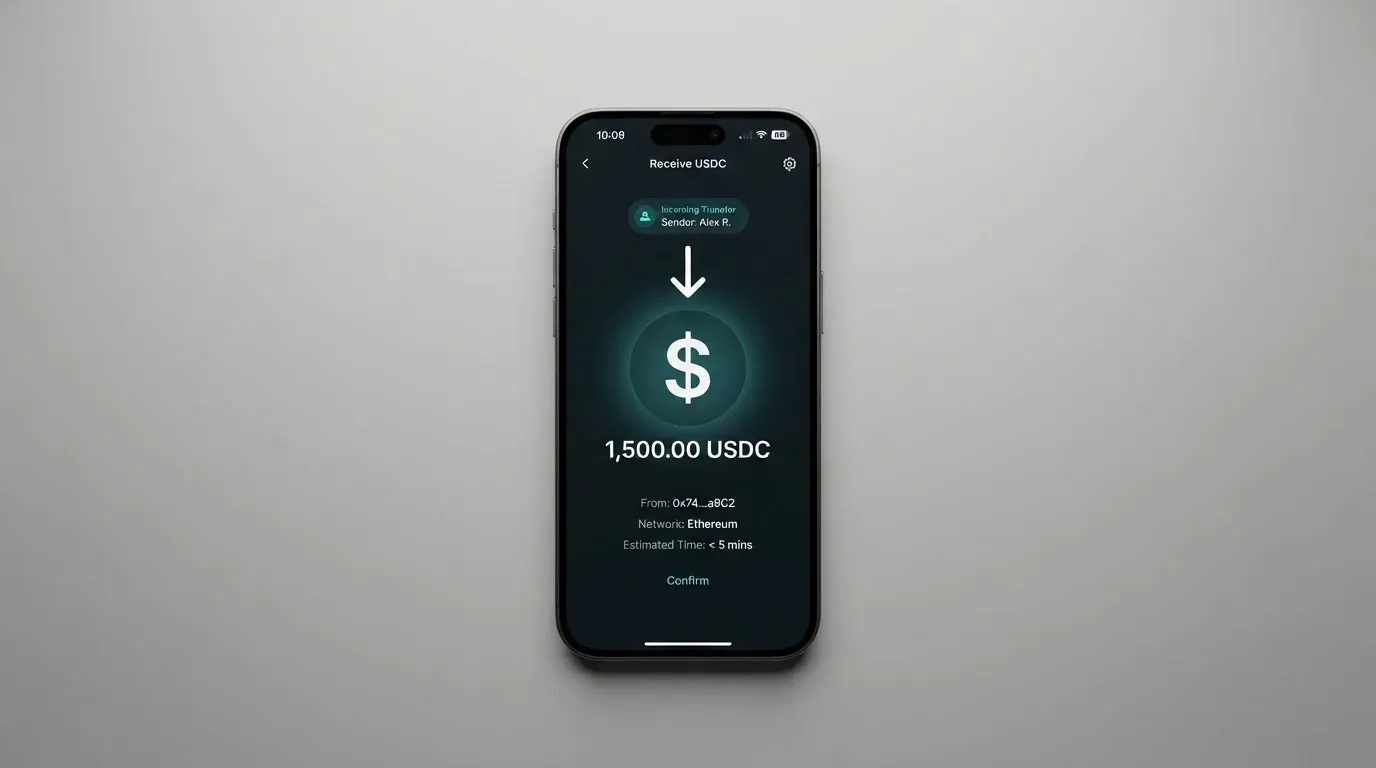
Crypto top-up is the headline method, and it works in USDC and USDT. The published fee is 0.8% plus a network fee on Free and 0.33% on Premium, but the network itself is not named on the public pages. That is a meaningful gap: USDC and USDT both run on multiple chains, and a transfer on the wrong chain can be lost or stuck, because blockchain transactions are irreversible. Before sending a meaningful amount, anyone who is not already familiar with stablecoin networks should confirm the chain with the app or with support, and should send a small test amount first. The company also lets you withdraw crypto on the Base network only, with no KeyOne fee on top of the network’s own fee, so Base is the one chain the company has clearly committed to.
Bank transfers come in two flavours. SEPA covers many EU countries and the UK, and the fee is 0.8% on Free and 0.3% on Premium. ACH is for the UK only, with the same fee split. SEPA has a monthly limit of EUR 20,000 in and EUR 20,000 out, and individual limits may be lower after a compliance check. For someone with a euro bank account in the EU, SEPA is the cheapest top-up path, but the percentage is still there.
Top-up from another Visa or Mastercard costs about 4.5%. That is the most expensive way in by a wide margin, and the only reason to use it is convenience: if you are topping up a small amount from a debit card you already have, the 4.5% is the price of not setting up a SEPA transfer. For larger amounts, this is the wrong method.
In-app exchange is the fourth option, and it is for people who already hold USDC or USDT in the KeyOne in-app wallet and want to convert to euros. The rate is 0.3% on the first EUR 1,000 a month on Free (EUR 2,000 on Premium), then 1.25% on anything above. This is the cheapest way to convert a stablecoin balance to a card balance, as long as the amount fits inside the cheap slice for the month.
Two more details round out the funding picture. The home page does not publish a minimum top-up amount, and the cardholder agreement does not give one either, so the practical minimum is whatever the app accepts. The card can be closed in the app at any time, and closing the card does not affect the balance: the balance stays where it is, and the user can withdraw it through the usual SEPA or ACH route. Account deletion is a separate process (request in the app under Profile > Support, or by email), and the company says it will close the card and accounts with Wirex within 30 days. KYC and transaction records are kept for 5 years, and the user is asked to withdraw remaining balances first. The terms also say the user can stop using the services and withdraw funds at any time, which is the right to have and worth keeping in mind.
Paying with it every day
Once the card is in the app, paying with it is the part most people care about, and KeyOne keeps the surface area small.
Apple Pay is supported, and the company markets the integration directly: add the card to Apple Pay in one tap. The card number is replaced by a device-specific Device Account Number stored in the Secure Element, each payment uses a one-time dynamic security code, and the real card number never sits on Apple’s servers. This is the standard tokenised wallet flow, and it is what most people in 2026 expect from a virtual card.
Google Pay is not stated, and that is one of the more conspicuous gaps. The home page and the FAQ talk about Apple Pay, and the Android app listing does not mention Google Pay in a way I could verify. Android users who rely on Google Pay at the till should treat Google Pay support as uncertain and check with support before relying on it.
Online payments use 3-D Secure, which is the standard challenge flow for online card payments. The issuer (Wirex) decides whether to approve the payment frictionlessly or to push a one-time code or biometric check back to the app, and the user approves or declines the payment inside the KeyOne app. That is the correct flow, and it is the flow that shifts liability for fraudulent online transactions.
Blocked categories are mentioned in general terms, but no list is published. The home page says “some countries, merchant categories and transactions are restricted”, and the list is not stated. Gambling is the category most issuers restrict (the network code MCC 7995), but the company does not confirm any specific list, and the safe assumption is that some things will be declined without explanation. That is normal for prepaid cards, but it is also normal for a user to want a published list, and KeyOne does not provide one.
Rewards and cashback are not stated. The home page and the fee page do not mention a cashback programme, a sign-up bonus or a points scheme, and the agreement does not mention one either. The Free plan, in particular, is a no-frills product, and the Premium plan’s selling point is higher limits and lower fees, not cashback.
The app is iOS-first. The iOS app is called “KeyOne: Crypto Card & Wallet”, requires iOS 17 or later, is at version 1.0.10, and is listed in English, Russian and Serbian. The App Store (Ireland) page shows no rating, with the message that the app “has not received enough ratings”. The Android listing on Google Play exists at com.keyonesolution.keyone, but the rating was not retrieved. There is also a web app at app.keyonepay.com, so the same account is accessible from a browser.
Disputes are handled through support. The cardholder agreement says that if a transaction is not recognised or is wrong, the user should contact support, which helps file a dispute with the issuer. No time frames are given for either side, and the word “chargeback” is not used. The terms set no refund time frames either, and blockchain transactions are irreversible, which limits what the issuer can do on the crypto side. Merchant refunds, when they happen, are credited to the KeyOne balance, and the agreement notes that the refund may arrive in a different currency than the original charge.
The reliability score in the verdict (7 out of 10) reflects this picture: the underlying plumbing is from Wirex, a Visa principal member in Europe since December 2020, and the cardholder agreement and terms were last updated on 12 October 2026, which is recent. The everyday-use score (4 out of 10) reflects the fact that the card is virtual only, ATM use is not stated, Google Pay is not stated, and no rewards programme is published. Those are real constraints, and they weigh against an otherwise clean fee table.
What can go wrong
The risk section for a small product like this is partly about the product itself and partly about the category, and the company does not make it easy to do the first part.
On the company side, the legal entity is KEYONE SOLUTION LTD, incorporated in Saint Christopher and Nevis, with company number C 63589. The home page says the company is “not a bank”, and the card is issued by Wirex under Wirex’s own Visa permissions. KeyOne Solution Ltd. is the technology interface, and the governing law of the terms is Saint Christopher and Nevis. That is not a red flag in itself (many crypto card programmes use a similar structure), but it does mean the user is dealing with two companies: the issuer (a regulated payments company) and the brand (a small technology company in a Caribbean jurisdiction). Anyone who wants to read the fine print should read both sets of documents, and the terms’ choice of governing law is worth knowing in advance.
On the security side, the home page and the FAQ describe a self-custody wallet. The private keys are created and stored on the user’s device through an embedded wallet provider, and KeyOne says it cannot move crypto without the user’s signature. That is the right design for a self-custody product, and it is also the dangerous one: losing the device or the PIN can mean permanent loss of funds, because no one else has the keys. On the card side, 3-D Secure approvals happen in the app, a compromised card can be blocked in the app, and the issuer can suspend or close a card for fraud or for use in an unsupported country. The home page is also clear that crypto balances are not covered by a deposit guarantee or investor compensation scheme, and the card is not a bank account.
On the support side, the fastest channel is a Telegram support bot at @keyone_supportbot, with an email address (obfuscated on the public pages), an X account at @keyoneapp for status, and an in-app chat under Profile > Support. The company says it “usually respond within a few hours, and always within 24”, and the hours are not stated. The website language selector shows English only, and the iOS app supports English, Russian and Serbian. That is fine for an English-speaking user; it is worth knowing for anyone else.
On the complaints and incidents side, the honest answer is that I could not find any. A search on Trustpilot and Reddit for complaints about KeyOne returned nothing about the card itself, and the only matches were unrelated products with similar names (OnePay, KeyOneClick). The App Store does not show a rating because there are not enough ratings yet. That is not the same as a clean record, because a small product has a small footprint, and “no complaints” often means “not enough users to complain”. It is also not a red flag, because the underlying issuer is Wirex, which has been running Visa card programmes since before 2020. The right read is that KeyOne itself is unproven, and that the user is taking a small counterparty risk on the brand on top of the usual counterparty risk on a card issuer.
Two more risks are worth flagging because they come from the category, not the company. Crypto balances are not the same as bank deposits, and they are not covered by deposit guarantee schemes, even when the issuing entity is a regulated EMI in the EU. And stablecoins, despite the name, are not necessarily stable: USDT and USDC are the two largest dollar stablecoins, and both have had depeg events in the past (USDC briefly lost its peg in March 2023 during the US banking crisis). The card balance is in euros, not in stablecoins, so the user is exposed to stablecoin price movement at the moment of top-up, not for the duration of the holding. That is a smaller exposure than a stablecoin-denominated card, but it is real.
What to take instead
KeyOne is not the only virtual crypto card on the market, and the alternatives that come up most often in the same conversation are Cardex, CardFlow and HyperCard. They are not direct substitutes, because each one has a different emphasis, and the comparison is not apples-to-apples. The table below is meant to help a reader who is choosing between these options, not to rank them.
| Card | Where it leans | Card type | Funding | Stated cost | Score |
|---|---|---|---|---|---|
| KeyOne | Multi-country, EUR balance, self-custody | Virtual Visa, EUR balance | USDC, USDT, SEPA, ACH, Visa/Mastercard top-up | Free plan, EUR 0 issuance and monthly; crypto top-up 0.8% + network | 6.8 / 10 |
| Cardex | “200+ countries”, Naira focus | Debit on VERVE, Visa, Mastercard, UnionPay; virtual and physical | USDT, USDC, BTC (networks not stated) | Not stated | 5.6 / 10 |
| CardFlow | Nigeria-focused fintech | Virtual USD Mastercard | BTC, USDT, ETH, Naira bank transfer | Free card creation; monthly fee not stated | 4.9 / 10 |
| HyperCard | “More than 176 countries” (acceptance) | Prepaid HyperCard, USD or EUR balance | USDT, BTC, ETH in app; networks not stated | Not stated | 4.7 / 10 |
A few things stand out. KeyOne is the only one of the four that publishes a complete fee schedule; the others leave most numbers as “not stated” on the public pages I could read. KeyOne is also the only one that ties the card to a self-custody wallet, which is a meaningful design choice for users who do not want to leave their crypto on a custodial platform. On the other hand, KeyOne is the only one that is virtual only, while Cardex at least offers both virtual and physical, and CardFlow and HyperCard both lean towards quick virtual issuance.
The right pick depends on the reader’s situation. Someone in Nigeria who wants a Naira-flavoured card will look at Cardex or CardFlow first. Someone who values acceptance over a published fee schedule will look at HyperCard. Someone who wants a free euro card in a country on KeyOne’s list, and who is comfortable with self-custody, will look at KeyOne first.
Who I would recommend it to
The shortest version is this: KeyOne is a good fit if you live in one of the 70 listed countries, you want a free virtual Visa with a euro balance, you are comfortable holding your own crypto keys, and you do not need cash from an ATM or a physical card. It is a poor fit if you need any of those last three things, or if you live in a country not on the list.
The longer version is for readers who want to think it through. If you are a freelancer or a remote worker in Georgia, Serbia or Kazakhstan, and you get paid in crypto or in euros, the Free plan gives you a clean euro card at no monthly cost, and the Premium plan becomes worth its EUR 149 a year once you are topping up more than about EUR 1,800 a month from stablecoins (the break-even is roughly the 0.8% versus 0.33% saving, divided into EUR 149). If you are a smaller-spend user in any of the 70 countries who just wants a euro card without a monthly fee, the Free plan is genuinely free, and the only cost to watch is the network fee on crypto top-ups. If you travel, the card works wherever Visa is accepted, but the conversion fee of up to 1% on non-euro currencies is the same kind of cost you would pay on most prepaid cards.
If you need a physical card, KeyOne does not offer one. If you need cash from an ATM, the policy is not stated, and I would not expect it to work without confirmation. If you need Google Pay, the home page does not say it is supported. If you are not comfortable with the responsibility of holding your own crypto keys, the self-custody design is a feature for one user and a bug for another, and you should weigh that before signing up.
My overall read is that KeyOne is a competent new product with a narrow audience. The 6.8 out of 10 reflects that the fee table is honest, the underlying issuer is established, and the cardholder agreement is recent. The score is held back by the missing ATM policy, the missing Google Pay statement, the unproven user footprint, and the closed list of 70 countries. For a person who fits the audience, it is a sensible option. For a person who does not, the alternatives table above is a better starting point.
Frequently asked questions
What is the KeyOne card?
KeyOne is a virtual Visa card whose balance sits in euros, tied to a self-custody crypto wallet inside the same app. The card is issued by Wirex under Wirex’s own Visa permissions, and the brand behind the app is KeyOne Solution Ltd., a company incorporated in Saint Christopher and Nevis that describes itself as a technology interface rather than a bank.
How does the KeyOne card work?
You top up the card by transferring USDC or USDT to the in-app wallet, by sending a SEPA or ACH transfer from a bank account, or by topping up from another Visa or Mastercard. The card then spends the euro balance wherever Visa is accepted, online, in apps or through Apple Pay, with a conversion fee of up to 1% when the merchant charges in a non-euro currency.
Is KeyOne a bank?
No. The home page is explicit that KeyOne is “not a bank”. Card issuance and payments are handled by Wirex, which is a regulated payments company, and KeyOne Solution Ltd. is the technology interface on top. Crypto balances in the in-app wallet are not covered by a deposit guarantee or investor compensation scheme.
Who owns KeyOne?
The brand is owned by KeyOne Solution Ltd., incorporated in Saint Christopher and Nevis (company number C 63589). The card is issued by Wirex, which became a Visa principal member in Europe in December 2020. The home page does not name individual owners, and the company is privately held.
Is the KeyOne card available in my country?
It depends. The home page lists about 70 supported countries, including most of the EU and the UK, Georgia, Moldova, Ukraine, Serbia, Azerbaijan, Kazakhstan, Uzbekistan, Japan, Thailand, the UAE, Bahrain, Nigeria, Ghana, Kenya, South Africa, Uganda, Mexico, Brazil, Argentina and Australia. Russia and Belarus are not on the list. If your country is not on the list, the home page says you cannot apply for a KeyOne card yet.
How do I apply for the KeyOne card?
You check that your country is on the supported list, then you submit a government-issued ID (passport, ID card, driving licence or residence permit, with the exact set depending on the issuing country) along with a selfie. If the partner asks for proof of address, you provide that too, and the card is then issued in the app as a virtual Visa with a number, expiry date and CVV. Processing time is not stated.
Does the KeyOne card require KYC?
Yes. The signup flow is the standard KYC flow for a regulated prepaid card: government-issued ID, a selfie matched to the photo on the ID, name and date of birth verified to match the application, and a proof of address if asked. The home page also notes that additional checks may be required, and the company says it keeps KYC and transaction records for 5 years.
How do I top up the KeyOne card?
The four methods are USDC or USDT from an external wallet, SEPA from a euro bank account, ACH for the UK only, and top-up from another Visa or Mastercard. Crypto top-up costs 0.8% plus a network fee on Free and 0.33% on Premium; SEPA and ACH cost 0.8% on Free and 0.3% on Premium; top-up from another card costs about 4.5%. The network for USDC and USDT is not named on the public pages, so send a small test amount first.
Is the KeyOne card safe?
The card is issued by a regulated payments company (Wirex), uses 3-D Secure for online payments, lets you block a compromised card in the app, and supports tokenised Apple Pay. The crypto side is self-custody, which means the user holds the keys and bears the risk of losing the device or the PIN. The card is not a bank, and crypto balances are not covered by deposit guarantee or investor compensation. The cardholder agreement and terms were last updated on 12 October 2026.
How do I close the KeyOne account?
The card can be closed in the app at any time without affecting the balance, and the balance can be withdrawn through SEPA or ACH. Account deletion is a separate step: you request it in the app under Profile > Support, or by email, after first withdrawing any remaining balances; the company says it will close the card and accounts with Wirex within 30 days, while keeping KYC and transaction records for 5 years.
Virtual card fees – cryptocardfacts
Content created by the «cryptocardfacts» team