
BKJ card review — a stablecoin-funded card with strong mobile-wallet support and a lot left unstated
 Available in US
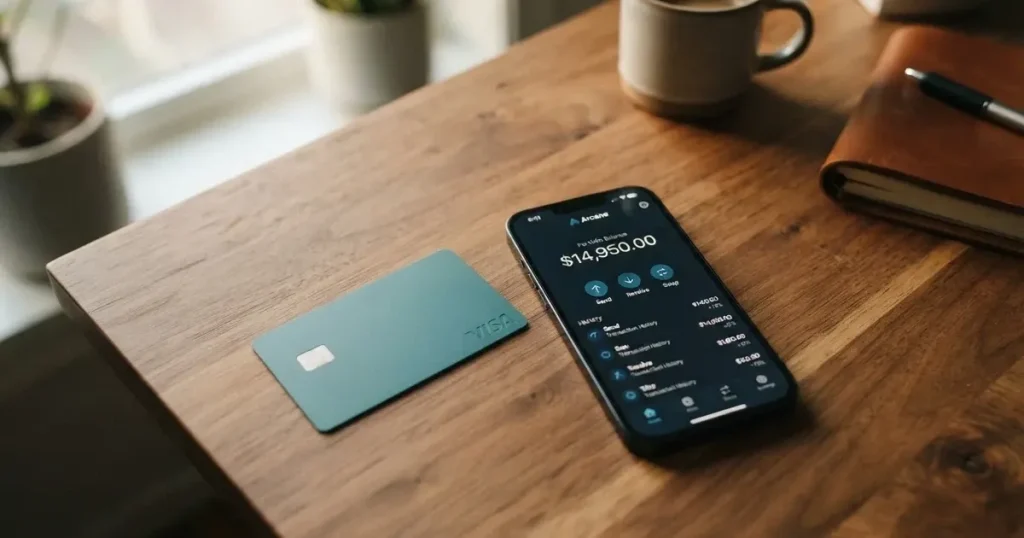
The BKJ card is a Visa-or-Mastercard-style payment card (the network is not named publicly) that you fund from stablecoins such as USDT and USDC and spend like an ordinary debit card, including through Apple Pay and Google Pay. It is run by BKJ PAYMENT INC, a Canadian money services business, and the card itself is issued by a partner whose name BKJ does not publish. That combination — a custodial crypto balance, a mobile-wallet-ready card, and a fee schedule that leaves the most expensive questions unanswered — is what this review walks through.
The BKJ card is best suited to people who already hold stablecoins on Ethereum or Tron, want a card that links to Apple Pay or Google Pay, and are comfortable with a custodial model where BKJ holds the balance. It is less suitable for anyone who needs a published fee schedule before signing up or who wants a named card issuer on the front of the terms.
Conditions are current as of October 28, 2026.
Verdict: 6.9 / 10 — practical for stablecoin holders, opaque on costs
A score of 6.9 out of 10 puts the BKJ card in the middle of the crypto-card range: stronger on access and daily use than on transparency and trust. The score reflects a card that does several everyday things well — a broad claimed country footprint, Apple Pay and Google Pay support, and stablecoin top-ups on Ethereum and Tron — while leaving the fee schedule, the ATM cost, the card network and even the card’s currency unstated on the public pages. For a reader who already has stablecoins and just needs a working card, the practical pieces are there. For a reader who wants to know what they will pay before they sign up, the missing numbers are a real obstacle.
| Criterion | Mark | Reason |
|---|---|---|
| Who can get it | 8 / 10 | A claimed network of 180+ countries, with a published restricted list |
| Cost | 4 / 10 | A 100 USDT physical-card fee is named; almost every other cost is not |
| Top-up options | 9 / 10 | USDT and USDC on Ethereum and Tron, plus 40+ fiat and crypto conversions |
| Reliability and complaints | 6 / 10 | A Canadian MSB licence, an unnamed issuer, and an unrated App Store listing |
| Everyday use | 9 / 10 | Virtual and physical cards, Apple Pay, Google Pay, ATM access on the physical card |
| Total | 6.9 / 10 |
If you are a stablecoin holder funding a card via Tron or Ethereum, the BKJ card does the core job: top up from the network you already use, add the card to a mobile wallet, and spend. If you care about predictable costs or want to see a named issuer, the same card starts to feel under-documented. The rest of this review goes through the details that drive that split.
Who will they give you the card
BKJ’s listing claims a payment network in 180+ countries and regions, but neither the site nor the listing publishes a country-by-country eligibility list. The restriction that *is* public is a list of places the service is not available: in a 11 September 2026 help-centre notice, BKJ set out that its services are unavailable in Russia, Belarus, North Korea, Iran, Myanmar, Cuba, Syria, Ukraine (including Crimea), Venezuela, Sudan, South Sudan, Libya, Burundi, the Central African Republic, Somalia, Zimbabwe, Afghanistan, mainland China and Iraq. The same notice says the list can change.
The terms require that you “reside in a country where the Services are available”, so eligibility is set by residence rather than citizenship, though a sanctions screen will still look at citizenship and country of birth. Two practical consequences follow. First, if you are in any of the listed regions, the app and the card are not for you. Second, if your country is not on the restricted list but is not on the 180+ list either, the public material does not confirm it — you would have to download the app and pass the identity check before you find out.
The card itself is positioned for anyone who can pass KYC, not for businesses. The terms make clear that BKJ may ask for more documents at any time, and that it can end the relationship without notice.
How to get it
The signup path is the same in every public description: download the app, complete registration and identity verification, then order a card. Identity verification is mandatory before you can apply for a card; the terms do not define KYC tiers, and the help centre has separate articles on “How to Conduct KYC Identity Verification” and on which functions are usable without KYC, which I have not read. Processing time and the specific documents BKJ asks for are not stated in the public material.
There are two card products. Virtual cards are available for Apple Pay and online purchases; the help centre references a “BIN449924 Singapore Virtual Card” article, which suggests a Singapore-issued virtual product, but the network and currency are not named on the card page. A physical card is also offered, with an issuance fee of 100 USDT that the listing describes as covering “card production and global logistics shipping costs”. That fee is non-refundable, and the order cannot be cancelled once paid.
The physical card is produced in about a week, and the listing says delivery is “normally around 20 business days”, varying by country and region; the countries it actually ships to are not listed. Replacement cost is not covered, which means a lost or stolen physical card may carry a fresh 100 USDT charge. Activation is by an emailed code plus a PIN and a contactless limit you set, with an option to use an email or Google Authenticator code for additional verification. The app is on iOS (version 1.4.5, dated 24 September 2026, requiring iOS 16.0 or later and also available on Mac M1 and visionOS) and Android, with an APK on BKJ’s static site for sideloading.
Fees: what it really costs
This is the section that most determines whether the card works for you, and it is also the thinnest part of the public material. The 100 USDT physical-card fee is the only number BKJ puts on the page. The listing claims a US$5 sign-up reward and “zero annual fee”. Beyond that, the card’s own pages and terms do not publish a fee schedule, and the listing’s marketing line of “save up to 90% on fees” is not backed by a schedule. The help centre has an article titled “BKJ Card Multi-Currency Transfer Limits & Fees Instructions”, which I have not read; for a card that converts between 40+ fiat currencies and crypto, that article is the one that would actually answer the cost question.

| Fee or limit | Value |
|---|---|
| Physical card issuance | 100 USDT (includes shipping) |
| Virtual card issuance | not stated |
| Annual or monthly fee | Zero annual fee stated; monthly fee not stated |
| Conversion fee (crypto to fiat) | not stated |
| Foreign-exchange fee | not stated |
| ATM fee | not stated (physical card has ATM access) |
| Daily spending limit | not stated |
| Monthly spending limit | not stated |
| Sign-up reward | US$5 (listing) |
| Spending rewards | Points exchangeable for BTC (rate not stated) |
To see what that means in practice, walk through three everyday payments with the information BKJ has and has not published.
*Coffee abroad, paid by phone.* You tap to pay with Apple Pay in a currency other than your card’s base currency. The blockchain network fee for the deposit was already paid when you topped up; the card’s own conversion and FX fees are what matter at the till, and they are not stated. The listing’s claim of “save up to 90% on fees” suggests the markup over a mid-market rate is meant to be small, but the actual figure is not on the page.
*Local supermarket, contactless.* You hold the physical card or phone over the terminal. The merchant sees a card whose network and country of issue BKJ has not published; some merchants apply extra scrutiny to prepaid or foreign-issued cards, and an unknown BIN can produce a decline that has nothing to do with your balance. The cost to you is the spread between the mid-market rate and whatever rate BKJ applies, which the public material does not give you.
*ATM withdrawal, travelling.* The physical card has “access to the global ATM network with instant fiat withdrawals” and the physical card supports contactless, but the ATM fee and the ATM limit are not stated. If your home currency is not the card’s base currency, an unstated FX fee is also in play. Until BKJ publishes the fee schedule, an ATM withdrawal is the kind of transaction you want to test with a small amount first.
The honest summary is that the card’s headline cost is the 100 USDT physical-card fee, and that every other cost is a question mark on the public pages.
Top up: how to fund the card
Funding is the part of the BKJ card that is best documented. The listing says the app supports USDT and USDC top-ups on the major blockchains, “including Ethereum and Tron”, and that the app converts between more than 40 fiat currencies and crypto. That combination — two of the highest-volume stablecoins on the two networks most users already have — is the reason the top-up score sits at 9 out of 10.
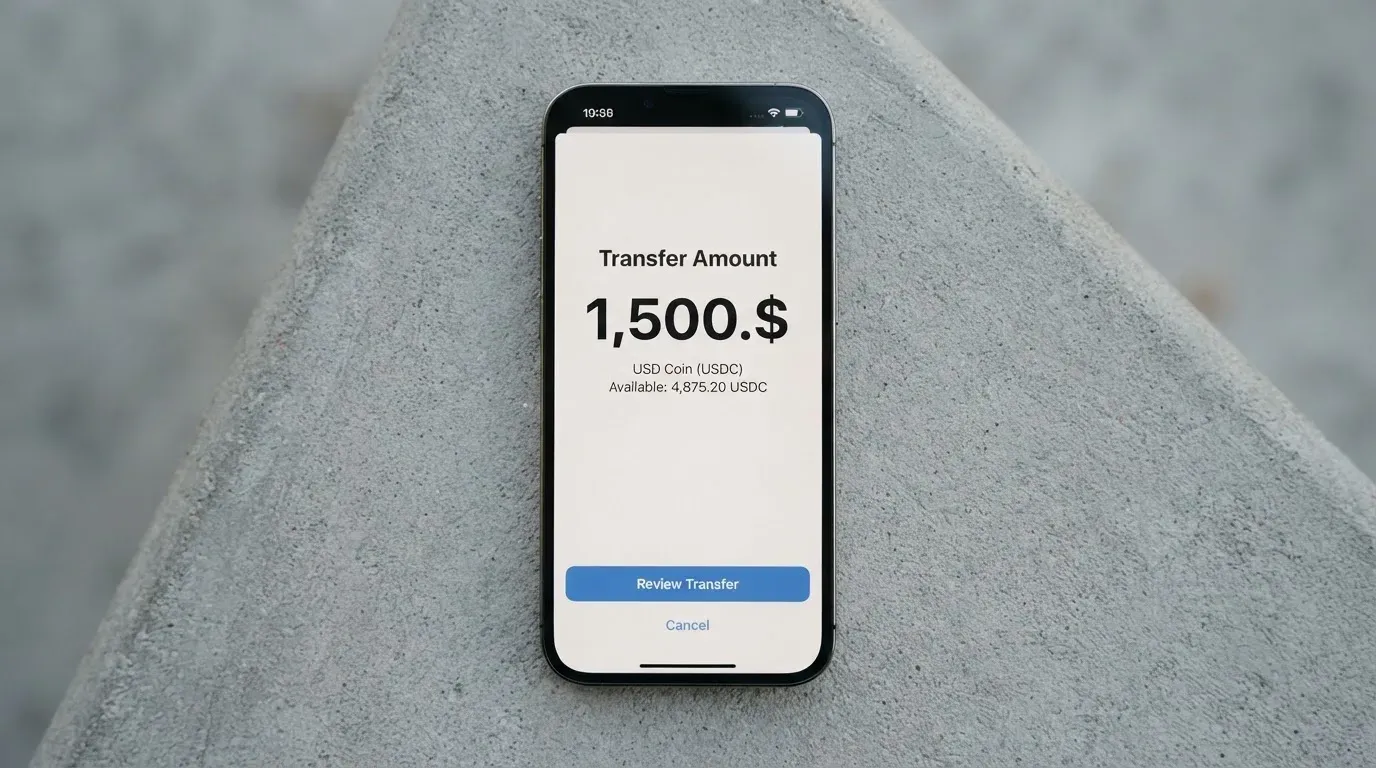
Three things to check before you send anything. First, confirm the network on the deposit screen; the help centre has troubleshooting content on “Explanation of Deduction Amount Difference”, which I have not read, but blockchain transfers are irreversible, and a deposit sent on a network the card provider does not support, or to an address of a different network, can be lost or stuck in manual support. Second, the deposit fee, the minimum top-up and who pays the network fee are not stated on the card page, so the network fee for an Ethereum USDT transfer is paid in ETH, and a Tron transfer burns TRX as bandwidth and energy; the app may cover these for you, or it may not — the public material does not say. Third, fiat top-up options are not described on the card page; the only fiat path described in the listing is the 40+ fiat-to-crypto conversion, which suggests you fund in stablecoins and then optionally convert inside the app.
For a reader who already keeps USDT on Ethereum or USDC on Tron, the top-up path is short. For a reader whose stablecoins sit on a less common network, the first step is to bridge to Ethereum or Tron before you can top up.
Paying with it every day
Day-to-day use is where the BKJ card is most like an ordinary payment card. The virtual card works in Apple Pay and for online purchases, and the physical card adds contactless and ATM access. A spending-rewards scheme pays points exchangeable for BTC, with the exchange rate not stated. The mobile-wallet setup is the part that feels least experimental: both Apple Pay and Google Pay are supported, the iOS app is current at version 1.4.5, and the help centre has a guide on adding the card to Apple Wallet.
Two practical caveats. The merchant category codes that BKJ blocks are not listed in the public material — the card page does not say which merchant categories are restricted, so a category such as gambling (MCC 7995), which many issuers block by policy, may or may not be open. And the dispute path is not the usual chargeback: the terms route disputes to arbitration at the Hong Kong International Arbitration Centre under English language and Hong Kong law, fees are non-refundable under section 7.3, and the help centre has guides for “BKJ Card Refund Not Received” and transaction failures that I have not read for time frames. In practice, that means a refund dispute is more likely to go through the app’s support channels than through a chargeback.
The App Store listing for the iOS app, as of 20 October 2026, has not received enough ratings or reviews to display a star rating or summary. That is a small but real signal: it limits how much you can learn from other users before you install.
What can go wrong
Five risks stand out, and they are not equally weighted.
*An unnamed issuer.* BKJ says the card is “issued by partners holding appropriate licences”, but does not name the issuer. Visa and Mastercard themselves do not issue crypto cards to consumers; they license issuers and can suspend a programme, and BKJ’s terms let the company “set off any of your liability” against your balance and may terminate services without notice (section 9), with no published commitment on what happens to a closed user’s balance. A 2022 example is a useful reference: Visa said on 13 November 2022 that it had terminated its global agreements with FTX, and the FTX US debit card was wound down by its issuer.
*Custodial balance.* BKJ’s terms describe a “Custodian Account(s)” and explicitly say an account is not a banking service, which places it outside deposit-guarantee schemes. The catalogue of past custodial failures is long — Mt. Gox (about US$350 million reported stolen between 2011 and 2014), Coincheck (about US$400 million in 2018), Ronin Network (US$625 million in 2022) — and a custodial crypto balance carries the same counterparty and hack risk as any other custodian.
*Restricted-region list that can change.* The 11 September 2026 help-centre notice puts the restricted list on a “can change” footing. If your country is added to the list after you have funded the card, the terms let BKJ end the relationship without notice, and the public material does not commit to a notice period for new loads or a date after which spending stops.
*Stablecoin depeg and sanctions.* Stablecoins aim to hold a peg but are not necessarily stable: TerraUSD collapsed in May 2022, and USDC temporarily lost its peg in March 2023 during the US banking crisis. Tether has also disclosed that it disables tokens in wallets on the OFAC sanctions list and has frozen funds tied to illicit activity, so a stablecoin balance is not censorship-proof.
*Unstated fees and unstated limits.* The fee schedule is largely unpublished, the ATM fee is not stated, the card’s base currency is not named, the network is not named, and the daily and monthly limits are not stated. A card that converts between 40+ fiat currencies and crypto without publishing the conversion fee is a card that asks you to find out at the till.
The complaint record is thin. No public complaints against BKJ surfaced during research, but the App Store listing has not received enough ratings to summarise, and the company is small enough that a low complaint count is not the same as a clean record.
What to take instead
The alternatives below share BKJ’s broad-country promise and stablecoin or crypto funding, with different trade-offs. None is presented as better; each is offered so the comparison is in one place.
| Card | Score | Where it fits | What it asks you to accept |
|---|---|---|---|
| BKJ | 6.9 / 10 | Stablecoin holders funding via Ethereum or Tron | An unnamed issuer and an unpublished fee schedule |
| Cardex | 5.6 / 10 | Users in Nigeria and other VERVE / Visa / Mastercard / UnionPay markets | An “AI-powered conversion rate” with no fee percentage published |
| CardFlow | 4.9 / 10 | Nigerians needing a free virtual USD Mastercard | A Nigeria-led product with no published fees and no monthly-fee disclosure |
| HyperCard | 4.7 / 10 | Users wanting a prepaid card in USD or EUR funded from USDT, BTC or ETH | An unstated card network and unstated fees |
Cardex is described in its listing as “one crypto card, 200+ countries” with no country list or exclusions on the public pages; its App Store listing is Naira-focused. It offers a debit crypto card on the VERVE, Visa, Mastercard and UnionPay networks, virtual and physical cards, real-time crypto-to-fiat conversion at the moment of payment, and an “AI-Powered Conversion Rate” that the site says scans global exchange rates and picks the best one at the moment of spend; no fee percentage is published. Funding is from USDT, USDC and BTC wallets, with the networks not stated. Its score is 5.6 out of 10.
CardFlow is positioned as “Nigeria’s smartest fintech card platform” for “Nigerians and global users”, with no country list or exclusions on the public pages. It offers a virtual USD Mastercard that the site says can be created in about 3 minutes, and the FAQ states that creating a virtual card is “completely free”; the monthly fee and other fees are not stated. Funding is from Bitcoin, USDT, ETH or Naira bank transfer, with the networks not stated. Its score is 4.9 out of 10.
HyperCard has no published country list on its official pages; its App Store listing says the card works in “more than 176 countries”, which is an acceptance figure, not an eligibility one. It offers a prepaid card in USD or EUR, with the network not stated on the App Store page; the App Store page lists no fees, and other pages do not state fees either. Funding is by depositing USDT, BTC or ETH in the app, which is then converted to USD or EUR on the card. Its score is 4.7 out of 10.
The honest comparison is that each of these cards solves the same problem with a different gap. Cardex names networks but not fees. CardFlow names a fee (zero for creation) but not its monthly cost. HyperCard accepts a wide range of crypto but does not state the card network. BKJ is the only one in the set that names stablecoin networks explicitly, and also the only one that asks you to accept the most opaque overall fee schedule.
Who I would recommend it to
I would recommend the BKJ card to a stablecoin holder who already keeps USDT on Ethereum or USDC on Tron, wants a card that works in Apple Pay and Google Pay from day one, is comfortable with a custodial balance held by a Canadian MSB-registered company, and is willing to learn the rest of the fee schedule by reading the in-app help article on multi-currency transfer limits before topping up. For that reader, the practical pieces line up: a broad country footprint, a virtual card for online use, a physical card with ATM access, and a top-up path that matches the networks the reader already uses.
I would not recommend it to a reader who needs a published fee schedule before signing up, who needs a named issuer, who lives in or holds citizenship in any of the restricted regions on the 11 September 2026 list, or who needs the protection of a banking-style deposit guarantee. The card’s terms are explicit that an account is not a banking service, and the fee schedule is the kind of document a careful reader should ask BKJ to send before loading a meaningful balance.
Frequently asked questions
What is the BKJ card?
The BKJ card is a payment card — virtual for online and mobile-wallet use, and physical with ATM access — funded from a custodial stablecoin balance (USDT and USDC on Ethereum and Tron, plus conversion between 40+ fiat currencies and crypto) and spent like an ordinary debit card, including through Apple Pay and Google Pay.
How does the BKJ card work?
You complete identity verification in the BKJ app, order a virtual or physical card, top up the card’s balance by sending USDT or USDC on a supported network (Ethereum or Tron are named), and the app converts the stablecoin into the card’s spending balance at the moment of payment; the card network and the card’s base currency are not named publicly.
Is BKJ a bank?
No. BKJ’s terms describe a “Custodian Account(s)” and state that an account is not a banking service, so the balance is not covered by a bank deposit guarantee scheme; BKJ PAYMENT INC is registered in Canada and holds a money services business licence (MSB C10001249) with FINTRAC.
Who owns BKJ?
The card programme is run by BKJ PAYMENT INC, registered in Canada, with the app published by BKJ TECHNOLOGY LIMITED; the card itself is “issued by partners holding appropriate licences” and the issuer is not named in the public material.
Is the BKJ card available in my country?
The public material does not give a country-by-country eligibility list; the listing claims a payment network in 180+ countries, and the 11 September 2026 help-centre notice lists Russia, Belarus, North Korea, Iran, Myanmar, Cuba, Syria, Ukraine (including Crimea), Venezuela, Sudan, South Sudan, Libya, Burundi, the Central African Republic, Somalia, Zimbabwe, Afghanistan, mainland China and Iraq as places the service is not available, with the list marked as “can change”.
How do I get a BKJ card?
Download the BKJ app on iOS or Android, complete registration and the mandatory identity verification, then order a virtual card (free, fee not stated) or a physical card for 100 USDT; the physical card is produced in about a week and delivered in around 20 business days, with countries not listed.
Does the BKJ card require KYC?
Yes. The terms require identity verification before you can apply for a card, and they let BKJ ask for more documents at any time; the help centre has separate articles on how to do KYC and on which functions are usable without it, but processing time and the specific documents required are not stated.
How do I top up the BKJ card?
Send USDT or USDC from your wallet to the deposit address shown in the app, on a network the app supports — Ethereum and Tron are named — and the app credits your card balance after the network confirms the transfer; the deposit fee, the minimum top-up and who pays the network fee are not stated on the card page, and you should confirm the network on the deposit screen before sending because blockchain transfers are irreversible.
Is the BKJ card free?
The physical card costs 100 USDT, which the listing says covers production and shipping, and the listing describes an annual fee of zero; the virtual card issuance fee, the conversion fee, the foreign-exchange fee, the ATM fee, and the daily and monthly limits are not stated, and the help centre article titled “BKJ Card Multi-Currency Transfer Limits & Fees Instructions” is the place to look for the full schedule.
Is the BKJ card safe?
The card uses a custodial balance held by BKJ PAYMENT INC, a Canadian MSB-registered company, with the card issued by an unnamed partner; safeguards described in public material include email-code and Google Authenticator verification at activation, a help-centre article on registered email and security configuration, and the terms’ reference to a Custodian Account, but the public material does not state whether balances are insured, whether the app supports instant card freeze, or whether there is in-app spending control.
Virtual card fees – cryptocardfacts
Content created by the «cryptocardfacts» team