
The promise is a virtual card in seconds with no identity check; the catch is that nobody will tell you who is issuing it
 Available in US
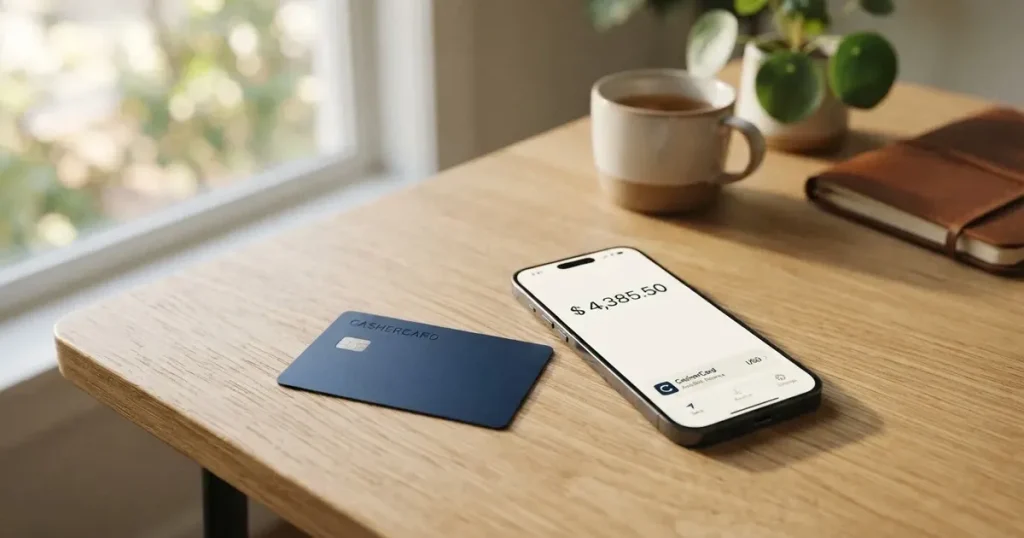
CasherCard sells one thing: a virtual payment card that you load with crypto, issued quickly, without handing over identity documents. The pitch is speed and anonymity at the point of signup — an email address, a crypto transfer, and a card number in a dashboard. The problem is not the concept, which is ordinary, but the disclosure around it. The company describes itself as “a registered technology company” and “not a bank or financial institution”, and it does not name the legal entity behind it, the address, or the licensed institution that actually issues the card. It says the issuing and wallet providers are unnamed regulated third parties and authorised Visa/Mastercard partners that “may change”.
That single gap shapes everything else in this review. You can find out what the card costs, what chains it accepts, what its limits are. You cannot find out who stands behind the money when something goes wrong. My score is 5.5 out of 10, and the reasoning is set out below.
The conditions described here are current as of October 28, 2026.
The score: 5.5 out of 10
CasherCard is a competent implementation of a familiar product with an incomplete disclosure layer. It suits you if you already hold crypto, want a spendable balance in minutes, and would rather not send documents to a payments company you cannot name. It does not suit you if you need to know that your balance is safeguarded, that you can dispute a charge, or that a named company is accountable to a regulator.
| Criterion | Mark | Why |
|---|---|---|
| Who can get it | 6 / 10 | Countries and citizenship are never named; payment methods “may vary over time and by location” |
| Cost | 4 / 10 | $4 per card issued, no subscription, but a 5% fee on every wallet top-up |
| Top-up options | 9 / 10 | Bitcoin, Ethereum, Solana, USDT, BNB, TRON, Polygon, Litecoin, Avalanche, Arbitrum |
| Reliability and complaints | 5 / 10 | No legal entity or issuer named; Trustpilot 4.1 out of 5 on 10 reviews, two complaints about “no KYC” advertising and a balance unavailable for weeks |
| Everyday use | 4 / 10 | Virtual only, no physical card; Google Pay listed, Apple Pay not mentioned; no ATM |
| Total | 5.5 / 10 | A usable card from a provider you cannot fully identify |
The audience the product genuinely fits is narrow and worth naming: crypto holders who want an instant, no-KYC virtual card and who are comfortable with a 5% cost on funding. If that is you, the mechanics below are honest about what they do and do not tell you. If you are anyone else — a person whose bank declined them, someone with a large balance, anyone who needs a chargeback — the missing issuer is not a small detail, it is the whole question.
Will they give you the card
Short answer: probably, because the bar is set extremely low, and that low bar is also the thing to worry about.
The terms say only that payment methods “may vary over time and by location”. There is no country list, no exclusion list, no citizenship statement. That is not a green light for anyone anywhere — it is an absence of information. If you are in a jurisdiction where e-money or crypto services are restricted, or where an unnamed issuer will not open an account for you, the card simply will not reach you, and nothing on the public pages will have warned you in advance.
Two structural facts help you read that silence. First, the card is virtual only — the site calls them “Instant Crypto Funded Virtual Cards”, and no physical card is offered. Second, the network is shown as Visa on the card graphic; Mastercard is not mentioned. The currency of the card is not stated, so I cannot tell you what your balance is denominated in, which matters if you are outside the United States.
There is also a category-level point worth holding in mind. Merchants can look up the issuer identification number at the start of a card number and see which institution and country issued it; if that differs from the billing address they may apply extra scrutiny. This is why cards issued in one place can look “foreign” in a shop in another. With no named issuing entity, you cannot even predict which country will appear in that lookup.
| What the card is | What that means for you |
|---|---|
| Virtual only, no physical card | Nothing to post to you; usable in online checkouts and wherever card numbers are accepted |
| Visa shown on the card graphic | Mastercard support is not claimed |
| Card currency not stated | You do not know what unit your balance is held in |
| No country or citizenship list | Eligibility is not publicly described, so you cannot check before applying |
| Payment methods “may vary over time and by location” | Availability is not guaranteed and can change without notice |
How to get it
The signup path is genuinely short: register with an email address, fund the wallet with crypto, then issue a card from the dashboard. No phone number, no personal data, no documents. The site advertises “Zero KYC”, and you confirm that you are at least 13 years old. Proof of address is not stated, and there are no KYC tiers — the product is simply positioned as no-KYC rather than as a tiered scheme.
Whether that is a good thing depends entirely on why you want it. In the EU, customer due diligence for regulated businesses covers name, address, date of birth, nationality and identity documentation, a sanctions check, the purpose of the relationship, and whether the customer is a politically exposed person. If a provider cannot complete that, the rules require it to refrain from the transaction and, where necessary, end the relationship. A service that asks for none of it is either operating outside that framework or relying on a third party that sits inside it — and here, which one is doing the checking is not something the site tells you.
I want to be careful with the framing, because this is where reviews of this kind usually slide into advice about avoiding checks. I am not going there. What you should know is narrower and factual: no-KYC means nobody has verified you, so if the provider or its unnamed issuer later decides they need your identity, you may find your account frozen or closed at exactly the moment you needed it. And in the US, nationality is recorded and screened separately from residence, because sanctions screening and issuer risk policy are often applied to citizenship and country of birth as well as to address. Anonymity at signup does not travel further than the signup.
There is nothing to activate in the usual sense — the card is issued from the dashboard as an instant virtual card — and because nothing physical is shipped, delivery terms do not apply.
Fees: what it really costs
The headline numbers are cheap; the recurring costs are where this product takes a real cut.
Issuing a card costs $4. There is no monthly subscription and no tiers — a single flat structure. Some virtual card options are listed as free, which is worth noting because it suggests the $4 applies to some card products rather than all of them. Funding the wallet costs 5%, and this is the fee you will pay most often, because every top-up goes through it.
Two fees you would want to know before spending are not stated: the crypto conversion fee and the foreign exchange fee. The fee page says fees and limits vary by “card program, provider availability, payment network, and account eligibility” — accurate, and not a number. The decline fee is 0%, which is genuinely useful to know because it means a rejected payment does not cost you extra. ATM withdrawals are not stated, and with a virtual-only card there is nothing to withdraw against.
Limits are clear: $5,000 maximum per transaction and $50,000 per month. Daily, weekly and total limits can be set per card in the dashboard, which is a control most cards of this kind do not offer.
| Item | Value |
|---|---|
| Card issuance | $4 per card |
| Monthly subscription | None |
| Tiers | None (“No tiers”); some virtual options listed as free |
| Wallet funding | 5% |
| Decline fee | 0% |
| Crypto conversion fee | Not stated |
| FX fee | Not stated |
| ATM | Not stated |
| Per-transaction limit | Max $5K |
| Monthly limit | $50K |
| Daily, weekly, total limits | Settable per card in the dashboard |
Two everyday payments, to make this concrete. You spend $40 of groceries from a card you topped up with crypto: the 5% funding fee was already charged when the money arrived, and the conversion rate applied at the moment of payment is not disclosed anywhere, so you cannot compute what that $40 cost in the coin you sent. You then spend €30 at a shop abroad: the foreign exchange fee is not stated, and the address verification check that many merchants run is mainly offered in the US, Canada and the UK and is generally unavailable for foreign-issued cards — which can cause declines, and sometimes a declined authorisation leaves a hold that can stay for several days.
The 5% deserves a second look, because it compounds differently from a one-off. It is charged on the way in, so a card you reload weekly pays it weekly. If you are deliberately using a card because your bank blocked you, 5% of every payment is not a rounding error against the value of the card.
Top up options
This is the strongest part of the product, and it is why the top-up line in the score is as high as it is.
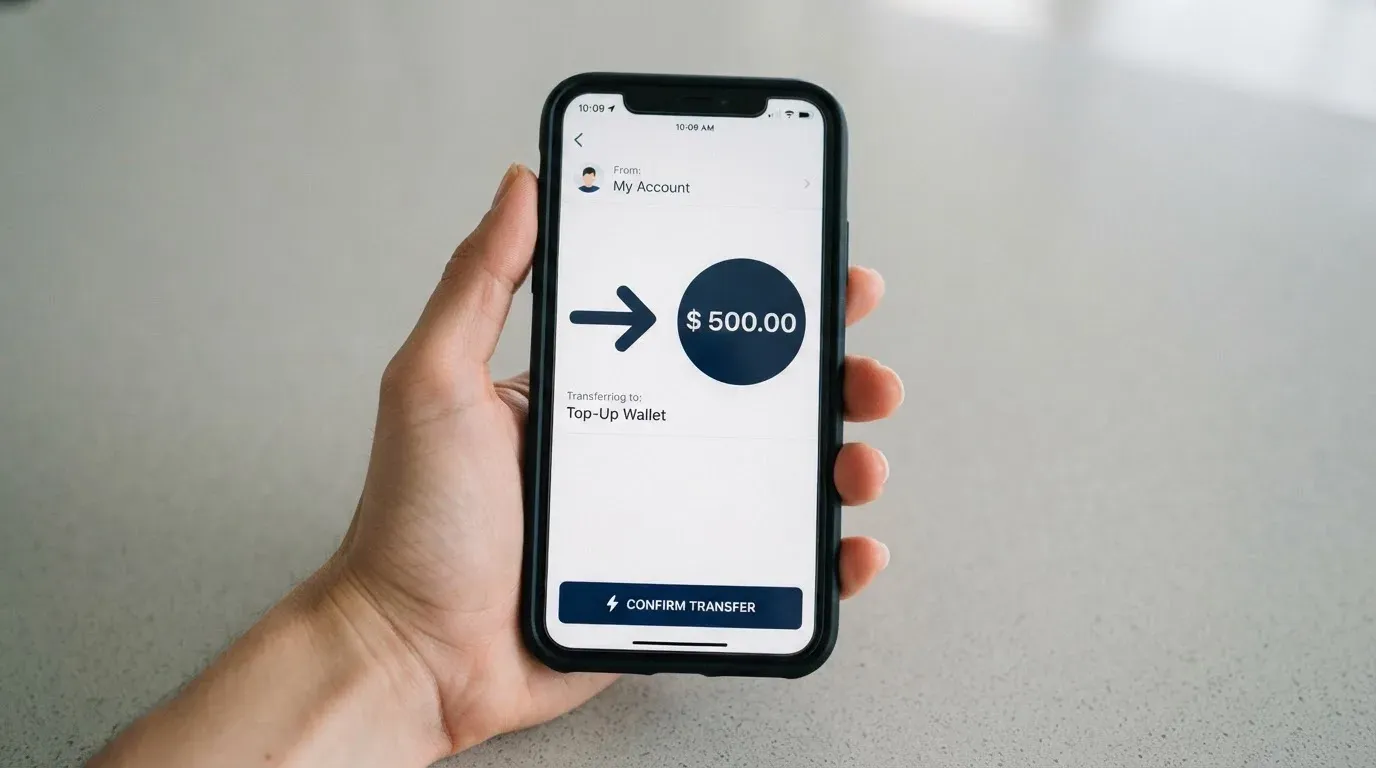
The listed coins and networks are Bitcoin, Ethereum, Solana, USDT, BNB, TRON, Polygon, Litecoin, Avalanche and Arbitrum. The FAQ frames the same thing by network: Bitcoin, Ethereum (ERC20), BNB Smart Chain (BEP20) and Tron (TRC20), with BTC, ETH, USDT and USDC as the assets. Money goes to the wallet first and then from the wallet onto cards, which is why the 5% funding fee sits between you and every card you issue from it. A minimum top-up is not stated, and it is not stated who bears the network fee for the transfer.
That last point is the one to get right. On-chain network fees are charged by the blockchain, not by the card provider, and they land on the asset you send. A wallet holding USDT on Ethereum but no ETH cannot send at all, because gas on Ethereum is paid only in ETH. Fees on Tron are paid through bandwidth and energy resources, often burning TRX. So before your first transfer, check that you hold the native coin for the network you are about to use, not just the token.
The network choice matters more than it looks. Circle lists USDC as natively supported on 38 networks as of 16 September 2026, including Ethereum, Solana, Base, Polygon PoS, Avalanche and Arbitrum — but Circle stopped supporting USDC on Tron in February 2024, so “USDC over TRC20” is not a native option. USDT is different: Tether describes it as issued on networks including Ethereum, Tron, Solana, Polygon and Avalanche, and the card’s own FAQ names TRC20. Transfers are irreversible, so a deposit sent on a network the provider does not support, or to an address belonging to another network, can be lost or need manual support recovery with no guarantee. Check the address twice.
| Top-up route | Networks named |
|---|---|
| Listed coins and chains | Bitcoin, Ethereum, Solana, USDT, BNB, TRON, Polygon, Litecoin, Avalanche, Arbitrum |
| FAQ networks | Bitcoin, Ethereum (ERC20), BNB Smart Chain (BEP20), Tron (TRC20) |
| Assets named in FAQ | BTC, ETH, USDT, USDC |
| Path | Into the CasherCard wallet first, then onto cards, with a 5% fee on funding |
| Minimum top-up | Not stated |
| Who pays network fees | Not stated |
| Fiat top-up | Not stated |
Withdrawing is the thin spot. The site says unused balance is refundable, but it does not state the method, the fee, or what happens to the balance if you close the account. Since the wallet sits with an unnamed provider rather than with you, “refundable” is a promise rather than a mechanism you can inspect.
Paying with it every day
Day to day, this is a virtual card and a web dashboard. There is no mobile app mentioned — the dashboard runs on the web, with a REST API for developers — and therefore no store ratings to read. Google Pay is listed; Apple Pay is not mentioned at all, which answers the most common search question about this card in the negative. Blocked merchant categories are not stated, and that cuts both ways: you may find gambling or adult merchants work when they should not, and you may find an ordinary category blocked by an unnamed issuer’s policy.
Rewards are not stated. There is a referral programme at /referral, but cashback is not mentioned, so do not model any of your expected returns around it.
The one part of daily use the site addresses directly is problems. There is no general dispute process: remedies relating to a vendor’s products or services must generally be pursued with that vendor, delivered gift cards and codes are non-refundable, and a defective item may be replaced or refunded after verification. Chargebacks are not mentioned. That is a significant gap for anyone who will use this card for anything expensive, because the usual protection for a card purchase in many jurisdictions simply is not described as available here. Prepaid-card coverage varies by jurisdiction and should not be assumed.
| Feature | Status |
|---|---|
| Physical card | Not offered |
| Google Pay | Listed |
| Apple Pay | Not mentioned |
| Mobile app | None mentioned; web dashboard plus REST API |
| Cashback or rewards | Not stated (referral programme exists) |
| Blocked merchant categories | Not stated |
| Chargeback | Not mentioned |
| Disputes | Handled with the vendor; gift cards and codes non-refundable; defective items may be replaced or refunded after verification |
| Support | Email [email protected] and [email protected], Telegram @CasherCard, WhatsApp link, contact form; replies “usually within 24 hours” |
What can go wrong
The most obvious risk is the one the company itself describes. CasherCard says it is “a registered technology company” and “not a bank or financial institution”, with card issuing and wallets provided by unnamed regulated third parties and authorised Visa/Mastercard partners that “may change”. No legal entity name, address or registration number is given anywhere in the public material. When you ask who to write to if funds are lost, there is no one to write to.
Custody is not stated either. Your funds sit in a CasherCard wallet. Whether they are safeguarded in a way you could claim on is not described, and safeguarding arrangements in this category are not the same as bank deposits. What the dashboard does offer is per-card daily, weekly and total spending limits and sub-accounts — useful controls, and more than many cards in this category provide. Two-factor authentication and an in-app freeze are not stated, which is a gap given that instant freeze is one of the standard safeguards in this category.
On complaints, no official incidents came up in my checking, and searches for reviews, Reddit threads and scam reports returned nothing about CasherCard at all — no independent reviews, no forum discussion. That silence is not a clean bill of health; for a service of this size it mostly means there is little public record either way. On Trustpilot the card sits at 4.1 out of 5 from 10 reviews, all within 12 months as read on 21 October 2026. Only two are complaints: one 1-star review in August 2026 alleging that cards advertised as no-KYC were used to cheat customers, and one 4-star in September 2026 saying prices were high and the balance could not be checked for weeks. Two complaints is not a recurring theme, but the first one lands exactly where the missing issuer information leaves a gap, and the second is a complaint about visibility of money.
Nothing dated has happened that I could find. There are no announcements, no incident reports, no regulatory actions in the public record. Support is reachable by email, Telegram, WhatsApp and a contact form, with a stated reply time of “usually within 24 hours”.
Two wider category risks are worth keeping in view, because they apply to crypto-funded cards generally and not only to this one. Programme closures happen: Visa terminated its global agreements with FTX on 13 November 2022 and the FTX US debit card was wound down by its issuer, and WaveCrest, a Visa issuer that supplied several crypto card brands, was suspended by Visa in Europe in 2018, closing all WaveCrest-issued Visa programmes. A closure typically means loading stops, then spending stops, then users are asked to withdraw remaining balances — and a secondary report of one 2026 closure put new loads ending 8 July 2026 and spending stopping 8 August 2026, though that is a single unconfirmed source. If the unnamed partner behind this card “may change”, that is the scenario to ask about.
The second is that depositing crypto into an unnamed wallet is the same category of decision as depositing into any custodial platform. Control of crypto belongs to whoever holds the private key or seed phrase, and a seed phrase of typically 12 to 24 words is an unencrypted form of that key — anyone who obtains it can restore the wallet and spend its funds. Transfers are typically irreversible and a stolen key has no built-in recovery: the network cannot freeze or return anything. Custodial platforms have a documented history of failure, including Mt. Gox at about US$350 million reported stolen between 2011 and 2014, Coincheck at about US$400 million in 2018, and the Ronin Network at US$625 million in 2022. I am not telling you this card will fail. I am telling you that you cannot see who holds the balance, which is the fact that would let you weigh that risk.
Finally, on where the money comes from and where it goes. Tether says it disables tokens in wallets on the OFAC sanctions list and has frozen funds tied to illicit activity, so stablecoins are not censorship-proof in either direction. That cuts both ways for you: the same infrastructure that can freeze an abuser’s balance can freeze yours while a provider completes its own checks, and there is no named compliance contact here to appeal to.
What to take instead
None of the alternatives below is clearly safer — the same disclosure gaps run through this whole corner of the market. They differ mainly in what they tell you.
Cardex scores 5.6 out of 10. It advertises “One crypto card, 200+ countries” with no country list or exclusions, and its App Store listing is Naira-focused, paying in Naira. It is a debit crypto card on the VERVE, VISA, Mastercard and UnionPay networks, offering both virtual and physical cards. Funding comes from USDT, USDC and BTC wallets, with networks not stated. Issuance cost and fee percentages are not stated; the site says an “AI-Powered Conversion Rate” scans global exchange rates and picks the best one when you spend. The attraction here is the physical card option and the multi-network reach; the drawback is that the conversion claim is marketing rather than a published rate or fee.
CardFlow scores 4.9 out of 10. It targets Nigeria — “Nigeria’s smartest fintech card platform” and “Nigerians and global users” — with no country list or exclusions stated. The product is a virtual USD Mastercard created in 3 minutes, and creating one is “completely free” per the site’s FAQ; monthly fee is not stated. Funding is Bitcoin, USDT, ETH or a Naira bank transfer, with networks not stated. The Naira bank transfer is the distinguishing feature if you are in that market.
HyperCard scores 4.7 out of 10. It is a prepaid card with a balance in USD or EUR, funded by depositing crypto such as USDT, BTC or ETH in the app and converting onto the card. Official pages state no country list; the App Store says the card works in “more than 176 countries” — which is a statement about acceptance, not about who is eligible to hold one. Issuance cost, fees and the card network are not stated on the pages I could read.
| CasherCard | Cardex | CardFlow | HyperCard | |
|---|---|---|---|---|
| Score | 5.5 / 10 | 5.6 / 10 | 4.9 / 10 | 4.7 / 10 |
| Card type | Virtual only, Visa shown | Virtual and physical, VERVE/VISA/Mastercard/UnionPay | Virtual USD Mastercard | Prepaid, USD or EUR balance |
| Cost | $4 per card | Not stated | Free to create virtual card | Not stated |
| Funding | BTC, ETH, USDT, BNB, TRON, Polygon, LTC, Avalanche, Arbitrum | USDT, USDC, BTC wallets | BTC, USDT, ETH or Naira bank transfer | USDT, BTC, ETH in the app |
| Target market | Not stated | 200+ countries claimed, listing is Naira-focused | Nigeria and global users | Not stated |
| Main gap | No named entity or issuer | No published fee percentage | Monthly fee not stated | Network, cost and fees not stated |
If your problem is that a bank will not give you a card, the honest comparison is not between these four. It is between any of them and a prepaid card from a named, regulated issuer in your own country, where the money is safeguarded, the entity is identifiable, and disputes have a route.
Who I would recommend it to
I would recommend CasherCard to one specific person: someone who already holds crypto, needs a spendable virtual balance today rather than after a verification process, is comfortable paying 5% on funding, and is genuinely relaxed about who holds their funds in the meantime. For that person, the product does what it says — many networks, fast issuance, sensible per-card limits, a 5,000 dollar transaction ceiling and 50,000 a month, and a zero decline fee.
I would not recommend it as your everyday card, because a virtual-only card with no Apple Pay, no stated chargeback process and no physical option is not an everyday instrument. I would not use it to hold a sum you would miss, because the wallet provider is unnamed and reversibility is exactly what an unstated custody model takes away. And I would think twice if your reason for wanting a no-KYC card is that a conventional institution turned you down: the absence of an answer here is not neutrality, and if the unnamed partner later needs your identity, the account you opened to avoid that process is the one that will be affected.
The check I would make first, before anything else on this page: look for the legal entity name and the issuing institution. If a provider cannot tell you who issued the card and who holds the balance, the 5.5 reflects that, not the technology — which is fine and unremarkable in itself.
Frequently asked questions
What is CasherCard?
CasherCard is a virtual payment card funded with cryptocurrency. You sign up with an email address, send crypto to a CasherCard wallet, and issue card numbers from a web dashboard. The site advertises “Zero KYC” and there is no physical card option. It describes itself as a technology company, not a bank or financial institution, and does not name the entity behind it.
How does CasherCard actually work?
You register by email, fund the wallet with crypto, and then issue cards from the dashboard, which can also create sub-accounts. Money sits in the wallet first and is spent from there, so each top-up passes through a 5% funding fee. The card is virtual only, with Visa shown on the card graphic, and the card currency is not stated anywhere on the public pages.
Is CasherCard a bank, and who owns it?
No — the site explicitly says it is “not a bank or financial institution”, describing itself as a registered technology company. It names no legal entity, address or registration number. Card issuing and wallets come from unnamed regulated third-party providers and authorised Visa/Mastercard partners that the company says “may change”, which is the single most important fact for a potential user.
Does CasherCard require KYC, and who can apply?
The site advertises “Zero KYC”; signup needs only an email, with no phone number or personal data, and you confirm you are at least 13 years old. Proof of address is not stated and there are no KYC levels. Country and citizenship are not named — the terms say only that payment methods “may vary over time and by location” — so eligibility cannot be checked in advance.
What does CasherCard cost, and is it free?
Issuing a card costs $4, with no monthly subscription and no tiers; some virtual card options are listed as free. Funding the wallet costs 5%, which you pay on every top-up rather than once. The crypto conversion fee and the foreign exchange fee are not stated, the decline fee is 0%, and ATM terms are not stated because the card is virtual only.
How do I top up, and what will it cost me?
You send crypto to the CasherCard wallet; listed networks are Bitcoin, Ethereum, Solana, USDT, BNB, TRON, Polygon, Litecoin, Avalanche and Arbitrum, and the FAQ names BTC, ETH, USDT and USDC. Funding costs 5%. Minimum top-up, who pays network fees, and whether fiat top-up is possible are all not stated. Make sure you hold the native coin for the network you use, since gas on Ethereum is paid only in ETH.
Can I use CasherCard in my country, and where does it work?
The card is virtual and Visa is shown on the card graphic, so it works wherever card numbers are accepted online or in shops that take that network. Eligibility is the unresolved half: no country list or exclusions is published, and payment methods “may vary over time and by location”. One respondent on Trustpilot reported that a balance could not be checked for weeks, which suggests availability is not uniform.
Is it safe to add CasherCard to Apple Pay or Google Pay?
Google Pay is listed on the site; Apple Pay is not mentioned at all, so you should assume the card cannot be added to Apple Wallet. A virtual card number is more exposed than a physical one, so treat the card details with the same care as a card you carry. Two-factor authentication and in-app freeze are not stated, and per-card spending limits are the main control the dashboard offers.
What happens if I have a problem with a payment?
There is no general dispute process. The site says remedies relating to a vendor’s products or services must generally be pursued with that vendor, gift cards and codes are non-refundable, and a defective item may be replaced or refunded after verification. Chargebacks are not mentioned, and prepaid-card coverage varies by country, so do not assume a refund route exists.
Is a CasherCard account worth it, and can I close it?
It suits someone who already holds crypto and wants a virtual balance quickly without identity checks, and who is comfortable paying 5% on funding. It is not suited to anyone wanting a named, accountable issuer or a way to dispute a charge. Unused balance is described as refundable, but the method, the fee and what happens to the balance on closure are not stated, so ask support before you load more than you can afford to lose.
Virtual card fees – cryptocardfacts
Content created by the «cryptocardfacts» team