
A multi-network crypto balance and a virtual Visa, with a 1.5% conversion by default
 Available in US
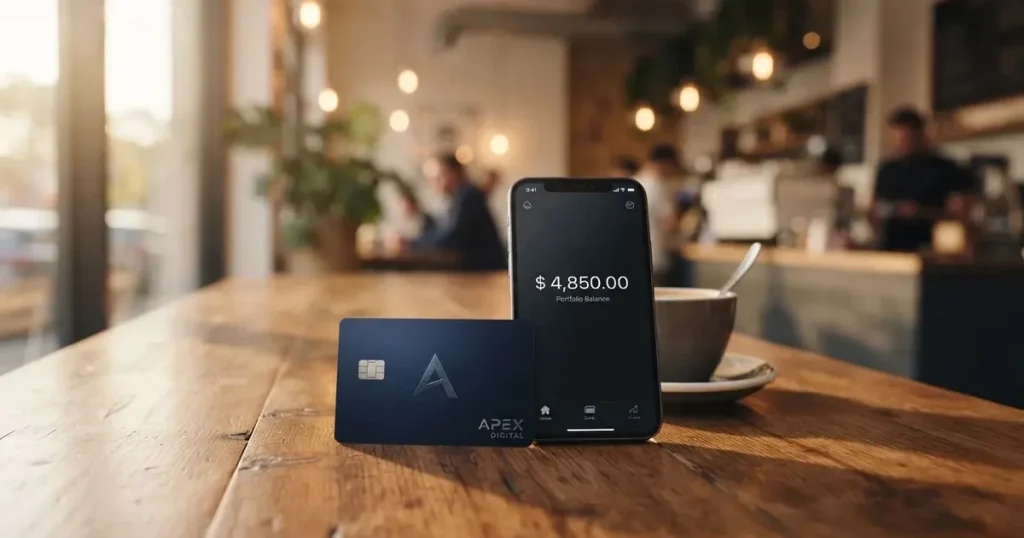
Most of us do not open a crypto card because we are excited about the technology. We open one because the ordinary card is the thing that stopped working — the application was declined, the address on the statement does not match the one we actually live at, the employer pays in a currency no local bank will touch, or the bank is simply not going to have us as a customer. If that is you, then Scallop is worth reading about carefully, because it takes a genuinely different route: you keep crypto or dollars in a Scallop account, you load a balance from that account onto a virtual Visa card, and you spend the loaded balance anywhere Visa is accepted.
Conditions are current as of October 28, 2026.
Read the conditions below as they stood when I checked them, in October 2026.
Scallop comes out at 6.6 out of 10. That is not a dismissive number. It reflects a service with one genuine and attractive idea — a card fed from a multi-network balance, so you are not locked to a single chain — wrapped in documentation that is thin in exactly the places where a cardholder needs answers. Costs are transparent enough to plan around. Everyday use is where the mark falls hard, and I will not paper over that.
The card suits you if you already hold crypto across several networks, you want a virtual Visa that draws on that balance, and you are comfortable with a provider whose documentation leaves real questions open. It does not suit you if you need a physical card in your wallet, a card that works in shops that tap, an ATM, Apple Pay or Google Pay, or certainty about who is behind the account.
| Criterion | Mark | Why |
|---|---|---|
| Who can get it | 8 / 10 | Onboarding from most countries not sanctioned by OFAC; Russia, Belarus, Ukraine, Iran, North Korea, Cuba, Venezuela and the United Kingdom are on the prohibited list |
| Cost | 7 / 10 | Voyager plan is free at $0/month with $2 per virtual card and 1.50% conversion; Mariner is $14.99/month at 0.75%; the card’s own FX fee is not disclosed |
| Top-up options | 9 / 10 | Card funded from the account balance across Ethereum, Tron, Base, Solana, BSC, Bitcoin, XRP and Sui; $15 minimum |
| Reliability and complaints | 5 / 10 | No operating company named on the documentation pages read; no complaint themes found; Trustpilot shows 0 reviews with a high-risk investments note; a card load cannot be returned |
| Everyday use | 3 / 10 | Virtual Visa only, up to three active cards; Apple Pay, Google Pay and ATM withdrawal are not addressed |
| Total | 6.6 / 10 | Strong on funding and reach, weak on the things you touch in a shop |
Will they give you the card?
Yes, for most people outside the sanctioned and prohibited list — but the rule is stated by country and left deliberately open at the edges.
Scallop says it can onboard customers from “most countries that are not sanctioned by OFAC”. On top of that, there is a separate Prohibited Countries & Regions list on which virtual cards are not available, and that list names Russia, Belarus, Ukraine, Iran, North Korea, Cuba, Venezuela and the United Kingdom. That last one surprises people, and it is worth noticing if you assumed the United Kingdom was a safe default for anything crypto-adjacent.
The next tier is what the documentation calls high-risk countries, with China, Turkey and Vietnam given as examples. There, applications are reviewed case by case after an additional questionnaire — not automatic refusals, but not automatic approvals either.
The honest gap, and I want to be plain about it because it affects a lot of readers: the pages do not say whether citizenship or residence decides eligibility. For someone with one passport and a different place of living, that difference is everything. If you are in that situation, the questionnaire is where you find out, and I would not assume the generous reading.
How to get it
The signup path runs through identity verification, and the document list is specific.
For individuals, the requirements are a passport or national ID for non-US users, or another form of ID plus a tax identification number — SSN or TIN. For the virtual card specifically, a valid passport is required, with two exceptions: users from Hong Kong and China. If you previously completed verification without a passport, you are asked to upload one during the card application itself.
Proof of address is conditional, not universal. It is required only in one situation: when you show a government ID from a high-risk region but your residence is elsewhere. That document must have been issued in the last 90 days, and it cannot be a PO box or virtual address.
One line in the terms will rule people out immediately: individuals over 65 years of age at the time of submission will not be accepted. That is a flat age cutoff, not a risk-based decision.
What you get is a virtual card, Visa-branded, accepted “wherever VISA is accepted”, with a maximum of three active virtual cards at any one time. There is no physical card. The currency the card is denominated in is not stated, which matters for how fees behave abroad — I come back to that in the costs section.
The public pages do not describe verification tiers in detail: the Tier 1 / Tier 2 / Tier 3 definitions are not given in what I read, beyond a note that HKD payin and payout is unavailable at Tier 1 or Tier 2 and that Tier 3 is for businesses. Processing times and rejection reasons are also not stated. So if you are trying to plan around a deadline — a move, a contract, a subscription that starts next week — you are planning around something the provider has not committed to.
Fees: what it really costs
The cost picture is the clearest part of Scallop’s documentation, and it is where the free plan quietly stops being free.

Three plans, each with a different card price and a different conversion fee. The number that actually bites is the swap fee, because it applies every time you move value into the card’s spendable balance.
| Fee or limit | Voyager | Mariner | Admiral |
|---|---|---|---|
| Monthly plan fee | $0/month | $14.99/month, waived with $10,000 average fiat balance | $49.99/month, waived with $50,000 average fiat balance |
| Virtual card issuance | $2 per virtual card | First card free, extra $1 each | Multiple cards free |
| Conversion (swap) fee | 1.50% | 0.75% | 0.40% |
| Card FX fee | not stated | not stated | not stated |
| ATM withdrawal fee | not stated | not stated | not stated |
| Card-load conversion rate | USDT at “1 USDT = 0.9975 USD”; other rates shown in the app before confirmation | as Voyager | as Voyager |
| Top-up minimum | $15 | $15 | $15 |
| Auto top-up threshold | minimum $20 | minimum $20 | minimum $20 |
| Daily and monthly spend limits | not stated | not stated | Tier 3 may have “higher limits”, no figures given |
| ATM withdrawal limits | not stated | not stated | not stated |
Mariner also changes what the account itself does: 50+ local fiat currencies, and the ability to send and receive with anyone. Admiral adds priority corridors and lists a 1.5% APR yield as “coming soon” — I would treat that as something that is not yet here.
Now the everyday payments, which is where plans get compared honestly.
Coffee, about $5, paid on the Voyager plan. If you already have USDT in your Scallop balance and load the card, the 1.50% conversion is the fee that applies. That is the number on Voyager, and there is no monthly fee on top of it. On Mariner the same purchase converts at 0.75% — but you are paying $14.99 a month for the privilege, which breaks even once your monthly spend is high enough to offset the fee difference. Do that arithmetic on your own habits, not on a hypothetical.
A $60 online subscription in a currency other than your balance’s. Here the card’s own FX fee is the open question. The card’s own FX fee is not disclosed, so whether the Visa exchange rate applies alone or with an extra margin is not clear. Compare that with the International Visa Card alternative below, which does publish its number — Visa exchange rate plus 2% FX fee — and you can see how much easier this decision is when a provider states its figure.
Loading $100 from crypto into the card. On Voyager the 1.50% swap applies. If you load USDT, the reference rate used is “1 USDT = 0.9975 USD”, and other rates are shown in the app before you confirm. Separately, on-chain network fees for your deposit are charged by the blockchain, not by the card provider — so what you pay on the way in is the network’s charge, plus whatever conversion applies.
Three things you should notice as you read that table. The ATM fee is not disclosed, which is consistent with virtual-only cards but still leaves a hole if you expected cash. The daily and monthly spend limits are not stated anywhere, so you cannot check whether a big purchase will clear before you commit to it — though you can set your own spending limits, which is a real mitigation. And user-set spending limits, instant freeze and real-time tracking are genuine protections, described under security later.
Top up: how money reaches the card
This is the section where Scallop is genuinely strong, and the reason it scored highest of all the criteria at 9 out of 10.
The card is funded only from a balance you already hold in your Scallop account — either fiat or stable digital assets. There is no direct bank transfer straight onto the card; the account balance is the reservoir.
That balance can hold tokens across a wide spread of networks: Ethereum (ETH, USDT, USDC), BSC, Solana, Bitcoin, Tron (TRON, USDT, USDC), Base (USDT, USDC), XRP, XDC, Sui and others. The page does not say these are deposit-only, so do not read the list as a promise that everything listed can be spent or withdrawn.
The minimum card top-up is $15. Auto top-up can be set with a threshold, minimum $20, paid from your available balance. And an important structural point: once money is loaded onto the card, it is reserved for card use. Loaded funds cannot be withdrawn, transferred or refunded. Virtual card loads cannot be refunded, withdrawn or reversed under any circumstances. The balance on closure is not stated.
That last set of sentences deserves a pause, because it is the single most important asymmetry in this review. Money that has left a crypto exchange and gone onto the card is committed. There is no undo. If you load by mistake, or load too much, or need it back tomorrow, the answer in the documentation is that it stays there.
What is not stated: the top-up fee itself, and who pays the network fee on the transfer. That is a gap you will feel most on cheaper networks.
Paying with it every day
Here is where the score drops to 3 out of 10, and I would rather state that plainly than talk around it.
You get a virtual Visa. That is the whole device. Apple Pay, Google Pay and ATM withdrawal are not addressed in the documentation I read. Wallets are not discussed. There is no cashback or rewards programme mentioned. The App Store and Google Play listings were not read, so I will not claim anything about how the app feels in practice.
That leaves a specific, practical picture. If you pay online, or in shops that take card numbers by hand or by terminal where you can type the number, the card works. If you tap a card against a reader in a queue, or want to pay with your phone, or need cash, this card does not do it as described. For a lot of people in the situation I described at the top — the person who needs a card because the ordinary one failed — online payment is exactly what they wanted. For someone paying for groceries in person, it is a serious limitation.
Two category behaviours are worth knowing, because they bite regardless of issuer. Address Verification Service compares the numeric parts of the billing address you type with the issuer’s records, and it is mainly offered in the US, Canada and the UK — which means a foreign-issued card can be declined at checkout for a reason that has nothing to do with your balance. And some merchants decline prepaid or foreign-issued cards because the BIN lookup reveals card type and issuer country. That is not Scallop being blocked; it is how card acceptance works.
Also worth knowing for planning: a declined authorisation can leave a hold on your funds that persists for several days, typically up to seven. A card that says no may still tie up the money for a week.
What can go wrong
Let me split this into the specific things Scallop’s own material says, and the general shape of the risk.
The specific items:
- Loaded money is not recoverable. Card loads cannot be refunded, withdrawn or reversed under any circumstances. This is stated plainly and it is the one to internalise before your first top-up.
- Wrong-network sends. Refund and recovery for wrong-network crypto or wrong-account fiat is handled through a support ticket, with an extra fee, not guaranteed, and it “may take several days”. Blockchain transfers are generally irreversible, so this is a request, not a remedy.
- No named company on the documentation pages read. Who operates the account and holds your balance is not stated there. That is a real question when you are trusting someone with money, and I would want it answered before I loaded anything significant.
- No complaint history, in either direction. No official incidents were found, and a search for reviews turned up nothing relevant. On Trustpilot, the page for the service had 0 reviews and no TrustScore as of 21 October 2026, and carries the note “This company may be associated with high-risk investments.” An empty review page is not a clean bill of health — it means there is no track record either way.
- Support is described only as “available through the app or official support channels.” Languages and hours are not stated.
The controls the documentation does describe are decent for a card of this kind: card details revealed only after you authenticate, instant block and unblock, permanent termination, spending limits you set yourself, real-time transaction tracking and monitoring, and cards that can be frozen and unfrozen at any time. That is the standard good practice, and it is worth something.
The broader context, briefly, because it applies to any custodial arrangement. Whoever holds the private key holds the crypto; with a custodial wallet the provider holds the credentials, so you must trust them completely. Transfers are typically irreversible and a stolen key has no built-in recovery — the network cannot freeze or return funds. Custodial platforms have a real history: Mt. Gox (about US$350 million reported stolen, 2011–2014), Coincheck (about US$400 million, 2018), Ronin Network (US$625 million, 2022). And card programmes themselves do close: Visa terminated its global agreements with FTX on 13 November 2022, and WaveCrest, a Visa issuer that supplied crypto card brands, was suspended by Visa in Europe in 2018, closing all WaveCrest-issued Visa programmes.
Before you fund it, do the check that takes five minutes. In the EU, stablecoin issuance and e-money are regulated under MiCA — rules on e-money tokens applied from 30 June 2024, the remaining crypto-asset service provider provisions from 30 December 2024, and the transitional period for existing providers runs until 1 July 2026 or until they are authorised or refused, whichever comes first. ESMA keeps an interim public register of authorised CASPs, white papers and non-compliant entities; a provider being on that register tells you something. Note also that a card is a payment service regulated separately from the crypto side, so a crypto card often rests on two licences. And a company’s funds are not the same as bank deposits, may not sit in a deposit guarantee scheme, and can be safeguarded by segregation or insurance instead.
None of that is a reason to walk away by itself. It is a reason to know which regime you are in before you load, because the protection you get depends on it.
What to take instead
Three alternatives came up in the same review pass. None is a clear winner; each trades Scallop’s strength for a weakness of its own.
| Alternative | Score | Card | Issuance / monthly | Conversion and FX | Who is excluded |
|---|---|---|---|---|---|
| Scallop | 6.6 / 10 | Virtual Visa, up to 3 active | $2 per card on Voyager, $0/month | 1.50% on Voyager, 0.75% Mariner, 0.40% Admiral; card FX not stated | Russia, Belarus, Ukraine, Iran, North Korea, Cuba, Venezuela, United Kingdom |
| International Visa Card | 6.7 / 10 | U.S.-issued Platinum Visa, virtual, pays in USD; physical “coming soon” | $5 one-time; no maintenance fee; plans Classic free, Pro $9.00/month, Max $19.00/month | USD use free on all plans; foreign currency “Visa exchange rate + 2% FX fee”; deposits of any kind free | Belarus, mainland China, North Korea, Cuba, India, Iraq, Iran, Israel, Myanmar, Nepal, Nicaragua, Russia, Syria, Turkey, Ukraine, Venezuela, Vietnam; purchases blocked in North Korea, Cuba, Iran, Russia, Syria, Ukraine, Venezuela |
| UNi Card | 6.1 / 10 | Multicurrency, Mastercard network, spends from UNi.Global balance; physical/virtual not stated | No annual fee; issuance fee not stated | “No annual fee or foreign transaction fee”; converted at live OTC rates; “no hidden exchange fees” | not stated |
| Whop Cards | 5.2 / 10 | Visa, works anywhere Visa is accepted online and in stores; virtual/physical not stated | “No extra fees”; no amounts listed | not stated | Belarus, China (Mainland), Cuba, Hong Kong, India, Iran, Iraq, Israel, Myanmar, Nepal, Nicaragua, North Korea, Russia, Syria, Turkey, Ukraine, Venezuela, Vietnam; consumer reach is 31 US states |
Read across the rows and the trade becomes obvious.
International Visa Card is the closest match on score and the clearest on cost: a stated 2% FX fee, deposits free, and a $5 one-time issuance. Its reach is narrower — a longer exclusion list, and purchases are blocked outright in seven countries, which matters if you travel. Its card is also virtual, with the physical version marked “coming soon”. No cashback is stated.
UNi Card is the one to look at if foreign transaction fees are your problem. It advertises no annual fee, no foreign transaction fee, conversion at live OTC rates and “no hidden exchange fees”, on a multicurrency Mastercard spending from your UNi.Global balance. Spend-to-Earn rewards up to 3% are advertised. The gaps are obvious: who is eligible is not stated, funding routes are not stated, and whether the card is physical or virtual is not stated — and for Scallop’s audience the last one is exactly the question that matters.
Whop Cards are a different shape of thing: a Visa spending from a Whop balance, with 5% cashback at select merchants (currently Uber), and consumer reach across 31 US states. But the “who” is the problem — an explicit unsupported-country list that includes Russia and Belarus, a US-state-by-state consumer footprint, and no stated conversion or FX fee amounts at all. The balance starts from stablecoin collateral in a linked wallet, though which coins and networks are not stated.
Honest summary of the comparison: if your priority is not paying conversion and FX fees, UNi Card’s published numbers are the strongest. If you want a card backed by a wide crypto balance you control the movement of, Scallop’s funding section is the strongest. If you want the clearest possible fee schedule, International Visa Card publishes more than Scallop does. And if you want a card in your hand for the high street, none of these four is clearly it.
Who I would recommend it to
I would recommend Scallop to a specific person: someone who already holds USDT or USDC across more than one network, who has tried the ordinary route and had it closed to them, who spends most of their money online, and who is comfortable reading a fee table rather than guessing at one. For that person, a multi-network balance feeding a virtual Visa, with no monthly fee on Voyager and a 1.50% conversion, is a workable arrangement — and the 9 out of 10 on top-up options is not marketing, it reflects a genuinely wide list of networks.
I would not recommend it to someone who needs a physical card, a phone tap, or cash. I would be cautious if you are over 65, because the cutoff is absolute. I would think twice before loading money you might need to get back, because the documentation is unambiguous that you cannot. And I would want the question answered — which entity operates this and holds my balance — before I put a meaningful sum in.
The 6.6 is roughly what I would expect from a service with a good idea and unfinished paperwork. It is not a warning. It is a description.
Frequently asked questions
What is the Scallop card?
The Scallop card is a virtual Visa card that spends a balance you load from your Scallop account. That account can hold fiat or stable digital assets such as USDT and USDC across many networks, including Ethereum, Tron, Base, Solana, BSC, Bitcoin, XRP and Sui. You transfer value into the account, load the card from the balance, and then pay anywhere Visa is accepted. No physical card is offered, and you can hold up to three active virtual cards at once.
How does the Scallop card work in practice?
You top up your Scallop account with crypto or fiat, then load money from that balance onto the virtual card. The minimum card top-up is $15. From there the card behaves like a prepaid Visa: the merchant is paid from the loaded balance, so it cannot overdraw. You can also set an auto top-up with a threshold of at least $20. The important caveat is that once money is loaded onto the card, it is reserved for card use and cannot be withdrawn, transferred or refunded.
Is Scallop a bank, and who owns it?
That is not stated on the official documentation pages I read — no operating company is named there, and the terms and support materials I checked do not identify the entity that holds your balance. Nothing I found contradicts that being deliberate; a provider may publish company details in its app or contract documents rather than in its help pages. But it is a fair question to ask before you fund an account, so I would look for the legal entity name and its licence in the app or the customer agreement rather than assume one.
Which countries can use the Scallop card?
Scallop says it can onboard customers from “most countries that are not sanctioned by OFAC”. Virtual cards are not available in the Prohibited Countries & Regions list, which names Russia, Belarus, Ukraine, Iran, North Korea, Cuba, Venezuela and the United Kingdom. High-risk countries — China, Turkey and Vietnam are the examples given — are reviewed case by case after an extra questionnaire. The pages do not say whether citizenship or residence decides eligibility.
Does the Scallop card require KYC, and what documents do I need?
Yes. Individuals need a passport or national ID if they are not US users, or another ID plus a tax ID number (SSN or TIN). For the virtual card specifically, a valid passport is required, except for users from Hong Kong and China. Proof of address is only required if you show an ID from a high-risk region but live elsewhere — issued within 90 days, no PO box or virtual address. One firm exclusion: individuals over 65 at submission are not accepted.
How much does the Scallop card cost to use?
On the free Voyager plan the monthly fee is $0 and each virtual card costs $2, with a 1.50% conversion fee. Mariner is $14.99/month (waived with a $10,000 average fiat balance) at 0.75%, with the first card free and $1 each after. Admiral is $49.99/month (waived at $50,000) at 0.40%, with multiple free cards. The card’s own foreign exchange fee is not stated, and ATM fees are not documented. Deposits carry on-chain network fees paid to the blockchain.
Can I use the Scallop card with Apple Pay or in shops?
Apple Pay and Google Pay are not addressed in Scallop’s documentation, and ATM withdrawal is not documented either — which follows from the card being virtual only. So tap-to-pay with a phone and cash withdrawal are not things I can confirm this card does. It is a virtual Visa that works where card details are accepted: most online payments, and terminals where you enter the number. If a physical tap or cash is central to how you spend, look elsewhere.
How do I top up the Scallop card, and can I get the money back?
You top up by loading from your Scallop account balance, minimum $15; auto top-up with a minimum $20 threshold is also possible. The account accepts ETH, USDT and USDC on Ethereum, USDT and USDC on Tron and Base, plus BSC, Solana, Bitcoin, XRP, XDC, Sui and others. You cannot get loaded money back: card loads cannot be refunded, withdrawn or reversed under any circumstances. The top-up fee and who pays the network fee are not stated.
Is the Scallop card safe to use?
The controls it documents are reasonable: card details revealed only after authentication, instant freeze and unfreeze, permanent termination, self-set spending limits, and real-time transaction tracking. Against that, funds sit with a provider rather than in your own wallet, blockchain transfers are generally irreversible, and loaded card funds have no recovery route at all. There is also no complaint history either way — no incidents found, and a Trustpilot page with 0 reviews carrying a high-risk investments note.
Is the Scallop card worth it?
Worth it if you hold crypto across several networks, want a virtual Visa funded from that balance, and pay mainly online — Voyager is free and the 1.50% conversion is a clear, published number. Not worth it if you need a physical card, phone tap, or ATM access, if you need cash back from a load, or if you are over 65. The honest summary is a strong funding model, 9 out of 10 on top-up options, attached to a minimal everyday card, 3 out of 10, and documentation that leaves the fee on a foreign-currency purchase unstated.
App and neobank card fees – cryptocardfacts
Content created by the «cryptocardfacts» team