
Two Visa cards paid from a wallet you keep the keys to — if your country is on the right side of the list
 Available in US
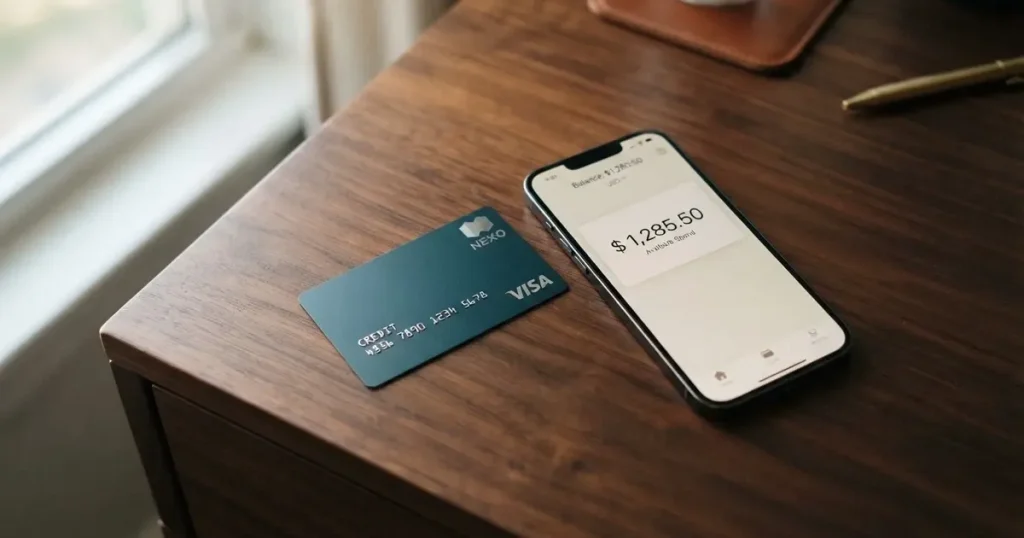
I spent a few days going through MP’s public pages, the help centre and the few bits of press that mention the company, and what follows is what I found, written for anyone who is weighing whether to put real money behind this card. The short version is that MP is a payment card line attached to a self-custody crypto wallet rather than a bank account, and it is licensed in three jurisdictions but does not name its card-issuing bank. That is the shape of it, and the rest of this page walks through who can get one, what it costs in practice, how the top-up flow works, where the friction shows up, and what I would point you to instead if MP is not the right fit.
Conditions are current as of October 28, 2026.
Conditions on this page are current as of October 2026.
Verdict
MP earns 7.1 out of 10 in my scoring, and the shape of that mark matters as much as the number. It loses points on two things the reader feels in everyday use: a 0.80% per-transaction fee on top of the issuer’s pass-through foreign-exchange margin, and a 23-country block list that includes Russia and Belarus, so it is not a card for everyone. It gains them on a different pair: a non-custodial wallet (you hold the keys) feeding a Visa virtual and a Visa physical card, with Apple Pay, Google Pay and, on the virtual card, Alipay and WeChat Pay.
If you live in a supported country, hold crypto rather than a bank balance, and want one wallet feeding both a virtual and a physical card, MP is worth a close look. If you live in or hold a passport from a country on the excluded list, or you want the cheapest possible card, the rest of this page is going to push you toward the alternatives.
Score breakdown
| Criterion | Mark | Why I scored it this way |
|---|---|---|
| Who can get it | 8 / 10 | 23 countries are closed, including Russia and Belarus, with extra regions where KYC cannot be completed; everywhere else is open, decided by document place of issue and residential address |
| Cost | 5 / 10 | Cloud Card 10 USDT to issue, Boundless 100 USDT, no monthly fee; 0.80% per transaction, crypto-to-fiat conversion is $0, ATM is 2% with a $1 floor |
| Top-up options | 7 / 10 | USDC and USDT into the MP wallet (non-custodial), via Binance Pay or on-chain, then onto the card; the specific networks are not listed on the pages I read |
| Reliability and complaints | 7 / 10 | MP Network Inc, registered in Delaware; MSB in the US, BSP and DASP in El Salvador, TCSP in Hong Kong; the issuing bank is not named; Flash Card was retired on 30 September 2026; I could not find independent reviews of the product |
| Everyday use | 9 / 10 | Cloud is a virtual Visa, Boundless is a physical Visa; Apple Pay and Google Pay work on both, Cloud also adds Alipay and WeChat Pay; Boundless supports ATM withdrawals |
The total lands at 7.1 / 10, which I read as “good in the right hands, hard to recommend in the wrong ones.” A holder who wants a virtual and a physical card from one wallet is exactly the reader this product was built for, and that is the audience note I keep coming back to. A reader whose first priority is lowest fees, or whose country is on the block list, should read the alternatives section rather than the verdict.
Who will they give you the card?
The first gate is geography, and it is a hard one. MP states that the card is unavailable in 23 countries “due to regulatory compliance”: Afghanistan, Belarus, the Central African Republic, Cuba, the Democratic Republic of the Congo, the Dominican Republic, Guinea-Bissau, Haiti, Iran, Iraq, Lebanon, Libya, Mali, Myanmar, North Korea, Russia, Somalia, South Sudan, Sudan, Syria, Venezuela, Yemen and Zimbabwe. On top of that, KYC cannot be completed in parts of Ukraine (Crimea, Donetsk, Luhansk, Zaporizhzhia and Kherson), Abkhazia, South Ossetia, Northern Cyprus, Somaliland, Transnistria and Nagorno-Karabakh.
What decides whether you qualify, in MP’s own words, is “mainly your document’s place of issue and your registered residential address.” That is worth pausing on, because it means holding a passport from a closed country is a problem even if you have moved somewhere open, and conversely a supported-country passport with a registered address inside an excluded region is also a problem. MP is explicit that documents cannot be switched to get around a regional restriction, so the eligibility question is settled at sign-up, not later. Russia and Belarus are both on the list, which I mention in the open because that is the most common question I expect from readers in those jurisdictions.
The other side of the gate is age and identity. KYC1, the level required to apply for a card, requires you to be 18 or older, supply basic personal information, present a government-issued ID (passport or national ID) and complete a selfie liveness check. The ID has to be unexpired with an “expiration date more than three months away” — meaning the card is real but the document behind it is treated as not. One identity verifies only one account, and a second account attempt is one of the explicit reasons MP lists for rejection, alongside being under 18, living in an unsupported country, blurry or cropped documents, expired documents, face mismatch, another person in the frame, and any name, date or number mismatch on the documents. I could not find a stated requirement for a separate proof of address.
There are two account tiers, and they are the same gate on a different door. A Registered account is the phone-only sign-up, with transfers capped at 1,000 USD a day and 10,000 USD in total, and it does not let you apply for a card. KYC1 is the ID plus selfie level, and it unlocks the card application as well as unlimited transfers and withdrawals up to 200,000 USD a day. Processing time after you submit is not stated on the pages I read, which is a small but real gap for someone who needs the card by a certain date.
How to get it?
The path runs inside the MPChat app, which is on iOS and Android. The order, as the help centre describes it, is: install the app, register, go to Assets and tap Activate Now, fund the wallet, then choose a card type and buy it. There is no web sign-up for the card itself — the card is an in-app product.
Two cards are on sale and one is gone. Cloud Card is a virtual card billed in USD, with no ATM access, issued in Singapore. Boundless Card is the physical Visa, also USD, with ATM access; its BIN, the six-digit number that identifies the issuer, is 45659910, so if a merchant’s payment system does a BIN lookup, that is the country that comes back. Flash Card was a virtual Visa (BIN 40433705) that was permanently retired on 30 September 2026 — issued Flash cards were converted to Cloud Cards and the balance moved to Total Assets, so if you are reading this and you held one, that is what happened to it. Cloud’s network is not stated on the pages I read, which I flag as a small hole.
Delivery of the physical Boundless card is handled case by case. MP says “Delivery time and region: Subject to the announcement on the Boundless Card application details page,” and that postage, “if any,” is set there as well. Replacement and reissue follow a tiered fee: $5 for the first one, $10 each after, with at least 31 days between replacements. That cadence is the kind of detail I would want to know before I lost the card once, not after.
Fees
The fee page is honest about the headline numbers, and the picture in practice depends on which card you choose and what currency you spend in. I read through the fee schedule, and this is what I think a real user is actually going to pay.
Costs at a glance
| Fee or limit | Cloud Card | Boundless Card |
|---|---|---|
| Card opening / production | 10 USDT | 100 USDT |
| Monthly fee | $0 | $0 |
| Crypto-to-fiat conversion | $0 | $0 |
| Transaction fee | 0.80% per transaction | 0.80% per transaction |
| FX / cross-border | Pass-through set by issuer, varies by region | Pass-through set by issuer, varies by region |
| Small-value fee | $0.15 per transaction of $1 or less | $0.15 per transaction of $1 or less |
| ATM | Not available | 2%, minimum $1 |
| Replacement / reissue | n/a | $5 first, $10 each later, ≥31 days apart |
| Single-transaction limit | $100,000 | $20,000 |
| Daily spending | $250,000 | $1,000,000 |
| Monthly | $1,000,000 | $5,000,000 |
| Annual | $2,000,000 | $10,000,000 |
A few things on this table are worth pulling out for the reader who is not a fee specialist. Crypto-to-fiat conversion is $0, which is unusually clean — many crypto cards charge a spread on top of the network fee. The 0.80% transaction fee is per transaction, so it stacks on smaller purchases more than on big ones. The “FX / cross-border” line is the one I would plan around: it is not a fixed MP markup, it is whatever the card issuer charges, and MP says it varies by country and region. The page states an all-in figure of roughly 1% for USD spending and 1.8%–2.2% for non-USD spending, but those numbers are the page’s own estimate and the issuer’s FX margin is the part you cannot pin down in advance.
Three everyday payments, and which fees bite
- A $50 coffee in USD on the Cloud Card. Crypto-to-fiat conversion is $0, the transaction fee is 0.80% ($0.40), and there is no FX cost because you are spending in USD. The all-in is about $0.40 on a $50 purchase, which is roughly the page’s own 1% headline for USD spending.
- A €45 dinner in EUR on the Boundless Card. The 0.80% transaction fee still applies (about $0.36 at the page’s assumptions), and on top of that the card issuer’s pass-through FX rate converts EUR to USD. MP’s page suggests 1.8%–2.2% all-in for non-USD spending, so a €45 dinner lands somewhere around $0.81 to $0.99 in fees, depending on the issuer’s margin. The exact figure is not on the page, which is the honest gap.
- A $200 ATM withdrawal on the Boundless Card. The fee is 2% with a $1 minimum, so this one is a flat $4. Per-transaction and per-day ATM limits are $1,500, with a maximum of five withdrawals per day and $15,000 per month. Mainland China ATMs are unavailable, Singapore ATMs are prohibited by policy.
The dispute and decline fees are the kind of thing you only read about after something has gone wrong, so I am putting them here while we are on the topic. A dispute or chargeback is $35 per case, a refund is $0, a reversal is $0.80 if your reversal rate goes above 15%, and a declined transaction is $0.80 with the first five per month waived. None of the time frames — how long a refund takes, how long a dispute can take to resolve — are stated on the pages I read.
Top up
The top-up path is the part of MP that is most different from a regular bank card, and it is worth walking through it because the wording on the help pages is sparse. The model is: deposit USDC or USDT into MP Wallet, which is non-custodial, then move that balance onto the card. There are two ways in. The first is via Binance Pay, which is a near-instant transfer between Binance accounts and the MP wallet. The second is on-chain, meaning a blockchain transfer from somewhere else, into the deposit address MP provides. Specific networks are not listed on the pages I read, which is the single largest gap in the top-up documentation, because sending USDT on a network MP does not support is the kind of mistake that loses money permanently.
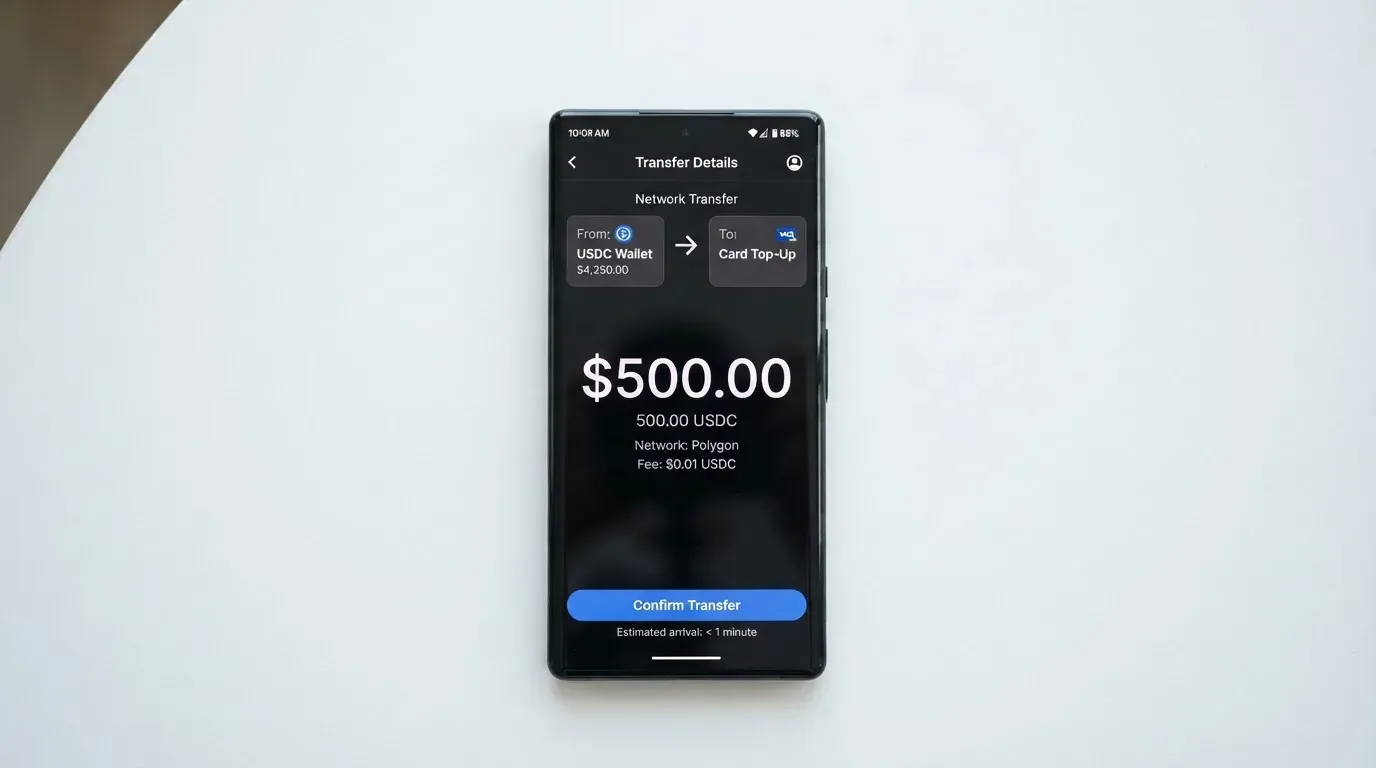
The card top-up itself does not show a fee on the fee page, and that is worth noting. There is an online withdrawal fee (Wallet > Pay) of 2.1 USDT per transaction, plus 0.1% on same-day withdrawals above 5,000 USDT. There is no published minimum top-up. KYC1 users can withdraw up to 200,000 USD a day. What happens to the balance if the account is closed is not stated, and a help article on bank transfers and withdrawals to a bank exists but I did not read it for this review.
In practice, this means the steps to a working card are: pick the right stablecoin, pick the right network (a step you have to verify with support, not the help pages), send it to the address MP provides, wait for confirmations, move the balance onto the card, and then spend. If you are used to bank-to-bank transfers, the irreversibility is the part that takes getting used to: a blockchain transfer sent to the wrong address or the wrong network is, in MP’s and the wider industry’s general posture, very hard to recover.
Paying with it every day
In day-to-day use, the card behaves like a prepaid Visa. Cloud is virtual-only and does not support ATM withdrawals. Boundless is a physical Visa and supports ATM withdrawals under the limits above. The mobile wallet support is where MP pulls ahead of some of the alternatives: Cloud links with Alipay, WeChat Pay, Google Pay and Apple Pay; Boundless supports Apple Pay and Google Pay. If you live in a market where Alipay and WeChat Pay are everyday tools, Cloud is the card you actually want at the till, because the Boundless card cannot reach them.
Blocked merchant categories are not stated on the pages I read, which is one of the things I would test before relying on the card for any specific kind of spending. The pages mention a “rewards balance” that cannot be used to pay reissue fees, but the rate or programme behind that is not published. The MPChat app is the operating surface for all of this — buying the card, freezing it, setting spending limits, contacting support. Store ratings for the app were not obtained for this review.
A few practical things I think a reader will want to know, drawn from the way crypto cards in this category tend to behave rather than from MP-specific pages: address verification (AVS), which is common in the US, Canada and the UK, is generally unavailable for foreign-issued cards, so a US website that asks for a ZIP can decline a card billed from Singapore. Some merchants decline prepaid or foreign-issuer cards at the BIN lookup stage. If a transaction is declined, a hold can stay on the funds for several days.
What can go wrong
The most recent thing that has already gone wrong is the Flash Card. It was permanently retired on 30 September 2026, and the migration path was straightforward — issued cards converted to Cloud Cards, balances moved to Total Assets — but it is the kind of product change that argues for keeping balances small and being ready to move. The change came with a stated notice period, and the card stopped working on the date given, which is the same pattern other crypto card programmes have followed when issuers have pulled them.
The corporate side is more reassuring than alarming, but only up to a point. MP Network Inc is a Delaware company at 8 The Green, Suite B, Dover, DE 19901, USA, and the brand is MPChat. The help centre lists three licences: an MSB registration in the United States, a BSP and DASP licence in El Salvador, and a TCSP licence in Hong Kong. The statement is dated 13 August 2026. The card itself is “issued in Singapore,” and the issuing bank is not named, which is the part I would push on. A Visa card without a named issuer is unusual, and the reader who cares about deposit-style protections should know that the named-issuer piece is missing.
On the wallet side, MP says the wallet is non-custodial, which means you hold the keys, and the help centre says card funds are “securely backed within a regulated trust framework.” Spending limits are managed in the app. I could not confirm 2FA on the pages I read, and instant freeze and 2FA are the two safeguards I would want to see before putting a meaningful balance behind a card. The support channels are in-app (Me – Customer Support), X (Twitter), an email at [email protected], and the Help Center at help.mp.net, which is published in English, Simplified Chinese and Traditional Chinese. Hours are not stated. I searched “MPChat MP card reviews trustpilot reddit” and did not find independent user reviews of the product, which is itself a data point: there is not much public word-of-mouth yet, and a reader who relies on that signal will not find much to read.
What to take instead
Three products sit in the same space as MP. None of them is the same product, and the differences are what I would push a reader to look at first.
| Card | Score | Where it works | Card type and cost | What it does well | Where it falls short |
|---|---|---|---|---|---|
| MP (this review) | 7.1 / 10 | Most of the world except 23 countries | Virtual Cloud (10 USDT) and physical Boundless (100 USDT) Visa | Non-custodial wallet feeding both cards; Apple Pay, Google Pay, Alipay, WeChat Pay | 0.80% per-transaction fee; issuing bank not named; networks not published |
| MetaMask Card | 7.1 / 10 | 45 listed countries and territories; others on a waitlist | Virtual Mastercard free; Metal Mastercard $199/year | 1% cashback on Virtual, 3% on Metal (capped at $10,000 then 1%); spends from connected wallet on Linea, Base, Monad, Solana | US and UK sign-ups temporarily closed; one card per user |
| KAST | 6.1 / 10 | Residence-based, list shown at KYC; not published | Virtual and physical Visa Platinum, Infinite and Infinite gold; up to 10 cards | Stablecoin top-up at 0%, USD card spend at 0%, transaction fee 0%, non-USD FX 0.5%–1.75%; cashback 1.5%–3% | Country list not published; Private tier is $10,000/year |
| TokenPocket (TP Card) | 5.8 / 10 | European Visa list and a separate Mastercard list (Americas “planned for Q2 2025”) | Virtual Fiat24 cards (no physical mentioned) on Arbitrum | “Apart from these, TP Card does not charge any additional fees”; 1% deposit fee refunded via rewards | 1% deposit fee applies before refund; physical card not offered |
The honest comparison comes down to which trade-off the reader wants to make. MetaMask matches MP’s overall mark of 7.1 and is more generous on cashback, but its country list and the US/UK sign-up pause make it narrower than MP in some markets. KAST is the cheapest card to actually use day to day, with no transaction fee and no stablecoin top-up fee, but its country list is not published and the Private tier is $10,000 a year. TokenPocket is the lightest product in the comparison and the only one that does not offer a physical card, which for many readers is a deal-breaker on its own.
Who I would recommend it to
I would point this card at a reader who already holds crypto in their own wallet, who wants one app to handle both a virtual and a physical Visa, and who lives in or holds documents from a country outside the 23-country block list. The Alipay and WeChat Pay support on the Cloud card is the clinching feature for a reader whose daily life runs through those rails, and the non-custodial wallet is the reason to choose it over a custodial product. The reader I would steer away is the one whose primary concern is fees — at 0.80% per transaction plus the issuer’s FX margin, this is not a budget card — and the one whose country is on the list, which is a hard no rather than a workaround.
Frequently asked questions
What is the MP card?
The MP card is a Visa payment card issued by MP Network Inc and attached to the MPChat app’s non-custodial crypto wallet. There is a virtual Cloud Card and a physical Boundless Card, both billed in USD, and a third product, Flash Card, was retired on 30 September 2026.
How does the MP card work?
You deposit USDC or USDT into the MP wallet, which is non-custodial, then move that balance onto the card. At the till or online, the card is treated as a prepaid Visa, and a 0.80% per-transaction fee plus any issuer FX margin is the cost of spending.
Is MP a bank?
No. MP is a financial technology company. The card is “issued in Singapore,” but the issuing bank is not named on the pages I read. MP holds an MSB registration in the US, a BSP and DASP licence in El Salvador and a TCSP licence in Hong Kong.
Who owns MP?
The legal entity is MP Network Inc, registered in Delaware at 8 The Green, Suite B, Dover, DE 19901, USA. The consumer brand is MPChat.
Is the MP card available in my country?
It is unavailable in 23 countries, including Russia and Belarus, and KYC cannot be completed in parts of Ukraine, Abkhazia, South Ossetia, Northern Cyprus, Somaliland, Transnistria and Nagorno-Karabakh. Eligibility is decided by document place of issue and registered residential address, and the page states documents cannot be switched to get around a regional restriction.
How do I apply for the MP card?
Inside the MPChat app, the steps are: register, go to Assets and tap Activate Now, fund the wallet, then choose a card type and buy it. KYC1 (ID plus selfie liveness) is required for the card application; a Registered phone-only account is not enough.
Does the MP card require KYC?
Yes. KYC1 requires being 18 or older, basic personal information, a government-issued ID with an expiration date more than three months away, and a selfie liveness check. One identity verifies one account, and a proof of address document is not stated as required.
How do I top up the MP card?
You deposit USDC or USDT into MP Wallet via Binance Pay or on-chain, then transfer the balance to the card. The specific networks are not listed on the pages I read, and sending on the wrong network is a permanent mistake.
How do I add the MP card to Apple Wallet or Google Pay?
Apple Pay and Google Pay work on both Cloud and Boundless, and Cloud additionally supports Alipay and WeChat Pay. The tokenisation happens in the MPChat app once the card is funded and active.
Is the MP card safe?
MP Wallet is non-custodial, so you hold the keys, and the help centre says card funds are “securely backed within a regulated trust framework.” I could not confirm 2FA on the pages I read, and the issuing bank is not named, so the safeguards you would normally expect to read about are partly unconfirmed.
Wallet card fees and costs – cryptocardfacts
Content created by the «cryptocardfacts» team