
Oppi in plain terms: a self-custody crypto wallet with a card attached
 Available in US
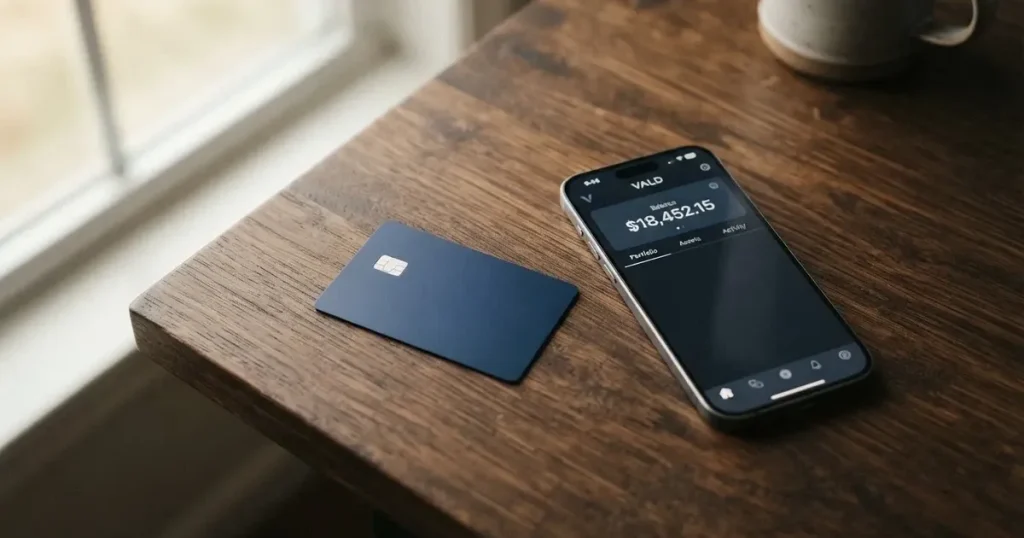
Oppi is not really a bank account with a card bolted on. It is a self-custody crypto wallet, and the card is one way of spending what the wallet holds. That single distinction explains almost everything you will like and almost everything you will not: you keep control of your keys, you load the card from a broad range of coins and networks, and there is no monthly fee — but the card draws down a balance you fund yourself, and the terms around eligibility, limits and delivery are thinner than you would find at an established card issuer.
I scored it 7.2 out of 10. That is a good card with real gaps in the paperwork, not a warning. If you are someone who cannot get an ordinary bank card, or you already hold crypto and want to spend it without going through an exchange every time, the offer is genuinely attractive. If you want the reassurance of a named issuer, a published limit table and clear dispute handling, this is not that card, and I would not pretend otherwise.
The conditions described here are current as of October 28, 2026.
Verdict: a solid 7.2 out of 10, aimed at people who already hold crypto
The score breaks into six criteria. Here they are with my reasoning, numbers as published.
| Criterion | Mark | Why |
|---|---|---|
| Who can get it | 9 / 10 | Claimed in 210+ countries; unofficial listings say 221, with Cuba, Iran, North Korea and Syria closed |
| Cost | 4 / 10 | Virtual activation 10 USD with 5 USD returned; physical 100 USD with delivery; a 2%–2.5% charge on non-USD payments; no monthly fee |
| Top-up options | 9 / 10 | BTC, BCH, BNB, ETH, LTC, SOL, USDT, TRX and USDC across Ethereum, BSC, Polygon, TRON and Solana |
| Reliability and complaints | 6 / 10 | Self-custody with keys on your device; issuer not named, company is Encoin Limited; no complaints found; App Store 4.6 out of 5 from 50 ratings |
| Everyday use | 9 / 10 | Virtual Mastercard, optional physical card, Apple Pay and Google Pay, ATM withdrawals claimed |
| Total | 7.2 / 10 | A broad, cheap-to-run card with a thin layer of published detail around the issuer and the limits |
Two of the marks pull the average up and one pulls it down hard. Cost is the weak point at 4 out of 10, and it is worth pausing on why. There is no monthly fee, which is genuinely better than most cards in this category. But the entry price is not zero — virtual activation is 10 USD with 5 USD of it credited back to you, and a physical card is 100 USD including shipping. On top of that, any purchase not in USD carries a 2% to 2.5% charge. If you spend mostly in dollars, that last part may never touch you. If you spend in euros, pounds or anything else, it will touch every single payment, and at the top of that range it costs you more per year than the card itself.
The 9 out of 10 for eligibility is a mark for reach, not for clarity. The card is claimed in “210+ countries”, with other pages saying 100+ or 200+. That number is doing a lot of work in the marketing, and I would hold it loosely — see the section on who gets the card, where I unpack what the figure actually refers to.
Everyday use also scores 9, and this is where the card is at its most convincing. A virtual Mastercard you can hold several of, an optional plastic card, Apple Pay and Google Pay, and stated ATM withdrawals. That is a complete everyday setup for most people. The reason it is not a 10 is that the fine print around spending controls, blocked merchant categories and what happens when a payment is disputed is not on the public pages.
Who should look at this card, then:
- You hold crypto and want to spend it directly, without an exchange account in between.
- You are comfortable with self-custody — with the responsibility that comes with it, which I cover under risks.
- Ordinary bank cards are hard or impossible for you to get, and a card claimed in 210+ countries changes that.
- You want a virtual card first, and a physical one only if you decide you need it.
Who should look elsewhere:
- You want a named, regulated issuer you can point to. Oppi does not name one.
- You spend almost entirely outside the US and want the card’s 2% to 2.5% foreign-exchange charge gone.
- You need a published spending-limit table, a dispute process, or a clear answer on what happens if your physical card never arrives.
- You would rather not hold the keys yourself, or you are new to crypto and self-custody would be a burden rather than a feature.
Who will they give you the card
The card is claimed in “210+ countries”, and the site itself hedges: availability varies and regulatory limits apply. Eligibility is checked at signup, so the country you are in when you register is the country that counts.
Now the honest part about that “210+” figure. An unofficial source, a third-party card comparison site, puts the number at 221 countries — a figure not confirmed by the card itself — and names Cuba, Iran, North Korea and Syria as restricted. That same source notes that the AML policy also bars Crimea, Donetsk and Luhansk. None of this is confirmed by the card itself — it comes from outside the company, and I would treat it as a useful pointer rather than a rulebook.
There is also a distinction worth holding on to, and it explains why you will see different numbers in different places. That same unofficial reading says “210+” refers to Mastercard acceptance — that is, where the card would be accepted once you hold it — not to the number of countries you can sign up from. Those are two different questions, and marketing copy tends to blur them.
Here is the practical summary:
| Question | What the card’s own pages say |
|---|---|
| How many countries | Claimed in “210+”; other pages say 100+ or 200+ |
| How is eligibility decided | Checked at signup |
| Restricted countries | A list exists in the page FAQ, but the answers were not readable |
| What is definitely restricted | Unofficial only: Cuba, Iran, North Korea, Syria; AML also bars Crimea, Donetsk, Luhansk |
The card does have a restricted-country list somewhere in its FAQ. The answers simply were not readable when I looked. That is not the same as there being no restriction — it means the restriction exists and the public explanation of it is thin. If your country sits anywhere near the list, the sensible move is to attempt signup and read the result, rather than to assume from the marketing number.
How to get it
Signing up is straightforward in the way these things usually are. The sequence I would expect:
- Create the wallet. This works without identity verification.
- Complete KYC when you want the card, not before. The wallet itself is functional without it.
- Verify with a government ID plus a selfie. The card’s own timing for this is not stated.
- The card is enabled once verification passes, and you can load and spend from then on.
There is one verification level described on the page: government ID plus a selfie, and that unlocks the card features. No tiers, no higher unlock, nothing to graduate into.
What is not stated on the card’s public pages is worth knowing before you start, because these are the questions people usually have and cannot find answered:
- Proof of address is not stated.
- An age requirement is not stated.
- Delivery time for the physical card is not stated.
- Which countries the physical card ships to is not stated.
- The cost of replacing a lost physical card is not stated.
An unofficial source adds two things. It says proof of address is required under the AML policy, and that above 10,000 USD of daily withdrawals or 100,000 USD monthly, you can expect proof of funds, a source-of-wealth questionnaire and a video call. Neither is confirmed by the card, and both are the kind of threshold that only matters once you are moving serious money — but they are worth knowing exist.
What it really costs: Fees
Here is the honest picture, and it is the part of this card I would read twice.

The headline is good: no monthly fee and no annual fee. That is better than many cards in this category. The rest is where it gets more complicated.
The one-off entry costs. A virtual card costs 10 USD to activate, and 5 USD of that is credited back to you — so effectively 5 USD for a card that works. The card’s own comparison table puts issuance at 5 USD, consistent with that. A physical card costs 100 USD including shipping. The App Store listing mentions a one-time fee without disclosing the amount, which is consistent rather than contradictory.
The charge that bites. Any purchase not in USD carries a foreign-exchange charge of 2% to 2.5%. This is the single largest cost in ordinary use, and it is recurring, unlike the activation fee.
The small stuff. Crypto top-up converts at the real-time rate, so no separate spread is described there. Swap fees are described as “low” but are not quantified anywhere I could find. ATM withdrawals are supported — the site says you can withdraw cash worldwide — but the fee and the allowance are not stated.
The limits. The card page publishes no limit table. I want to be careful here: an Oppi blog is said to give 100,000 USD a day and another page 10,000 USD a day. Those two figures contradict each other, so I have not used either. An unofficial source says there is no published card limit table and that a December guide described “several thousand dollars per day” depending on verification. Treat the limits as unknown rather than assuming either number.
| Item | Cost or limit |
|---|---|
| Virtual card activation | 10 USD one-time, 5 USD credited back |
| Physical card | 100 USD including shipping |
| Monthly fee | None |
| Annual fee | None |
| Foreign-exchange charge on non-USD purchases | 2% to 2.5% |
| Crypto top-up conversion | At the real-time rate |
| Swap fee | Described as “low”; amount not stated |
| ATM withdrawal fee | Not stated |
| ATM withdrawal allowance | Not stated |
| Daily and monthly spending limits | Not stated on the card page |
Let me make this concrete with three ordinary payments, because a fee table rarely tells you what a fee will actually do.
A coffee in your own country, paid in USD, on a virtual card. You pay the coffee. There is no monthly fee to amortise, no FX charge because the purchase is in USD, and no extra card fee described. The only real cost is whatever the network charged you to convert the crypto you loaded — and that happened at top-up time, not at the till. This is the card at its cheapest and least complicated.
A coffee in a country whose currency is not the dollar. The same coffee now carries the 2% to 2.5% foreign-exchange charge. On a 4 USD coffee that is eight to ten cents a time, and on a monthly subscription of 50 USD it is 1 to 1.25 USD a month (or 12 to 15 USD a year) — figures from third-party sources, not confirmed by the card — for the privilege of spending money you already had. On a large purchase it becomes the dominant cost in the transaction. If you are outside the US, this is the number that decides whether Oppi is convenient or expensive for you.
A physical card bought with a view to using it abroad, plus an ATM withdrawal. You have already spent 100 USD to have the card in your hand. Then the first foreign purchase takes 2% to 2.5%, and the ATM withdrawal has a fee and an allowance that the card does not publish, so you cannot cost it in advance. There is also a conflict worth flagging: the card page states the FX charge, while the App Store listing says travel bookings carry “no currency exchange fees”. I would not plan around the App Store version. Where the two disagree, the card’s own fee page is the one I would trust, and even then I would watch the first few statements to see what actually happens.
One more cost that is not the card’s: the network fee for your crypto deposit. That is charged by the blockchain, not by Oppi. It is small, it is unavoidable, and it has nothing to do with the card.
How to Top up
Topping up is the part of this card that is genuinely excellent, and it is the clearest reason to give it a 9.
The card accepts a broad range of coins: BTC, BCH, BNB, ETH, LTC, SOL, USDT, TRX and USDC. Those are supported across five chains — Ethereum, BSC, Polygon, TRON and Solana. The App Store listing goes further and says 40+ assets. Pre-funding, the virtual card and the physical card all draw on one balance, so a single top-up covers all of them.
Here is what you should know that is less obvious:
- Crypto top-up converts at the real-time rate, so you are not paying a quoted spread.
- A minimum top-up amount is not stated.
- A fiat top-up route is not stated — the card’s public pages describe funding by crypto, not by bank transfer.
- Withdrawing money back out of the card balance is not stated.
- Unofficial only, and not itemised on Oppi’s own page: loading a card typically costs 1% to 2%, according to a guide cited by a third-party comparison site.
The most important practical warning in this section is not about fees. It is about networks. Blockchain transfers are irreversible. If you send a deposit on a network the card does not support, or to an address belonging to a different network, the funds can be lost, or need manual support recovery with no guarantee of the outcome. Before your first transfer, confirm the network matches what the app is asking for, character by character. Two details make this more likely to bite:
- On Ethereum, the ERC-20 standard means a wallet holding USDT but no ETH cannot send, because gas is paid only in ETH.
- On Tron, fees are paid through bandwidth and energy, often burning TRX, so a tiny TRX balance matters.
And one that catches people out: Circle stopped supporting USDC on Tron in February 2024, so “USDC over TRC20” is not a native option. If that is the route you were planning, it is closed. Check what the app shows you for the network on the day you send, not what a guide from last year says.
Paying with it every day
This is where the card scores well, and where the missing detail is most noticeable.
What works:
- A virtual Mastercard, issued into the app, with multiple virtual cards allowed on one balance.
- An optional physical card. The page’s own table lists the physical card as Visa, while the App Store says the virtual card is Mastercard and the physical is VISA, and another page says Visa/Mastercard. The brand of the physical card is genuinely unclear from the public pages.
- Apple Pay and Google Pay, which is how most people will actually day-to-day use it.
- ATM withdrawals, stated on the main site as “withdraw cash worldwide”.
- Oppi Points on eligible card spending, redeemable for top-ups. The rate and any caps are not stated.
- Currency: USD is implied, with the FX charge applying to anything else.
What is not on the public pages, and what you would want to know before relying on it:
- Whether any merchant categories are blocked. Gambling is the usual one — the category code for gambling is MCC 7995, and many issuers block it by policy rather than by law, with the list varying by issuer. Oppi does not say whether it does.
- What the dispute process is. The help centre shows a list of FAQ questions but not the answers.
- The app is iPhone-focused: iOS 15.6 or later, also listed for M-series Mac and Vision, and English only. There is no Android version listed in the App Store terms, though a Google Play listing exists separately — see below.
On the app rating, the honest reading: the App Store shows 4.6 out of 5 from 50 ratings as of 2026-10-20, which is a good score on a small sample. Unofficial figures floating around for both stores are all over the place — Apple at 4.6 from 16 ratings, Google Play variously at 4.3, 4.8 from 11 and 4.5 from 386. None of those is an official read, and the spread between them tells you the picture is thin rather than settled. A high score from a few dozen people is a weak signal, and I would not treat it as evidence that anything is robust.
Support runs through a help centre at the support section of the site and a support email address, with in-app support tickets added per the release notes. Hours are not stated, and the listing is English only.
What can go wrong
Here is the honest risk section, and I have ordered it by how much it should worry you.
You hold the keys, which means you hold the risk. Oppi is self-custody: your private keys stay on your device, and the card’s claim is that Oppi does not hold your funds at any point. That is a real strength against a provider collapsing. It is also a transfer of responsibility. A seed phrase is typically 12 to 24 words in an unencrypted form; anyone who obtains it can restore the wallet and spend the funds. Transfers are irreversible, and a stolen key has no built-in recovery — the network cannot freeze or return anything. You also carry the risk of phishing and of clipboard-hijacking malware that silently swaps a copied address.
For context on what the alternative looks like: custodial platforms have a documented history of failure — Mt. Gox at about 350 million USD reported stolen between 2011 and 2014, Coincheck at about 400 million in 2018, and the Ronin Network bridge at 625 million in 2022. Self-custody trades counterparty risk for personal-key risk. Neither is zero. Know which one you are choosing.
Nobody will tell you who issues the card. This is my biggest reservation. The App Store developer is Encoin Limited, trading as Oppi Wallet. The site says the wallet is operated by Oppiwallet and is “VASP-certified”. But the card issuer and BIN sponsor are not named, and no licence number or jurisdiction is stated. A third-party source reported the same gap in August 2026.
What that means in practice: a card number starts with a six- or eight-digit BIN that identifies the issuing institution, and merchants can look it up and see which institution and country issued it — and may apply extra scrutiny if the issuer country differs from your billing address. When you use this card, you are relying on an issuing arrangement the company has not described. And it is not unusual for programmes to end: Visa terminated its global agreements with FTX on 13 November 2022, and the FTX US debit card programme was wound down; WaveCrest, a Visa issuer that supplied several crypto card brands, was suspended by Visa in Europe in 2018, closing all WaveCrest-issued Visa programmes. Closures typically mean a notice period, then loading and spending stop, then you are asked to withdraw what is left.
No complaints is not the same as proven reliability. I searched for user complaints and found essentially nothing about Oppi on Trustpilot or Reddit — only unrelated products. The App Store rating is the only real user signal. A third-party site reported in August 2026 that Trustpilot has a single review, and mentioned one reviewer saying a physical card was never delivered — one anecdote, unconfirmed, but it is the exact failure mode that matters if you have paid 100 USD. Silence in a review database usually means a small user base, not a spotless one.
Payments can be declined for reasons you cannot see. Address verification compares the numeric parts of a billing address against issuer records; it is mainly offered in the US, Canada and the UK and is generally unavailable for foreign-issued cards, which can cause declines. Some merchants decline prepaid or foreign BINs because the lookup reveals the card type and issuer country. A declined authorisation can leave a hold on your funds for several days, typically up to seven. So can a merchant, a hotel or a car-rental desk simply look at the card and decide against it.
Your protection on a disputed charge is not something I can confirm here. A chargeback is a refund ordered by the issuer, with reason codes for fraud, duplicate billing or goods not received. In the US, debit card reversal rights come from Regulation E and credit card rights from Regulation Z; prepaid-card coverage varies and should not be assumed. 3-D Secure adds an identity check to online payments — Visa’s brand is Visa Secure, Mastercard’s is Identity Check — and under it, liability for fraudulent online payments can shift from the merchant to your bank, or, per its critics, to you. Oppi does not publish its dispute or chargeback terms on the pages I read. I would not spend confidently until you have seen them.
Safeguards are half-described. The typical toolkit for this category is app-based two-factor authentication, an instant card freeze, spending limits, 3-D Secure confirmation and tokenised mobile wallets. Of those, Oppi’s public pages describe the tokenised mobile wallets — Apple Pay and Google Pay — and say nothing specific about the freeze, the spending controls or any insurance.
A stablecoin is not a dollar. USDT and USDC are US-dollar-pegged, and the BIS put about 90% of stablecoin market capitalisation in these two as of July 2025. But “despite the name, stablecoins are not necessarily stable”: TerraUSD collapsed in May 2022, and USDC temporarily lost its peg in March 2023 during the US banking crisis. If you load the card from a stablecoin, you are taking that risk on top of everything else. Also worth knowing: Tether says it disables tokens in wallets on the OFAC sanctions list and has frozen funds tied to illicit activity, so stablecoins are not censorship-proof.
Tax is not the card’s business, but it is yours. The IRS treats digital assets as property, so exchanging them for goods, services or dollars generally produces a taxable gain or loss. For personal or investment holdings the result is a capital gain or loss, short-term if held a year or less, and the gain is measured in local fiat currency at fair market value on the date of the transaction. Each card payment funded from crypto may therefore be a separate disposal. I am not giving tax advice here — but if this is going to be a meaningful volume of spending, that is a conversation to have with a professional in your own jurisdiction.
One structural point that explains a lot of the above. A card itself is a payment service regulated separately from the crypto side — under MiCA, e-money tokens may be issued only by a credit institution or an electronic money institution, EMIs must safeguard customer funds by segregating or insuring them, and such funds are not the same as bank deposits and may not sit under a deposit guarantee scheme. A crypto card often depends on two licences: one for the money side, one for the crypto side. When you cannot see either, that is the gap you are noticing.
What to take instead
I want to be careful here. None of these is a clear winner, and the comparison is about fit rather than ranking. All three sit in the same category and share the same structural risks.
| Oppi | MetaMask Card | KAST | TokenPocket | |
|---|---|---|---|---|
| Score | 7.2 / 10 | 7.1 / 10 | 6.1 / 10 | 5.8 / 10 |
| Who can get it | Claimed in 210+ countries | 45 listed countries and territories; waitlist elsewhere | Residence list shown at KYC, not published | A list of European countries for Visa; a longer list for Mastercard |
| Card | Virtual Mastercard, optional physical | Mastercard; virtual first, metal by pre-order | Virtual and physical, up to 10 | Visa/Mastercard debit; Fiat24 cards virtual |
| Cost | 10 USD virtual (5 back), 100 USD physical | Virtual free; metal 199 USD per year | 0 / 1,000 / 10,000 USD per year by tier | NFT creation fee partly covered; “no additional fees” |
| Main fee | 2%–2.5% on non-USD | “Minimal fee”, amount not stated | FX 0.5%–1.75%; 0.10 USD under 25 USD | 1% on crypto deposit |
| Rewards | Oppi Points, rate not stated | 1% cashback virtual, 3% headline on metal capped at 10,000 USD | 1.5% / 2% / 3% USD cashback by tier, capped | 1% deposit fee “refunded later via rewards” |
Choose MetaMask Card if you want the clearest paperwork of the four. It names its issuer, Monovate, with Crypto Life as card provider. It is open in 45 listed countries and territories — Andorra, Argentina, Brazil, Canada, Mexico, Germany, France, Spain, Uruguay among them — with a waitlist elsewhere, and it asks for proof of residency. Ineligible regions limit sign-ups but not spending, which is a more coherent position than most. US and UK sign-ups are temporarily closed per its FAQ. The virtual card is free with no annual or maintenance fee; the metal card is 199 USD a year. It says no foreign transaction fee and uses the Mastercard rate. Rewards are the strongest here: 1% cashback in mUSD on the virtual card, and on the metal card a 3% headline that its own footnote caps at the first 10,000 USD spent before dropping to 1%, plus a $FLY bonus via Blackbird. It spends directly from a connected wallet across Linea, Base, Monad and Solana, with mUSD, wETH, EURe, GBPe, USDC and USDT named. Its own catch is that Solana-only wallets cannot withdraw credit. One card per user.
Choose KAST if you spend travel money and want to know your FX rate in advance. Its cost structure is the most transparent of the four: annual membership of 0 USD for Standard, 1,000 USD for Premium and 10,000 USD for Private, billed annually upfront with no monthly option, plus 2 USD for an extra virtual card and a 40 USD delivery fee on a Standard physical card. It then tells you the fees outright — 0% stablecoin top-up, 0% card spend in USD, 0% transaction fee, 0% Apple and Google Pay, and a non-USD foreign-exchange charge of 0.5% to 1.75% depending on your residence country, the transaction country and the card programme. It also names the small fees other cards leave vague: 0.10 USD on non-USD transactions under 25 USD, and 0.50 USD for a declined transaction. Cashback is 1.5% on the first 2,000 USD a month, 2% on the first 10,000 USD, or 3% on the first 40,000 USD, paid in USD when the transaction is authorised. But note the size of its entry tiers and its own internal conflict: the funding page lists USDT, USDC, PYUSD and RLUSD while the terms say acceptable tokens are “currently USDT and USDC”. It is also strict about identity — only the account holder’s own ID is accepted, a VPN does not bypass it, and dual citizens holding an ID from a supported country may still pass while others with an ID from a restricted region may not.
Choose TokenPocket if your country is on its list and you want the simplest fee story. It offers a Mastercard debit across a broad set of countries including Australia, Canada, Hong Kong, Japan, Taiwan, New Zealand, Singapore, South Korea and the UK, and a Visa debit across a shorter European list including Germany, France, Spain and Switzerland, with the Americas planned for Q2 2025. It runs on Arbitrum, with balances in EUR24 and USD24. The fee structure is unusually plain: a 1% fee on crypto deposits into the card, described as refunded later through rewards or reduced transaction fees, and otherwise “no additional fees”. The trade-off is that it is the least specific of the four — no cashback, no FX fee stated, no coins or networks listed in its FAQ, and an NFT creation fee that TokenPocket partly covers while leaving you to pay “a small portion” of an amount it does not name.
And if none of these fit your country, remember that the alternatives are also regional. A card that is unavailable to you is not a fallback.
Who I would recommend it to
I would recommend Oppi to someone in this position: you already hold crypto, you would rather not route every purchase through a central exchange, you are comfortable being the one who holds the keys, and you are in a country where ordinary cards are awkward to get. For you, the 9 out of 10 for top-up options and the 9 for everyday use are the whole value proposition — a broad choice of coins and chains, a virtual card you can hold several of, a physical one only if you want it, and Apple Pay and Google Pay on top. The lack of a monthly fee means the card is cheap to leave open once you have paid the 5 USD effective activation cost.
I would recommend it more cautiously if you mostly spend outside the US. Know what you are agreeing to at the 2% to 2.5% foreign-exchange charge, and do not let the App Store’s “no currency exchange fees” line on travel bookings talk you out of reading the card’s own fee page.
I would not recommend it as your only card, and I would not recommend it if you need any of the following: a named issuer you can contact, a published spending-limit table, documented dispute and chargeback handling, a clear delivery commitment for the physical card, or Android support in the first-class way the iPhone app gets it. Those are not nitpicks. They are the difference between a product you can evaluate and one you have to take on trust, and on this card the trust is doing a lot of work.
My own order of operations, if I were signing up: confirm my country is eligible before anything else; read the fee page rather than the app listing; complete KYC only when I actually want the card; make my first top-up a small one, on a network I have confirmed twice; check the FX charge on a small foreign purchase before relying on it; and go looking for the dispute policy in the help centre, which is the one document I could not find.
Frequently asked questions
What is Oppi card?
It is a payment card attached to a self-custody crypto wallet rather than a bank account. You load the balance from your own crypto, and the card spends from it, much like a prepaid card. The virtual card is a Mastercard; a physical card is optional. Because the wallet holds the keys, you spend without an exchange in the middle.
How does the Oppi card work?
You fund the wallet, the crypto converts to a spendable balance, and the card draws down that balance as you pay. It cannot overdraw, because there is nothing to overdraw. Pre-funding, the virtual card and the physical card all share one balance, so one top-up covers all three. Points accrue on eligible spending.
Is Oppi a bank?
No, and it matters that you understand the difference. The App Store developer is Encoin Limited, and the site describes itself as VASP-certified. But the card issuer and BIN sponsor are not named, and no licence number or jurisdiction is stated. Funds stay in your own wallet on your device, so there is no bank deposit behind this card.
Who owns Oppi?
The company behind the App Store listing is Encoin Limited, which publishes the app under the name Oppi Wallet. The site says the wallet is operated by Oppiwallet. What is not established anywhere public is which institution issues the card itself — the issuer and BIN sponsor are simply not named. If that matters to your decision, ask before you fund it.
Is Oppi card available in my country?
The card is claimed in “210+ countries”, though other pages say 100+ or 200+, and the site itself notes that availability varies with regulatory limits. Eligibility is checked at signup. An unofficial source lists 221 countries and names Cuba, Iran, North Korea and Syria as restricted. The card does have a restricted-country list in its FAQ, though its answers were not readable.
Does Oppi card require KYC?
The wallet does not. Card features do. You need a government ID plus a selfie, and that is the single verification level described. Proof of address and an age requirement are not stated on the public pages, though an unofficial source says proof of address is required under the AML policy. Verification thresholds, not the card itself, are what large balances run into.
How do I top up the Oppi card?
Send crypto to the wallet and the card shares that balance. Supported coins are BTC, BCH, BNB, ETH, LTC, SOL, USDT, TRX and USDC, across Ethereum, BSC, Polygon, TRON and Solana. Conversion happens at the real-time rate. The critical step is matching the network to what the app requests — a mismatch can lose the funds, since transfers are irreversible.
Is Oppi card free?
Not quite. There is no monthly and no annual fee, which is the good news. Virtual activation is 10 USD with 5 USD credited back to you, and a physical card is 100 USD including shipping. The recurring cost to watch is 2% to 2.5% on any purchase not in USD. Swap fees are described as low but not quantified, and ATM fees are not stated.
Is Oppi card safe?
It depends what you are comparing against. Self-custody means your keys stay on your device and Oppi does not hold your funds, which removes counterparty risk but makes you responsible for key loss, phishing and wrong-network transfers. Against that, the issuer is unnamed, the dispute process is not published, and physical-card delivery is not promised. I would treat it as a spend card, not the only card you hold.
Is the Oppi card worth it?
For someone who already holds crypto and cannot easily get an ordinary card, probably yes — the fee is 5 USD effective, there is no monthly charge, and the top-up options are the broadest in this category. For everyone else it depends on where you spend. Outside the US the 2% to 2.5% foreign-exchange charge adds up, and if you want a named issuer and published limits, one of the other cards will serve you better.
Wallet card fees and costs – cryptocardfacts
Content created by the «cryptocardfacts» team