
Telecard, the virtual Mastercard you open in Telegram
 Available in US
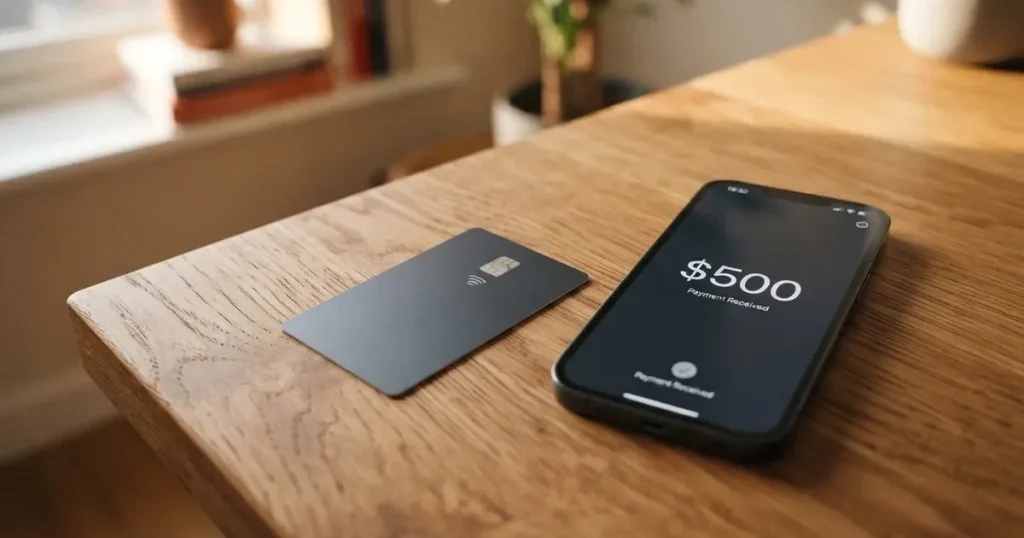
Telecard is one of the more interesting newcomers in the crypto-card space because it skips the app-download step entirely. You do not install a separate wallet, you do not wait for a plastic card in the post, and you do not visit a website. You open a Telegram bot, answer a few questions, and a virtual Mastercard number lands in the chat, denominated in US dollars and ready to spend anywhere Mastercard is accepted, online or through Apple Pay and Google Pay. The balance is funded with USDT or USDC, converted at the moment of payment.
I went through the card’s own pages, its help centre and its terms, and I think the honest summary is this: Telecard is a fast, low-friction way to turn stablecoins into a spendable card number, especially if you already live inside Telegram. That convenience comes with real trade-offs, and they are the kind of trade-offs you only notice when something goes wrong. There is no public name for the company behind it, no disclosed issuer, no licence, no deposit insurance, and no real track record you can read about. I will get to the scoring in a moment, but if you are the kind of person who weighs a card on the strength of the institution behind it, Telecard will not satisfy you.
The conditions described below are current as of October 28, 2026.
Verdict
Telecard earns 6.1 out of 10 from me. That is a “worth trying with eyes open” score, not a “set and forget” score. The card does a narrow thing well, and it does that thing with less friction than almost any competitor I have looked at. What keeps it from a higher mark is the gap between the polished product and the absence of public information about who actually runs it.
Here is the score broken down by what matters:
| Criterion | Mark | Why I scored it this way |
|---|---|---|
| Who can get it | 8 / 10 | Usable in over 150 countries wherever Mastercard is accepted; only users blocked or sanctioned by the US Government, including OFAC, are excluded |
| Cost | 6 / 10 | Standard plan is $5 once, VIP is $49 plus $19 a month; 1.5% on non-USD payments, 0.5 USDT gas per transaction, and a $99 minimum to activate that stays in the wallet |
| Top-up options | 7 / 10 | USDT on Tron (TRC-20) and Ethereum (ERC-20), USDC on Ethereum (ERC-20); deposit fee advertised as 0%; bank transfers still “coming soon” |
| Reliability and complaints | 3 / 10 | No legal entity, jurisdiction, issuer or licence named in the terms, the company describes itself as “not a bank”, funds are custodial, and there are no public reviews to read |
| Everyday use | 6 / 10 | Virtual Mastercard is instant, Apple Pay and Google Pay work, but there is no plastic card and no ATM access |
| Total | 6.1 / 10 |
Who Telecard suits: a Telegram user who already holds USDT, wants a card number in minutes, and is comfortable with a custodial balance. Who it does not suit: anyone who needs a physical card, anyone who needs cash from an ATM, anyone who needs fiat top-up by bank transfer today, and anyone who would not put money on a card issued by an unnamed company.
Who will give you the card
The site says Telecard works in over 150 countries, in any place where Mastercard is accepted. That is a wide net, and it is the kind of claim crypto cards make when they want to seem open without committing to a country list. There is no list of supported countries, and there is no list of excluded countries either. If you are reading this from a small country with strict capital controls, the practical answer is that the only hard exclusion the terms give is “users blocked or sanctioned by the United States Government, including OFAC”. If you are an OFAC-listed individual, the card is not for you. For everyone else, the geographic openness is real but undocumented.
Identity verification is “available in most major regions”, and there is no per-country availability page I could find. That vagueness is itself a tell: a regulated e-money institution usually publishes a clear list of where it onboards customers, because its licence covers specific jurisdictions. Telecard’s terms describe it as “a financial technology company, not a bank and not insured by the FDIC”, and they stop there. I will come back to that, because it matters more than the country question.
The age limit is not stated. The card is virtual, so there is no delivery address, but for the KYC process the help page asks for proof of address dated within the last three months, which means you need a documented residential address somewhere.
How to get it
You start in a Telegram bot, not on a website. That is the defining feature of the product, and it shapes everything else about it.
The signup path looks like this. You open the bot, you pick a plan, you submit your documents, you wait for the bot to message you back. The card is virtual, so the moment you are approved you have a card number, an expiry and a CVV, and you can add it to Apple Pay or Google Pay straight away. There is no plastic card to wait for, and no metal tier.
The two plans work differently on identity:
- Standard plan ($5 one-time). You go through KYC. The help centre says you need a government ID, a selfie holding that ID, and a proof of address dated within three months. The review takes 24 to 48 hours, and the bot tells you the result inside Telegram. The card activates after approval. The main landing page says verification “takes up to 5 minutes”, which contradicts the help centre. I would plan around the longer number; “up to 5 minutes” is the marketing line, and 24 to 48 hours is the operations line.
- VIP plan ($49 setup, then $19 a month). No KYC. You get the card without handing over documents. The trade-off is the monthly fee and the fact that you are loading a custodial balance with no identity on file, which is exactly the kind of pattern that gets accounts frozen when something is later flagged. I will say more on that in the risks section.
The card itself is a virtual Mastercard, denominated in US dollars. If you spend in any other currency, the conversion fee applies. There is no physical card, no metal card, and no ATM access. If you need cash, this is not the card for you. If you need a card to tap at a shop, Apple Pay and Google Pay cover that, as long as your phone is the kind of phone those wallets run on.
A small but useful detail: the VIP plan lets you reissue the card for $15, which matters if your card number ever leaks.
Fees: what it really costs
This is the section that decides whether Telecard is good value for you, so I will walk through the actual numbers and then run them against three everyday payments.
The costs, in one place:
| Fee or limit | Amount |
|---|---|
| Standard plan signup | $5 one-time |
| VIP plan signup | $49 one-time |
| VIP monthly fee | $19 / month |
| VIP card reissue | $15 |
| Minimum deposit to activate | $99 (stays in your wallet, “NOT a fee”) |
| Currency conversion fee (non-USD payments) | 1.5% |
| Gas fee per successful card transaction | 0.5 USDT |
| FX or cross-border fees | “up to 3% each” |
| Deposit fee | 0% (advertised) |
| ATM withdrawal | not stated |
| Daily spending limit | $500 |
| Monthly spending limit | $5,000 |
| Card currency | USD |
| Multi-currency balances | not stated |
A few things stand out. The $99 minimum is presented as a deposit, not a fee, which is technically true: the money sits in your wallet and you can spend it. But if you only wanted to try the card with $20, you cannot. The 1.5% conversion fee only applies to non-USD payments, so a US cardholder paying in dollars pays nothing on top of the gas. The “up to 3%” FX and cross-border lines are written in a way that lets the provider charge the full 3% if they want to, with no obligation to tell you when, and that is a meaningful gap. The lack of a stated ATM fee is not the same as a free ATM: there is no ATM access at all.
To make these numbers less abstract, here are three everyday scenarios:
- A $100 online subscription in US dollars. You are not paying a conversion fee. The card charges 0.5 USDT gas on top, which at a $1 USDT peg is about $0.50, so the true cost of the payment is $100.50 plus whatever network fee you paid when you loaded the card. If you topped up with USDT on Tron, the deposit network fee is small, often a fraction of a dollar. This is the cheapest scenario, and it is the one the card is built for.
- A €85 dinner in Berlin. The card converts euros to dollars at the Mastercard rate, then takes 1.5% on the dollar amount, then takes 0.5 USDT gas. If the euro is at 1.08 dollars, $85 EUR is about $92, the conversion fee is about $1.38, and the gas is $0.50, so the total cost is about $93.88. That is reasonable, but you should also assume the upper end of the “up to 3%” cross-border line may apply; on this transaction, that is potentially another $2.76, taking the worst case to about $96.64.
- A $20 coffee at a local café, paid via Apple Pay in local currency. This is where the structure of the fees hurts. The 0.5 USDT gas fee on a $20 payment is significant for such small transactions. For small, frequent offline payments, this card is the wrong tool. It is built for online spend and bigger tickets, not for tapping a transit reader twice a day.
One more thing worth flagging: the VIP plan’s $19 a month is steep for a card without KYC, and it only makes sense if the no-KYC angle is the whole point for you, or if you spend enough that the higher limit you can request by email is worth the fee.
Top up: how to fund the card
Funding the card is the part that takes the most care, because the wrong network choice can lose your money. Crypto transfers are irreversible, and the help centre is explicit that a deposit sent on a network Telecard does not support, or to an address of a different network, can be lost or require manual support recovery with no guarantee.
The supported routes are:
- USDT on Tron (TRC-20)
- USDT on Ethereum (ERC-20)
- USDC on Ethereum (ERC-20)
The main page also lists ETH and TRX, which the help page does not. I would not treat the main page’s list as a contract: if the help centre is the operations document, follow it. Polygon is not supported, so do not send USDT on Polygon hoping it will arrive. Circle stopped supporting USDC on Tron in February 2024, so “USDC on TRC-20” is not a real option even though some wallets still let you select it. If you try, you are gambling on the provider’s support team to recover the funds.
The deposit fee is advertised as 0%, but the underlying network fee is paid by the blockchain, not by Telecard, and on Ethereum that fee can be uncomfortable during busy periods. On Tron it is usually a fraction of a dollar. The card-charging gas is 0.5 USDT per successful transaction, and who pays the deposit-side network fee is not stated. In practice you will pay it from your sending wallet.
The $99 minimum to activate is the first number to plan around. If you load $80, the card does not activate. If you load $99.50, the card activates and you have $99.50 to spend. The minimum is not a fee; it stays in your wallet.
The card advertises bank transfers as “coming soon”. I would not plan a use case around that. When bank transfer arrives, it will probably come with its own KYC, and the rules around who can use it will tighten.
Paying with it every day
Telecard is a virtual card, and it behaves like one. The card number lives in the Telegram bot, you can copy it for online checkout, and you can push it into Apple Pay or Google Pay for tap-to-pay. There is no physical plastic, no embossed name, no ATM, and no contactless card to hand over at a shop.
The blocked-merchant list is not stated. That is not unusual for a virtual card, but it is worth knowing if you intend to use it for online services that screen cards. Categories that are commonly blocked on prepaid and crypto-funded cards include gambling, adult content, and some subscription services; the help page does not tell you which, if any, Telecard restricts. If a category is important to you, the only safe move is to ask [email protected] before you load the card.
The reward programme runs on a points unit called Fiorini. You earn Fiorini for each activated referral, and you get cashback when your friends spend. The conversion is 1 USDT equals 100 Fiorini. The cashback rate itself is not specified, so I cannot tell you whether it is generous, modest or token; you would have to test it on a small spend and read the bot’s message.
The wallet itself is the Telegram bot, so the whole experience runs through Telegram. There is no separate app to download, no separate login, and no separate password manager to keep. That is a feature for some people and a drawback for others: if you use Telegram on multiple devices, the card is wherever Telegram is.
Disputes and refunds are governed by a clause in the terms that requires binding arbitration, no class actions, and an instruction to contact [email protected] first. The terms do not address the refund policy in detail. In a chargeback situation, what matters is the issuer, and as I will come to in the next section, the issuer is not named.
A practical worry with virtual prepaid cards is the address-verification gap. Many US, Canadian and UK merchants use Address Verification Service, which compares numeric parts of your billing address with the issuer’s records. AVS is generally unavailable for foreign-issued cards, and that can cause declines. The card currency is USD and the issuer is undisclosed, so expect a small share of online checkouts to refuse the card on the first try. The 3-D Secure flow exists where the merchant supports it, and your experience will depend on whether the issuer’s setup challenges you with a code or approves you frictionlessly.
What can go wrong
This is the section I weighed most heavily when scoring the card, and it is the section you should read most carefully. The product works; the question is what happens to your money when the product, the company or the regulator has a problem.
The most important fact about Telecard is what the company does not tell you. The terms describe it as “a financial technology company, not a bank and not insured by the FDIC”, and as a Mastercard partner. The legal entity behind the brand is not named. The jurisdiction it operates under is not named. The issuer of the card is not named. The licences it holds, if any, are not named. Compared with regulated e-money institutions in Europe, which publish their company number, regulator and safeguarding arrangements, Telecard’s terms are silent on the basics. That silence is not in itself proof of wrongdoing, but it means the reader has no public record to check.
Your funds sit in a Telecard account, which is custodial. That means Telecard holds the credentials to the funds, not you. You can withdraw to an external wallet on Tron or Ethereum, usually within minutes, and the network fee on Tron is about 0.5 to 2 USDT while Ethereum is 5 to 50+ USDT depending on congestion. There is also a 0.5 USDT withdrawal gas fee on the main page. If you treat the card as a transient account, you top up what you intend to spend and you withdraw the rest, you limit your exposure. If you treat it as a long-term store of value, you are accepting counterparty risk you cannot measure, because the company behind the counterparty is not visible.
The track record is also thin. I searched Trustpilot and Reddit for “telecard.ai reviews” on 2026-10-21 and found nothing naming the brand. There is no Trustpilot page for Telecard, and no recurring complaint data. The card could simply be new, or it could be small enough that it has not yet attracted public criticism. Either way, the absence of a public review footprint is itself a risk signal: if something goes wrong, there is no community of users to compare notes with.
Support runs through the Telegram bot, an in-app chat, a help centre at telecard.ai/help, and the email [email protected]. The general response time is 24 to 48 hours, and urgent cases such as blocked cards are prioritised. If your account is locked on a Friday evening, you are waiting until at least the following business day. Two-factor authentication, instant card freeze, and the standard safety toolkit of a banking app are not described in the public pages, so I cannot confirm that they exist.
The way a crypto card typically fails is the way FTX failed, or the way WaveCrest failed in 2018 when Visa suspended the European programme and every WaveCrest-issued card stopped working overnight. In November 2022, Visa said it had “terminated our global agreements with FTX” and the FTX US debit card programme was wound down by its issuer. That is the standard risk shape: the network partner can withdraw, the issuer can be replaced, and the user’s balance is held by the weakest link in the chain. With Telecard, you do not know who that weakest link is, because the issuer is not named.
One more piece of context. Cryptocurrency transfers are irreversible. A stolen private key has no built-in recovery. Custodial platforms have failed before, sometimes losing hundreds of millions of dollars at a time. Stablecoins can depeg, even though they are designed not to. Tether says it disables tokens in wallets on the OFAC sanctions list and has frozen funds tied to illicit activity, so even “untraceable” stablecoin transfers are not censorship-proof at the issuer level. None of this is unique to Telecard, but the lack of named, regulated counterparties means you have fewer backstops if any of these risks materialise.
What to take instead
If Telecard does not fit your situation, three alternatives cover the main gaps.
| Card | Score | What it offers that Telecard does not, and what it does not |
|---|---|---|
| Azul Card | 5.3 / 10 | Mastercard virtual card with a published list of excluded countries; card creation $20 one-time (refunded after $2,000 spent), $5 monthly maintenance; crypto top-up fee 4% and $0.25 per transaction; FX fee not stated; physical card not yet available |
| OnCards | 4.6 / 10 | Virtual Mastercard or Visa in Telegram, network not fixed; USDT BEP-20 funding only, no bank transfers; fees and limits not stated on the public pages |
| Ape Wallet | 5.5 / 10 | Virtual Visa issued in Telegram with a Russian focus; service card plus Apple Pay / Google Pay card; wallet balance in USDT; specific fees, issuance price and country rules not stated |
None of these scores beat Telecard on the headline number, and that is intentional: the comparison is meant to show that the alternatives each have their own gaps. Azul is the most transparent of the three on geography, but more expensive on every transaction. OnCards is the closest in spirit to Telecard but is even less forthcoming on fees. Ape Wallet is the only one that explicitly describes a service card separate from a payment card, which is a useful model if your main use is online subscriptions.
If the deciding factor for you is the absence of a published issuer, the honest answer is that you should look outside this set of Telegram-based cards entirely. A regulated e-money institution that publishes a licence number, a regulator and a safeguarding policy will always score higher on reliability, even if it does not give you the same five-minute signup experience.
Who I would recommend it to
I would recommend Telecard to a Telegram user who already holds USDT, spends mostly online in US dollars, and wants a card number in minutes rather than days. I would recommend the Standard plan over the VIP plan unless the no-KYC angle is genuinely the point, because $19 a month is a lot to pay for a feature that mostly insulates you from documentation the regulator will probably ask for later anyway. I would treat the card as a transient account: top up what you intend to spend in the next week or two, and withdraw the rest to a wallet you control. I would not store savings on it.
I would not recommend it to anyone who needs a physical card, anyone who needs to take cash out at an ATM, anyone who needs bank-transfer funding today, or anyone whose primary concern is the identity of the institution behind the card. If you fit any of those, the alternatives table points you towards options that are more honest about their own gaps, and you should keep shopping.
The most useful single thing you can do before signing up is to email [email protected] with the questions the public pages do not answer. Ask who the issuer is. Ask which regulator oversees them. Ask how customer funds are safeguarded. If the answers are clear, the 6.1 I gave the card starts to look conservative. If the answers are vague, the 6.1 starts to look generous.
Frequently asked questions
What is Telecard card?
Telecard is a virtual Mastercard you open inside a Telegram bot, denominated in US dollars and funded with USDT on Tron or Ethereum, or with USDC on Ethereum. The card number is generated instantly and works anywhere Mastercard is accepted, online or through Apple Pay and Google Pay.
How does Telecard card work?
You load the card with a stablecoin transfer, the card holds a US-dollar balance, and at the moment of payment the balance is spent through Mastercard. Non-USD payments go through a 1.5% conversion fee, and every successful card transaction also takes a 0.5 USDT gas fee.
Is Telecard a bank?
No. The company’s own terms describe it as “a financial technology company, not a bank and not insured by the FDIC”. Funds held in a Telecard account are custodial and are not covered by a deposit guarantee scheme, and the legal entity, jurisdiction, issuer and licences are not named in the public terms.
Is Telecard card available in my country?
The site says the card is usable in over 150 countries wherever Mastercard is accepted, and identity verification is “available in most major regions”. There is no list of supported or excluded countries, and the only hard exclusion is users blocked or sanctioned by the US Government, including OFAC.
How to get Telecard card?
Open the Telecard Telegram bot, choose the Standard plan ($5 one-time) or the VIP plan ($49 plus $19 a month), submit the required documents if you are on Standard, wait 24 to 48 hours for the KYC review, and a virtual Mastercard number is delivered in the chat. The main page advertises verification “in up to 5 minutes”, which contradicts the help centre’s 24 to 48 hours.
Does Telecard card require KYC?
The Standard plan requires KYC, including a government ID, a selfie holding the ID, and a proof of address dated within three months. The VIP plan does not require KYC, in exchange for the $49 setup fee and the $19 monthly fee.
How to top up Telecard card?
Send USDT on Tron (TRC-20) or Ethereum (ERC-20), or USDC on Ethereum (ERC-20), to the deposit address the bot shows you. The minimum to activate the card is $99, the deposit fee is advertised as 0%, and bank transfers are listed as “coming soon”.
How to add Telecard card to Apple Wallet?
Open the bot, view your card details, and follow the standard Apple Pay add-card flow using the card number, expiry and CVV the bot provides. The same path works for Google Pay. The card tokenises into the wallet’s Secure Element and is then usable for tap-to-pay where accepted.
Is Telecard card safe?
The card uses a virtual Mastercard number, supports tokenised mobile wallets, and holds customer funds in a custodial account. It does not name its issuer, jurisdiction or licences, does not document 2FA or instant card freeze, and has no public review footprint on Trustpilot or Reddit as of 2026-10-21, so the safest use is to treat the balance as transient rather than as long-term storage.
How to delete Telecard account?
The public pages do not describe an account-deletion flow. The practical path is to withdraw any remaining balance to an external wallet on Tron or Ethereum, request closure through the in-app chat or [email protected], and follow whatever identity or balance-settlement steps the support team asks for. Treat the closure process as a support ticket rather than a one-click action.
Virtual card fees – cryptocardfacts
Content created by the «cryptocardfacts» team