
A virtual Mastercard that only EEA residents can hold, drawn on a USDT/USDC balance in the Phemex exchange
 Available in US

The Phemex card is a virtual Mastercard debit that pulls from your Phemex Spot Account, auto-converts USDT or USDC into the merchant’s currency at the till, and pays cashback in USDT. There is no physical version, no annual fee, and no monthly charge. The catch is geography: the card is only available to people who live in the European Economic Area, and a reader outside those 30 countries will read this review for context but will not be able to apply.
I went through Phemex’s own terms, the cardholder agreement and the public rollout information, then cross-checked user reports on Trustpilot and the way comparable cards handle their fees. The result is a card that does the basics cleanly and cheaply, but lives or dies by the exchange behind it. That exchange has a long queue of complaints about frozen withdrawals and repeated identity checks, and the card sits on top of it.
Conditions are current as of October 28, 2026.
Verdict
If you already live in the EEA, use Phemex as your exchange, and want a simple way to spend USDT or USDC in shops and online without a physical card, this is a reasonable option. The pricing is honest: no issuance, annual or closure fees, and the cashback rate is clear. If you are outside the EEA, you are excluded by design, and the card is not for you. If you want a physical card, an ATM, or a card from a brand with a quieter Trustpilot profile, look elsewhere.
The card scores 5.9 out of 10 overall. The full breakdown is below.
| Criterion | Mark | Reason |
|---|---|---|
| Who can get it | 5 / 10 | EEA residents only, 30 countries in the list |
| Cost | 8 / 10 | Issuance, annual and closure are free, no monthly fee; conversion spread with no percentage quoted; VIP cashback 1%, Standard 0.25% |
| Top-up options | 6 / 10 | Spot Account balance in USDT and USDC, auto-converted at the till; networks not applicable |
| Reliability and complaints | 4 / 10 | Programme manager IMMERSVE LIMITED (New Zealand), Mastercard licence; Trustpilot on the exchange 2.0/5 from 277 reviews, withdrawal blocks; custodial balance |
| Everyday use | 6 / 10 | Virtual Mastercard, Apple Pay and Google Pay; no ATM |
The intended audience is clear from the score: EEA residents who want cashback in USDT on a virtual card. If that is you, the card earns its keep. For almost anyone else, the geographic wall and the exchange’s reputation are reasons to keep looking.
Will they give you the card
Phemex is unusually strict about who can hold this card. The terms say the card is “available exclusively to users residing in the European Economic Area”. The 30 countries it lists are Austria, Belgium, Bulgaria, Croatia, Cyprus, Czech Republic, Denmark, Estonia, Finland, France, Germany, Greece, Hungary, Ireland, Italy, Latvia, Lithuania, Luxembourg, Malta, Netherlands, Poland, Portugal, Romania, Slovakia, Slovenia, Spain, Sweden, Iceland, Liechtenstein and Norway. The rule is by residence, not by citizenship, so a Brazilian or Turkish citizen living in Berlin is in; a German citizen on holiday in Bangkok is not.
There is a small wrinkle. The cardholder terms define the EEA as excluding Croatia, Ireland and Romania, which directly contradicts the country list above. In practice, applications from those three countries are processed the same way as the rest, but the conflict is real on paper. If you are reading this from one of those three, do not rely on the inconsistency being resolved in your favour; treat the country list as the safer signal.
You must also be 18 or over. The cardholder is a single natural person; one virtual card per user, no joint accounts, no business cards.
The address check is the part that trips people up. Residents of 12 countries (Austria, Belgium, Denmark, Finland, France, Germany, Italy, Netherlands, Norway, Poland, Spain, Sweden) type their address into the form. Everyone else in the EEA has to upload a proof of address dated within the last 3 months: a bank document, a utility bill or a government document. If that document does not match the name and address on your KYC, the application stalls.
The KYC is otherwise standard: identity verification plus address verification, with a single tier. Phemex does not publish a processing time, so I cannot tell you whether you wait a day or a week. Rejection reasons it names are: incomplete KYC, unsupported region, failed address verification, failed risk or compliance review, and inconsistent information. None of those are negotiable once flagged.
If you are reading this from the United Kingdom, the United States, Switzerland, Australia, or anywhere in Latin America, Asia or Africa, the eligibility wall is at the door. You will not be able to apply, and there is no waiting list or “register your interest” button the way some other cards have. The card exists to serve one regulatory market.
How to get it
The signup flow is short and lives inside the Phemex app or the web card page. The card page is officially supported on Chrome, Safari and Firefox. The App Store and Google Play ratings I would have liked to quote were not read for this review.
You start by opening the Card page from inside Phemex. If you do not yet have a Phemex Wallet, you create one first; the card sits on top of the same account. You then complete KYC: identity document, selfie or liveness check, residential address, and a mobile number. The mobile number is what Phemex will use to contact you, so use one you actually keep.
You then agree to three documents: the Phemex Terms of Use, the Phemex Privacy Policy, and the Phemex Cardholder Terms. The third is the one to read carefully; it is where the fees, the FX spread wording, the dispute windows and the liability cap all live. Submit, and the system either approves the application, asks for more documents, or rejects it.
There is no “ship a card” step, because there is no card to ship. The product is a virtual Mastercard only, and the card details are “issued immediately on approval”. You see a card number, an expiry and a CVC inside the Phemex card page, and you can add the card to Apple Pay or Google Pay on the same screen.
The replacement rules are worth noting because they are unusual. The cardholder terms say there is no replacement after cancellation or termination; a fresh card is possible only if the concerns that ended the previous one no longer apply. So if you ever cancel the card voluntarily, do not expect to come back and get a new one as a matter of course.
Fees: what it really costs
The fee structure is the strongest part of this card. There is no card issuance fee, no annual fee and no account closure fee. There is no monthly charge. There is one tier of fees, so the table below applies to everyone; the only thing that varies by user is the cashback rate.

| Fee or limit | Value |
|---|---|
| Issuance | Free |
| Monthly fee | None |
| Closure | Free |
| Crypto auto-conversion | A spread at transaction time; no percentage stated |
| FX (non-USD purchases) | Card network baseline rate plus a possible Phemex conversion spread; no percentage stated |
| ATM | Not stated (virtual card) |
| Per-transaction limit | 5,000 USD |
| Daily limit | 5,000 USD |
| Monthly limit | 30,000 USD |
| Annual limit | 100,000 USD |
Two fees deserve a closer look because they are the only ones you will actually pay in normal use.
Crypto auto-conversion. Every time you pay, Phemex sells your USDT or USDC at the spot rate and applies a spread. The size of that spread is not published. “Spreads and markups are non-refundable”, the terms say, which is standard language but worth knowing. The honest way to estimate the cost is to assume a small single-digit markup over the mid-market rate and check your statements against the rate on a price site.
FX on non-USD purchases. If you pay in euros, pounds or any non-USD currency, the Mastercard network converts at its baseline rate, and Phemex may add its own spread on top. Again, the percentage is not stated. In practice, if you spend in USD or in a stablecoin-pegged currency, you avoid the second layer of cost.
Cashback is the offset, and it depends on your Phemex user tier, not on a paid card tier. The card has no paid tiers of its own. Standard users get 0.25% back in USDT; VIP users get 1%. Promotions can lift the VIP rate to 3% for limited periods. There is no monthly cap on cashback. It is credited to your Spot Account on the 10th of the following month in UTC, and it is paid only on completed eligible purchases. If a transaction is refunded, the cashback is reduced proportionally.
A few everyday examples will make the cost easier to picture. Imagine you spend 100 USDT on a subscription billed in USD. Phemex sells your USDT at the spot rate with its spread, the merchant receives USD, and you get 0.25 cents back as a Standard user. If that same 100 USD is billed in EUR, the Mastercard rate applies on top, plus the possible Phemex spread, and you receive 0.25 cents back in USDT once converted. The cost is the FX margin, which can be 1-3% on a bad day, far larger than the cashback.
For an ATM scenario there is no scenario, because the card is virtual and there are no ATM terms. If a virtual card number is entered into a cash withdrawal at a bank counter, that is a separate conversation; the cardholder agreement does not address it.
A practical rule of thumb: pay in USD where you can, hold your balance in USDC rather than USDT if you want the cleanest redemption, and check the rate on your statement against CoinGecko or your exchange’s spot price to keep the spread honest.
Top up: how to fund the card
The Phemex card has no balance of its own. It draws on your Phemex Spot Account, and the only two assets it can pull from are USDT and USDC. There is no separate “card balance” to top up, no card-network reload step, and no choice of blockchain to worry about, because the funds are already inside the Phemex exchange.
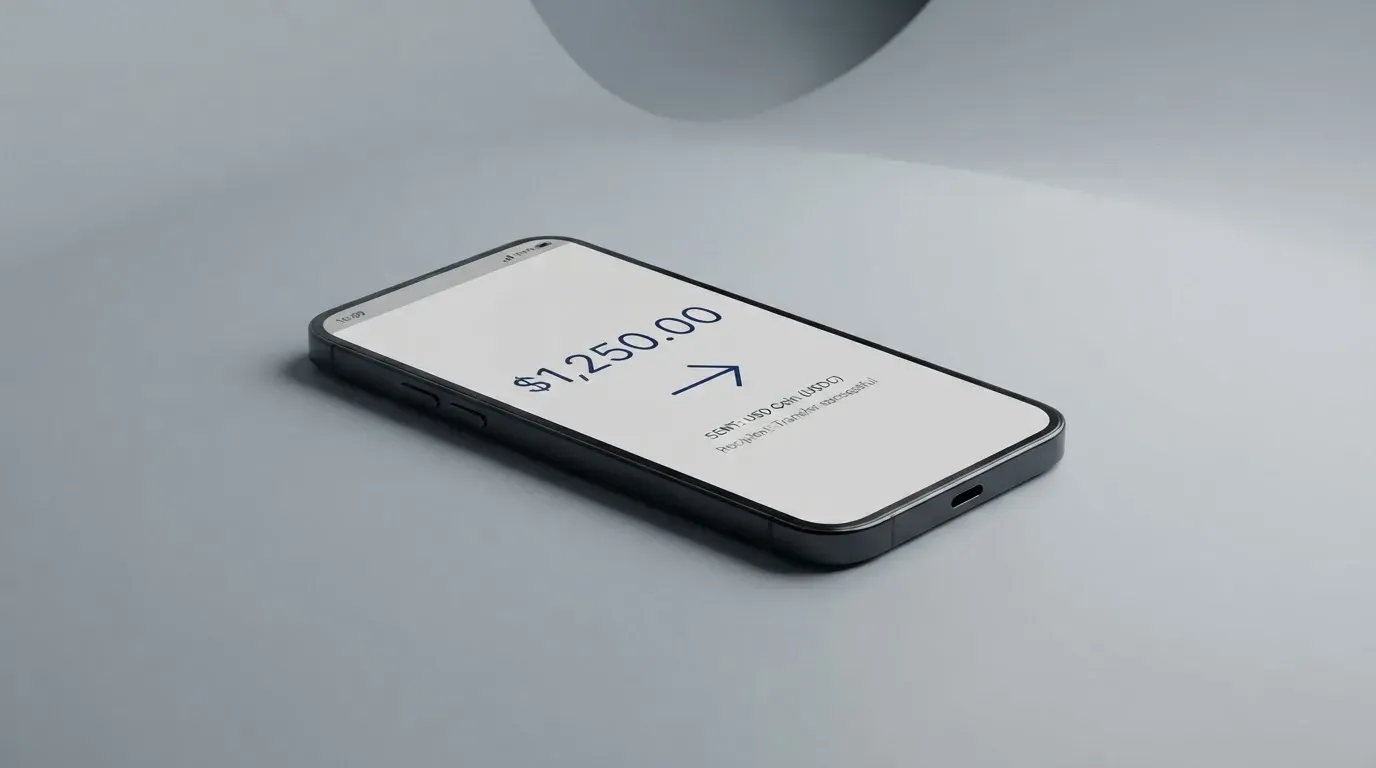
In practical terms, you fund the card by funding your Phemex account. The card page shows Transfer and Deposit buttons. You send USDT or USDC to your Phemex wallet, it lands in your Spot Account, and the card spends from that balance. The terms do not state a minimum top-up, do not state a fee, and do not state a processing time, so the only cost on the funding side is whatever network fee you paid to get the stablecoins into Phemex in the first place. That is a blockchain fee charged by the network, not by Phemex, and it is a category fact rather than a card fee.
Each of the two coins can be switched on or off, and you can set a priority order. If both are enabled and your balance is mixed, Phemex spends from the one at the top of the list. The auto-conversion happens at the point of sale, not on a schedule, which means the rate you get is the rate at the moment you tap or type.
When you cancel the card, the remaining balance is refunded to the Phemex Wallet after all final transactions and fees have settled. The programme can be terminated by Phemex with 60 days’ written notice, in which case the same refund logic applies.
Two practical tips. First, the absence of network choices also means the absence of network mistakes; you cannot send the wrong token to the wrong chain here, because the card is not a wallet. Second, because the card is custodial, the funds are not yours in a self-custody sense: Phemex holds the private keys, and you rely on the exchange to keep them safe. That single fact, more than any fee, is the trade-off you make for the convenience.
Paying with it every day
In daily use, the Phemex card behaves like any other virtual Mastercard. You get a 16-digit number, an expiry and a CVC inside the Phemex card page; you can type those details into an online checkout, save them in a browser password manager, or push them into Apple Pay or Google Pay. Tokenised mobile wallets are supported on both major platforms.
A 4-digit PIN may be required at physical stores. Because the card is virtual, “physical stores” here means a wallet-on-phone tap-to-pay, not a plastic dip. The PIN is set in the Phemex app; if you forget it, you reset it through the same flow.
The cardholder terms do not publish a list of blocked merchant categories for spending, which is unusual. They do, however, list categories that do not earn cashback: Financial and Investment, Cash-like and Crypto-related, Gambling, Government Services, Education, Insurance, Business Services, and Professional Services. A transaction can still go through at those merchants; the cashback is simply zero. In plain terms, paying a subscription to a stockbroker, betting on a sportsbook or settling a tax bill with a government portal will all work as card payments, but none of them will pay you back.
For disputes, the windows are written down. Unauthorised transactions must be reported within 13 months of the debit. Merchant disputes (the goods did not arrive, the goods were not as described) need written confirmation within 120 days. Merchant-initiated amount disputes (a hotel pre-auth that did not release, a fuel pump hold) get 8 weeks. Fiat refunds, when they happen, reduce the cashback proportionally. These are normal for a card programme and worth keeping in mind before assuming a refund will restore the original cashback.
Settlement is in USD. The Mastercard settles the transaction in dollars, and Phemex converts your USDT or USDC to USD at the till. If the merchant is in euros, the conversion is at the Mastercard baseline rate plus the Phemex spread, and the only thing you can control is the moment you tap.
Limits, as listed in the cost section, default to 5,000 USD per transaction, 5,000 USD per day, 30,000 USD per month and 100,000 USD per year. These are adjustable downward inside the app, but not upward without contacting support. For most personal spending they are not the binding constraint; the binding constraint is the size of your stablecoin balance.
A handful of practicalities worth knowing. Tokenised card numbers can be restricted by the issuer, so if Phemex decides a token cannot be used for online or contactless transactions, that decision is final inside the Phemex app. A declined authorisation can leave a hold on the funds for up to 7 days, which on a stablecoin balance is not a problem in itself, but it can make it look like the funds are gone when they are only locked. Address Verification Service, used by US, Canadian and UK merchants, is generally not available for foreign-issued cards, so a few checkout flows will decline the card for “billing address mismatch” reasons that have nothing to do with your balance.
What can go wrong
The card is small in scope but inherits the risks of the brand that issues it. Two questions matter: who actually runs the card programme, and how does the exchange behind it behave when things go wrong.
On the first question, the programme manager is IMMERSVE LIMITED, registered in New Zealand under company number 9429050083725, with a Financial Service Provider registration FSP1003031. The card is issued under a Mastercard International licence. There is an inconsistency in the terms: a definitions list at one point names IMMERSVE LIMITED as “Card Issuer”, while other paragraphs leave the issuer unnamed. The Phemex name is the brand; the actual card programme sits with the New Zealand company. The customer funds in your Spot Account sit with Phemex, and the terms describe safeguarding “in accordance with applicable law” without naming a deposit protection scheme. They explicitly cap your liability for a lost card at €50 or £35, depending on jurisdiction, which is standard for the EEA.
On the second question, the Trustpilot profile of the Phemex exchange is the part that gives me pause. As of reading on 2026-10-21, the exchange sits at 2.0 out of 5 from 277 reviews, 31 of them in the last 12 months. The themes that come up again and again are: withdrawals blocked or locked, repeated KYC re-verification months after the original approval, slow or scripted support, and disputed liquidations on derivatives positions. One reviewer, on 1 July 2026, describes a card deposit followed by a fresh KYC re-check. None of these are card-specific reviews, but they are the reviews of the company that holds your balance.
A few other risks to keep in mind, in plain language:
- Custodial balance. Your USDT and USDC sit inside the Phemex exchange, not in your own wallet. If Phemex is hacked, becomes insolvent or freezes accounts, the card is the least of your worries: the balance itself is the exposure.
- Stablecoin depeg. USDT and USDC are designed to hold 1 USD each, but neither is backed 1-to-1 in all circumstances. USDC briefly lost its peg in March 2023 during the US banking turmoil, and the wider stablecoin market has had worse cases. The card does not protect you from that; it converts at the rate of the moment.
- Issuer-side freezes. A freeze initiated by the issuer or by compliance cannot be undone from the app. The “Freeze Card” button is a user tool; an issuer-side freeze is a different thing.
- Programme closure. Card programmes get shut down. The pattern across the industry is: notice period, stop loading, stop spending, ask users to withdraw the remaining balance. If Phemex winds the card down, the 60 days’ notice clause in the terms is what you would rely on, and your exposure is the time it takes to extract your stablecoins.
- A history of security incidents at the exchange. A 2025 security incident interrupted deposits and withdrawals. The exchange has continued to operate, and the card programme rolled out from 14 September 2025, gradually expanding through the EEA.
- Limits are the regulator’s, not the brand’s. A sanction list update, a new compliance rule, or a renewal of your KYC can all change your ability to spend. None of these are Phemex-specific risks, but on a card that exists in only one regulatory market, they concentrate the risk.
The honest summary: the card itself is small and simple, and most of the things that can go wrong go wrong at the exchange layer. If you are comfortable keeping a working balance in Phemex for daily spending and not your life savings, the card is reasonable. If you would not keep that balance in Phemex without the card, the card does not change the calculation.
What to take instead
The Phemex card is a narrow product by design. Three alternatives cover the main reasons a reader might be looking at it: the first is for someone outside the EEA, the second for someone who values a different combination of fees and rewards, the third for someone who wants a similar auto-convert stablecoin experience elsewhere.
Young Card (5.7 / 10) is an alternative if you want a crypto-funded card with token-based rewards. Where I could read the official pages, residency rules, fees, funding mechanics and the card form factor were not stated; the only fact I can confirm is the rewards structure. Cashback is paid in YNG tokens at a rate that depends on your Club tier: Essential 0.1%, Gold 1.8%, Platinum 3.6%. The Bronze and Silver rates were not stated. Treat the score and the rewards rate as the only confirmed parts; everything else should be checked on the official site before applying.
MSX (6.4 / 10) sits a little higher on the score and is the alternative to look at if you want a card with a similar crypto-funded model but a different brand behind it. I could not find an official page that confirms residency rules, the card form, fees or rewards, so the score is the only line I can stand behind with confidence. Before you compare it directly to Phemex, read the issuer’s own cardholder terms.
Bybit Card (6.0 / 10) is the closest functional alternative for a reader who is outside the EEA. Bybit’s card is offered across Argentina, AIFC (Kazakhstan), Georgia, Kazakhstan, Australia, Mexico, Brazil, Peru and an “Asia Pacific” region. It is explicitly not available to EEA customers: the cards page says “This product is not meant for European Economic Area customers. All European Economic Area customer participation is strictly prohibited.” The reverse of the Phemex rule, in other words.
Bybit’s structure is more complex than Phemex’s. It offers virtual and physical cards in most regions, with a virtual card required first. Card networks and currencies vary: Mastercard prepaid in Argentina, Mastercard credit in the AIFC/Georgia/Kazakhstan/Australia/Mexico group, Visa prepaid in Brazil and Peru, Visa credit in Asia Pacific. Validity is 3, 5 or 6 years depending on the country. Physical card issuance fees range from 5 USD in Argentina to 29.99 USD in Australia, and some VIP tiers get the fee waived.
The funding model is similar in spirit but more granular: the card pulls from a Funding Account and a Flexible Easy Earn balance, fiat first, then crypto sold at the “Bybit One-Click Sell” rate plus a 0.5% to 0.9% crypto conversion fee depending on the region. The default coin priority is USDT, then USDC, GRAM, BTC, ETH, XRP, reorderable in the card dashboard.
On rewards, from 5 October 2026 only crypto-funded transactions earn cashback or points; fiat-funded spending does not. The tier ladder is Base 2.00%, Beta 2.00%, Alpha 4.00%, Apex 6.00%, Omega 8.00%, Infinite 10.00%, each with its own monthly cap and a minimum monthly spend for non-VIP users. The welcome offer is 10% back up to 110 USDT in the first 30 days, with subscription cashback for higher tiers. A referral bonus of 20 USDT or 10 USDT is also offered.
For a reader who needs a card outside the EEA, Bybit is the natural comparison. For a reader inside the EEA, Bybit is not an option, and Phemex is back on the table.
Who I would recommend it to
I would recommend the Phemex card to a reader who:
- lives in one of the 30 EEA countries listed above and can show a recent proof of address;
- already has, or is willing to open, a Phemex account, and is comfortable with Phemex’s Trustpilot profile;
- holds a working balance in USDT or USDC and wants to spend it without first selling to a bank;
- is happy with a virtual card and Apple Pay or Google Pay for in-person payments;
- does not need cash, an ATM, or a physical card;
- spends mostly in USD, where the FX spread is avoided;
- is at VIP tier and therefore gets the 1% cashback rather than the 0.25% Standard rate.
I would steer a reader away from the Phemex card if any of the following apply:
- you are outside the EEA, where the card is not available;
- you need a physical card or cash from an ATM;
- you want to keep your funds in a self-custody wallet and only convert at the moment of payment;
- the Trustpilot profile of the exchange is a deal-breaker for you;
- your main spending is in cashback-excluded categories like government services, insurance or financial products;
- you want a card that publishes the FX and conversion spread as a percentage.
If the second list describes you, look at Bybit Card for geographic flexibility, at a self-custody-linked card for control of your own keys, or at an ordinary bank-issued debit card funded by selling crypto when you need it. The Phemex card is best for a narrow use case, and outside that case the trade-offs do not favour it.
Frequently asked questions
What is the Phemex card?
The Phemex card is a virtual Mastercard debit that lets you spend the USDT and USDC sitting in your Phemex Spot Account. The card has no physical version, no issuance fee and no annual fee, and the cashback is paid in USDT into your Spot Account on the 10th of the following month.
How does the Phemex card work?
You apply inside the Phemex app, complete KYC and address verification, and the card is issued immediately on approval. At the till or in an online checkout, Phemex auto-converts your USDT or USDC to the merchant’s currency, applies a spread at transaction time, and credits any cashback in USDT the next month. Settlement is in USD.
Is Phemex a bank?
No. Phemex is a cryptocurrency exchange, and the card programme manager is IMMERSVE LIMITED, registered in New Zealand under company number 9429050083725. The card is issued under a Mastercard International licence. Phemex is not a bank and your balance is not a bank deposit.
Who owns Phemex?
Phemex is the brand that runs the exchange and markets the card. The card programme itself sits with IMMERSVE LIMITED in New Zealand. The cardholder terms do not name a parent company for Phemex in the documents I read.
Is the Phemex card available in my country?
Only if you live in one of the 30 EEA countries: Austria, Belgium, Bulgaria, Croatia, Cyprus, Czech Republic, Denmark, Estonia, Finland, France, Germany, Greece, Hungary, Ireland, Italy, Latvia, Lithuania, Luxembourg, Malta, Netherlands, Poland, Portugal, Romania, Slovakia, Slovenia, Spain, Sweden, Iceland, Liechtenstein or Norway. The rule is by residence, not citizenship. There is a conflict in the terms: the cardholder definition of the EEA excludes Croatia, Ireland and Romania even though they appear in the country list.
How do I apply for the Phemex card?
Open the Card page inside the Phemex app or on the Phemex web card page, complete KYC, verify your residential address (typed for 12 countries, uploaded as a recent document for the rest), enter a mobile number, agree to the three required documents, and submit. The card is issued immediately on approval.
Does the Phemex card require KYC?
Yes. Phemex runs a single level of identity verification plus an address check, and it can repeat identity checks later. The terms list incomplete KYC, unsupported region, failed address verification, failed risk or compliance review and inconsistent information as reasons for rejection. Phemex does not publish a processing time.
How do I add the Phemex card to Apple Wallet or Google Pay?
From the card page, choose Apple Pay or Google Pay and follow the tokenisation steps. Both wallets are officially supported. The card number is replaced by a device-specific number inside the wallet, and each tap uses a one-time dynamic security code.
How do I top up the Phemex card?
The card has no balance of its own. You fund it by sending USDT or USDC to your Phemex Spot Account, switching the coins you want to use on inside the card page, and setting a priority if you hold both. The card spends from that balance directly. Network choice is not a factor because the funds already sit inside Phemex.
Is the Phemex card safe to use?
The card itself is a standard virtual Mastercard with a 4-digit PIN, an in-app freeze, and per-transaction, daily, monthly and annual limits. The bigger risk is the exchange that holds your balance: Phemex is custodial, the exchange sits at 2.0 out of 5 on Trustpilot from 277 reviews, and the terms do not promise a deposit protection scheme. Treat the card as a spending tool for a balance you would be comfortable keeping on the exchange, not as a vault.
Exchange card fees – cryptocardfacts
Content created by the «cryptocardfacts» team