
Banqa card review: a self-custody Visa Infinite for people who already hold USDC
 Available in US
Banqa is a crypto payment card for people who already hold USDC and are willing to keep their own keys. It charges no annual fee on its Standard tier, spends straight from a self-custody smart-contract wallet, and hands you a virtual or physical Visa Infinite. In exchange you accept the responsibility that comes with holding your own keys, and a fee schedule that is heavier than it first looks once you start using the card outside the United States or at a cash machine.
I gave it 7.1 out of 10. That is a good card, not a flawless one. If your problem is that an ordinary bank card is hard to get — because of where you live, what documents you hold, or how your name appears on records — Banqa is one of the more interesting answers on the market, precisely because it is not a bank. If you simply want a cheap debit card and already have a functioning bank account, it is hard to justify over one of the alternatives I look at below.
The conditions described here are current as of October 28, 2026.
The score
| Criterion | Mark | Why |
|---|---|---|
| Who can get it | 6 / 10 | No country list is published; eligibility depends on residence and applicable rules, confirmed at application and KYC |
| Cost | 7 / 10 | No annual fee on Standard, physical card 39.00 USD with delivery, 1.99% FX on non-USD, 1.50 USD per ATM withdrawal |
| Top-up options | 7 / 10 | USDC into a self-custody smart-contract wallet on Base, Arbitrum and Ethereum; USDC top-ups fee-free, other assets and networks 0–1% by route |
| Reliability and complaints | 7 / 10 | Codego Group brand, cards issued by a Visa Principal Member under a Visa licence, Banqa is not a bank, issuer unnamed; SOC 2 and penetration tests; Trustpilot 3.7 from one review |
| Everyday use | 9 / 10 | Virtual and physical Visa Infinite, Apple Pay and Google Pay, ATM 1% + 1 USD |
| Total | 7.1 / 10 | A strong everyday card with a self-custody twist and an honest, published fee page |
The two ends of that table tell the story. Everyday use is where Banqa shines — a real Visa Infinite, virtual and physical, that works in the usual wallets. Eligibility is where it is weakest, because nobody outside can tell you in advance whether you will be approved. That uncertainty is not a flaw you can design away; it follows from the fact that Banqa does not publish the list of countries it serves.
Will they give you the card?
No country list is published. Banqa’s own position is that eligibility depends on residence and applicable rules, and that it is confirmed during the application and KYC process. A supported-countries page exists on the site and is linked, but the list behind it is not part of what the card publicly commits to. So if your question is whether Banqa works in your country, the honest answer is: apply, and find out.
Two general points help you frame that. First, country rules and citizenship rules are not the same thing. KYC screening records nationality separately from residence, because sanctions screening and issuer risk policy apply to citizenship and country of birth as well as to country of address. A card that accepts your address of residence can still decline your document if the passport is from somewhere the issuer treats as higher risk.
Second, the age requirement is not stated. Most prepaid and debit cards in this category go to adults aged 18 or over, and some issuers set higher limits, but Banqa does not publish its own floor. If you are under 18, do not assume.
How to get it
The application runs on standard KYC. You need a government ID — a passport, national ID or driver’s licence — plus proof of address dated within three months. Higher verification tiers may ask for source-of-funds documents, meaning evidence of where the money you are about to load came from.
Verification has two speeds. Automated checks usually finish within minutes; a manual review takes 24 to 48 hours. If a check fails, you can retry from the dashboard. That is worth knowing: a first rejection is not necessarily the end, and the retry is handled in the same place you applied.
The card itself is a Visa Infinite, available as a virtual card and as a physical one; business customers get both as well. The card currency is USD, which means anything you buy in another currency carries an FX fee — a figure I come back to in the costs section, because it is the number that will shape how you actually use this card.
The physical card costs 39.00 USD for issuance and shipping. Countries served and delivery times are not stated, so if you need the physical card quickly, that is another thing to raise before you commit.
Daily, weekly and monthly limits depend on your verification tier, and the amounts are not published. You can set your own per-transaction limits. The upshot is that your working limit is something you discover in the dashboard after approval, not something you can read off a table beforehand.
What it really costs: the Fees
The fee page is unusually clear, and I would rather start with the honest total than the headline. There is no annual fee on the Standard tier. There is a physical card at 39.00 USD including delivery. Account residency under Visa Corporate is 3.00 USD, corporate card issuing is 5.00 USD, and account closure is a one-time 10.00 USD. A monthly fee is not stated.
| Fee or limit | Value |
|---|---|
| Annual fee, Standard tier | None |
| Monthly fee | Not stated |
| Physical card, issuance and shipping | 39.00 USD |
| Account residency (Visa Corporate) | 3.00 USD |
| Corporate card issuing | 5.00 USD |
| Account closure | 10.00 USD one-time |
| Conversion | No manual conversion — USDC is spent against collateral |
| FX, non-USD transactions | 1.99% |
| ATM, fixed fee | 1.50 USD per withdrawal |
| ATM, percentage fee | 1% of the amount, plus 1 USD for end users |
| ATM balance / decline / authorisation check | 0.60 USD |
| Daily, weekly, monthly limits | Set by verification tier; amounts not published |
| Per-transaction limits | Settable by the user |
Now three everyday payments, so the table becomes real.
Coffee in your own country, priced in dollars. Nothing extra. This is the case the card is designed for: USDC in the wallet, spend it, the network does the rest, no conversion step because there is no conversion.
Coffee in a country that does not use dollars. You pay 1.99% on top of the price. That is the FX fee on non-USD transactions, and it applies every time, silently, at every till. On a 4 USD coffee it is roughly eight cents. On a 200 USD night out it is 3.98 USD. On a month of travel it becomes a number you would have wanted to know before you left.
Withdrawing cash at an ATM. Here the schedule is the most expensive part of the card. A fixed fee of 1.50 USD per withdrawal, plus a percentage fee of 1% of the amount and 1 USD for end users, plus 0.60 USD for a balance, decline or authorisation check. Limits follow Visa partner standards, and no free allowance is stated. Banqa’s scorecard puts the end-user cost as 1% plus 1 USD; the fee page also lists the 1.50 USD fixed fee. On a 100 USD withdrawal, that is comfortably over three dollars before your own bank’s own ATM charge. Treat the cash machine as a last resort, not a feature.
One more thing about the conversion line in the table. Banqa spends USDC directly against collateral — there is no manual conversion step, which is the design’s main appeal. But “no manual conversion” is not “no cost”. The cost lives in the network fee, the FX fee, the ATM fees, and the deposit fee if you arrive through a route other than plain USDC.
How to Top up
Top-ups are where Banqa is cleanest, and the reason is structural rather than promotional. Your USDC sits in a self-custody smart-contract wallet — your wallet, your keys — on Base, Arbitrum or Ethereum. You top up by sending USDC to it. The site says to hold USDC on Base and Arbitrum, and to send only USDC on Base.
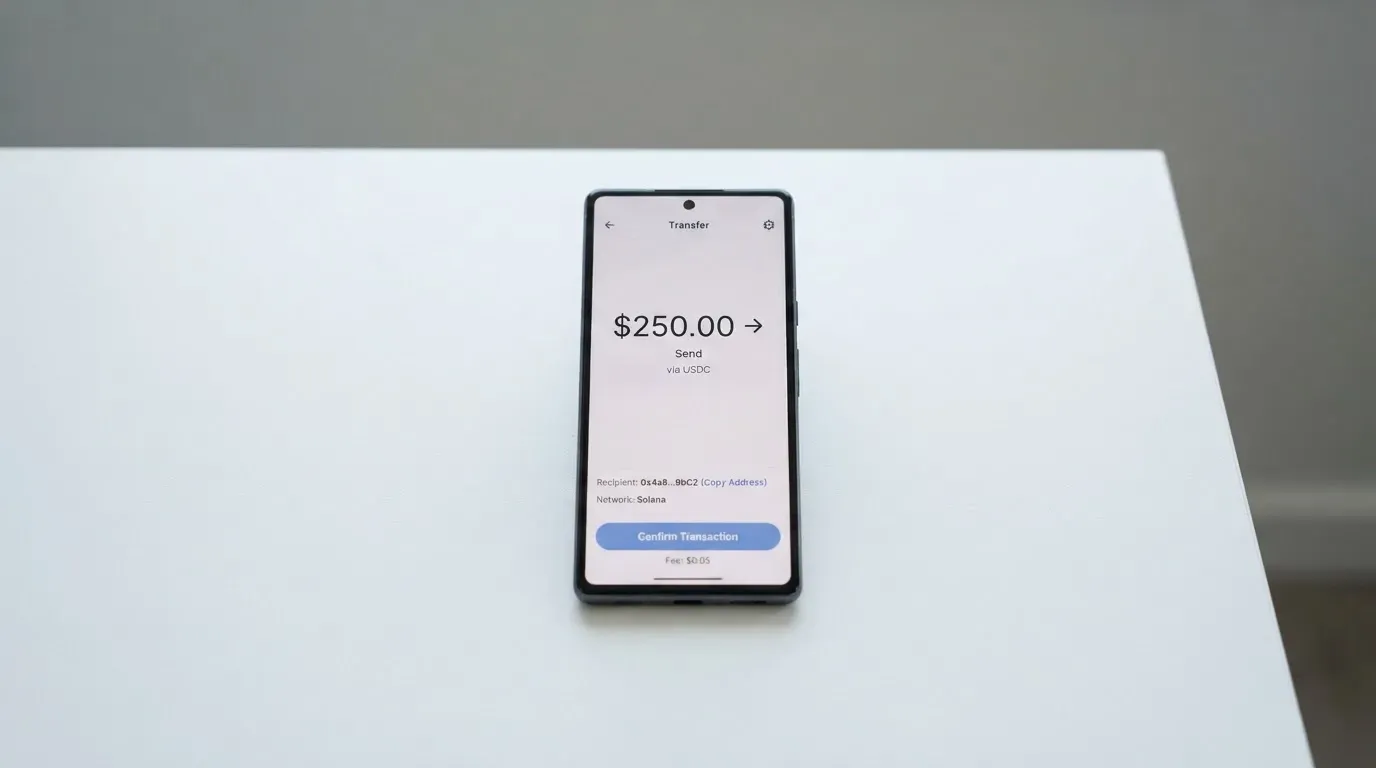
Deposits of USDC carry zero fee. Other assets and other networks cost from nothing up to 1% depending on the route. A minimum is not stated.
Two things to keep in mind as you fund the card. First, the networks named are the ones the card supports: Base, Arbitrum, Ethereum. A transfer sent on a network the card does not support, or to an address belonging to a different network, can be lost outright — blockchain transfers are irreversible, and recovery then depends on manual support involvement with no guarantee. Read the network name, not the token name. Sending USDC over a network the card does not use is the single most common and most expensive mistake available here.
Second, self-custody cuts both ways. Your keys are yours, which means nobody can move your funds without your signature — and also means that if you lose your recovery phrase, Banqa cannot get them back. The phrase is shown once and is not recoverable by Banqa.
To take money back out, the withdrawal flow moves USDC from the card’s collateral into your self-custody wallet through an on-chain authorisation. An off-ramp fee of 1% plus 3.00 USD is given as an example. Closing the account costs 10.00 USD.
Paying with it every day
This is the strongest section of the card, and the reason for the 9 out of 10. It is a Visa Infinite, in virtual and physical form. It works with Apple Pay and Google Pay. Those two facts together mean you can do almost everything you would do with an ordinary card: add it to your phone, tap, and go.
The virtual card arrives before the physical one, which is what you want if you intend to use it online or in a wallet from day one. The physical card at 39.00 USD is the price of not having to depend on your phone.
Blocked merchant categories are not stated. This matters more than it sounds. Some issuers block specific merchant category codes — gambling (MCC 7995, covering casinos, betting and lotteries) is the classic one — and those blocks vary by issuer rather than by law. Banqa does not publish its list, so you cannot know in advance whether a given category is closed to you.
On rewards, there is no cashback stated. There is a referral programme, though: 0.15% of your friends’ spend, plus a 10 USD bonus when a friend reaches 500 USD of spend. Treat that as a nudge, not a reason.
Control and reporting run through a web and app dashboard. The platforms it runs on and any app store ratings are not stated, which is a small negative for anyone who rates tools by their reviews before installing them.
If a payment goes wrong, chargeback handling appears as a disclosed item in the fee schedule, which means you are paying for the mechanism rather than it being free. The actual process and time frames are not described. Do not assume a US-style dispute timeline applies.
What can go wrong
The honest list starts with the things Banqa has not published.
- No country list. You cannot pre-check eligibility.
- No limits published. Daily, weekly and monthly caps depend on your tier, and the amounts are not public.
- No issuer named. Banqa says its cards are issued by a Visa Principal Member under a licence from Visa, but the issuer’s name and licences are not stated. Banqa itself says it is not a bank. For a card aimed at people with banking access problems, that is a fact to sit with.
- Very thin complaint record. Trustpilot shows 3.7 out of 5 from a single review — a 5-star review from July 2026, with Trustpilot noting the company has not invited reviews. No complaint themes because there is nothing to draw themes from. One review is not evidence of anything, in either direction.
The structural risks are more interesting. The card rides on a self-custody smart-contract wallet. The upside is control; the downside is that key loss, phishing and clipboard malware that swaps copied addresses are your problem alone, and on-chain transfers are irreversible. Banqa runs penetration tests and operates under SOC 2 controls, which is real diligence on their side — but it does not touch the failure modes that live in your own wallet.
A second category of risk is not really anybody’s fault. Crypto card programmes can be closed. In November 2022 Visa terminated its global agreements with FTX and the FTX US debit card programme was wound down. WaveCrest, a Visa issuer that supplied crypto card brands, was suspended by Visa in Europe in 2018, closing all its Visa programmes. Closures typically follow a pattern: a notice period, spending and loading stop, then users are asked to withdraw remaining balances. So keep your balance on the card small enough that you could move it in a day, and know that the money you have not moved is the money at risk.
Stablecoins are not, despite the name, guaranteed to be stable. They aim to hold a stable value against a currency, and they sometimes fail to: TerraUSD collapsed in May 2022, and USDC temporarily lost its peg in March 2023 during the US banking crisis. Circle says USDC is redeemable 1:1 for USD and fully backed by cash and cash equivalents with monthly reserve attestations; the BIS in July 2025 put about 90% of stablecoin market capitalisation in USDT and USDC together. That is a good track record, not a guarantee.
There is also the payments-level friction that is normal for a card like this and not the brand’s fault. A prepaid or foreign-issued card can be declined at a merchant that looks up the BIN and sees an issuer country unlike the billing address. Address Verification Service is mostly a US, Canada and UK system and generally unavailable for foreign-issued cards, which causes declines. A declined authorisation can also leave a hold on funds for up to seven days.
Finally, one thing nobody mentions enough: paying with crypto-backed money can be a taxable event. In the US the IRS treats digital assets as property, so spending them generally produces a capital gain or loss, measured in local currency at fair market value on the date of the transaction. That means each card payment funded from crypto may be its own disposal. I am not giving you tax advice — I am telling you to ask someone who knows your jurisdiction.
Support is email, with replies usually within 24 hours, plus a help centre and contact pages. No news or announcement channel is described.
What to take instead
If Banqa is not right for you, it helps to know what the alternatives actually charge. Here are three, from the same comparison set. Note the scores are on the same ten-point scale, and MetaMask’s 7.1 is identical to Banqa’s.
| Card | Score | Who | Card and cost | Fees to watch |
|---|---|---|---|---|
| TokenPocket | 5.8 / 10 | Visa debit for a list of European countries and territories (Germany, France, Spain, Switzerland); Mastercard debit for Australia, Canada, Hong Kong, Japan, Taiwan, New Zealand, Singapore, South Korea, UK | Mastercard/Visa debit, runs on Arbitrum, Fiat24 cards virtual; balances in EUR24 and USD24 | NFT creation fee partly covered by TokenPocket, user pays “a small portion”; 1% fee on crypto deposits, refunded later via rewards; no other fees |
| MetaMask | 7.1 / 10 | 45 listed countries and territories (Andorra, Argentina, Brazil, Canada, Mexico, Germany, France, Spain, Uruguay); others on a waitlist; proof of residency; US and UK sign-ups temporarily closed | Mastercard; virtual card instant, Metal $199/year; issuer Monovate, card provider Crypto Life | “Minimal fee for each transaction” (amount not stated); no MetaMask fees; no foreign transaction fee, Mastercard rate used |
| KAST | 6.1 / 10 | Residence-based list shown at KYC; citizenship also matters, and a VPN does not bypass; dual citizens with an ID from a supported country may pass | Virtual and physical, up to 10 cards; Visa Platinum (Standard), Infinite metal (Premium), Infinite gold (Private); USD balance | Stablecoin top-up 0%, USD spend 0%; non-USD FX 0.5%–1.75% by residence and transaction country; declined transaction 0.50 USD |
Three observations.
On fees, Banqa is middle of the road. KAST charges zero on stablecoin top-ups and zero on USD spend, which is hard to beat on paper, but it comes with membership tiers of 1,000 USD a year (Premium) and 10,000 USD a year (Private), and a 1 USD monthly inactivity fee after 12 months. MetaMask charges a “minimal fee” it does not quantify and no foreign transaction fee, which is elegant. TokenPocket’s 1% deposit fee is refunded later through rewards and lower transaction fees, so it is a deferral, not a saving.
On cashback, Banqa has the least. KAST pays USD cashback of 1.5% up to 2,000 USD a month on Standard, 2% up to 10,000 on Premium, 3% up to 40,000 on Private. MetaMask pays 1% on Virtual and a headline 3% on Metal, though the footnote caps it at 3% for the first 10,000 USD spent and 1% after. Banqa states no cashback at all. If you spend heavily and care about rebates, that is a real gap.
On eligibility, the shape of the answer differs. TokenPocket and MetaMask publish country lists. KAST and Banqa do not, and both tie the decision to a KYC screen. Banqa’s advantage over KAST is structural: KAST’s own documentation is unusually frank that living in a supported country is not enough if you only hold an ID from a restricted region, and that only the account holder’s own ID is accepted. Banqa says nothing of the sort, which means you learn less before you apply.
Who I would recommend it to
I would recommend Banqa to someone in this specific position: you already hold USDC, you keep your own keys or are willing to, you are comfortable sending a stablecoin on a named network and understanding that a mistake on the chain is a permanent one, and an ordinary bank card is either unavailable to you or a bureaucratic problem you have failed to solve. If that is you, Banqa is a good card with an honest fee page and a strong everyday setup — virtual and physical Visa Infinite, Apple Pay and Google Pay, no annual fee, and USDC top-ups with no fee.
I would not recommend it to you if you want cashback, or if you need a card you can use at an ATM regularly, or if you would rather not manage a self-custody wallet, or if you simply need a reliable debit card linked to a bank account you already have. And if your question is whether you will be approved in your country, I cannot answer it, and neither can the card — that is the one thing about Banqa that no review, including this one, can fix.
Frequently asked questions
What is the Banqa card?
The Banqa card is a Visa Infinite payment card that spends USDC held in a self-custody smart-contract wallet on Base, Arbitrum or Ethereum. It comes in virtual and physical form, works with Apple Pay and Google Pay, and has no annual fee on the Standard tier. You keep your own keys; Banqa is a programme manager on top of a Visa Principal Member’s card, and it states it is not a bank.
Is Banqa a bank?
No. Banqa says plainly that it is not a bank. It is a brand of Codego Group, and its cards are issued by a Visa Principal Member under a licence from Visa, with the issuer’s name and licences not stated publicly. This is an ordinary structure for a crypto card, but it means you are dealing with a card programme rather than a bank account.
Which countries can I use Banqa in?
No country list is published. Banqa’s position is that eligibility depends on residence and applicable rules and is confirmed during application and KYC. A supported-countries page is linked but not committed to publicly, so the only reliable way to know is to apply and go through verification. Citizenship may also be screened separately from residence.
How much does a Banqa card cost?
There is no annual fee on the Standard tier. The physical card is 39.00 USD including issuance and shipping. Non-USD transactions carry a 1.99% FX fee. ATM withdrawals cost a 1.50 USD fixed fee plus 1% and 1 USD for end users, with a 0.60 USD balance, decline or authorisation check. Closing the account is a one-time 10.00 USD.
How do I top up the Banqa card?
Send USDC to your self-custody smart-contract wallet on Base, Arbitrum or Ethereum. USDC top-ups are free; other assets and networks cost from nothing up to 1% depending on the route. Make sure the network matches what the card supports — Base, Arbitrum, Ethereum — because a transfer on an unsupported network or to a wrong-network address can be lost, as on-chain transfers are irreversible.
Is Banqa card free?
Partly. There is no annual fee on the Standard tier, and USDC deposits cost nothing. But the physical card is 39.00 USD, non-USD spending adds 1.99%, ATM withdrawals are among the more expensive things you can do with the card, and closing the account costs 10.00 USD. Free to open is not the same as free to use.
What are the daily and monthly limits?
Daily, weekly and monthly limits depend on your verification tier, and the amounts are not published. Higher tiers may require source-of-funds documents during KYC. You can set your own per-transaction limits in the dashboard. Verification itself is usually minutes if automated, or 24 to 48 hours for a manual review.
Does Banqa offer cashback?
No cashback is stated. There is a referral programme that pays 0.15% of friends’ spend and a 10 USD bonus when a friend reaches 500 USD in spend. If rebates matter to you, KAST and MetaMask publish cashback rates and Banqa does not.
Is Banqa card safe?
It uses a self-custody wallet, app-based freeze, email OTP or Google 2FA, passkeys rolling out, and SOC 2 controls with penetration tests at Codego. But self-custody means you own the risk: a lost recovery phrase cannot be recovered by Banqa, and crypto transfers are irreversible. Programme closures have happened in this industry before, so do not leave a large balance sitting on the card.
Where can I use the Banqa card?
Anywhere a Visa is accepted, in practice, virtual or physical, and in Apple Pay and Google Pay. But prepaid and foreign-issued cards can be declined at some merchants, and Banqa does not publish which merchant categories are blocked. Address Verification Service is largely unavailable for foreign-issued cards, which is a common cause of declines. Expect it to behave like a well-run prepaid card, not like a local debit card.
Wallet card fees and costs – cryptocardfacts
Content created by the «cryptocardfacts» team