
The 20 USDT deposit, the missing ATM, and a licence claim I could not verify
 Available in US

If you are reading this, you are probably in the situation I keep meeting in this category: you hold stablecoins, you hold them in your own wallet rather than on an exchange, and you want to spend them at an ordinary shop without giving up control of the keys or paying a card fee on every purchase. BenPay Alpha is built exactly for that person. The card page describes a virtual Visa that draws on a self-custodial balance, with a zero monthly fee, a zero annual fee and a zero conversion fee. That sounds almost too clean, and in places it is: the physical card does not exist yet, the card issuer is not named, and several of the numbers you would need to plan a month of spending simply are not stated anywhere I could read.
The conditions described below are current as of October 28, 2026.
I came to this card with a question rather than a verdict: is a genuinely fee-free crypto card real, or is the fee moved somewhere less visible? What I found is that the visible fees really are zero, the invisible ones are where the reading gets difficult, and the product’s biggest limitation is not cost at all. It is that the Alpha tier is, right now, a virtual card and a mobile wallet pairing — useful, but a narrower tool than the word “card” suggests.
Verdict: 7.4 out of 10
I scored the BenPay Alpha card at 7.4 out of 10. That is a good score for a card that charges nothing, and a mediocre one for a card that cannot yet hand you plastic or reach an ATM. Here is how the total breaks down, criterion by criterion, with the marks unchanged as I worked them out.
| Criterion | Mark | Why |
|---|---|---|
| Who can get it | 8 / 10 | Officially open to everyone with no country list; 14 restricted countries appear in starting data but I could not confirm that on a readable official page |
| Cost | 9 / 10 | Officially 0 monthly, 0 annual, 0 top-up, 0 crypto-to-fiat conversion; unofficially a refundable 20 USDT deposit; FX fee not disclosed |
| Top-up options | 8 / 10 | USDC or USDT on ETH, BSC, Base and Optimism, USDC converted to BUSD 1:1, self-custody wallet |
| Reliability and complaints | 6 / 10 | App publisher Wuben Inc., a claimed FinCEN MSB licence, card issuer not named, no reviews found |
| Everyday use | 5 / 10 | Virtual Visa, Apple Pay and Google Pay exist; the physical card and the ATM are “coming soon” and do not work at the date of my record |
| Total | 7.4 / 10 | — |
Two things about those numbers are worth saying plainly. The low mark on everyday use is not a complaint about quality — a virtual card that works in Apple Pay is more useful than many physical cards, because a lost phone matters less when the card itself is not in your pocket. It is a mark on completeness. And the reliability mark sits at 6 because silence is not reassurance: I found no Trustpilot page for BenPay and no Reddit discussion worth the name, which for a young product is normal and for a card holding your money is not comforting.
Who this suits, plainly: you already keep USDT or USDC in a self-custodial wallet, you spend in USD or in countries where a foreign BIN still clears, and your priority is paying without a percentage skimmed off each purchase. Who it does not suit: anyone who needs a physical card today, anyone who withdraws cash, anyone who wants to spend a currency other than the dollar without being surprised by an undisclosed FX charge, and anyone who is uneasy that the licence claim is the company’s own statement and the issuer is unnamed.
Will they give you the card
The short answer: the official line is that the card is open to everyone, and the honest answer is that I could not read the card’s own page to confirm it. BenPay’s Medium posts from May 2025 describe the card as “open to everyone” and publish no list of eligible or restricted countries. That is a genuinely open stance, and it is the one I want to pass on to you.
What sits underneath it is less tidy. My starting data listed 14 restricted countries, Russia and Belarus among them, but I could not confirm that list on any readable official page. So I will not repeat it to you as fact. What I can say is this: an open-to-everyone marketing line and a sanctions-screening process are not in conflict. Every serious card operation screens identity and location against sanctions lists regardless of how its sign-up page reads, which is exactly why your nationality and country of residence may be recorded and checked separately from each other. Treat “open to everyone” as an invitation to apply, not as a promise that every applicant will be approved or that restrictions are absent.
There is one more thing the card’s public pages do not say: the KYC level, that is, how far the verification goes and what the consequences of each level are. It is not stated. I mention it here rather than later because it determines your limits, and limits are the thing that decides whether a card is usable for you — and they are the thing the Alpha card also leaves vague.
How to get it
Applying is described as a two-step process, and the sign-up runs through Google or Apple account authentication called zkLogin. That part is straightforward and is not where you should be spending your attention.
The KYC picture is where the sources disagree, and I would rather show you the disagreement than smooth it over. BenPay’s own Medium material from May 2025, talking about BenPay Card generally, says “No KYC”. A user post on Binance Square, undated and therefore unofficial, says the Alpha card requires full KYC with an ID document, while ChainCatcher reported in December 2024 that the Platinum tier requires “necessary KYC”. My reading is that the “No KYC” line is about the sign-up flow and the older card, and that the Alpha card is a later, more regulated product. But I want to be honest about what that is: an inference from the pattern, not a confirmation from the company.
For you this matters in one direction only — expect to be asked for identification. Treat any promise you have seen that the Alpha card needs nothing as out of date or about something else. Conversely, a product that asks for your ID is not automatically a trustworthy one; asking for documents is normal and regulated, and tells you nothing about how the funds are held.
What you actually receive on approval is a virtual card on the Visa Global Network. The physical card was described as “coming soon” in May 2025, and I have nothing since that tells me it arrived. Delivery times are not stated. Card currency is also not stated on a readable official page; my starting data says USD settlement, which I cannot confirm officially, so treat the card as dollar-denominated until you see otherwise in your own app.
Fees: what this card really costs you
Here is the part that should make you interested, and the part where I have to be most careful about the difference between what is written and what is not.

The officially published numbers are unusually good. There is no monthly fee and no annual fee. The conversion of crypto to fiat is charged at 0, and loading the card costs 0. That is the whole visible cost structure.
| Item | Fee or limit |
|---|---|
| Card opening fee (Alpha) | Not stated |
| Monthly fee | 0 |
| Annual fee | 0 |
| Top-up fee | 0 |
| Crypto-to-fiat conversion fee | 0 |
| FX / foreign currency fee | Not stated |
| ATM withdrawal | Not available — physical card and ATM “coming soon” |
| Refundable deposit | 20 USDT (unofficial; covers failed transactions and disputes) |
| Spending capacity per card | Up to $200K |
| Per-KYC-level limits | Not stated |
| Minimum top-up | Not stated |
Read that table twice, because two of its rows are the most important. The FX fee is not disclosed anywhere I could read, and the card settles in USD. Those two facts together mean: if you are outside the dollar zone, your effective cost of a purchase is unknown to you at the moment you make it. That is not a reason to refuse the card, but it is a reason to convert the balance once, consciously, instead of discovering the margin in a restaurant.
The unofficially reported numbers add one line and they matter more than they look. A user post describes a refundable 20 USDT deposit, held against failed transactions and disputes, and reports no card opening fee at the time of writing. For the Platinum tier ChainCatcher reported a 20U opening fee, a top-up from 1% and no monthly fee. Since you are reading about Alpha, the Platinum figures are context, not terms — but they are a reminder that BenPay has priced different tiers differently at different times, and that a promotional price is not the same as a permanent one.
Three everyday payments, so the numbers become real:
A $12 coffee in a dollar city. Nothing is deducted for the conversion, nothing for the card, nothing for loading. If you top up beforehand with 15 USDT and spend 12, the model says 3 stays with you. This is the case the card is built for and the case where it is genuinely hard to beat.
A €40 dinner on a trip. Here the card goes quiet. You are spending euros against a dollar balance, the FX fee is not stated, and the payment may additionally face scrutiny simply because the BIN’s country differs from your billing address — which is a normal, network-level thing that happens with any foreign-issued card and can cause a decline at the terminal. I cannot tell you what this costs you. That is the honest answer, and it is also the answer you should refuse to accept silently: check the app’s own disclosure before you rely on the card abroad.
A $60 subscription. Straightforward in the same way as the coffee, with one difference you should know about. A declined authorisation can leave a hold on your funds that stays for days — up to seven is typical. And if the recurring payment fails, that refundable 20 USDT deposit is what the unofficially reported terms point to. Budget for a held balance on top of your spending money.
One more limit deserves your attention because it is the one that is stated and surprising: a single card supports spending of up to $200K. That is a ceiling, not an allowance, and for a card whose per-verification-level limits are not published, I would treat it as a sign that large balances are possible rather than as permission to hold one.
Top up: moving coins onto the card
Topping up is the operation this card does best, because it is the one with the fewest surprises attached. You load with USDC or USDT, on the Ethereum, BSC, Base or Optimism networks. USDC is converted to BUSD 1:1. The wallet behind the balance is self-custodial, which means the keys are yours.
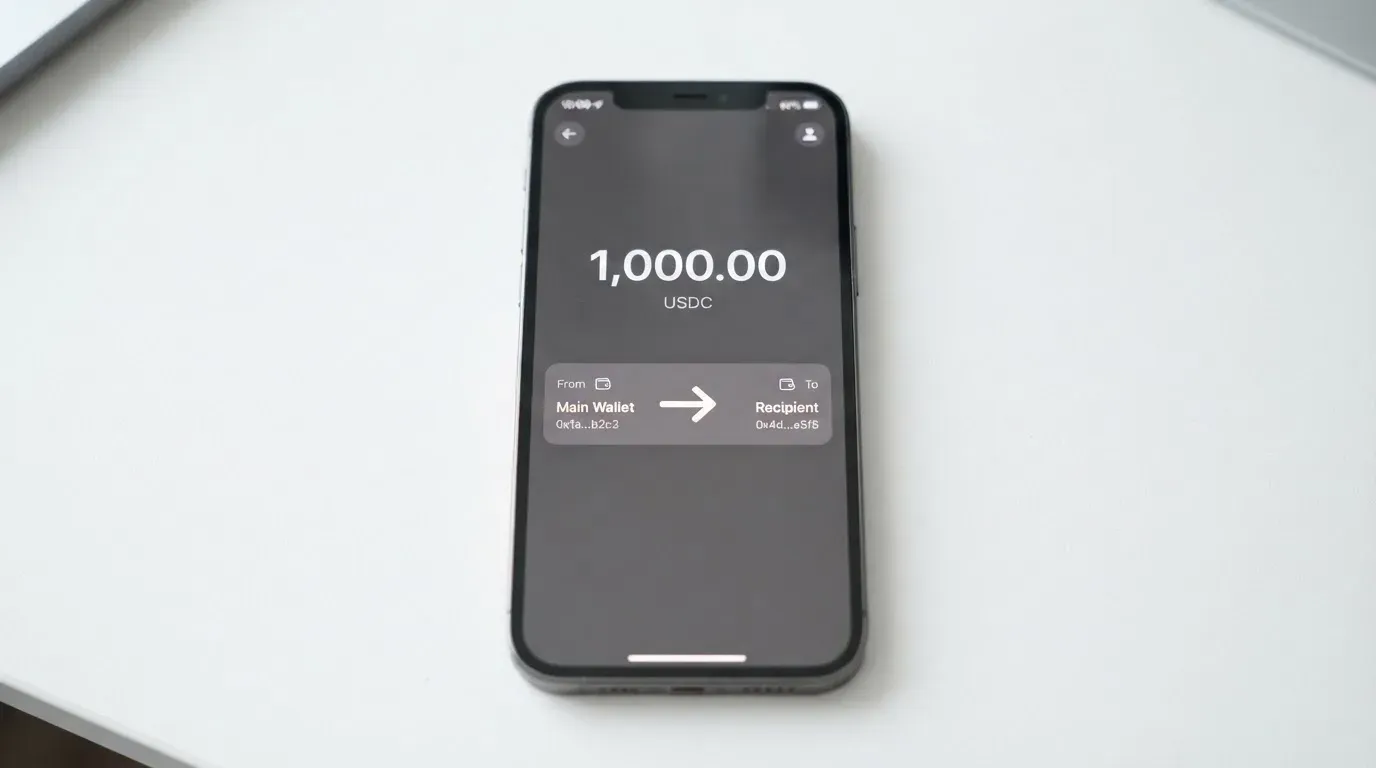
The top-up fee is 0. What is not stated: the minimum top-up amount, and who pays the on-chain network fee. That second one is worth a moment of your attention, because network fees are charged by the blockchain rather than by the card company — they are not free, they are just not BenPay’s. On Ethereum that can be several dollars by itself; on Base or Optimism it is usually far less. The practical consequence is that topping up a small amount on Ethereum costs a meaningful fraction of it, which is a fact about the network rather than about this card’s pricing.
One thing to internalise before your first transfer, because it is the one irreversible error available: blockchain transfers cannot be undone, and a deposit sent on a network the provider does not support, or to an address belonging to a different network, can be lost or need manual recovery with no guarantee. Match the network letter by letter. If you are sending USDT, note that it exists on several chains; if you are sending USDC, note that Circle stopped supporting USDC on Tron in February 2024, so the USDC-over-TRC20 route that many people use out of habit is not a native option here.
Withdrawal is not stated. I cannot tell you whether you can move a balance back out to your own wallet, on what terms, or how long it takes, and for a card whose main appeal is self-custody, that silence is the one I would most like answered.
Paying with it every day
The daily experience is a virtual Visa that you add to a phone wallet. Apple Pay and Google Pay are both supported, and Alipay and WeChat Pay can be bound to it as well. The iOS app on the US App Store carried a 4.8 out of 5 rating when I read it, with the Google Play listing not read at the time.
Let me explain what the wallet binding actually does, because it is the single most misunderstood thing in this category. Apple Pay does not store your card number. It replaces it with a device-specific number kept in the phone’s Secure Element, never on Apple’s servers, and each payment carries a one-time dynamic security code. That is a meaningful security property, and it is a reason to prefer the virtual card in a phone wallet over a plastic card. It is also a reason to keep the issuer’s freeze control in mind — the same issuer can restrict the tokenised number on phone or online use.
What is not stated for Alpha is the blocked merchant categories. In this category those lists vary by issuer and are set by policy rather than law; the category you might expect to see blocked is gambling, coded 7995. I cannot tell you whether BenPay blocks it, so if gambling matters to you, ask in the app rather than discovering it.
Rewards are not stated for Alpha. I would not build a plan around undated promotions, as their presence or absence says nothing about the card’s core economics, which are already zero-fee by design.
Dispute handling is not stated. That matters more than it sounds. A chargeback is a refund ordered by the issuer, and your right to one depends on the issuer’s rules and on the regulation it operates under; US prepaid-card coverage in particular varies and should not be assumed. Where the issuer is unnamed and the dispute process is undescribed, you are relying on the company that claims the licence, not on a named institution with published rules.
What can go wrong
This is the section where the card is thinnest, so I will be blunt rather than diplomatic.
The issuer is not named. The app is published by Wuben Inc. and BenPay claims a US FinCEN MSB licence, which is a money-transmitter registration rather than the licence of the institution that actually issues your card. Visa and Mastercard do not issue crypto cards to consumers themselves; they license issuers, and a crypto brand is often only the programme manager in front. So the entity that holds your card balance and handles a chargeback is somewhere behind a layer that the public pages do not name. My starting data names BenFen Inc.; I could not confirm it officially.
Self-custody cuts both ways. The keys are yours, and that is the whole point — but it means phishing, seed-phrase loss and clipboard-hijacking malware are your problem, and a stolen key has no recovery. The comparison worth keeping in mind: custodial platforms have a documented failure history, from Mt. Gox and Coincheck to the Ronin bridge. Custody means trusting someone else; self-custody means trusting only yourself. Neither is free, and the difference is a choice, not a safety claim.
Freezes and spending controls are not stated. The typical safeguards in this category are app-based two-factor authentication, an instant card freeze, spending limits and 3-D Secure confirmation. I could not find which of these BenPay offers. If your priority is being able to stop a card the moment it goes missing, that is a question to ask before you load it.
A 20 USDT deposit with unclear terms. Unofficially reported as refundable and tied to failed transactions and disputes. Who decides a transaction has failed, how quickly a deposit is returned, and whether it is returned at all — none of that is stated. Twenty dollars is not much; the principle is.
Sanctions and network reality. Tether states that it disables tokens in wallets on the OFAC sanctions list and has frozen funds tied to illicit activity. Stablecoins are not censorship-proof, and neither is any card that screens them.
Programme risk exists for the whole category. Cards get wound down: Visa terminated its agreements with FTX on 13 November 2022, and WaveCrest’s European Visa programmes were closed after Visa suspended it in 2018. Closures typically follow a pattern — a notice period, then loading and spending stop, then you are asked to withdraw. With BenPay, no such notice exists yet, and the combination of a young product, an unnamed issuer and no published withdrawal terms means you should not treat the balance as money you can leave parked indefinitely.
No complaints found, which is ambiguous. I found no official incident reports, no Trustpilot page for BenPay, and no Reddit reviews. For a service launched in 2025 that is unremarkable. It also means you have no community-verified record to lean on, and that is what a first customer is being asked to accept.
One general point on why a card like this can simply be declined at the till, since it will not always be about BenPay: a merchant can look up the BIN and see which institution and country issued the card, and apply extra scrutiny when that differs from the billing address. Address verification, which compares the numeric parts of the billing address against issuer records, is mostly offered in the US, Canada and the UK and is generally unavailable for foreign-issued cards. That is ordinary network behaviour, not a blacklist, and it is the reason a perfectly valid card can fail at one shop and work at the next.
What to take instead
If the Alpha card’s gaps — no plastic, no ATM, undisclosed FX, unnamed issuer — do not sit well with you, these are the three I would look at. Their scores are my own marks on the same scale, so you can see the trade rather than take my word for it.
| Card | Score | Who it suits | The catch |
|---|---|---|---|
| BenPay Alpha | 7.4 / 10 | Self-custody holders of USDC/USDT who want zero card fees | Virtual only, ATM pending, FX undisclosed, issuer unnamed |
| MetaMask | 7.1 / 10 | Wallet-native users who want cashback and Apple Pay | Sign-up in 45 listed countries/territories, others waitlist; Metal costs $199/year |
| KAST | 6.1 / 10 | People who want a physical card, multiple cards and tiered cashback | Annual membership runs from 1,000 USD on Premium; residence list must be checked at KYC |
| TokenPocket | 5.8 / 10 | Users in Europe and a fixed list of Asia-Pacific countries | 1% deposit fee; Americas were planned for Q2 2025 |
MetaMask is the closest competitor and, for many people, the safer pick. It is a Mastercard, the virtual card is free with no annual or maintenance fee, and the Metal card is $199/year. It spends directly from your connected wallet on Linea, Base, Monad and Solana, with no additional MetaMask fees, no foreign transaction fee, and the Mastercard rate used for conversion — which is precisely the line BenPay leaves blank. Cashback is 1% on the virtual card in mUSD, and on Metal the headline 3% is limited by the footnote to the first $10,000 spent before it drops to 1%. The issuer is named: Monovate, with Crypto Life as card provider. The catch is geographic: sign-up is open in 45 listed countries and territories, other regions join a waitlist, US and UK sign-ups are temporarily closed, proof of residency is required, and the rule is that ineligible regions limit sign-ups, not spending.
KAST is for people who want the physical object and a fuller card hierarchy — virtual and physical, up to ten cards, from Visa Platinum to metal and gold-plated variants. It publishes its money side in a way BenPay does not: stablecoin top-up 0%, card spend in USD 0%, transaction fee 0%, Apple and Google Pay 0%, and a disclosed non-USD FX fee of 0.5%–1.75% depending on where you live and where you spend. There are small sharp edges — a declined transaction costs 0.50 USD, a non-USD transaction under 25 USD costs 0.10 USD, and an inactivity fee of 1 USD/month starts after 12 months — but at least they are written down. The membership is what gives me pause: Standard is free, Premium is 1,000 USD/year, Private is 10,000 USD/year, and those fees turn a free card into an expensive one fast. Eligibility is residence-based and shown at KYC, with a restricted-locations rule that can block you even if you live in a supported country but hold ID from a restricted region.
TokenPocket is the weakest of the four at 5.8, mostly on cost structure. It runs on Arbitrum, with Visa debit for a list of European countries and Mastercard debit for Australia, Canada, Hong Kong, Japan, Taiwan, New Zealand, Singapore, South Korea and the UK, among others, and balances in EUR24 and USD24. But it charges 1% to deposit cryptocurrency into the card — a fee BenPay does not charge at all — and there is an NFT creation fee you pay a “small portion” of. The 1% is described as refunded later through rewards and reduced transaction fees, which is a promise about the future in exchange for a charge today. No cashback figure is stated.
If your priority is genuinely “spend my own stablecoins with no card fees and no platform holding the keys”, BenPay Alpha is currently the most direct expression of that, and no one on this list matches it exactly. If your priority is anything else, the same page gives you a card with more of the numbers written down.
Who I would recommend it to
I would recommend the BenPay Alpha card to you if all four of these are true. You already hold USDT or USDC in a wallet you control, and you are used to the fact that sending to the wrong network is irreversible. You want to spend in dollars, or in places where a foreign-issued card is unremarkable. You are content with a virtual card in a phone wallet and do not need to withdraw cash. And you are willing to accept an unnamed issuer and an undisclosed FX fee as the price of the zero fees.
I would hold you back if any one of these is true instead. You need plastic in your wallet. You need an ATM. You spend regularly in a currency other than the dollar, and an unknown conversion margin is not something you will tolerate. You want a published dispute process, a named issuing bank, or a cashback scheme you can rely on. Or you simply prefer a product whose fee schedule is complete — in which case KAST writes down more of its costs than BenPay does, and MetaMask writes down more of its rewards.
And I would say this to everyone: load it with an amount you can afford to lose, withdraw what you do not need, and come back to it when the physical card and the withdrawal terms have been published. The zero fees are real. So is the possibility that this product changes shape.
Frequently asked questions
What is the BenPay Alpha card?
The BenPay Alpha card is a virtual Visa card that spends from a self-custodial crypto balance. You load it with USDC or USDT from your own wallet, and the balance is spent as if it were ordinary fiat. Officially it carries no monthly fee, no annual fee, and no crypto-to-fiat conversion fee. It is phone-first: Apple Pay and Google Pay are supported, and the physical card was described as “coming soon”.
How does the BenPay Alpha card work?
You hold your own keys, transfer USDC or USDT on Ethereum, BSC, Base or Optimism, and the card spends that balance. USDC converts to BUSD 1:1. Top-up and conversion are both charged at 0. Because the wallet is self-custodial, you bear the risk of key loss and of sending to the wrong network, which cannot be undone — the trade for not trusting a custodian.
Does the BenPay Alpha card require KYC?
Expect to be asked for identification. BenPay’s own May 2025 material says “No KYC”, but that appears to describe the sign-up flow or an earlier card. Unofficial sources say the Alpha card requires full KYC with an ID document, and a December 2024 report said the Platinum tier requires “necessary KYC”. Treat any no-KYC claim as out of date for Alpha.
Is the BenPay Alpha card free?
The published fees are 0 monthly, 0 annual, 0 top-up and 0 conversion, and one unofficially reported source says there is no opening fee at present. An undated user post also describes a refundable 20 USDT deposit covering failed transactions and disputes. The opening fee for Alpha and the FX fee are not stated. So: the card is free to hold, with a deposit you should treat as withheld money.
How much can I spend, and is there a limit?
A single card supports up to $200K in spending, according to the May 2025 material. That is a ceiling rather than an allowance. Per-KYC-level limits are not stated, so if you plan to hold a large balance, check what your own verification level permits inside the app before you rely on the headline number.
Can I use the card in my country, and can I withdraw cash?
Country availability is the thinnest part of the record. BenPay described the card as open to everyone with no published list, while 14 restricted countries including Russia and Belarus appeared in my starting data and I could not confirm them on an official page. Sanctions screening applies regardless of that marketing line. Cash withdrawals are not available: the physical card and ATM withdrawals were “coming soon”.
How do I top up, and can I get money back out?
Top up by sending USDC or USDT from your own wallet on ETH, BSC, Base or Optimism, with a 0 top-up fee. The minimum amount and who pays the on-chain network fee are not stated — network fees come from the blockchain, not from the card. Withdrawal is also not stated: whether you can move the balance back to your wallet, on what terms, and how fast, is simply not published.
Is it safe, and who runs it?
The app is published by Wuben Inc. and BenPay claims a US FinCEN MSB licence, which is a money-transmitter registration rather than the licence of the entity that issues your card. The card issuer is not named publicly. Self-custody means a lost key or a phishing site is unrecoverable. Freeze controls, spending limits and dispute handling are not stated. I found no official incidents and no user reviews — unremarkable for a young product, but no reassurance either.
Is it worth it compared with other cards?
Worth it if your priority is spending self-held stablecoins with no card fees, because MetaMask, KAST and TokenPocket all charge something at top-up or membership. Less compelling if you want a physical card, a named issuer, a published cashback scheme or a disclosed FX rate: KAST publishes more of its fees, and MetaMask names its issuer and states that no foreign transaction fee applies.
How do I add the card to Apple Wallet or Google Pay?
Both mobile wallets are supported, and Alipay and WeChat Pay can also be bound. Adding the card through the app generates a device-specific number that is stored in the phone’s Secure Element rather than on Apple’s servers, with a fresh one-time code per payment. That is why a virtual card in a phone wallet is convenient and why the issuer’s ability to freeze the tokenised number is worth checking before you load it.
Wallet card fees and costs – cryptocardfacts
Content created by the «cryptocardfacts» team