
TokenPocket card review — a virtual Visa or Mastercard for crypto holders who can't get a bank account
 Available in US
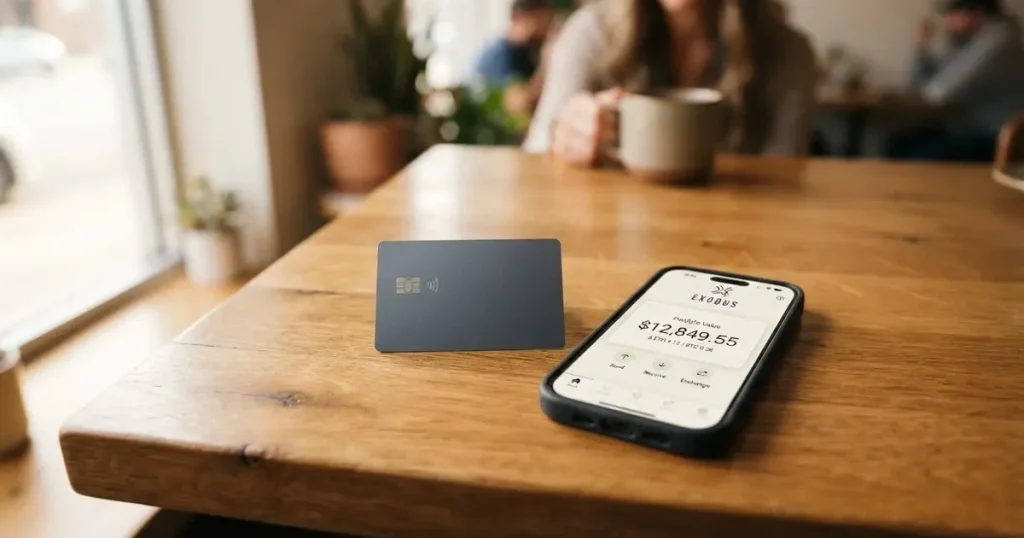
TokenPocket is best known as a self-custody crypto wallet, but it also offers a payment card. The card is a Visa or Mastercard debit, runs through an on-chain account NFT, and lives as a virtual card in the TokenPocket app. There is no mention of a physical card. In this review I walk through who can get it, what it really costs, how you fund it, what daily life with it looks like and what can go wrong, and then I compare it to three alternatives for people who can’t or don’t want to use an ordinary bank card.
Conditions in this article are current as of October 28, 2026.
Verdict: 5.8 out of 10 — narrow but usable for a specific group
TokenPocket’s card scores 5.8 out of 10 in my assessment. That score reflects a card that does some things well and leaves a lot unsaid.
On the positive side, eligibility is reasonable: Visa is available across a list of European countries (Germany, France, Spain and Switzerland are named), and Mastercard covers a long list of Asia-Pacific countries (Australia, Canada, Hong Kong, Japan, Taiwan, New Zealand, Singapore, South Korea, UK). The card also accepts Apple Pay, Google Pay, Samsung Pay, Alipay and WeChat Pay, which matters in Asia. Costs are advertised as low: a small fee to mint an account NFT, a 1% fee on crypto deposits and “no additional fees” beyond that.
On the negative side, the card is virtual only, and the public FAQ does not state a card-issuing bank, an ATM policy, daily or monthly limits, an FX fee, supported coins or supported networks for top-up. Trustpilot reviews of the issuer-side service, Fiat24, sit at 2.2 out of 5 from 8 reviews, all 1-star, with complaints about unresponsive support and funds being held. The Americas are listed as “planned for Q2 2025” rather than live.
Who it suits
- People in the named European or Asia-Pacific countries who already use the TokenPocket wallet and want a Visa or Mastercard they can spend from a crypto balance.
- Users who want to fund a card directly from a self-custody Arbitrum wallet rather than from a custodial exchange account.
- People who specifically need Alipay or WeChat Pay support, which most Western cards don’t have.
Who it does not suit
- US, Latin American and most African residents (Americas “planned for Q2 2025”).
- Anyone who needs a physical card or ATM withdrawals — neither is mentioned in the FAQ.
- Users who want a clear, published fee schedule for FX, ATM, monthly maintenance or daily limits.
- People who would be uncomfortable with an issuer that has only 8 reviews averaging 2.2 on Trustpilot.
Score breakdown
| Criterion | Mark | Reason |
|---|---|---|
| Who can get it | 7 / 10 | Two clear regional lists (Visa in named European countries, Mastercard across Asia-Pacific) but the Americas are still on a roadmap. |
| Cost | 7 / 10 | One named 1% deposit fee and a small NFT minting fee; everything else is silent. |
| Top-up options | 4 / 10 | Only “from the TokenPocket wallet on Arbitrum” is stated; coins and networks are not named. |
| Reliability and complaints | 4 / 10 | Issuer is not named in the FAQ; Fiat24 reviews are 2.2 from 8 one-star entries. |
| Everyday use | 6 / 10 | Five mobile wallets supported, including Alipay and WeChat Pay, but the card is virtual only. |
| Total | 5.8 / 10 | Able to do the job in the regions it covers, but too many gaps to recommend without caution. |
Who will they give you the card
TokenPocket splits eligibility by network. The Visa debit is for a list of European countries and territories, with Germany, France, Spain and Switzerland given as examples. The Mastercard debit is for a longer Asia-Pacific list: Australia, Canada, Hong Kong, Japan, Taiwan, New Zealand, Singapore, South Korea and the UK are named. The FAQ mentions more countries on each side but does not publish the full list.
For the Americas, the FAQ says support is “planned for Q2 2025”. That is a roadmap statement, not a live service, and it has not been updated to confirm that it shipped.
The card runs on the Arbitrum network. Balances are held in EUR24 and USD24, which are tokenised representations of euro and US dollar balances. EUR24 and USD24 can also be transferred to another registered account-NFT holder, so the balance behaves more like a stablecoin than a closed-loop prepaid balance.
What is not stated: minimum age, citizenship rules separately from country of residence, the full country list, the issuer’s name, and whether the cards are issued by a bank or by an electronic money institution.
How to get it
Sign-up is described in the FAQ as a sequence: download the TokenPocket app, create or import an Arbitrum wallet, mint an account NFT, complete registration, then receive the card. Verification happens on-chain through the wallet. The FAQ does not give a separate document list (passport, proof of address) and does not state whether some users are asked for more documents than others. One account NFT can be minted per wallet.
The card you receive is described as a “Mastercard/Visa debit card” — virtual, not physical. There is no mention of a physical version, no delivery address question and no delivery timeframe.
What is not stated: the full KYC document list, who reviews the documents, how long KYC usually takes, the order in which virtual and physical cards (if any) become available, and whether there is a minimum wallet balance at sign-up.
Fees — what it really costs
TokenPocket’s stated pricing has two parts. The first is a one-off cost to mint the account NFT, partly covered by TokenPocket — the user pays “a small portion” but the amount is not disclosed. The second is a 1% fee on every crypto deposit into the card, which the FAQ says “will later be refunded to users through rewards, reduced transaction fees, etc.” Apart from these, “TP Card does not charge any additional fees.”

Inter-institution settlement may add fees that come from the wider card network, not from TokenPocket directly. An FX fee is not stated. ATM fees, daily and monthly limits, monthly maintenance and tier structures are not stated either.
Costs at a glance
| Fee or limit | Stated value |
|---|---|
| Card issuance (NFT mint) | A “small portion” — amount not stated |
| Monthly or annual fee | None stated |
| Crypto top-up fee | 1% (to be refunded later) |
| Foreign exchange fee | Not stated |
| ATM fee | Not stated |
| Daily limit | Not stated |
| Monthly limit | Not stated |
Three everyday payments, in detail
- Coffee in a European city, paid with Apple Pay from the Visa card. The card is loaded with EUR24, so there is no FX step. Network and merchant fees can still apply but TokenPocket does not list any of its own beyond the 1% deposit fee, and that fee would have been paid at top-up, not at the till.
- A meal in Tokyo, paid with Google Pay from the Mastercard card. You loaded USDC into the card and it sits as USD24, so the card is paid in USD. The card scheme handles the dollar-to-yen conversion, but TokenPocket does not publish an FX margin, so the actual cost depends on the network rate plus any markup that an acquirer adds.
- Sending EUR24 to a friend’s registered account NFT. No top-up fee applies, because no new deposit is happening — you are just moving your existing balance to another address the system recognises.
The practical takeaway: a clear published FX fee and ATM policy would make the cost of using this card predictable. Without them, the only fee you can plan for is the 1% deposit fee.
How to top it up
Funding the card is described in one sentence: crypto deposits come from the TokenPocket wallet. The wallet is an Arbitrum wallet, and the FAQ points to Arbitrum as the home network for the account NFT. Balances show up as EUR24 or USD24.
The FAQ does not list which specific coins or networks can be used to top up, what the minimum deposit is, who pays the on-chain network fee or whether you can fund the card from a bank account, a card or a wire. For a card that positions itself as a bridge from crypto to everyday spending, the absence of a published top-up coin and network list is unusual.
What is not stated: supported coins for top-up, supported networks, minimum deposit, network-fee payer, fiat on-ramps (bank transfer, card), and whether a wire withdrawal from the card account is offered in addition to crypto deposits.
For context on what “not stated” means here: a stablecoin transfer is a blockchain transaction. If you send a token on a network the card provider does not support, or to an address that belongs to another network, the funds can be lost or only recovered with manual support intervention. The FAQ does not warn about this in the top-up section, so the safest read is to wait for an in-app deposit screen before sending anything.
Paying with it every day
In the regions where the card is live, the supported spending surface is wide. The FAQ names five mobile wallets: Apple Pay, Google Pay, Samsung Pay, Alipay and WeChat Pay. TokenPocket’s card is virtual, so the practical experience is “add to wallet, then tap.” The app is the management surface: card details live inside TokenPocket, not on a piece of plastic.
There is no stated blocked-merchant list, so it is reasonable to expect the card to work where most Visa or Mastercard prepaid products work, including online shops. Some merchants and category codes (gambling is the most common example) are routinely blocked by issuers, and TokenPocket does not publish a list of its own.
Refunds are described as taking 15 to 30 business days once the merchant completes its own refund process. Chargeback rules are not stated. No cashback scheme is published, and the 1% deposit fee is described as something that “will later be refunded” through rewards or reduced transaction fees, not as a current cashback programme.
What is not stated: physical card, ATM withdrawals, contactless plastic, blocked merchant categories, current cashback rate, chargeback process, custody model (who holds the EUR24/USD24 between top-up and spend) and 2FA inside the app.
What can go wrong
The card has two layers of risk: the risks that come with any self-custody wallet, and the risks that come with an under-documented issuer.
On the wallet side, TokenPocket uses Web3 wallet credentials (a seed phrase) rather than a username and password. Losing the seed phrase is a real problem: the FAQ says Fiat24, the service behind the card, can verify your identity, lock the old account and move the NFT and funds to a new Arbitrum wallet, possibly for a small fee. Stolen credentials are a worse problem: if you are still logged in you can lock the card and move funds; if you are not, you have to contact Fiat24. Crypto transfers are irreversible, and there is no built-in way for the network to freeze or reverse a transfer. The custody model for the EUR24 and USD24 balance between top-up and spend is not stated.
On the issuer side, the FAQ does not name a card-issuing bank. The support email and the lost-key recovery process both point to Fiat24, a Swiss e-money service. Fiat24’s Trustpilot page (read 2026-10-21) sits at 2.2 out of 5 from 8 reviews, every one of them 1 star. The complaints run from December 2024 to May 2026 and cover unresponsive support, funds being held or delayed, and failed transfers. Those are user reports, not official findings, but they are the only published signal of how the issuer-side service behaves when something goes wrong.
Other named risks: TokenPocket says it works with “a compliant financial institution” (a Swiss-compliant bank) but does not name the licence, the licence number or the regulator. Card programmes can be suspended by the network — Visa and Mastercard can wind down an issuer or a programme manager, and when they do, balances and cards can be paused. There is no public incident involving TokenPocket, but the smaller the issuer the fewer the answers when something does happen.
What is not stated: licences, custody model, 2FA inside the app, AML/sanctions policy, an incident response process, and an SLA for support.
What to take instead
The TokenPocket card is one of several options aimed at people who want a Visa or Mastercard funded by crypto. Three of the most discussed are below. None is identical to TokenPocket; the right one depends on which trade-off matters most to you.
MetaMask Card — score 7.1 / 10
MetaMask’s card is a Mastercard issued by Monovate, with Crypto Life as card provider. A virtual card is issued instantly; a Metal tier can be pre-ordered in the app for $199 a year. Sign-up is open in around 45 listed countries (Andorra, Argentina, Brazil, Canada, Mexico, Germany, France, Spain, Uruguay are examples), with other regions on a waitlist. Proof of residency is required; US and UK sign-ups are temporarily closed per the FAQ. Funding is from the connected wallet itself — Linea, Base, Monad and Solana are named networks, and mUSD, wETH, EURe, GBPe, USDC and USDT are named tokens. Cashback is paid in mUSD into the Money Account: 1% on Virtual, headline 3% on Metal (with a footnote that limits 3% to the first $10,000 spent and then drops to 1%). The MetaMask Card page describes a “minimal fee per transaction” but the amount is not stated on the pages read.
Compared to TokenPocket, MetaMask offers a more transparent fee structure and a published cashback scheme, though you should note the waitlist in some regions and the $199 Metal annual fee.
KAST — score 6.1 / 10
KAST offers Visa cards (Standard, Premium, Private) in virtual and physical form, with up to 10 cards per user. Pricing is layered: Standard has no annual fee, Premium is $1,000 a year, Private is $10,000 a year, all billed annually upfront. Spending is in USD from a stablecoin balance, with 0% on stablecoin top-up, 0% on card spend in USD and 0% on Apple or Google Pay. Non-USD FX is 0.5% to 1.75% depending on residence, transaction country and card programme. Cashback ranges from 1.5% on Standard (capped at $2,000 a month) up to 3% on Private (capped at $40,000 a month), paid in USD at authorisation.
The KAST card stands out with a real fee schedule and a tiered product, but unlike TokenPocket, its country list is not published, and the top-tier $10,000 Private membership is clearly not aimed at casual users.
Zeal — score 6.1 / 10
Zeal runs on top of Gnosis Pay. Spend is in 150+ countries; the underlying card programme is live in the EU, UK, Brazil, Colombia, Mexico, Japan, Singapore, the Philippines, Indonesia and Thailand, with notes mentioning Mexico, Colombia and Bolivia. The card is a Visa; a virtual card is available for online use and can be added to Apple Pay. Accounts are in EUR, USD and GBP. Zeal advertises no extra FX fee — conversion is at the Visa wholesale rate — and up to 4% cashback paid in GNO on Gnosis Chain, with a rate that can change. The exact coins supported for top-up are not stated for Zeal, and a physical card is not stated.
Zeal provides a published wholesale-rate FX model and a real cashback, though the cashback is paid in GNO, which must be held in the card Safe, and cost details are notably absent from their own site.
Side-by-side
| Card | Network | Issuance | Annual fee | FX | Stated cashback | Score |
|---|---|---|---|---|---|---|
| TokenPocket | Visa or Mastercard | Mint an account NFT | Not stated | Not stated | None stated | 5.8 / 10 |
| MetaMask | Mastercard | Free Virtual; Metal pre-order | Metal $199 | Mastercard rate (no FX fee) | Up to 1% Virtual, 3% Metal | 7.1 / 10 |
| KAST | Visa | Free Standard, paid Premium/Private | $0 / $1,000 / $10,000 | 0.5%–1.75% non-USD | 1.5%–3% in USD | 6.1 / 10 |
| Zeal (Gnosis Pay) | Visa | Not stated | Not stated | Visa wholesale | Up to 4% in GNO | 6.1 / 10 |
The pattern in the table is what I take from these products: the ones that score higher publish more. TokenPocket’s score reflects how much it leaves to the reader to find out.
Who I would recommend it to
If you live in one of the named European countries or one of the named Asia-Pacific countries, you already use the TokenPocket wallet and you are comfortable with Arbitrum, the card is a reasonable way to convert a self-custody balance into a Visa or Mastercard you can tap through Apple Pay, Google Pay, Samsung Pay, Alipay or WeChat Pay. It is especially useful in Asia because most Western cards do not support Alipay or WeChat Pay. The 1% deposit fee and the small NFT minting fee are the only two costs in writing.
If you need a physical card, ATM withdrawals, an FX margin in writing, a published daily or monthly limit, or a clear cashback programme, this card is not for you. If you live in the Americas, the card is not yet available — the FAQ says Q2 2025, with no follow-up confirming it shipped. If you are risk-averse about issuer reputation, an 8-review, 2.2-out-of-5 Trustpilot page on the issuer-side service (Fiat24) is a yellow flag, not a red one, but a yellow flag worth taking seriously.
My honest take: the card is functional, narrow and under-documented. The user experience is “mint, fund, tap,” and TokenPocket has put more effort into the wallet and the regional rollout than into the published fee schedule. For a European or Asia-Pacific user who is already inside the TokenPocket ecosystem, that may be enough. For anyone else, one of the alternatives above will probably serve you better.
Frequently asked questions
What is the TokenPocket card?
The TokenPocket card is a Visa or Mastercard debit card issued through an on-chain account NFT. Balances are held in EUR24 or USD24, and the card is virtual — there is no mention of a physical version. It is designed to let TokenPocket wallet users spend a crypto balance in the real world.
How does the TokenPocket card work?
You mint an account NFT inside the TokenPocket app on Arbitrum, top it up with crypto from your TokenPocket wallet, and the balance appears as EUR24 or USD24. You then add the virtual card to a supported mobile wallet (Apple Pay, Google Pay, Samsung Pay, Alipay or WeChat Pay) and pay at the till. The FAQ describes the deposit as a 1% fee and the card as having “no additional fees” beyond that.
Is TokenPocket a bank?
No. TokenPocket is a self-custody crypto wallet. The card programme is run with “a compliant financial institution” described as a Swiss-compliant bank, and the support address is Fiat24, but neither the issuer nor the licence is named in the FAQ. The card is a debit product, not a bank account, and balances are held as tokenised e-money rather than as deposits.
Where is the TokenPocket card available?
Visa is available in a list of European countries and territories, with Germany, France, Spain and Switzerland named as examples. Mastercard is available in Australia, Canada, Hong Kong, Japan, Taiwan, New Zealand, Singapore, South Korea and the UK, among others. The Americas are listed as “planned for Q2 2025”, and the full list per region is not published.
Does the TokenPocket card require KYC?
Yes, in the sense that the sign-up flow is described as a registration step inside the app, with verification tied to the on-chain wallet. The FAQ does not publish a separate document list, so the safest assumption is to have a passport and a proof of address ready in case the team asks for them during the registration step.
How do I top up the TokenPocket card?
The FAQ says crypto deposits come from the TokenPocket wallet and the wallet is on Arbitrum. It does not name the supported coins, the supported networks beyond Arbitrum, the minimum deposit or who pays the on-chain network fee. Treat the in-app deposit screen as the source of truth, because sending a token on the wrong network can mean losing the funds.
How do I add the TokenPocket card to Apple Wallet?
The card is virtual, so the path is the standard TokenPocket app flow: open the card screen, choose to add to a wallet, and follow the prompts for Apple Pay. Google Pay, Samsung Pay, Alipay and WeChat Pay work in the same way. The FAQ does not give a step-by-step, so the in-app instructions are the only guide.
Is the TokenPocket card free?
In part. The account NFT is partly covered by TokenPocket; the user pays “a small portion”, the amount of which is not stated. There is a 1% fee on crypto deposits, which the FAQ says “will later be refunded” through rewards or reduced transaction fees. ATM, FX, monthly and annual fees are not stated.
Is the TokenPocket card safe?
In a self-custody sense, the card is tied to a wallet whose credentials you hold, which removes the exchange-side risk but adds the risk of seed-phrase loss or theft. In an issuer sense, the FAQ does not name a card-issuing bank, and the issuer-side service (Fiat24) has a 2.2-out-of-5 Trustpilot score from 8 one-star reviews, so caution is warranted. The card is a debit product, not a deposit, so balances are not covered by deposit guarantee schemes.
Can I withdraw cash with the TokenPocket card?
The FAQ does not mention ATM withdrawals or physical cards. With only a virtual card, cash withdrawal in the usual sense is not available. If a physical version ships later, ATM access is the kind of detail the FAQ will need to add — until then, treat the card as online and contactless only.
Wallet card fees and costs – cryptocardfacts
Content created by the «cryptocardfacts» team