
Solayer scored 6.2 out of 10 — the fees are clearer than the company behind it
 Available in US

The Solayer card is a Visa you spend from a stablecoin balance, aimed at people who already hold crypto on Solana and want it to behave like an ordinary payment card in a shop. That narrow picture is exactly what makes it interesting and exactly what holds it back. It does the everyday job well — virtual and physical Visa, Apple Pay, Google Pay, spending straight from what you loaded — and it is not extravagant about what it claims. But the numbers you care about most are the ones the card’s own pages disagree about, and the entity behind it is not named on those pages. My score is 6.2 out of 10.
The conditions described here are current as of October 28, 2026.
Verdict: 6.2 out of 10, built for stablecoin holders on Solana
Six point two, and the shape of that number matters more than the number. This is not a bad card. It is a card that works, does its job, and is surrounded by documentation that does not quite agree with itself. If you are a stablecoin holder on Solana outside the restricted countries, the day-to-day mechanics are solid and I found no complaints to weigh against it. If you are choosing on the strength of the provider rather than the product — who is behind this, which licence covers it, what happens when it stops — the picture is thin, and the marketing language does not match the technical description in the docs.
| Criterion | Mark | Why |
|---|---|---|
| Who can get it | 7 / 10 | Residents and citizens of listed countries are shut out, and the list includes Russia and Belarus, most of the EU, the UK, Switzerland, Turkey, the UAE, India and China; third-party counting puts it at 120 available and 94 restricted |
| Cost | 5 / 10 | $20 a year membership, $24.99 or $59.99 for physical delivery, $0.10 + 1.5% on non-USD spend, cross-border fee up to 3%, and the top-up fee quoted three different ways |
| Top-up options | 5 / 10 | Stablecoins, but no specific coins named; Solana, with other networks added at the issuer’s discretion |
| Reliability and complaints | 6 / 10 | Issuer is Third National; the legal entity and licences are not disclosed; no complaints found, though the custody description conflicts with the “non-custodial” marketing |
| Everyday use | 8 / 10 | Virtual and physical Visa, Apple Pay and Google Pay, ATM on the physical card up to $250 a withdrawal — though the pages conflict about both the physical card and cash |
| Total | 6.2 / 10 | Strong daily mechanics, thin disclosure, and a fee schedule that changes shape depending on which page you read |
I want to be precise about one thing before we go further: nothing here is a reason to avoid the card, and nothing here is a promise that it will be fine. It is a young product with real gaps in its paperwork, and the sensible way to hold it is with those gaps in view.
Who they will give the card to
You can get it if you are 18 or older and pass KYC — but the first gate is geography, and the card’s own wording is unusually blunt about it. The rule covers both citizenship and residence: residents or citizens of the listed countries “not eligible to sign up for the Solayer Card, regardless of their current place of residence”. So moving to an eligible country does not help if your passport is from a restricted one. That phrasing is in the card’s material, and it is stricter than most cards in this category.
What is on the restricted list, among many entries: Russia, Belarus, Georgia, Turkey, Serbia, the United Arab Emirates, Ukraine, Moldova, Montenegro, most EU states, the UK and Switzerland. Notably, Armenia, Kazakhstan, Azerbaijan, Uzbekistan and Kyrgyzstan are *not* on that list — which means they are not excluded, but it does not mean you are confirmed eligible either. The page states plainly that it does not list eligible countries.
The US is where the documents contradict each other, and it is worth dwelling on because it is the one case where a US reader could be misled. One set of documents lists restricted US states: AZ, DE, GA, ID, LA, MD, MT, NV, NM, ND, OH, OR, RI, SD, VT, WA, WI. The card terms separately say the user attests not to be a US citizen and that the card is “intended for those outside of the United States”. Two documents, two different answers about the same country. If you are in the US, you cannot resolve this by reading the site.
The third-party count — CryptoCardHub’s figure of 120 available and 94 restricted — is unofficial and not confirmed by the card. I include it because it is a useful sense of scale, not because the card stands behind it.
How to get it
Four steps, roughly. The card is a Visa, “issued by the Issuer under license from Visa”, in both virtual and physical form. Currency is USD, and spend in any other currency is converted to USD.
The identity check is the part that takes time and the part most worth reading twice. You give country of residence, address, occupation, annual salary and an email code, then one of three documents: a passport, a driver’s licence or Aadhaar. You upload both sides as JPG, PNG, HEIC, WEBP or PDF up to 50MB, and pass a face liveness check. Review and approval take 3 to 5 business days after the KYC is done.
The physical card is where the money shows up. US Express delivery is $24.99 and 2 to 5 business days, tracked. International Express is $59.99 and 5 to 11 business days, tracked, and that includes production. Shipping is the only charge for the card itself. New users also pay a one-time $20 account activation fee that covers the virtual card for the first year. Two things to note before you order: your address cannot be changed afterwards, and no country list for delivery is given beyond the eligibility restrictions themselves. If the card is lost or stolen you freeze it in the app and order a replacement — the replacement fee is not stated.
One inconsistency here, which I would want answered if I were ordering: the documentation says cards are digital only with the physical version “coming soon”, while a separate Physical Card page describes the ordering process in detail. The ordering page is the more specific of the two, which is mild reassurance, not proof.
Fees: what it really costs
This is the weakest part of the card, and it is weak in a specific way — not because the fees are high, but because the same fee appears at three different values on three different pages. The $20 annual membership covers card access and maintenance for 12 months, and there is no tier structure: one product, with points from spending and referrals unlocking benefits along the way. Whether an issuance fee or monthly fee exists is not stated; the product page lists no card fees at all.
| Fee or limit | What the card states |
|---|---|
| Membership | $20 per year, covering card access and maintenance for 12 months |
| One-time activation | $20 for new users, covering the virtual card for the first year |
| Physical card delivery | US Express $24.99; International Express $59.99 |
| USD transaction | $0.15 |
| Non-USD transaction | $0.10 + 1.5% (fee page) or $0.10 + 1.75% (FAQ) |
| Cross-border fee | Up to 3% (terms) |
| Conversion to USD | At the card-network rate |
| Crypto conversion fee | Not stated |
| Top-up fee | 1% per top-up (fee page); 0.5% (FAQ); $0.10 per transaction (top-up tutorial) |
| ATM | Physical card only, up to $250 per withdrawal including surcharges, three attempts per rolling 24 hours; standard ATM and network fees may apply |
| Cash advances | Not available (terms) — ATM page says otherwise |
| Late payment | Up to $40 (terms) |
| Returned payment | Up to $29 (terms) |
| APR | 0% currently, may be introduced later (terms) |
| Spending limits | Dynamic, may be modified at any time; figures not stated |
| Card count | 10 cards total including cancelled |
Now the three everyday payments, because that is where a fee schedule stops being abstract.
A $30 coffee in New York, in dollars. That is a USD transaction: $0.15, per the fee page, plus whatever the merchant charges. This is the clean case, and it is the case the card is good at.
The same coffee in Lisbon, paid in euros. This is the case the documents disagree about. The fee page says $0.10 + 1.5%. The FAQ says $0.10 + 1.75%. The terms add a cross-border fee of up to 3%. Take the lowest published figure and a $30 spend costs you about $0.55; take the highest and it is more than double that. Which one applies is not something I can tell you from the card’s pages.
A $200 purchase in Tokyo, if you want the exposure to sit in one place: non-USD conversion at the card-network rate, then the same disputed percentage on top, and the cross-border fee potentially reaching 3% as well. The stack is not hidden, but it is not presented as a single number anywhere.
The unofficial figures I found — $10,000 daily and $30,000 monthly spending, $500 at the ATM — come from a Chinese-language listing on cryptocards.so, undated, and may predate the current structure. Treat them as indicative of the order of magnitude and nothing more.
How to top up
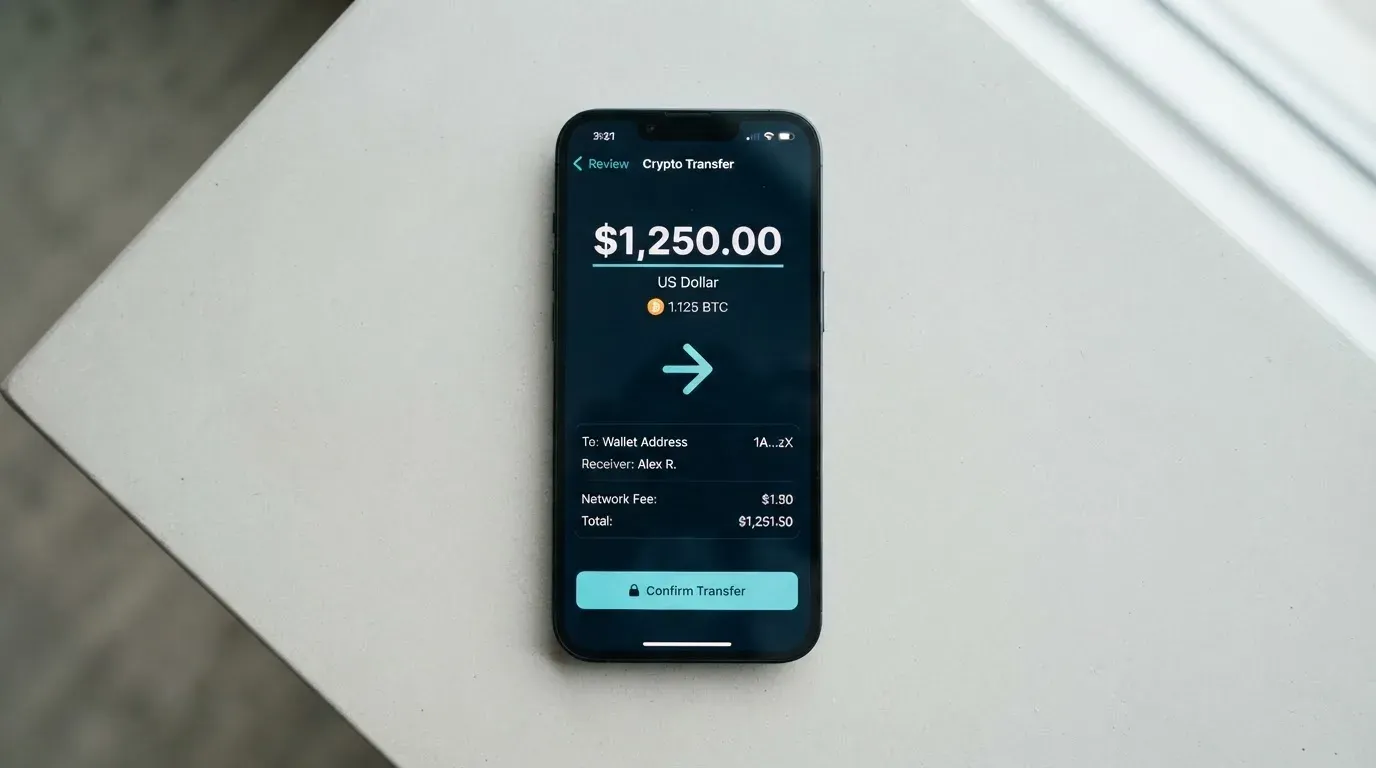
Top up with stablecoins. That is the mechanism, and the sequence is short: in the app, open the Card tab, choose Deposit, then approve the transaction in your wallet. Solana is the supported chain; other networks are added at the issuer’s discretion.
Three things I could not pin down, and they are all the things you would want before you commit money. Which specific coins are accepted is not stated. The minimum top-up is not stated. And whether you can fund by card, bank transfer or anything other than crypto is not stated. If you are used to cards you can top up with a bank transfer in thirty seconds, this is a different workflow: your own crypto has to move first.
The fee is quoted three ways by official pages — 1%, 0.5%, and $0.10 flat — and I would plan on the highest of them.
Then two structural details. Cards deactivate after 6 months of inactivity, and reactivating means a new card issuance, not a switch. And how to withdraw your card balance back to your wallet is not covered anywhere: neither the top-up page nor the terms explain it. The terms say only that the balance can be repaid anytime without penalty, that chargebacks resolved in your favour are credited to the Solayer Account, and that on termination the card must be surrendered. If you are the kind of user who keeps money on a card for a while and then takes it out, that unanswered question is worth asking support before you load anything.
Paying with it every day
The daily experience is the strongest thing about this card. Virtual and physical Visa, Apple Pay and Google Pay for contactless, spend in USD with everything else converted to USD. Merchant categories are restricted: gambling-related activity is prohibited, as are cash-like transactions such as traveler’s cheques, foreign currency, money orders, wire transfers and cryptocurrency itself.
On a physical card, ATM use works where Visa ATMs are available, up to $250 per withdrawal including surcharges, three attempts per rolling 24 hours. The terms, however, say cash advances are not available. Both statements are on the card’s own pages.
Rewards exist but are loosely specified. No cashback rate is stated. What is stated: points from spending and referrals, ecosystem perks, and yield on eligible balances. There is no tier ladder to climb.
The app is Solayer Pay, on both the Apple App Store and Google Play. On the app store ratings themselves the picture is thin and contradictory — an App Store US rating of 5.0 from two ratings, a third-party count of 500+ Google Play downloads, and a separate report from March 2026 showing 0.0. Those figures are not read from the stores directly; take them as evidence that nobody has written a proper review yet, in either direction.
If something goes wrong with a purchase, the route is: ask the merchant first; if unresolved or unauthorised, start a chargeback in the Solayer Account; report within 60 days at most after the charge posts on the periodic statement. The card network may want extra documents, the disputed amount may stay due while the dispute runs, and if you win, the money is credited to the Solayer Account.
What can go wrong
The main thing that can go wrong is the one nobody can quite describe: the entity behind the card.
The issuer is Third National, per the card terms. The Solayer legal entity and its licences are not stated. Those are two different gaps and both matter — one tells you who stands behind the balance, the other tells you which regulator can make them behave.
The custody description conflicts with the marketing. The documentation describes provider-operated hybrid custody: hot wallets hold a small operational balance, cold wallets hold most assets offline with multi-signature, and there are “circuit breakers that freeze suspicious activity”. A lost card can be frozen and unfrozen instantly in the Solayer Card Dashboard. The marketing calls the card non-custodial and fully on-chain. Those two descriptions are not the same architecture, and a reader who only read the marketing would form the wrong mental model of where their money sits. Two-factor authentication, spending controls and insurance are not stated.
On complaints: I found none. No Trustpilot page for the Solayer card, no Reddit or forum complaints, no official incidents. A third-party site noted independent feedback is minimal. Take that as genuinely thin data rather than a clean record — a young product with almost no users has almost no complaints, which is not the same as being trouble-free.
The history is short. It launched in April 2025 as the Emerald Card, was renamed Solayer Pay per a May 2026 press release, and the physical card arrived in a press release dated 14 May 2026. A widely quoted 1% cashback and 10% first-purchase offer appears to have been a 2025 campaign, and it is not something to plan around. One detail worth knowing because it affects your setup: early on, top-ups were Solana-wallet only, with Blockmedia reporting over $15 million in cumulative top-ups.
Support runs through the Solayer Discord. The terms also give [email protected] and the phone number +1 (734) 510 1402.
What to take instead
I compare against three cards I looked at, on published figures.
| Card | Score | Card | Fees | Rewards |
|---|---|---|---|---|
| Solayer | 6.2 / 10 | Visa, virtual and physical | $20/year; $0.10 + 1.5% or 1.75%; cross-border up to 3%; top-up quoted 1%, 0.5% or $0.10 | No cashback rate stated; points from spend and referrals |
| TokenPocket | 5.8 / 10 | Visa/Mastercard debit, virtual; on Arbitrum | Small NFT creation fee partly covered; “apart from these, TP Card does not charge any additional fees”; 1% on crypto deposit | No cashback; the 1% deposit fee said to be refunded later via rewards |
| MetaMask | 7.1 / 10 | Mastercard; virtual instantly, metal pre-orderable | Virtual free, no annual fee; metal $199/year; “minimal fee for each transaction”; no foreign transaction fee | Cashback in mUSD: Virtual 1%; Metal 3% capped at first $10,000 spent |
| KAST | 6.1 / 10 | Visa Platinum, Infinite metal, Infinite gold; physical and virtual | Stablecoin top-up 0%, USD spend 0%, non-USD FX 0.5%–1.75%, under $25 non-USD $0.10 | USD cashback: Standard 1.5% on first $2,000/month, Premium 2% on first $10,000, Private 3% on first $40,000 |
MetaMask is the one I would point at first, and the reason is transparency rather than price. Sign-up is open in 45 listed countries and territories with proof of residency required, and the rule that ineligible regions limit sign-ups but not spending is a cleaner design than a citizenship ban. Its fee disclosure is the most honest of the four: a “minimal fee for each transaction” with a linked table, no foreign transaction fee, and Mastercard’s rate. Spending comes directly from your connected wallet across Linea, Base, Monad and Solana, from mUSD, wETH, EURe, GBPe, USDC or USDT. The catch is the metal card at $199 a year, and one detail that bites Solana users specifically: a Solana-only wallet cannot withdraw credit. US and UK sign-ups are temporarily closed per the FAQ.
KAST is the one to look at if fee transparency on stablecoins is what you care about. Stablecoin top-up 0%, USD spend 0%, Apple and Google Pay 0%, non-USD FX 0.5%–1.75%, and real tiered cashback in USD from 1.5% up to 3% by tier. But the tiers are the catch: Standard is free, Premium is $1,000 a year and Private is $10,000 a year. Eligibility is residence-based, shown at KYC, and no country list is published — plus holding an ID from a restricted region can disqualify you even from a supported country, and VPN does not bypass it.
TokenPocket scores lowest and the reason is structural: virtual cards only, on Arbitrum rather than Solana, and a 1% fee on crypto deposits that is described as refunded later through rewards. That “later” is doing a lot of work. Its eligibility list is the widest of the four, though.
Who I would recommend it to
Three people, specifically.
If your stablecoins already sit on Solana and you want to spend them in ordinary shops without moving them first, this card does that job cleanly, and the 8/10 on everyday use is not generous — it is descriptive. Apple Pay, Google Pay, a physical Visa, a working ATM. Most cards in this category cannot say all three.
If you are put off by upfront cost, you will not be put off here. $20 a year is low, the virtual card is covered by the first-year activation fee, and delivery is $24.99 domestic.
If you are choosing on disclosure — and if you are reading this page at all, some part of you is — pick another card. Not because this one is dishonest, but because you should not have to reconcile three pages to find out what a fee is, and you should not have to guess whether “non-custodial” describes your money accurately.
And if you are in a restricted country or hold a restricted passport, none of this applies to you, and no amount of residence elsewhere changes it.
Frequently asked questions
What is the Solayer card?
The Solayer card is a Visa payment card that spends from a stablecoin balance you load yourself, rather than from a bank account. It exists in virtual and physical form, is issued by Third National under licence from Visa, and is aimed at stablecoin holders, particularly on Solana. It also has an app, Solayer Pay, with a points scheme. It is a payment product with crypto behind it, not a bank account.
Is Solayer a bank?
No, and this is worth being clear about. Third National is named as the issuer in the card terms, but the Solayer legal entity and its licences are not stated anywhere on the public pages. Visa and Mastercard do not issue crypto cards themselves; they license issuers, and the crypto brand is often just the programme manager in front. So there is an issuing institution behind the card, but the crypto side of the operation is not clearly identified.
How do I get the Solayer card?
You need to be 18 or older, live in or hold citizenship of a permitted country, and pass KYC. The flow asks for your country of residence, address, occupation, annual salary and an email code, then a passport, driver’s licence or Aadhaar with a face liveness check. Approval takes 3 to 5 business days after KYC. A physical card costs $24.99 for US delivery or $59.99 international.
Does Solayer card require KYC?
Yes. Identity verification is mandatory, using a passport, driver’s licence or Aadhaar card, uploaded on both sides in JPG, PNG, HEIC, WEBP or PDF up to 50MB, plus a face liveness check. The specific rejection reasons and the document tiers are not stated. Also worth knowing: eligibility rules cover citizenship as well as residence, so the list of barred countries applies to your passport, not just where you live.
How much does the Solayer card cost?
Membership is $20 a year, covering card access and maintenance for 12 months, and new users pay a one-time $20 activation fee that covers the virtual card for the first year. Delivery of a physical card is $24.99 (US Express) or $59.99 (International Express). Spend costs $0.15 in USD, or $0.10 + 1.5% outside the US, with a cross-border fee of up to 3% on top. No issuance fee is stated.
Can I top up the Solayer card with normal money?
The card’s own pages describe topping up with stablecoins only, on Solana, with other networks added at the issuer’s discretion. Whether bank transfer or card funding is offered is not stated, and the minimum top-up is not stated either. The fee is quoted three different ways by official pages: 1%, 0.5%, and $0.10 flat. Plan for the highest of those. No specific coins are named.
Can I use the Solayer card in my country?
Only if your country is neither on the restricted list nor caught by the citizenship rule. The list includes Russia, Belarus, most EU states, the UK, Switzerland, Turkey, the UAE, India, China and Ukraine, and the wording bars citizens of those countries “regardless of their current place of residence”. Armenia, Kazakhstan, Azerbaijan, Uzbekistan and Kyrgyzstan are not on the list, so they are not excluded, though eligibility is not confirmed. No list of eligible countries is published.
Is the Solayer card safe?
It depends on what you mean. The documentation describes hybrid custody with cold storage, multi-signature and “circuit breakers that freeze suspicious activity”, plus instant card freeze in the dashboard — but the marketing calls it non-custodial and fully on-chain, which is a different architecture. The issuer is named; the licences are not. No complaints were found, which for a young product with few users means thin data rather than a clean record.
Is the Solayer card free?
No, but it is close. There is a $20 annual membership and a $20 one-time activation fee for new users. The physical card has no card fee — only the shipping charge. What is not stated is any issuance or monthly maintenance fee; the product page lists no card fees at all. The term that catches people is the $20 membership, which is charged annually rather than monthly.
Is the Solayer card worth it?
If you hold stablecoins on Solana and want to spend them without moving them first, the everyday mechanics justify themselves: virtual and physical Visa, Apple Pay and Google Pay, and ATM on the physical card. I scored it 6.2/10. What holds it back is not the product but the paperwork — the top-up fee quoted three ways, non-USD fee quoted two ways, the ATM and physical-card pages contradicting the terms, and no licence disclosure. If you want clarity, MetaMask or KAST publish their numbers more plainly.
Wallet card fees and costs – cryptocardfacts
Content created by the «cryptocardfacts» team