
THORWallet Card Review: A DeFi Wallet With a Mastercard Face
 Available in US
The THORWallet card is one of those crypto cards that promises to turn a self-custody wallet into something you can actually use at a shop. On paper it ticks a lot of boxes: a Mastercard (virtual, and physical on the pricier tier), a Swiss IBAN, top-ups in USDC with no fee from THORWallet itself, and a stated availability in more than 170 countries. On the other hand, the card is issued through a partner, the licence situation is not spelled out, and the app’s store rating sits just under four stars. So is it worth your money? I went through the card’s own pages and the surrounding facts and give you a clear verdict below, along with every fee, every limit, and an honest account of where the risks actually sit.
The conditions described here are current as of October 28, 2026.
Verdict: 7.5 out of 10 — good for DeFi users, patchy for everyone else
The card scores 7.5 / 10 overall. That is not a “buy it and forget it” score; it is a “this does something specific quite well, but read the fine print” score. It suits people who already live in the crypto world — you hold your own keys, you are comfortable moving USDC on a network, and what you want is a card that spends straight out of that balance and an IBAN that appears conventional. It does not suit someone who wants a plain bank card with no crypto involved, or someone who needs the issuing bank, the licence and the card scheme spelled out in plain language.
Let me break that total down the way I scored it, so you can see where the strength and the weakness actually sit.
| Criterion | Mark | Why |
|---|---|---|
| Who can get it | 9 / 10 | Available in “170+ countries” including the US, but availability “depends on the user’s country of residence, verification status” and other eligibility rules. |
| Cost | 7 / 10 | Basic $5 once; Premium $99 with an invite code (listed $124). Top-up 0%, FX markup 1.5%, ATM $1 at home and $5 abroad. |
| Top-up options | 6 / 10 | USDC top-ups carry no THORWallet fee; an older page pointed to USDC on Arbitrum, other crypto swapped in-app, and a bank transfer. |
| Reliability and complaints | 6 / 10 | EMM Ventures AG (Zug) is behind it; card and IBAN run through Fiat24; the issuing bank and licences are not disclosed. No complaints found; App Store 3.9 / 5 from 120 ratings. |
| Everyday use | 9 / 10 | Premium gives a virtual and physical Mastercard, Apple Pay and Google Pay on the virtual one, and a $2,500 ATM cap per transaction. Basic is virtual only. |
The audience this card is genuinely built for, I’d say, is DeFi wallet users who want a Mastercard and an IBAN. If that is you, the 9s on availability and everyday use are real and you will feel them. If you are anything else, the 6s on cost transparency and reliability are what you will feel.
My advice, in one line: if your money is already sitting in crypto and you want to spend it without touching an exchange, look closely — but read the section on who issues this before you put anything on it.
Will they give you the card?
Availability is broad but not automatic. The card’s FAQ says it is available in “170+ countries” including the United States, but it also says availability “depends on the user’s country of residence, verification status” and other eligibility rules. Russia does not appear in the country list. In other words, this is not “turn it on anywhere”; the rule is by where you live and how far your verification has gone.
There is a second, older layer to this. An older IBAN/Mastercard FAQ described a Swiss IBAN available in “50+ countries” and country-based standard monthly bank limits — $100,000 for the EU, UK and similar, but only $1,000 for countries such as Turkey, Georgia, Armenia, India and Argentina. So the limit you are handed can depend heavily on where you are registered, and that is worth knowing before you plan around spending.
The practical takeaway: check whether your country of residence is on the current list, and expect your starting limit to be set by your verification level, not by what you would like it to be.
How to get it
Getting the card is a short, app-based process. You install the app, complete verification, and order the card. For the Basic tier the card is described as “ready in 5 minutes.”
That word “virtual” matters. The Basic tier is a virtual card only; the Premium tier gives you a virtual and a physical Mastercard. The virtual card can be added to Apple Pay and Google Pay. The card currency is USD. If you also take the Swiss IBAN account, it supports CHF, EUR, USD and RMB, and the card debits the matching currency account in the app.
There is one honest gap here. Delivery details are not stated on either FAQ page: which countries the physical card ships to, how long it takes, what it costs to send, and what a replacement costs — none of that is published. So if you are buying Premium mainly for the physical card, you are buying something whose shipping terms you will have to look up yourself or ask support about.
Fees: what it really costs
The headline numbers are friendly; the details have a few sharp edges. Let me give you the full picture before the examples.
| Fee or limit | Value |
|---|---|
| Basic card issuance | $5 one-off (free with an invite code) |
| Premium card issuance | $99 with an invite code (listed $124), one-off, no subscription |
| Swiss IBAN account | Free |
| Monthly fee | None stated |
| Top-up fee | 0% |
| Card FX markup | 1.5% (Basic and Premium) |
| ATM fee | $1 domestic / $5 international |
| ATM limits | $2,500 per transaction; $10,000 daily; $20,000 monthly (Basic) / $60,000 (Premium) |
| Free ATM allowance | Not stated |
| POS daily limit | $50,000 (Basic) / $500,000 (Premium) |
| POS monthly limit | $100,000 (Basic, after verification) / $1,000,000 (Premium) |
Now, three ordinary payments and which of these actually bite.
A coffee abroad. This is where the 1.5% FX markup hits. You are in a local currency, the card is a USD card, so every conversion carries that 1.5% on both tiers. On a small purchase it is a few cents; on a large one or a currency with a weak rate it adds up. There is no free ATM allowance stated either, so if you take cash out you pay the fee — $1 at home, $5 abroad — on top of whatever the ATM operator charges.
An online subscription in dollars. Here the FX markup does not apply if you are billed in USD, and there is no THORWallet transaction fee stated on top. The thing to watch is 3-D Secure: Mastercard runs it as “Identity Check,” which can send a one-time code or a biometric prompt. Some foreign-issued cards also fail the Address Verification Service check, which is mainly a US/Canada/UK thing, so an occasional decline is not unheard of with this kind of card.
A transfer from your own wallet to fund it. Topping up in USDC carries a 0% THORWallet fee. But the blockchain is separate from the card provider: on-chain network fees (gas) for your deposit are charged by the network itself, not by THORWallet. Who exactly pays those network fees for a top-up is not stated, so do not assume it is all covered. And the older page’s mention of a 1% / 0.5% / 0.25% crypto top-up fee by tier belongs to an earlier Fiat24 tier structure (Standard / Gold / Platinum), not to the current Basic / Premium plan — treat it as history, not as today’s price.
One more thing the fine print says, and it matters: fees and limits are “indicative” and vary by jurisdiction and verification. So the table above is the honest starting point, not a guarantee for your specific case.
Top up: how the money gets in
Topping up is where this card is at its simplest, and also where the old and new information diverge a little. The current answer is USDC, with a 0% THORWallet top-up fee on both plans. The minimum top-up is not stated, so there is no published floor I can quote you.
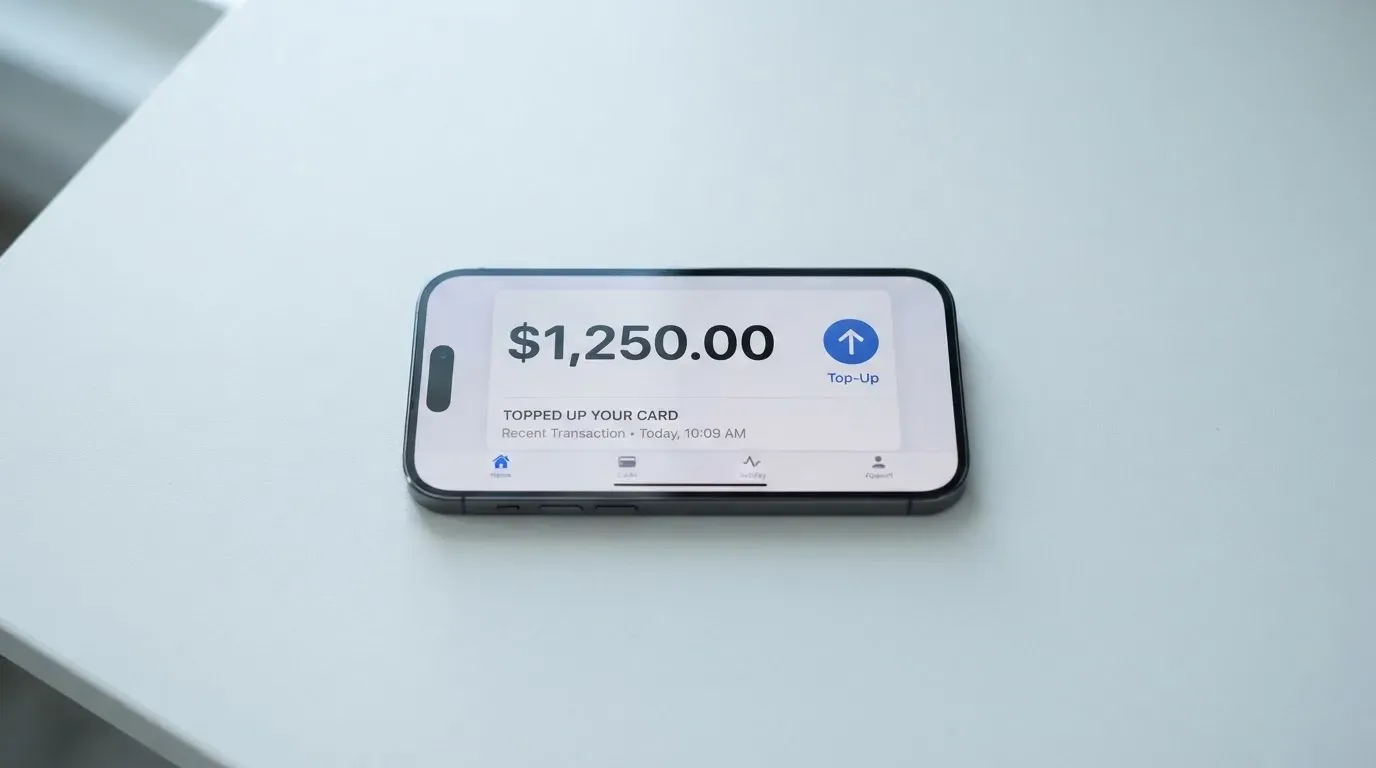
The older Fiat24 page tells a slightly more detailed story: USDC on the Arbitrum network, other crypto swapped inside the app, and a direct bank transfer as an option. That is still a reasonable mental model for how the top-up works in practice — you send or convert into a stablecoin, and the balance lands ready to spend. But if you are planning around “USDC on Arbitrum” specifically, confirm the current network in the app, because the network detail that is published comes from an older page.
Two cautions to carry with you. First, blockchain transfers are irreversible, so a deposit sent on a network the provider does not support — or to an address belonging to a different network — can be lost, or need manual support recovery with no guarantee. Second, who pays the network fee is not stated. Getting the network right is the single most important step in topping up, more important than the 0% headline.
Paying with it every day
Day-to-day this is a competent card, better than its reputation for caution suggests. Apple Pay and Google Pay work on the virtual card, which is how most people will actually use it — you tap your phone and the virtual card is the one in play. Basic gives 0% cashback; Premium gives 0.5% cashback in USDC, capped at $5,000 of spend in the first year (the FAQ later describes the cap as $2,000/month), and higher cashback for eligible $TITN stakers. The Swiss IBAN itself carries no cashback.
The spending limits are generous on the top tier. Basic allows $20,000 per in-person transaction, $50,000 a day and $100,000 a month once verified — though note that Basic actually *starts* at a $10,000 monthly limit right after the standard verification done during card setup, and reaching the higher figures needs an extra questionnaire and a review. Premium lifts this to $100,000 per transaction, $500,000 a day and $1,000,000 a month. Cash at ATMs runs to $2,500 per withdrawal, $10,000 a day, and $20,000 (Basic) or $60,000 (Premium) a month.
Two everyday-use things the card’s pages do not cover: which merchant categories are blocked (gambling is often blocked by policy rather than law, and the list varies by issuer — but this card does not publish one), and what the dispute or refund process is if a purchase goes wrong. Neither is stated. Support is 24/7 in-app chat — “Standard” on Basic, “Priority” on Premium.
What can go wrong
Nothing here is a red flag in itself, but there are real gaps, and for a card that touches your money I would rather name them than round them off.
The issuing bank is not named. This is the biggest single thing to sit with. THORWallet’s own terms say it is not the card issuer — the card contract is with the provider, and the card and IBAN run through Fiat24 (Swiss). The issuer or BIN sponsor bank is not named on the pages, and licences are not stated. THORWallet also says plainly that it is not a bank, e-money institution or payment institution. So you are holding a card whose issuing institution you cannot identify from the published material. Some third-party writing even carries a “regulated by BaFin” heading while the body only says the fiat on-ramp provider is fully regulated in Switzerland — a mismatch worth ignoring.
Nobody found complaints — which is not the same as nobody having them. A search turned up no THORWallet-specific Trustpilot or Reddit complaints; the results that came back were for other brands (Trust Wallet, CL Card). A Trustpilot page exists for thorwallet, but no score or count was read. The App Store rating is 3.9 out of 5 from 120 ratings. So the honest read is: no recurring complaint themes surfaced in one search, but also no body of satisfied reviews to lean on. And the card contract sits with an unnamed provider, which is precisely the situation where a dispute can get complicated.
App and access. The iOS app is rated 3.9 / 5 from 120 ratings, needs iPhone iOS 17.0 or later, and the listing is in English only. The Google Play rating was not read. The Swiss IBAN exists only in the mobile app, not the web app. Support is 24/7 in-app chat, with unofficial reports of German-language support and a Discord ticket channel. If your money is in the IBAN and your phone is gone, that is a worse position than it sounds.
Not stated that you may want to know. Withdrawing card balance back out, account closure and what happens to a leftover balance are not covered on either FAQ page. Card freeze, two-factor authentication, spending controls, and any insurance or safeguarding of funds are also not stated. In the category generally, a declined authorisation can leave a hold on your balance for several days, sometimes up to seven — worth remembering before you try to spend right after a failed payment.
The self-custody side has its own risks. The app presents itself as a non-custodial DeFi wallet, and crypto in a self-custody wallet stays yours — but that also means it is yours to lose. A stolen private key has no recovery: blockchain transfers are irreversible and the network cannot freeze or return funds. Clipboard-hijacking malware that swaps a copied address is a real and common theft vector. Holding with a custodial platform carries the opposite risk, and the category has a record of it — Mt. Gox, Coincheck and Ronin Network are the standard cautionary examples. With THORWallet you are taking on the self-custody version of that risk, on top of the card’s issuer opacity.
A tax footnote that is not really a footnote. The IRS treats digital assets as property, so spending crypto generally produces a taxable gain or loss, measured in your local currency at the value on the date of the transaction. I am not going to advise you on your taxes — but every card payment funded from crypto can be its own taxable event, and that is worth checking against a professional rather than assuming the card hides it.
What to take instead
If THORWallet is not the right shape for you, three comparable crypto cards scored better or differently on my criteria, and it helps to see them side by side.
- MetaMask Card — 7.1 / 10. A Mastercard that spends directly from your connected wallet, no custodial top-up step. Virtual card is free with no annual or maintenance fee; the Metal card is $199/year. Cashback is paid in mUSD: 1% on Virtual, up to 3% on Metal for the first $10,000 spent then 1%. No MetaMask fees and no foreign transaction fee, though it lists a “minimal fee for each transaction” of unstated amount. Sign-up is open in 45 listed countries/territories with proof of residency, others waitlist, and US/UK sign-ups were temporarily closed.
- KAST — 6.1 / 10. A stablecoin-balance card with the most transparent fee schedule in this group: stablecoin top-up 0%, USD spend 0%, transaction fee 0%, Apple/Google Pay 0%, non-USD FX 0.5%–1.75% depending on where you live and where you’re spending. Cashback is 1.5% / 2% / 3% on the first 2,000 / 10,000 / 40,000 USD a month by tier. But membership costs money above the free tier — Premium is 1,000 USD/year, Private 10,000 USD/year — and it is a Visa, not a Mastercard.
- TokenPocket — 5.8 / 10. A Visa/Mastercard debit running on Arbitrum, virtual only, split by region (Visa for much of Europe, Mastercard for Asia-Pacific and others). It charges a 1% fee on crypto deposits, refunded later via rewards or lower transaction fees, and otherwise claims no additional fees. No cashback stated outright.
The honest comparison: if the thing you care about most is the *cheapest, clearest* spending, KAST’s fee table is the most legible and MetaMask’s free virtual tier is the cheapest entry. If you care most about *spending straight from a self-custody wallet with no top-up detour*, MetaMask is the closest to that idea. THORWallet’s distinctive offer is not the fee schedule — it is the combination of a DeFi wallet, a Mastercard and a Swiss IBAN in one app. If that combination is what you were after, THORWallet earns its place; if it is not, one of the three above is a cleaner fit.
Who I would recommend it to
I would point THORWallet at a specific person: you already hold crypto in a self-custody wallet, you are comfortable picking a network and sending USDC, and what you want is to spend that balance at ordinary merchants — with a Swiss IBAN in the same app as a bonus. You will like the 0% top-up fee, the virtual card in Apple Pay, and the fact that it works in a very large number of countries. You should go in knowing the FX markup is 1.5%, that the Basic tier starts you at a $10,000 monthly limit, and that the issuing bank is not named.
I would not point it at someone who wants a normal bank card, who needs the ATM to be free, who needs to know exactly which institution regulates and issues the card, or who plans to lean heavily on cash withdrawals or on the Swiss IBAN’s own features. For those, a conventional bank card — or one of the alternatives above — is the more predictable tool.
My honest one-line verdict: it is a capable, well-priced card for someone who already lives on-chain, wrapped in more issuer opacity than I would like, and best treated as a spending tool rather than as a place to hold a balance you are not actively using.
Frequently asked questions
What is the THORWallet card?
The THORWallet card is a Mastercard that spends from a crypto balance held in the app, plus an optional Swiss IBAN account in the same place. The Basic tier is virtual only; Premium adds a physical card. The virtual card can go into Apple Pay and Google Pay. The card currency is USD, and the IBAN supports CHF, EUR, USD and RMB. It is aimed at people already using a self-custody DeFi wallet.
How does the THORWallet card work?
You install the app, complete verification, and order the card — Basic is described as “ready in 5 minutes.” You top up with USDC at a 0% THORWallet fee, and the balance behaves like a prepaid account the card spends from. Spending in a non-dollar currency adds a 1.5% FX markup. Note the card contract is actually with the provider, not with THORWallet, which is not the card issuer.
Is THORWallet a bank?
No. THORWallet says it is not a bank, e-money institution or payment institution, and its terms say it is not the card issuer. The card and IBAN are delivered through Fiat24, a Swiss provider. The issuer or sponsor bank behind the card is not named on the pages, and licences are not stated. Think of it as a crypto app with a card front-end, not as a bank.
Who owns THORWallet?
The footer names EMM Ventures AG, based in Zug, Switzerland, as the operator behind THORWallet. The card and IBAN themselves run through Fiat24. No issuing bank is disclosed. Some third-party writing has carried a “regulated by BaFin” heading, but the body of that writing only says the fiat on-ramp provider is fully regulated in Switzerland.
In which countries is the THORWallet card available?
The FAQ says “170+ countries” including the US, but availability “depends on the user’s country of residence, verification status” and other eligibility rules, and Russia is not on the list. An older FAQ described a Swiss IBAN in “50+ countries” with country-based monthly bank limits — $100,000 in the EU/UK, but only $1,000 in places like Turkey, Georgia, Armenia, India and Argentina. Check your own country first.
Does the THORWallet card require KYC?
Yes — KYC is mandatory for the banking/card side and is verified by the Fiat24 team, and THORWallet says it does not store the KYC data. Third-party sources report that email, phone and an ID document are required, with no proof of address or selfie. The provider may also ask about source of funds, wealth and tax residence. The exact document list and processing time are not stated.
How do I top up the THORWallet card?
Top up with USDC — the THORWallet fee is 0% on both plans. An older page specified USDC on the Arbitrum network, with other crypto swapped inside the app and a bank transfer also possible. The minimum top-up is not stated, and neither is who pays the blockchain network fee. Confirm the network in the app, because a deposit on the wrong network can be lost — blockchain transfers are irreversible.
Is the THORWallet card free?
Not quite. Basic is $5 one-off, or free with an invite code. Premium is $99 with an invite code (listed $124), also one-off, with no subscription. The Swiss IBAN account is free, and there is no monthly fee stated. On top of that, spending abroad carries a 1.5% FX markup, and ATMs cost $1 at home and $5 abroad, with no free allowance stated.
Is the THORWallet card safe?
It depends what you mean. The app is a non-custodial DeFi wallet, so crypto control stays with you — but that also means key loss, phishing and clipboard malware are on you, and stolen crypto cannot be recovered. On the card side, the provider runs the KYC, the issuer bank is not named, and dispute and safeguarding arrangements are not stated. No specific THORWallet complaints surfaced in my search, and the iOS app sits at 3.9 / 5 from 120 ratings.
Can I use the THORWallet card in Apple Pay and Google Pay?
Yes, on the virtual card. The card’s Mastercard FAQ confirms both mobile wallets work with the virtual card, which is the easiest way to pay in practice. Apple Pay replaces the card number with a device-specific number and uses a one-time code per payment. Whether any merchant categories are blocked on the card is not stated — gambling, for instance, is often blocked by issuer policy rather than by law, but this card does not publish a list.
Wallet card fees and costs – cryptocardfacts
Content created by the «cryptocardfacts» team