
A closer look at HostFi's virtual crypto card and what its public pages still don't tell you
 Available in US

HostFi is a name that has been showing up in searches as a “crypto card” in Nigeria, alongside promises of paying with digital assets and topping up from a wallet. The product page still labels its cards as “Coming soon,” the App Store listing is the Nigerian storefront, and a great deal of the basic information a reader usually expects from a card review is simply not published anywhere I could find. So this review is partly a tour of what HostFi does say, and partly a clear list of what it does not.
The short version: HostFi is a Nigerian-focused crypto-finance app from a Delaware-registered company called HostFi Services Ltd, trading as Host Finance. It issues virtual Visa or Mastercard cards that you can fund with fiat or digital assets, it has a points-based rewards block that is still marked “Coming soon,” and the cards themselves are also still labelled that way on the website. Most fees, limits, supported coins and networks, KYC documents, the issuing bank and the company’s licences are not stated on the pages a normal user can read. That is a lot of unknowns for a product that asks you to keep a balance on a card.
I have read the public pages and the App Store listing, and I have searched for outside coverage, complaints and trustpilot reviews; that is what I am reporting on here. I do not have a HostFi card in my hand.
Conditions are current as of October 28, 2026.
Verdict
HostFi scores 4.3 out of 10 in my reckoning. The score reflects the fact that the public material gives you very little to act on: the company, its licences and its issuing bank are not named, fees and limits are not stated, supported coins and networks are not listed, and the cards themselves are still labelled “Coming soon” on the site. The product is also Nigeria-only by appearance, and the App Store listing concentrates on Naira virtual cards. That makes it a difficult recommendation for anyone outside Nigeria, and even for users in Nigeria the missing numbers are a real obstacle.
| Criterion | Mark | Why |
|---|---|---|
| Who can get it | 4/10 | Only “selected countries” mentioned; App Store is Nigeria; Nigerian law governs the terms |
| Cost | 5/10 | No issuance, conversion, FX, ATM or monthly fees disclosed on the public pages |
| Top-up options | 4/10 | “Fiat or digital assets” is the only line; coins and networks are not named |
| Reliability and complaints | 5/10 | No licences or issuing bank named, no complaints found, App Store rating 4.3 from 89 ratings (read 2026-10-21) |
| Everyday use | 3/10 | Virtual only, Visa or Mastercard, no wallet support stated, rewards block marked “Coming soon” |
| Total | 4.3/10 |
This is a card for a very specific reader: a user in Nigeria who wants a virtual Visa or Mastercard topped up from the HostFi app, who is comfortable that several basics are still unannounced, and who is not planning to rely on a physical card, an ATM, or a published fee schedule. If that is not you, the alternatives later in this review will suit you better.
Who will they give you the card
The short answer is that the public pages do not tell you, in detail, who is eligible. The site says only that “Some products are available only in selected countries,” without naming the countries. The terms are governed by the laws of Nigeria, the App Store storefront is the Nigerian store, and the App Store release notes talk about Naira virtual cards. The combination of those three signals points to a Nigeria-first product, but it is not the same as a published country list, and there is no statement of age, residency, citizenship or document requirements anywhere I could find.
For context, this is a pattern that comes up with smaller crypto-card programmes: the marketing is global, but the legal reality is one or two jurisdictions. The HostFi terms go further than that, anchoring the relationship to Nigerian law, so if you are reading this from outside Nigeria, the page is useful mainly as a warning to expect the card either to be unavailable to you or to behave differently from how a local card would.
What is also missing is the usual roster of KYC facts: documents, proof of address, age minimum, and any tiered verification. The site does not state any of these. I treat that as a “not stated” fact, not as a confirmation that no checks apply, because regulated card programmes almost always verify identity somewhere in the flow even if the marketing page is silent.
If you are a Nigeria-based user, the App Store description and release notes suggest that the card is what you would actually be applying for; if you are elsewhere, the same pages do not promise availability to you. I would not sign up on the assumption that a card will be issued to a non-Nigerian applicant.
How to get it
The sign-up flow is, again, only partly described in public. The App Store says you can fund cards with fiat or digital assets and that several cards can be created, which implies the in-app process is to register, verify if verification is required at all, pick a card network, and then create a virtual card. The site itself is light on step-by-step instructions, and the “Cards” block is still labelled “Coming soon” on the date I checked.
The card is virtual only. There is no physical card mentioned anywhere on the official pages, and no delivery procedure to consider. When you create a card, you choose between Visa and Mastercard, and you also “choose your preferred currency.” The site does not list which currencies are offered. Naira is implied by the App Store context, and other currencies are not ruled out, but I cannot tell you a list.
The activation step is not described either. With many virtual cards, activation happens the first time the card details are loaded into a wallet or used online; the public HostFi pages do not spell that out, so I would expect to learn it in-app rather than from the marketing site.
What this means for you: you can probably download the app, register, and attempt to create a card, but the rest of the journey — identity checks, the currency choice list, the supported coins for funding — is a discovery exercise rather than something you can plan around in advance.
Fees
This is the section where HostFi’s public material is thinnest, and it is the section that matters most if you are about to put money on a card. Issuance fee, monthly fee, conversion fee, FX margin, ATM fee, daily and monthly spending limits — none of these are stated on the official pages. The site does not publish a fee schedule, the App Store description does not list one, and the release notes I read do not fill the gap.

I will not invent numbers. The honest position is that I cannot tell you what a HostFi payment will cost, what a monthly fee will be, what FX margin will be applied if you spend in a currency other than the card’s currency, or what an ATM withdrawal would have cost if the card even worked at an ATM, which is itself not stated.
| Fee or limit | Amount on official pages |
|---|---|
| Issuance | Not stated |
| Monthly fee | Not stated |
| Conversion (crypto to fiat at payment) | Not stated |
| FX (cross-currency spending) | Not stated |
| ATM withdrawal | Not stated |
| Daily spending limit | Not stated |
| Monthly spending limit | Not stated |
To make the cost question more concrete, here is what I would want to know for three common cases, and what HostFi’s public material actually says.
- Buying a coffee online with the card. The interesting cost is the conversion from the card’s funding asset to whatever the merchant charges in. HostFi does not publish a conversion fee or a margin, and it does not say which digital assets are supported, so the only honest answer is “I do not know from the public pages.”
- Paying for a subscription in a different currency from the card’s. Cross-currency spending normally carries an FX margin or a flat cross-border fee; HostFi does not state either. If your card is in Naira and you pay a USD subscription, the cost depends entirely on a number the company has not published.
- Withdrawing cash from an ATM. The card is virtual, and ATM use is not described. Many virtual cards cannot be used at ATMs at all; some can, with a fee. HostFi’s pages say nothing about it.
I would treat “not stated” as a reason to ask support directly before loading any meaningful balance, and as a reason to start small if you do decide to try the card.
Top up
Funding the card is described at a high level and not in detail. The App Store listing says cards “can be funded with fiat or digital assets.” The site does not list which fiat rails are available for deposit, does not list which cryptocurrencies are accepted, and does not list the networks on which those cryptocurrencies can be sent. The App Store release notes do mention Naira withdrawals to bank accounts, in the context of HostFi as a “crypto banking app,” but that line is about bank withdrawals from the app’s general balance, not about topping up a card specifically.
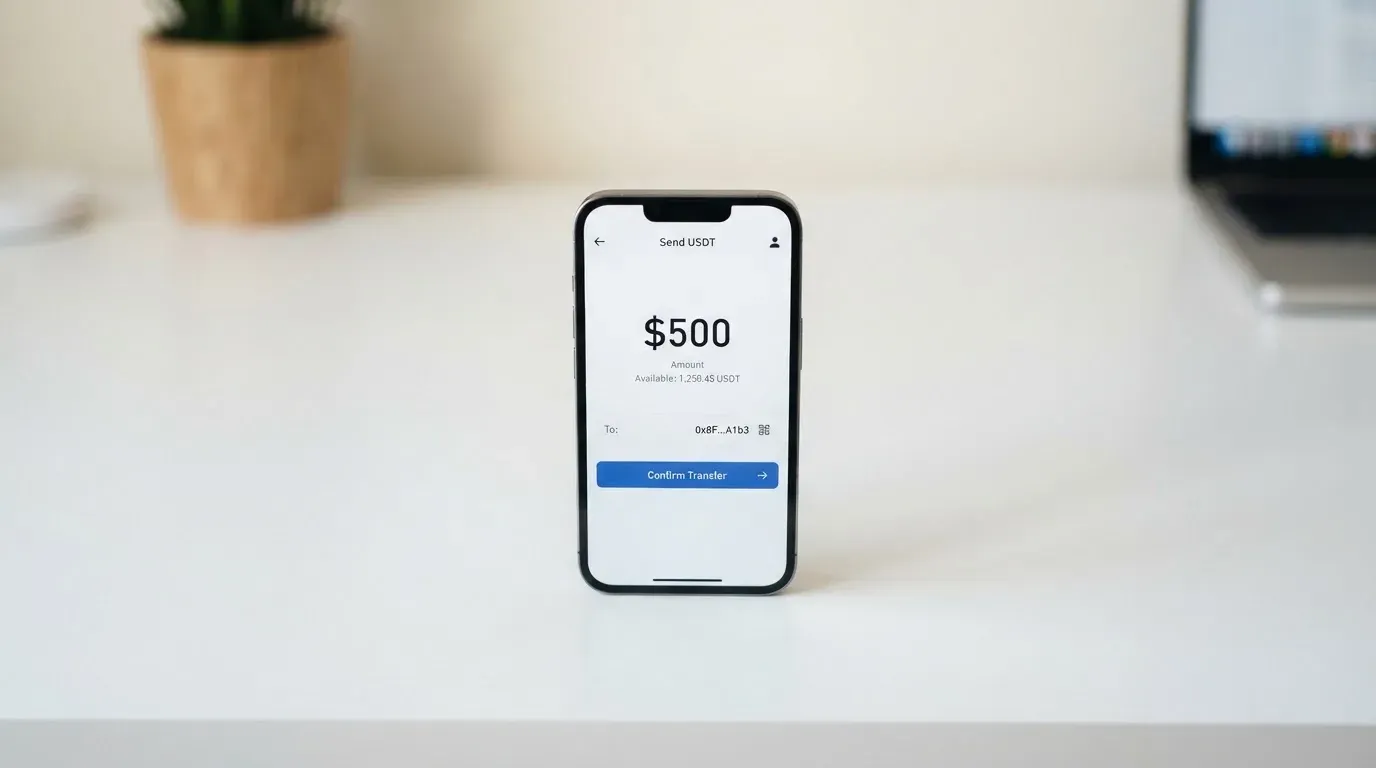
For a crypto-funded card, the network question is the one that most often catches users out. Sending USDT on the wrong network is a common way to lose money, because transfers are irreversible and a deposit to an address on an unsupported chain may not be recoverable. The general background on this is that blockchain transfers are typically one-way, and that support-recovery for misrouted deposits is not guaranteed. HostFi does not tell you, on the public page, which networks to use, so the only safe move is to confirm the deposit network inside the app before sending anything.
If you are funding in Naira, the App Store mention of Naira withdrawals suggests the in-app balance is at least partly Naira-denominated, and it is reasonable to expect an in-app path from a local bank account to the card balance, but this is implied, not stated.
I would not load a large balance until the funding instructions are visible in the app. The risk on this side is not HostFi’s reputation — there are no complaints I could find — it is that misrouted deposits are a category-level hazard that the HostFi pages do nothing to mitigate.
Paying with it every day
The everyday picture is built almost entirely from what is not said. The card is virtual, and you choose between Visa and Mastercard. The site does not state which mobile wallets the card can be tokenised into — Apple Pay, Google Pay, Samsung Pay — and does not say whether online card use is restricted. There is no statement of merchant category restrictions, no statement of gambling-block policy, and no statement of 3-D Secure enrolment, even though those are the practical questions that decide whether a card works at a particular online shop.
The rewards story is also thin. There is no cashback stated. The app does include a points-based rewards programme and a referral programme (“Invite friends to HostFi and earn rewards”), but the rewards block on the site is marked “Coming soon.” If you are signing up for the rewards angle, you are signing up for something that is not yet available, and that does not have a published earning rate.
The App Store rating, for what it is worth, is 4.3 out of 5 from 89 ratings on the Nigerian storefront, read on 2026-10-21. That is a small sample, and it reflects the app as a whole rather than the card specifically, but it is the only number from a third party I could find. Google Play rating is not stated on the pages I could read.
The dispute path is not described either. The site has a help centre and a contact email link, but no statement of dispute procedure, chargeback rights, or how a blocked transaction would be handled. For a virtual card that you would mainly use online, that is a meaningful gap.
What can go wrong
The risks for a HostFi user are a mix of category-level risks and HostFi-specific gaps. I will list them in the order I would check them if I were the one deciding whether to use the card.
- Counterparty risk. HostFi is a custodial product, which means your card balance and any crypto held in the app sit on the company’s side of the ledger. The site mentions “cold storage, multi-factor authentication, and advanced encryption” as platform-wide safeguards, but it does not say whether customer funds are segregated, whether they are safeguarded under EMI rules, or whether the issuing bank or programme manager holds them. The company behind the app is HostFi Services Ltd, trading as Host Finance, with a Delaware address at 1007 N Orange St, 4th Floor, Wilmington, DE 19801, and terms governed by Nigerian law. Licences are not stated, and the issuing bank is not named. The general background here is that several large custodial platforms have failed over the years, and a card user is exposed to the same counterparty risk as any other custodial customer.
- Missing information. The bigger practical risk is the absence of the numbers you would normally compare. If you cannot see fees, limits, supported coins, supported networks, KYC requirements, dispute procedure, or the licence and issuing bank, you are choosing on the basis of marketing copy, not on a fee schedule. That is a different kind of risk from counterparty failure, but it makes any decision harder to justify.
- Card programme changes. The general background for crypto cards is that programmes do get shut down, sometimes with short notice. Network rules let a card network suspend a programme, and a programme manager can also wind a card down. HostFi has no public incidents I could find, but the structural risk is the same as for any programme where the issuing bank and the licence are not visible.
- Sanctions and identity checks. The site does not describe its KYC process, but regulated card programmes do screen customers against sanctions lists and PEP lists. Nationality is part of that screening, separate from residence. If you are in a country HostFi does not support, or if your citizenship triggers a sanctions match, the card will not work. I am not telling you how to get around any of that; I am flagging it so that the reader does not assume the absence of a published KYC page means there are no checks.
- App-only controls. The card is virtual, and the only stated controls are inside the app. If you lose your phone, the path to freezing the card or rotating card details depends on how the app handles lost-device recovery, and that is not described on the public pages.
- No physical card, no ATM. If your everyday use includes cash, this card does not cover it.
- Deposit mistakes. If you top up with crypto on the wrong network, the deposit is likely unrecoverable, and the public pages do not give you the network list to check against.
I searched for “HostFi card reviews trustpilot reddit” on 2026-10-21, and no HostFi-specific results came back; only an unrelated brand called HostFaddy. There is no Trustpilot page for HostFi that I could find. That is not the same as “no complaints” — it means there is no public review footprint to lean on either way. The App Store rating is the only outside signal I have.
What to take instead
The honest comparison here is that the HostFi material is too thin to compare on fees. I have read the public pages of three alternatives and I will describe them on the same dimensions, with the same “not stated” honesty where the page does not give a number.
| Feature | HostFi | Cardex | CardFlow | HyperCard |
|---|---|---|---|---|
| Score | 4.3/10 | 5.6/10 | 4.9/10 | 4.7/10 |
| Card type | Virtual Visa or Mastercard | Crypto debit on VERVE, Visa, Mastercard, UnionPay (virtual and physical) | Virtual USD Mastercard | Prepaid HyperCard |
| Country framing | Nigeria storefront; “selected countries”; Nigerian law | “200+ countries”; App Store Naira-focused | Nigeria (“Nigeria’s smartest fintech card platform”) and “Nigerians and global users” | App Store says card works in “more than 176 countries” (acceptance, not eligibility) |
| Currency | “Choose your preferred currency” (not named); Naira implied | Naira per listing | USD (virtual Mastercard) | USD or EUR balance |
| Creation cost | Not stated | Not stated | “Free” per site FAQ; monthly fee not stated | Not stated |
| Conversion | Not stated | Real-time crypto-to-fiat at payment, with an “AI-Powered Conversion Rate” (no fee % stated) | Not stated | Not stated |
| Funding | “Fiat or digital assets” (coins and networks not named) | USDT, USDC, BTC wallets (networks not stated) | BTC, USDT, ETH, or Naira bank transfer (networks not stated) | Deposit USDT, BTC, ETH in the app, converted to USD or EUR |
| Rewards | Points programme and referral, block marked “Coming soon” | Not stated | Not stated | Not stated |
Reading this, the trade-off is straightforward. Cardex and CardFlow are more forthcoming on country framing and on the funding assets they accept, but they also have meaningful gaps: Cardex does not state fees, CardFlow does not state most fees either, and neither names the networks. HyperCard is a prepaid card with a published USD or EUR balance, but the card network is not stated on the App Store page, and fees are not stated.
If your main criterion is that the company publish enough numbers for you to make a real decision, none of these three is fully there either, but Cardex and CardFlow give you more material to work with than HostFi does. If your main criterion is “virtual Mastercard on the App Store, free to create, with a Naira bank-transfer option,” CardFlow is the closest match to what HostFi appears to be aiming at. If your main criterion is global reach and a multi-network card, Cardex is the closer match.
Who I would recommend it to
I would recommend HostFi, with caveats, to a reader who is in Nigeria, who is comfortable that several basics are not yet published, who wants a virtual Visa or Mastercard from an app that supports both fiat and crypto funding, and who is not planning to depend on cash, a physical card, or a published fee schedule. The points-based rewards block being labelled “Coming soon” matters here: if you are signing up primarily for rewards, you are signing up for something that is not yet live.
I would not recommend it to a reader who is outside Nigeria, who needs to know fees and limits before loading a balance, who needs a physical card, who needs ATM access, who needs a published dispute or chargeback procedure, or who would be uncomfortable with a card programme where the issuing bank and the licence are not named. I would also be cautious if the reader were planning to keep more than a small testing balance on the card, because the counterparty story is not visible on the public pages.
If the cards move from “Coming soon” to live, and if the fee schedule, supported coins and networks, KYC requirements, the issuing bank, and the licences are published, a lot of the gaps I have flagged here would close, and the score would move with them. As of the date on this review, they have not.
Frequently asked questions
What is the HostFi card?
The HostFi card is a virtual payment card issued through the HostFi app, on either the Visa or Mastercard network, that you can fund with fiat or digital assets. The cards block on the HostFi site is labelled “Coming soon” as of the date of this review.
How does the HostFi card work?
You register in the HostFi app, create a card, and load a balance in fiat or in supported digital assets. The card then spends that balance through the Visa or Mastercard rails, much like a prepaid card. The site does not state the conversion mechanics, the supported coins, or the supported networks, so the in-app flow is the practical source of truth.
Is HostFi a bank?
HostFi is not described as a bank on its public pages. The app is positioned as a “crypto banking app” in App Store copy, and the company behind it is HostFi Services Ltd, trading as Host Finance, registered in Delaware with terms governed by Nigerian law. The issuing bank for the card is not named, and the company’s licences are not stated.
Who owns HostFi?
The operating company is HostFi Services Ltd, trading as Host Finance. The published address is 1007 N Orange St, 4th Floor, Wilmington, DE 19801, and the App Store developer is listed as HostFi Services Limited. Ownership beyond the operating company is not stated on the public pages.
Is the HostFi card available in my country?
The site says only that “Some products are available only in selected countries,” and does not publish a list. The terms are governed by Nigerian law and the App Store storefront is Nigeria. If you are outside Nigeria, the public material does not confirm availability to you.
How do I get a HostFi card?
You download the HostFi app, register, and create a virtual card, choosing Visa or Mastercard and a preferred currency. Identity-verification steps are not described in public. The cards block on the site is labelled “Coming soon” as of this review.
Does the HostFi card require KYC?
The public pages do not state what identity checks, if any, are required to open a card. Most regulated card programmes verify identity somewhere in the flow, and sanctions screening is standard, but the specifics for HostFi are not published.
How do I top up a HostFi card?
The App Store says cards “can be funded with fiat or digital assets.” The site does not list the supported coins or the supported networks, and there is no separate deposit-rail page. The in-app flow is the practical source of truth, and you should confirm the network inside the app before sending any crypto deposit.
Is the HostFi card free?
The official pages do not state an issuance fee, a monthly fee, a conversion fee, or an FX margin. I cannot tell you from the public material what it costs to hold or use the card. The absence of a fee schedule is one of the main reasons this review does not give the card a higher score.
Is the HostFi card safe to use?
The site describes platform-wide safeguards including cold storage, multi-factor authentication and encryption, and the App Store rating is 4.3 out of 5 from 89 ratings on the Nigerian storefront as of 2026-10-21. There is no Trustpilot page for HostFi, and I did not find HostFi-specific complaints on the searches I ran. The structural risks are the same as for any custodial card product, and the absence of published licence, issuing bank, and dispute-procedure information makes the safety case harder to verify independently.
Virtual card fees – cryptocardfacts
Content created by the «cryptocardfacts» team