
WebitPay Card Review: A Visa Funded From USDT or USDC, With a Lot Left Unsaid
 Available in US
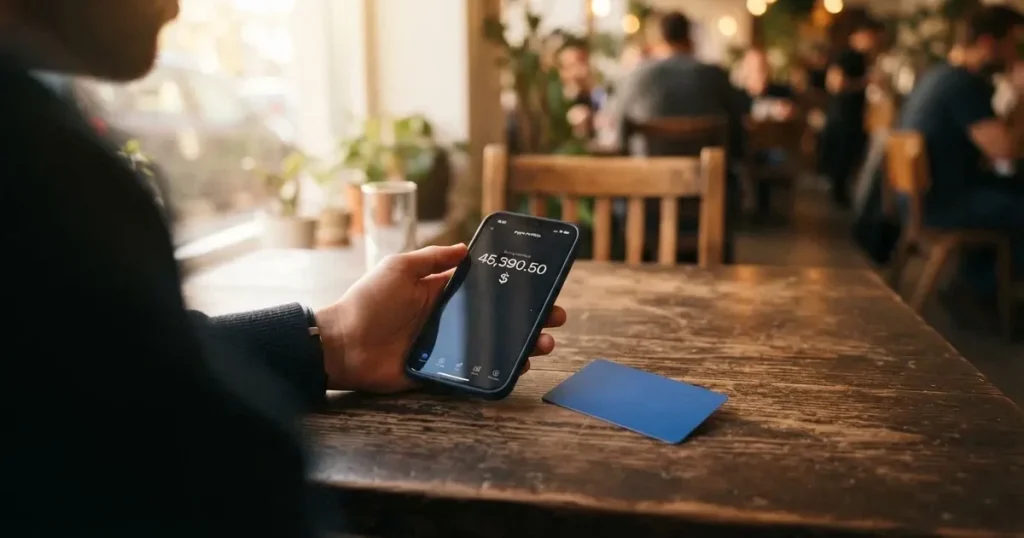
If you are weighing the WebitPay card, you probably already know the basic pitch: a Visa card, physical and virtual, that you load with USDT or USDC and then spend wherever Visa is taken. The promise is simple. The reality, as the public materials show, is that almost every number you would normally compare cards on, fees, limits, supported countries, processing time, is left unstated. The card works, the app exists, and there is no public record of incidents. But anyone trying to decide whether to put real money through it has to make that call with far less information than competitors give you.
This review walks through what WebitPay itself publishes, where the gaps are, and how the card stacks up against three alternatives. Conditions are current as of October 28, 2026.
Verdict
WebitPay earns 6.0 out of 10 in this review. The card’s strongest suit is everyday use: a real Visa, virtual and physical, Apple Pay and Google Pay on the virtual card, ATM access on the physical one. Its weakest suits are everything you would normally rely on a fee schedule to check: a fee page that says it will be published later, no published list of supported countries, no published limits, no published networks for stablecoin top-ups. The company is based in Hong Kong, the card is issued by Reap Technologies Limited, and no financial licence is named for either party.
This card suits a particular kind of user, and it does not suit another. If you want a Visa paid out of a USDT or USDC balance and you are comfortable researching networks, fees and limits directly with support before sending money, WebitPay can serve you. If you want a card where the terms page tells you the issuance fee, the monthly fee, the FX margin, the daily limit and the supported countries before you sign up, this is not that card.
Score breakdown
| Criterion | Score | Reason |
|---|---|---|
| Who can get it | 5/10 | No list of supported countries on the public site; the terms bar anyone under sanctions, and the FAQ refers to a list of prohibited countries without showing it. |
| Cost | 5/10 | The fee schedule is announced as “available on our website” but the numbers are not there; the only stated fee is a 1% currency-conversion charge on ATM withdrawals, plus a separate ATM fee whose amount is not given. |
| Top-up options | 5/10 | USDT or USDC from a personal wallet; the supported networks, minimum and any top-up fee are not published. |
| Reliability and complaints | 7/10 | Webit Information Technology Limited in Hong Kong; the card is issued by Reap Technologies Limited; no licence is named for either; 2FA via Google Authenticator; no public incidents or complaints found; the iOS app has a 5.0 average from only two ratings. |
| Everyday use | 9/10 | Physical and virtual Visa; the virtual card works in Apple Pay and Google Pay; the physical card supports ATM withdrawals. |
| Total | 6.0/10 | A working Visa on a stablecoin balance, undermined by missing numbers on cost, country coverage and limits. |
Who can get the WebitPay card
WebitPay’s public materials do not state which countries are supported. The terms say you must not be subject to sanctions, and the FAQ refers to a list of prohibited countries and regions without showing it. In practice that means you will not know whether you are eligible until you go through sign-up and KYC, which is the point at which the third-party provider screens your documents.
For comparison, an alternative like the International Visa Card from the comparison section below spells out its list: a long roster of excluded residences and registrations, plus a separate list of countries where purchases are blocked. WebitPay does neither.
If you live in a sanctioned jurisdiction, the answer is no, regardless of what the rest of the page says. If you do not, your next step is the sign-up flow.
How to get it
You start in the WebitPay app, where sign-up leads into KYC handled by an automated third-party provider. The provider is named in WebitPay’s documentation as Shufti Pro, and the process uses facial recognition alongside data matching. WebitPay retains the right to add manual review on top, which means a check that comes back inconclusive in the automated stage can be escalated to a human reviewer.
The specific documents, the proof of address, the minimum age and the proof-of-funds requirements are not stated in the public materials. So is the processing time, and so is the list of reasons an application might be rejected. The terms do state one thing clearly: if you refuse or fail KYC, the account can be suspended.
Once KYC is done, the app offers both a physical and a virtual Visa. Card currency is not stated. Delivery time for the physical card is not stated either. The App Store description says the card works at “millions of Visa-supported merchants”, which is true of any Visa but is the only usage figure the issuer publishes.
The honest summary: signing up is straightforward if the app is available in your country, but the lack of published processing times and document lists means you should not plan a trip around a card that has not arrived.
What it really costs
The headline on costs is that there is no published fee schedule. WebitPay’s FAQ points to a “WebitPay Card Service Fees” page, but the numbers on that page are not shown in the public materials. The only fee that does appear with a number is a 1% currency-conversion fee on ATM withdrawals, alongside a separate ATM fee whose amount is not given.
That is thinner than what the alternatives publish, and it is worth walking through. Imagine three everyday payments and what they would cost if you had to guess the rest of the schedule from this one number.
Costs
| Item | Amount |
|---|---|
| Card issuance fee | Not stated |
| Monthly or annual maintenance fee | Not stated |
| Crypto-to-fiat conversion fee | Not stated |
| Foreign-currency (FX) fee | Not stated |
| ATM fee | Separate fee, amount not stated |
| ATM currency-conversion fee | 1% |
| Free ATM allowance | Not stated |
| Daily spending limit | Not stated |
| Monthly spending limit | Not stated |
| ATM withdrawal limit | Not stated |
Three everyday payments
Paying for a coffee in your home currency. With no FX involved and no ATM in the loop, the only fee that could apply is the crypto-to-fiat conversion, and that figure is not stated. In the App Store description WebitPay describes “multi-currency payments across international platforms”, which suggests there is a conversion step, but the cost of that step is not published. You would need to ask support, or watch a first transaction carefully, to find out.
Paying for a subscription billed in euros to a card funded from USDC. Two fees can stack here. The first is the conversion of USDC to whatever currency the card holds at the moment of payment. The second is the FX margin, if the card settles in a different currency from the merchant. Neither number is in the public materials. Competitor cards typically publish one of them, often both, and WebitPay publishes neither.
Withdrawing cash from an ATM abroad. This is the only case where a fee is on the record: 1% currency conversion, plus a separate ATM fee whose amount is not stated, and with no free allowance. The total could end up modest or punitive depending on that second number, and you cannot tell which without contacting support.
The practical effect is that you have to confirm the missing numbers before you commit. A card with no published fee schedule is not the same as a card with no fees; it is a card where the fees are not in writing.
Top up the WebitPay card
The top-up side of WebitPay is also under-documented. The public materials say you can top up with USDT or USDC sent directly from your own wallet. The networks supported, the minimum top-up and the deposit fee are not stated. The terms add one condition: the funds have to come from a legitimate source.
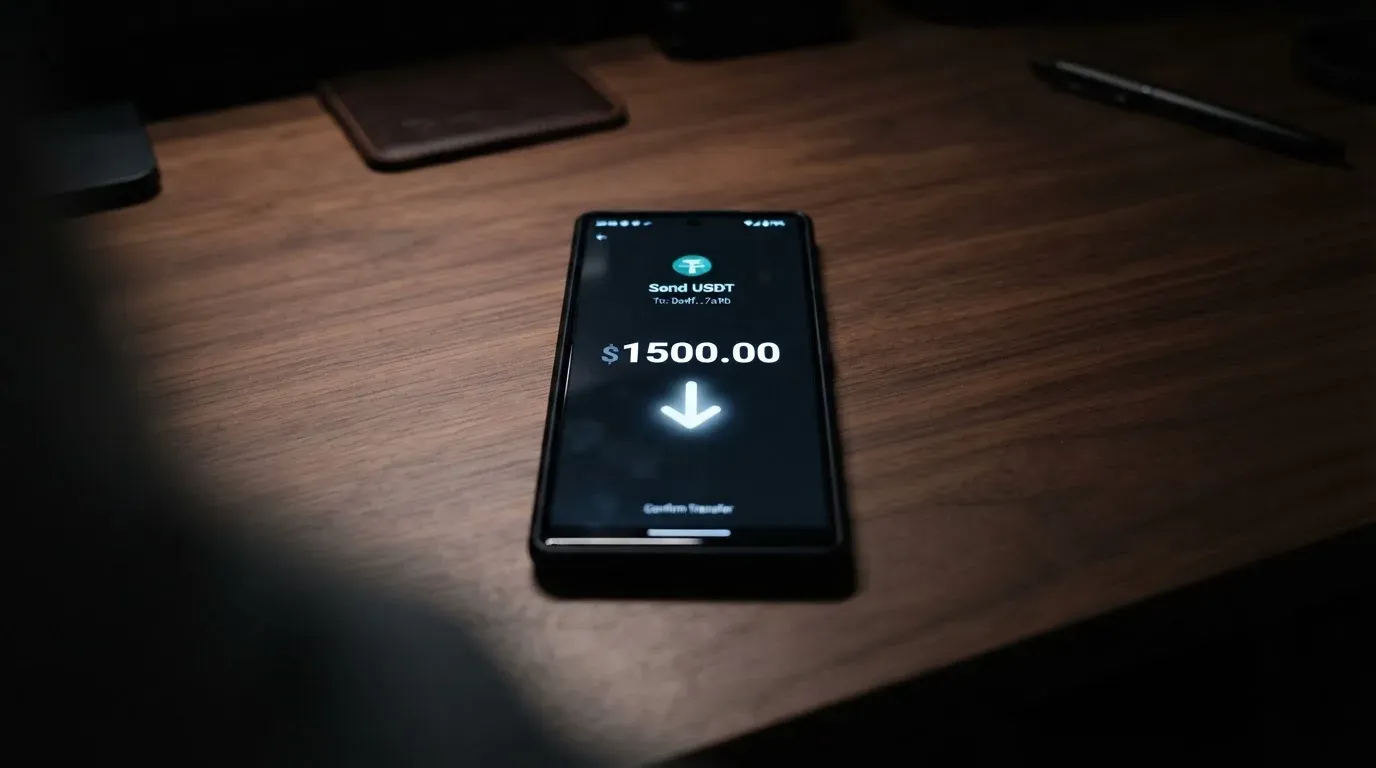
A few points from how stablecoins actually work, which matter for any top-up to a card like this:
USDT and USDC are both US-dollar-pegged tokens, but they exist on multiple blockchains. USDC, for example, is natively issued on dozens of networks, including Ethereum, Solana, Base, Polygon PoS, Avalanche, Arbitrum and Stellar, and Circle stopped supporting USDC on the Tron network in February 2024. USDT has been issued on Ethereum, Tron, Solana, Polygon, Avalanche and others. The blockchain you choose to send on sets the network fee you pay, and it is paid by your wallet, not by WebitPay. Some networks, like Ethereum, require a small balance of the native token (ETH) to pay gas before a transfer can be sent at all, even when the token being moved is a stablecoin.
Two things follow from this. First, you need to know which network WebitPay’s deposit address belongs to, because sending USDT or USDC on the wrong network is one of the most common ways users lose money in crypto, and the loss is usually permanent. Second, the network fee is on top of any WebitPay top-up fee, and that WebitPay fee is not published. So the total cost of a top-up is, today, a sum of three things: the network fee, an unstated WebitPay top-up fee (if any), and the conversion fee from USDC or USDT into the card balance.
If you do not yet know how to pick a network or pay gas, this card is not the place to learn. It is worth getting that part of your wallet workflow solid elsewhere first.
Withdrawal from the card back to fiat or to crypto is not described in the public materials. The terms say that on account closure, any remaining funds “may be returned under applicable law”, which is a fairly soft commitment. The practical way to read this: there is no documented way to cash out through the card itself, and the only guaranteed path to your money on closure is whatever the issuer and programme manager agree to do under the laws that apply to you.
Paying with it every day
Once the card is loaded, the day-to-day picture is the strongest part of WebitPay. You have a physical card and a virtual card, both Visa. The virtual card works in Apple Pay and Google Pay, which means you can pay with a phone or watch anywhere contactless Visa is taken. The physical card supports ATM withdrawals.
There is no extra WebitPay fee for using Google Pay, but the network, third parties and the issuer (Reap) can still apply their own charges, which is normal. The categories of merchant that are blocked on the card are not published. The iOS app has a 5.0 average rating, but only from two reviewers, so the score is essentially anecdotal. The Google Play rating has not been checked. The current iOS version, at the time of the conditions being current, is 1.4.5.
A few practical notes that come up with any crypto Visa:
Online merchants sometimes decline prepaid or foreign-issued cards based on the BIN, the first six or eight digits of the card number, which identifies the issuing institution. A card issued through Reap in Hong Kong can look “foreign” to a merchant in another country, and the merchant’s fraud rules may decline it even when the payment is legitimate. The same is true of address-verification checks, which are mainly available in the US, Canada and the UK, so a foreign-issued card can face more declines at smaller US websites. None of this is specific to WebitPay, but it is worth knowing if you have had trouble with other crypto cards in the past.
If something goes wrong with a payment, the terms ask you to contact the merchant first. If that does not resolve it, you can raise a claim with WebitPay, which will liaise with Reap and the card networks “subject to eligibility and timelines”. A reversal is not guaranteed. As with most prepaid cards, the consumer-protection rules that apply to US debit cards or to credit cards do not automatically extend to a card like this, so the practical safety net is thin.
What can go wrong
The company behind WebitPay is Webit Information Technology Limited, with an office at Room 2706, 27/F, Everbright Centre, 108 Gloucester Road, Wan Chai, Hong Kong. The card is issued by Reap Technologies Limited, and Webit describes itself as the programme provider. The site says the company holds “necessary financial licenses”, but it does not name any. The terms are governed by Hong Kong law.
That combination, a Hong Kong programme manager, an issuer whose licence is not named in the public materials, and a card product that handles customer balances, is the most important thing to weigh. The funds on the card sit in an electronic-money account in name; the specifics of how they are safeguarded (segregated in dedicated accounts, insured, or held alongside the firm’s own funds) are not stated. EU rules require electronic-money institutions to safeguard customer funds that way, but those rules apply only to firms authorised in the EU, and there is no statement that Reap is.
On the operational side, there is no public record of a major incident involving WebitPay. The iOS app has only two ratings. No Trustpilot page for WebitPay turned up in search. That is not a clean bill of health; it is a thin record. A card with a long-running Trustpilot page with hundreds of complaints would be a worse sign, but a card with no signal at all is just a card you have to take on the company’s word.
On the security side, WebitPay does the standard things: two-factor authentication through Google Authenticator, an Anti-Phishing Code, WhatsApp OTP for some actions, balance alerts, and the ability to freeze a lost physical card. Support is reachable by email at [email protected] and by phone at +852-96958088, Monday to Saturday 8:00 to 18:00, and there is a Help Center on Zendesk. None of that is unusual for a card of this kind.
A second category of risk is the category risk, not the company-specific risk. Crypto cards have been shut down before. Visa terminated its global agreements with FTX in November 2022, and the FTX US debit card programme was wound down by its issuer shortly after. In 2018, Visa suspended WaveCrest as an issuer in Europe, which closed every WaveCrest-issued Visa programme overnight. Programme closures typically follow a pattern: new loads end, spending stops, users are given a window to withdraw any remaining balance. The exact timelines and the chances of recovering funds are not something you can count on in advance. The lesson from those episodes is that holding large balances on any single crypto card is risky, and that applies here as well.
A third category is the stablecoin risk. USDT and USDC are designed to hold a steady value against the US dollar, but they have depegged before, most notably TerraUSD in May 2022, and USDC briefly lost its peg in March 2023 during the US banking stress. Stablecoins are also not censorship-proof: Tether has frozen tokens in wallets tied to sanctioned addresses. None of this is a reason to avoid stablecoins in general, but it is a reason not to load more than you are willing to leave on a card if something unusual happens.
What to take instead
If the WebitPay card is missing numbers you wanted, three alternatives do publish more of them. They are not direct substitutes, because each takes a different approach to the same problem, but they are useful reference points when you are deciding.
International Visa Card
The International Visa Card (score 6.7 out of 10) is a US-issued Platinum Visa on the virtual side, with a physical card marked “coming soon”. The published country list is long, and a clear set of countries is barred either at the account level or at the purchase level, with FATF grey-list countries reviewed case by case. Fees are published: $5 one-time to issue the virtual card, no maintenance fee on the free plan, $9 a month for Pro and $19 a month for Max. Card use in US dollars is free on every plan; foreign-currency transactions carry a “Visa exchange rate + 2% FX fee”. Deposits of any kind are free, including USDC and USDT into the USD account at 1:1, plus USD, EUR, SEPA, SWIFT and FedNow deposits. Networks for the USDC and USDT deposits are not stated. There is no cashback programme.
UNi Card
The UNi Card (score 6.1 out of 10) is a multicurrency card on Mastercard that spends from the UNi.Global account balance. The public materials state “no annual fee” and “no foreign transaction fee”, with assets converted at “live OTC rates” and “no hidden exchange fees”. Issuance fee, country list, and the specifics of how to fund the underlying account are not stated. The published reward is up to 3% back under a “Spend-to-Earn” programme.
Whop Cards
Whop Cards (score 5.2 out of 10) are Visa cards that spend from a Whop balance; the pending balance is usable as soon as a payment arrives, with settled funds used for standard withdrawals. The country lists are the most detailed of the three: 31 US states for consumers and 41 for businesses, with a long list of unsupported consumer and corporate countries. Cards can be issued to team members as well as to the account holder. The page says “no extra fees”, but does not list issuance, monthly or FX amounts. The published reward is 5% cashback at selected merchants, currently Uber, with more planned.
The quick read across the three: if you want the most published numbers, the International Visa Card publishes the most. If you want a Mastercard with explicit fee language, the UNi Card is the one. If you want a card with detailed US-state and country lists, Whop Cards publishes the most. None of them is a perfect stand-in for WebitPay’s promise of a Visa on a stablecoin balance, and each has its own gaps, but they are what is on the table.
Who I would recommend it to
The WebitPay card is for a fairly narrow reader. You want a Visa, you want it funded from USDT or USDC, you are comfortable with stablecoin networks and gas, and you are willing to ask support for the numbers the website does not publish before you send any meaningful amount. You are also comfortable with the issuer (Reap Technologies Limited) and the programme manager (Webit Information Technology Limited in Hong Kong) without the comfort of a named licence, and you are not loading more on the card than you are prepared to leave there if something changes.
The WebitPay card is not for you if you need a card that publishes its fee schedule, its country list, its daily and monthly limits and its supported stablecoin networks up front. It is also not for you if you want strong regulatory naming, EU or US licensing, or a long public track record. The card is also not ideal if you want to keep large balances on a prepaid card, given the category risk of programme closures and the issuer-specific risk of an unstated safeguarding setup.
If you fall into the first group, WebitPay is a workable answer to a fairly specific need. If you fall into the second, the International Visa Card, the UNi Card or the Whop Cards comparison above is a better starting point, even though each has its own gaps.
Frequently asked questions
What is the WebitPay card?
The WebitPay card is a Visa-branded payment card, available as a physical and a virtual card, that spends from a balance funded by the stablecoins USDT or USDC. It is run by Webit Information Technology Limited in Hong Kong, and the card itself is issued by Reap Technologies Limited. The virtual card can be added to Apple Pay and Google Pay, and the physical card supports ATM withdrawals.
How does the WebitPay card work?
You complete sign-up and KYC in the WebitPay app, after which you can order a physical or a virtual Visa. To spend, you top up the card by sending USDT or USDC from your own wallet to the address WebitPay provides; the card holds a balance in the card’s settlement currency, and at the point of sale the balance is used to pay the merchant through the Visa network.
Is WebitPay a bank?
WebitPay does not describe itself as a bank. The card-issuing partner is Reap Technologies Limited, and the programme provider is Webit Information Technology Limited in Hong Kong. The site says WebitPay holds “necessary financial licenses”, but it does not name any in the public materials. The card account is described as an electronic-money account.
Who owns WebitPay?
The published company behind the card is Webit Information Technology Limited, registered in Hong Kong with an office at Room 2706, 27/F, Everbright Centre, 108 Gloucester Road, Wan Chai. The card is issued by Reap Technologies Limited, which is a separate entity. Ownership of Webit Information Technology Limited is not stated in the public materials.
Is the WebitPay card available in my country?
The public site does not list supported countries. The terms bar anyone subject to sanctions, and the FAQ refers to a list of prohibited countries and regions without showing it. The practical answer is that eligibility is determined during the KYC step, so you only know for sure once the third-party provider has screened your documents.
How do I get the WebitPay card?
You download the WebitPay app and complete the sign-up flow, which includes KYC through an automated third-party provider (Shufti Pro) using facial recognition and data matching, with possible manual review. Once KYC is approved, you can order a physical and a virtual Visa in the app. Processing time and the specific documents required are not stated on the public site.
Does the WebitPay card require KYC?
Yes. KYC is required for the card, and the public materials describe it as handled by an automated third-party provider with the option of manual review. Refusing KYC, or failing it, can lead to account suspension, and the published reasons for rejection are not listed.
How do I top up the WebitPay card?
You top up the WebitPay card by sending USDT or USDC from your own wallet to the deposit address WebitPay gives you. The supported networks, the minimum top-up and the WebitPay top-up fee are not published, so the safe sequence is to ask support which network to use before you send, and to send a small test amount first. Network fees are paid by your wallet, not by WebitPay.
How do I add the WebitPay card to Apple Wallet?
The virtual card supports Apple Pay. The standard flow is to open the WebitPay app, choose the virtual card, and follow the in-app prompt to add it to Apple Wallet. Because the card details are tokenised, the actual card number is not stored on Apple’s servers.
Is the WebitPay card safe?
The card uses standard safeguards: two-factor authentication through Google Authenticator, an Anti-Phishing Code, WhatsApp OTP, balance alerts, and the ability to freeze a lost physical card. The card is issued by Reap Technologies Limited, whose licence is not named in the public materials, and the safeguarding of customer balances is not described. The iOS app has a 5.0 rating from only two reviewers, and there is no public record of major incidents. As with any prepaid card, the consumer-protection rules that apply to US debit or credit cards do not automatically extend to a card of this type.
App and neobank card fees – cryptocardfacts
Content created by the «cryptocardfacts» team