
How the Tonhub card works, what it costs, and who it actually suits
 Available in US
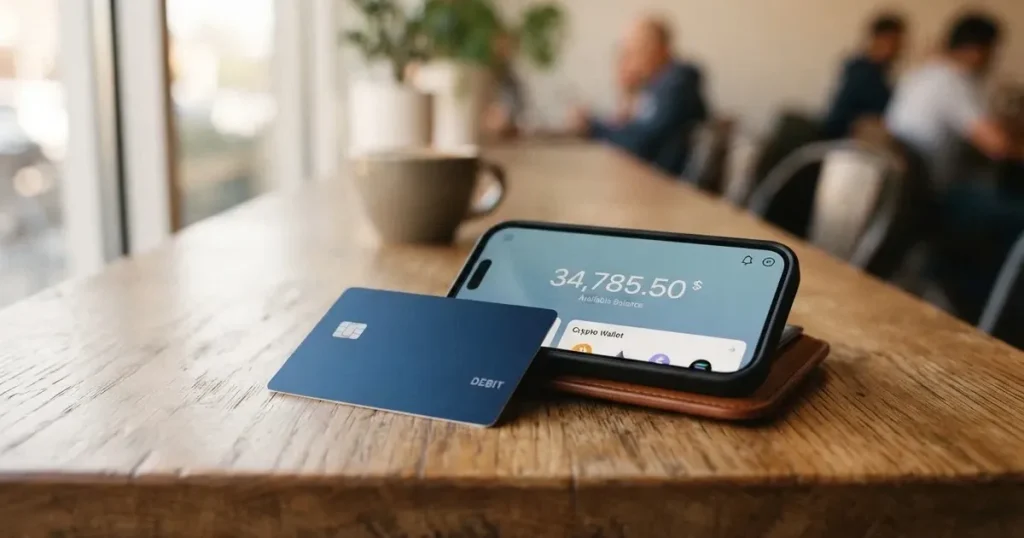
The Tonhub card is a Visa Debit that pulls funds from a crypto balance sitting in the user’s own wallet rather than from a custodial account held by the card provider. That design choice makes it stand out in a market where most crypto cards behave like prepaid products: you deposit, they hold the money, they convert at the point of sale. With Tonhub the keys stay with you, the smart contracts have been audited by Trail of Bits, and the card is aimed squarely at EU residents who already hold TON or USDC and want to spend them in the real world. The trade-off is that very little about the programme is published in plain numbers, and the only public customer review that exists is a hard one to read.
This review covers what the card does, what it costs (as far as the card itself says), how to top it up, and the practical risks you should weigh before you apply. The conditions described here are current as of October 28, 2026.
Verdict
The card sits at 5.3 out of 10, which reflects a product that has the right technical idea but leaves the reader guessing on a lot of practical details.
The score breaks down as follows:
| Criterion | Mark | Why it lands there |
|---|---|---|
| Who can get it | 5 / 10 | EU residents aged 18 and over; the rest of the world is excluded for now |
| Cost | 7 / 10 | Fees are not officially disclosed, but an unofficial 1.5% transaction fee is reported |
| Top-up options | 5 / 10 | TON and USDC are shown on the page; USDT appears in a user review; SEPA and SWIFT bank transfers are offered |
| Reliability and complaints | 4 / 10 | The operator and card issuer are not named, the one Trustpilot review is a 1-star complaint about a near two-month dispute, and the money had not been returned at the time of writing |
| Everyday use | 5 / 10 | Only a virtual Visa Debit after verification; Apple Pay and Google Pay support is unconfirmed by the card itself |
In short, this is a card for an EU-based reader who already lives inside the TON ecosystem, is comfortable with the self-custody model, and can tolerate a fee structure that is not spelled out on the card’s own pages. It is not a card for someone looking for a published fee schedule, a physical card, or a programme with a track record of customer reviews.
Who they will give the card to
Tonhub’s published eligibility is narrow. You need to be at least 18 years old and resident in the European Union. That is the full list of stated requirements, and it is worth noting what is not said: there is no published list of excluded EU member states, no statement on which ID documents are accepted, and no indication of which address proofs are accepted. The card’s pages mention “25+” countries, but that figure is presented as a usage statistic, not as an eligibility list, so it should not be read as a list of supported nationalities.
What this means for you as a reader: if you are outside the EU, you are out for now. Inside the EU, the basic age and residence check is the stated bar, but the absence of detail on documents, processing time, and the reasons a verification might fail means that a reader who already has trouble passing KYC at mainstream fintechs should not assume Tonhub will be easier or harder.
How to get the card
The sign-up flow runs through the Tonhub app. You add a wallet, tap the Tonhub Card banner, and go through an identity verification step before a virtual card is issued. The card is a Visa Debit, and the only form mentioned is virtual. There is no mention of a physical card on the public pages, and no delivery country, time, or cost is published.
Verification itself is described in one line: the user must verify their identity before the card is issued. The documents, the address proof, the processing time, the success rate, and the grounds for rejection are not stated. So while the steps on paper are short — install the app, add a wallet, verify, receive a virtual card — the practical questions a reader in a hurry would ask (how long does KYC take, what ID is accepted, what happens if I am refused) are not answered on the card’s own pages.
Fees and what a payment really costs
This is the section where the card’s transparency falls down. The Tonhub pages include a “Fees & Conditions” section, but the amounts are not captured in any public source I have read. The official position, then, is that the fee schedule is not stated.
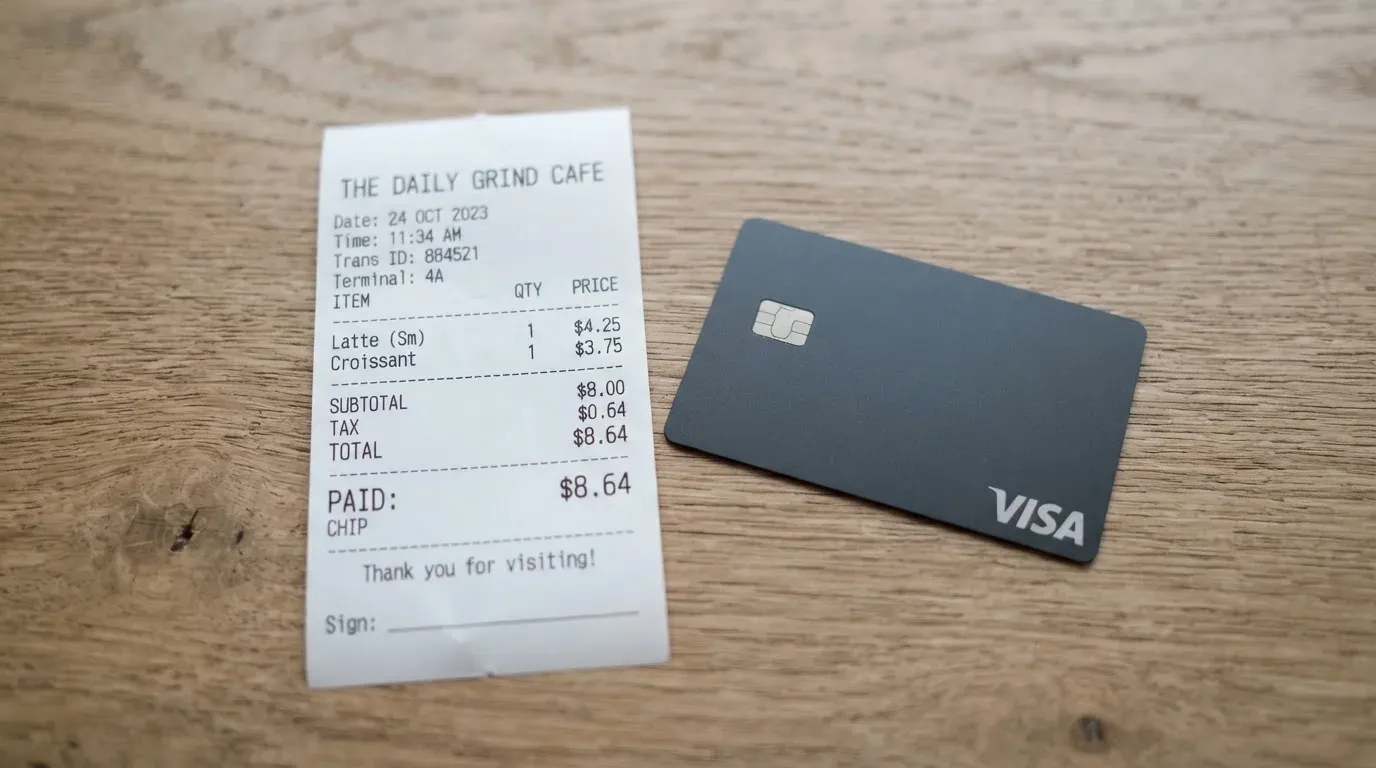
What is in the public domain is an unofficial figure: a 1.5% transaction fee, reported by Forklog in November 2024 and echoed in a company profile on dealroom. The card’s own pages do not confirm or deny this, so it should be read as a working estimate rather than a fact. There is no published information on monthly fees, ATM withdrawal fees, foreign-exchange spreads, or daily and monthly caps. The only cap mentioned is a user-controlled on-chain spending limit — you set how much the card is allowed to spend in a given period, and the smart contracts enforce it.
The card’s currency is also not stated. The assets shown on the page are TON and USDC, with USDT mentioned in a user review, so the practical question of how the card behaves when you pay in euros or in a non-EU currency is not answered in the card’s own materials.
| Fee or limit | What the card says |
|---|---|
| Issuance | Not stated |
| Monthly fee | Not stated |
| Transaction fee | Not stated officially; 1.5% reported unofficially |
| Foreign-exchange fee | Not stated |
| ATM fee | Not stated |
| Daily and monthly limits | User-set on-chain spending limits; no fixed caps published |
| Tiers | Not stated; the card is presented as a single product |
| Supported balances | TON and USDC shown on the page; card currency not stated |
Three everyday payments, and what they would cost
Without published numbers, the only honest way to handle this is to walk through the payments and note where a fee would be applied.
A coffee paid in a eurozone café: the card converts the underlying TON or USDC balance into euros at the merchant’s rate, then adds whatever conversion or FX fee the card’s terms contain. The card’s fee for this step is not stated, and the only unofficial number is the 1.5% transaction fee mentioned above. A €4 coffee, if that figure held, would carry about €0.06 in fees, before any network or conversion cost the card itself does not publish.
A subscription billed in US dollars: the same path, but with a currency conversion layered on top. The official fee for non-euro spending is not stated. If the unofficial 1.5% applies, a $9.99 monthly subscription would carry roughly $0.15 in fees per charge.
An online purchase from a shop that uses 3-D Secure: the card may prompt for an extra confirmation step, but there is no published fee for that flow. Whether the payment is approved frictionlessly or challenged is up to the issuer, whose identity is not named on the card’s pages.
The honest reading is that a reader who cares about the all-in cost of a payment — spread, conversion fee, network fee, on-chain gas — has to be ready to test with a small amount first, because the card does not publish enough information to do the maths in advance.
How to top it up
Topping up starts in the user’s own wallet, not on the card. The card draws on a linked crypto balance that lives in a non-custodial wallet the user controls. The flow described on the card’s pages is that Tonhub pre-funds the payment at the point of sale and then debits the user’s balance after the network and merchant confirm. If the balance is insufficient, the payment is declined and the funds are not moved.
The assets shown on the card’s pages are TON and USDC. A user review on the page mentions paying with USDT as well, so in practice at least three stablecoins or native assets appear to be in circulation, but the card does not publish an official list. Bank transfers are offered: SEPA and SWIFT are named as top-up routes, and SEPA is the natural fit for EU residents. The fees and minimums for those transfers are not stated.
There is also an “Emergency Withdrawal” feature that lets designated heirs retrieve card-linked funds on-chain, which is a useful safety net given the self-custody model. The closure process and any associated fees are not described.
What this means in practice: you hold the asset in your own wallet, you make sure the balance is funded before you tap to pay, and you accept that the on-chain top-up will carry a network fee paid to the blockchain, not to Tonhub. The card’s own fee for the top-up step is not stated.
Paying with the card day to day
The card is presented as virtual only; there is no mention of a physical version. The card is managed through the Tonhub app, and the only mobile-wallet support that appears on the card’s own pages is a passing mention of Apple Pay in a user review. Google Pay support is not mentioned on the card, although an unofficial source (Forklog, November 2024) reports that both Apple Pay and Google Pay are supported. Given that nothing in the card’s own materials confirms this, treat mobile-wallet support as unconfirmed by the card.
There is no published list of blocked merchant categories, and no published list of MCCs the card will refuse. There is also no published information on rewards, cashback, or sign-up bonuses. Refunds are described in general terms: “Refunds are issued only for legitimate, verified transactions.” The card’s pages do not state the chargeback time frames or how long a dispute typically takes, which matters because the only public customer review of the card describes a dispute that took nearly two months to file and had not returned the money at the time of writing.
The everyday use case, then, looks like this: you carry a virtual Visa Debit on your phone, you fund it from your own wallet, you pay at the point of sale, and you accept that the dispute process is not documented in any detail you can plan around.
What can go wrong
This is the section the rest of the review has been pointing at.
The operator entity and the card issuer are not named on the card’s own pages. The brand is Tonhub, with references to “Holders” elsewhere on the page, and the smart contracts have been audited by Trail of Bits. That is a serious audit, but it covers the on-chain code, not the operational side of the card programme: who holds the licence, who issues the Visa, who safeguards the pre-funded balance while a payment is settling.
Customer feedback is thin. Trustpilot shows a 3.2 out of 5 from a single review, read on 2026-10-20. That single review is a 1-star complaint from February 2026 describing disputes that took about two months to file, disputes that were eventually won, and money that had still not been returned. The same review mentions slow copy-paste support replies and an extra video-call ID check that was repeated despite prior verification. One review is not a pattern, but it is the only signal the public has, and the issues it raises are exactly the issues a self-custody card needs to handle well: dispute handling, support responsiveness, and how the programme treats users who have already passed KYC.
Security on the asset side is strong. The keys are held by the user, Ledger hardware wallets are supported, the smart contracts are audited, every transaction is monitored by anti-fraud and AML systems, and suspicious activity is blocked automatically. The user can also set on-chain spending limits, which is a useful ceiling. What is not stated is whether the card offers in-app freeze, whether there is any insurance on the pre-funded balance during the brief window between a merchant charge and the on-chain settlement, and what happens if the operator’s service is interrupted.
External context is mixed. The card was reported to have launched on 8 November 2024 by Forklog, initially for EU residents, with expansion to other regions planned for 2025; no confirmation of that expansion has been found, and no 2026 news has surfaced. The wider category has a history of programmes closing: WaveCrest was suspended by Visa in Europe in 2018, and FTX’s US debit card was wound down by its issuer in November 2022. A card programme that does not name its issuer gives a reader no easy way to judge that risk in advance.
The Help Center is at help.holders.io, and the audit, the KYC flow, and the self-custody architecture are the published defences. Beyond that, the card asks a reader to take a good deal on trust.
What to take instead
If the things that give you pause above are the things that would give you pause, here are three alternatives with different trade-offs.
TokenPocket (5.8 out of 10)
TokenPocket’s card is a Visa or Mastercard debit that runs on Arbitrum, with balances in EUR24 and USD24. The signup list is a mix of European and Asia-Pacific countries, so it is a useful alternative if you are outside the EU but on its supported list. The Americas were planned for Q2 2025, so it is worth re-checking if you are in the US or Canada. The cost story is that TokenPocket covers most of the NFT creation fee (the user pays a small portion that is not stated) and “apart from these, TP Card does not charge any additional fees”. A 1% fee is charged when depositing cryptocurrency into the TP Card, with a promise that the fee is later refunded via rewards or reduced transaction fees; foreign-exchange fees and inter-institution settlement costs are not stated. There is no cashback stated, and the practical position is that the deposit fee is the headline number while the rest of the cost structure is unstated. The card is virtual only, in the sources read, and is best read as a wallet-native option if you already use TokenPocket and are in a covered country.
MetaMask (7.1 out of 10)
MetaMask’s card is a Mastercard issued by Monovate, with Crypto Life as the card provider, and it spends directly from the connected wallet. The Virtual card is free, with no annual or maintenance fee; the Metal card is $199 a year. Transaction fees are described as “minimal” with the exact amount not on the pages read, and the card says there is no foreign-transaction fee — it uses the Mastercard rate. The card supports Linea, Base, Monad, and Solana, and the named tokens include mUSD, wETH, EURe, GBPe, USDC, and USDT, with the page saying nine in total. Cashback is paid in mUSD: 1% on Virtual, and a headline 3% on Metal that the footnote limits to the first $10,000 spent, then 1%. The Blackbird dining app offers 5X (Virtual) or 7X (Metal) $FLY bonuses. The card is open in 45 listed countries (US and UK sign-ups temporarily closed per the FAQ), with proof of residency required and a waitlist for unsupported regions. It is the strongest alternative on the list if you want a published fee structure and a published rewards rate, and if you are in a country where the card is live.
KAST (6.1 out of 10)
KAST offers a Visa with three programmes: Standard (free), Premium ($1,000 a year), and Private ($10,000 a year). There are virtual and physical cards, up to 10 per user, with designs that include Visa Platinum, Visa Infinite metal, Visa Infinite gold-plated, and themed Pengu, Solana, and Bitcoin options. The account balance is in USD, with stablecoin deposits converted 1:1 at a 0% spread, and the headline fees are 0% on stablecoin top-up, 0% on card spend in USD, 0% transaction fee, and 0% on Apple and Google Pay. Non-USD foreign-exchange fees are 0.5% to 1.75% depending on residence country, transaction country, and card programme. USD cashback is 1.5% on the first $2,000 a month for Standard, 2% on the first $10,000 for Premium, and 3% on the first $40,000 for Private, with KAST Points adding 1% to 2% on Premium and Private. Eligibility is residence-based, and KAST’s own pages are explicit that a country on the restricted list can still block KYC for an ID from that region, and that a VPN does not bypass the check. The trade-off is the high annual fee on the upper programmes and the need to live in a supported country.
How the four cards compare
| Tonhub | TokenPocket | MetaMask | KAST | |
|---|---|---|---|---|
| Network | Visa | Visa or Mastercard | Mastercard | Visa |
| Custody | Self-custody | Wallet-linked | Wallet-linked | Custodial (USD balance) |
| Card form | Virtual | Virtual | Virtual and Metal | Virtual and physical |
| Published fee schedule | No | Partial (1% deposit fee named) | Partial (no FX fee, minimal tx fee) | Yes (0% on USD spend, FX 0.5–1.75%) |
| Rewards | Not stated | None stated | 1% Virtual, 3% on first $10k Metal (mUSD) | 1.5–3% USD cashback by tier |
| Eligibility | EU, 18+ | EU and APAC list | 45 listed countries (US/UK paused) | Residence-based, list not published |
The headline difference is that Tonhub is the only one of the four that asks you to hold your own keys, and the only one that does not publish enough about its fees or its issuer for a reader to do the maths in advance.
Who I would recommend it to
I would recommend the Tonhub card to a reader who is already living in the EU, already comfortable with the TON ecosystem, and already holding TON or USDC in a self-custody wallet. The audit, the on-chain spending limits, the Ledger support, and the emergency-withdrawal option are all designed for that reader, and they will feel like a natural fit.
I would not recommend it to a reader who needs a physical card, who needs a published fee schedule, who needs a clear answer to the question “who issues this Visa, and which regulator oversees the programme,” or who needs a card with a track record of public reviews. The lack of named operator and issuer, the absence of published fees, and the single 1-star Trustpilot review are not, on their own, reasons to walk away, but they are reasons to be cautious.
The deeper issue is information. The card has the right architecture for a self-custody spending product. It just does not yet publish the kind of detail a reader needs to use it with confidence. If you are the kind of reader who is happy to test with a small balance, who does not rely on chargebacks, and who is comfortable taking the operator and the issuer on trust until the public information catches up, the card can work for you. If you are not that reader, the alternatives above are better documented.
Frequently asked questions
What is the Tonhub card?
The Tonhub card is a Visa Debit that draws on a crypto balance held in the user’s own non-custodial wallet. It is issued as a virtual card after identity verification, and the card is aimed at EU residents aged 18 and over who already hold TON or USDC.
How does the Tonhub card work?
When you pay, Tonhub pre-funds the merchant and then debits the linked crypto balance after the network and merchant confirm. If your balance is too low, the payment is declined and the funds are not moved. The card does not behave like a credit card; it is a debit product tied to a balance you hold yourself.
Is Tonhub a bank?
No. Tonhub is not described as a bank on its own pages. The operator entity and the card issuer are not named in the public materials, and the smart contracts have been audited by Trail of Bits. The audit covers the on-chain code, not the operational side of the card programme.
Is the Tonhub card available in my country?
The card states that it is available to EU residents aged 18 and over. The “25+” countries figure on the card’s pages is a usage statistic, not an eligibility list, and there is no published list of excluded EU member states. If you are outside the EU, the card is not currently offered to you.
How do I get the Tonhub card?
You download the Tonhub app, add a wallet, tap the Tonhub Card banner, and complete identity verification. A virtual Visa Debit is then issued. The card’s pages do not list accepted identity documents, address-proof requirements, processing time, or the grounds on which a verification might be refused.
How do I top up the Tonhub card?
You fund the linked balance in your own wallet before paying. The card’s pages show TON and USDC, with USDT mentioned in a user review, and SEPA and SWIFT bank transfers are offered as top-up routes. The fees and minimums for those transfers are not stated, and the on-chain top-up will carry a network fee paid to the blockchain, not to Tonhub.
Can I add the Tonhub card to Apple Pay or Google Pay?
Apple Pay is mentioned in a user review quoted on the card’s pages, and an unofficial source (Forklog, November 2024) reports that both Apple Pay and Google Pay are supported. The card’s own pages do not confirm this, so treat mobile-wallet support as unconfirmed by the card.
Is the Tonhub card safe?
The card’s architecture is non-custodial, with keys held by the user, Ledger hardware wallet support, on-chain spending limits, and smart contracts audited by Trail of Bits. What is not stated is the operator entity, the card issuer, and the safeguards on the pre-funded balance between a merchant charge and the on-chain settlement.
How do I file a dispute or chargeback?
The card’s pages say that “refunds are issued only for legitimate, verified transactions.” The time frame for filing, the time frame for resolution, and the reason codes are not stated. The only public customer review of the card describes a dispute that took about two months to file and had not returned the money at the time of writing.
Is the Tonhub card worth it?
For a reader who is already EU-based, already holds TON or USDC in a self-custody wallet, and is comfortable with a card that does not publish a full fee schedule, the card can be a sensible option. For a reader who needs a physical card, published fees, a clear named issuer, or a track record of public reviews, the alternatives covered above are better documented.
Wallet card fees and costs – cryptocardfacts
Content created by the «cryptocardfacts» team