
A no-fee crypto card for Colombian residents, built on balances you top up first
 Available in US
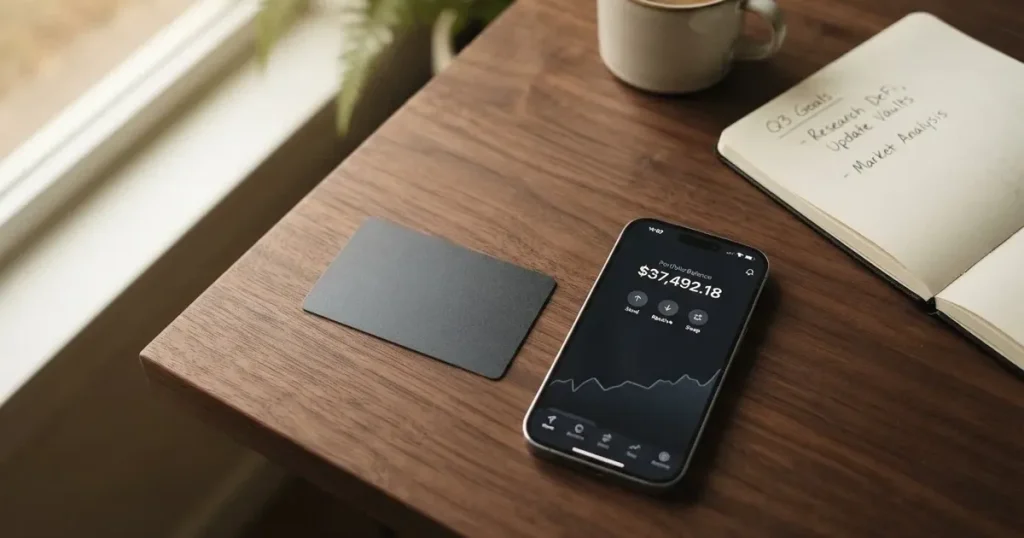
If you have trouble getting an ordinary bank card — because of where you live, what documents you hold, or simply because the bank down the road does not want your business — a crypto card sounds like a practical way out. The Littio card is one of the more interesting examples of that idea, but “interesting” is doing a lot of work in that sentence. It is a Colombian service, it runs on Mastercard rails, it charges almost nothing to open and use in your own currency, and it is built around balances you load yourself rather than a credit line. That combination makes it genuinely useful in one specific situation and quietly unhelpful in most others.
I went through the card’s own pages line by line: who it is for, how you apply, what every fee is, how you add money, and what happens when you use it in a shop. I also looked at what happens when things go wrong — the regulatory position, the complaints, the security setup. What follows is what I found, written for someone deciding whether this card solves their particular problem or whether they should keep looking.
The conditions described here are current as of October 28, 2026.
The short verdict: a 6.0 out of 10, and a narrow audience
The Littio card scores 6.0 / 10. That number is not a verdict on the technology; it is a verdict on fit. The card does a small number of things very well — everyday spending is genuinely cheap and the Apple Pay and Google Pay support is first-class — but it is built for a specific person in a specific country, and it comes with structural caveats that no amount of good app design removes.
Who it suits: Colombian residents who want to hold a dollar balance, load it cheaply, and spend it anywhere Mastercard works without paying a monthly fee or an annual fee. If you live in Colombia, want a US-dollar pocket without a dollar bank account, and do not mind holding crypto stablecoins to get one, this card is a good tool for that job.
Who it does not suit: anyone outside Colombia looking for a card that reliably solves banking access; anyone who needs bank-level deposit protection; anyone who wants a card they can load from a plain bank transfer without touching crypto at all; and anyone for whom a “verification” step that is only described in one Spanish phrase on a website is too vague to bank their monthly bills on.
Here is how the score breaks down, criterion by criterion.
| Criterion | Mark | Why |
|---|---|---|
| Who can get it | 3 / 10 | A Colombian service: top up via PSE, Nequi, Bancolombia, Bre-B; the Mastercard works in 190+ countries but the list of eligible countries is not disclosed |
| Cost | 8 / 10 | No annual fee and no fee for issuing the digital card; 0% commission when the currency matches; physical card $3 USD; other currencies 2% plus the Mastercard rate |
| Top-up options | 6 / 10 | Top up with USDC, EURC, COPM or MXNB, plus PSE, Nequi, Botón Bancolombia, Bre-B; networks are not named |
| Reliability and complaints | 5 / 10 | The service is not supervised by Superfinanciera, the issuer is not named; Trustpilot 4.4 out of 5 across 187 reviews, with complaints about support and verification |
| Everyday use | 9 / 10 | Digital and physical cards, Apple Pay and Google Pay, ATMs up to $500 per withdrawal |
| Total | 6.0 / 10 | Strong day-to-day spend, narrow eligibility, unresolved regulatory questions |
The pattern in that table is the whole story. The two highest marks are the two things you touch every day: what it costs and how it feels to use. The lowest is the first thing you have to get past: proving you can have it. A card that is a joy to use and impossible to get is not a good card for most people.
Will they give you the card?
Short answer: the card’s own site does not say who is eligible, and that gap is the single biggest practical obstacle to using this service. Eligibility is not stated on the site. What the site does tell you is that this is a Colombian service — you top up through PSE, Nequi, Bancolombia or Bre-B, all Colombian rails. That tells you where the money comes from, and it tells you where the operation is centred, but it is not the same as a published eligibility list.
This matters more than it might sound. Cards in this category come in two shapes: one that is genuinely open to anyone with a phone and an address, and one that quietly restricts itself to residents of a particular country. Littio’s public pages point firmly at the second. If you are reading this from outside Colombia, assume you cannot get one until the company tells you otherwise, and treat any blog post or forum comment suggesting otherwise as unverified.
The card itself is a Mastercard, used in Colombia and in 190+ countries. Whether you get a digital card, a physical card, or both is your choice — the two versions exist side by side and can be active at the same time — but the site does not frame one as a default for new users. Operations are in digital assets: USDC, EURC and COPM.
On the regulatory side, one thing is stated clearly and you should read it before anything else. Littio states that it is not supervised by the Superintendencia Financiera de Colombia and does not provide financial services requiring authorisation. The company behind it, Selenio S.A.S. (“Littio Colombia”), operates the service as “mandatario de ejecución”. The card issuer and BIN sponsor are not named.
I want to be precise about what that means, because it is easy to read too much or too little into it. It does not mean Littio is doing something wrong. It means the entity you are contracting with is not a supervised financial institution, and the institution that actually issues the Mastercard on the back of the card is not identified on the pages I read. That is unusual, and it is a different structure from a regulated European e-money issuer or a US bank. It is worth asking the company directly — and worth deciding whether the answer matters to you — before you load anything you would miss.
How to get it
The application happens in the app. The site mentions “Verificación de identidad” — identity verification — and that is essentially the whole of what it says about the checks. The specific documents you need, whether proof of address is required, and what age minimum applies are not stated. What identity document is accepted, whether a selfie is involved, and how long review takes: also not stated.
What is stated is the part that matters after you are in: the card is requested from the app, and an OTP is sent by email on transactions. So expect to verify your email, expect a per-transaction code, and expect the identity check to be part of joining rather than something you can defer.
The card comes in two versions. The digital version is for online use and works with Apple Pay and Google Pay. The physical version works at Mastercard point-of-sale terminals worldwide and supports ATM withdrawals — only the physical card supports ATMs. You can have both active together.
On the physical card’s arrival, the numbers are clear but the logistics are not. The physical card costs $3 USD, deducted from the app balance. The digital card is free. Replacing a lost physical card costs $3 USD. Delivery countries, delivery time and shipping cost are not stated.
That last gap is a real one. Three dollars tells you the card is cheap; it does not tell you whether it will arrive in Bogotá next week or in six weeks, or whether it will arrive at all outside the country. If you need a physical card quickly, this is a question to ask before you order, not after.
The company running the verification is Selenio S.A.S. Help runs through an Intercom help centre in Spanish, plus social links.
Fees: what it really costs
This is where Littio scores best, and the reason is structural rather than promotional. There is no annual fee, no management fee, and no issuance fee for the digital card. The physical card is $3 USD. Spend in the currency the card is set to, and the commission is 0% — no monthly charge hanging over you, no percentage nibbled at every purchase.
The catch is currency, and it is the catch that will actually cost you money.
The card can be set to USD, EUR, COP or MXN, and purchases in the currency the card is set to carry no commission. Spend in any other currency and you pay 2% plus the Mastercard exchange rate. Set the card to dollars, pay in euros, and both charges apply. The card may also fall back to another currency balance if the one it is set to is short, which is helpful but worth knowing about before you wonder why a purchase hit the wrong pot.
Here is the full picture, and note how much of it the card simply does not publish.
| Item | What Littio says |
|---|---|
| Handling fee | $0 |
| Issuance fee | Not stated |
| Digital card issuance | Free |
| Physical card | $3 USD |
| Purchase commission (matching currency) | $0 in USD, EUR, COP, MXN |
| Purchase commission (other currency) | 2% plus the Mastercard exchange rate |
| Card currency options | USD, EUR, COP, MXN |
| ATM in Colombia | $6,180 COP per transaction |
| ATM abroad | Fee set by the ATM owner; amount not stated |
| Minimum purchase | 1 USD, or the EUR/COP/MXN equivalent |
| Maximum purchase | $3,500 per 24 hours, adjustable in the app |
| ATM withdrawal maximum | $500 per withdrawal |
| Annual fee | None |
Limits are published and adjustable, which is a point in its favour: the $3,500 daily purchase cap and $500 ATM cap can be changed in the app under Tarjeta, Límite de gastos. ATM fees are only partly specified — in Colombia you know you are paying $6,180 COP a time, but abroad the ATM owner’s fee is unknown, so a withdrawal in a foreign country can cost more than the amount you planned.
Three everyday payments, to make the numbers concrete:
- A $20 coffee in Bogotá, card set to USD. No commission, no conversion. This is the card at its best.
- A €35 dinner in Rome, card set to USD. 2% plus the Mastercard exchange rate. On €35 that 2% is €0.70, plus whatever spread the Mastercard rate carries over the real mid-market rate. Small, but it is not zero, and it recurs on every foreign purchase.
- A $200 withdrawal from an ATM in Colombia. The $6,180 COP transaction fee applies, and the withdrawal count sits under the $500 cap. Abroad, add the ATM owner’s fee on top, and you are at the mercy of a number the card does not publish.
There is also no cashback on card spend. Littio offers rewards of up to 9.8% E.A., but those apply to balances held in Bolsillos/Bóvedas, not to money you spend with the card. Read those two things separately: the headline return is on funds you hold, not on funds you use.
How to top it up
Topping up is where Littio is most clearly designed for its home market, and it has two distinct routes.
The local rails are PSE, Nequi, Botón Bancolombia and Bre-B. These are the everyday way to move Colombian pesos into the card.
The crypto route is USDC, EURC, COPM or MXNB. Fees and minimum top-up amounts are not stated on the pages I read, and — this is the one that catches people — the networks are not named either. That matters more than it sounds. If you send USDC on a network the provider does not support, the transfer can be lost or need manual support recovery, and there is no guarantee of either. Check the supported network before you move anything, not after.
Two fee facts worth knowing: transfers to another Littio user are free, and transfers to external wallets start from $1 USDC.
Taking money back out is where the fee schedule gets detailed, and the detail is uneven. To a Colombian bank, the first two withdrawals are $0; over 20,000 COP is $0; under 20,000 COP is $0.50 USD. To a USDC wallet it is 1%. To a US bank $2.99 USD (in the 10–7,000 USD range); to a European bank EUR 2.99 (10–7,000 EUR); to a Mexican bank 3 MXN (10–7,000 MXN); to a third-party Colombian account $2; to another Littio user $0. Processing times are not stated, and neither is what happens to the account if you close it.
I would not call that schedule predatory — it is broadly in line with what this category charges — but the gaps are the problem. Unstated times on a withdrawal mean you cannot plan around it, and an unstated closure policy means you should ask what happens to any remaining balance before you ever close anything.
Paying with it every day
Daily use is the reason this card exists and the reason it scores 9 out of 10 here. Digital and physical versions, Apple Pay and Google Pay via NFC in stores and online, Mastercard accepted wherever Mastercard goes. That is a short list and it is completely ticked.
Apple Pay and Google Pay matter more than they sound. When you add a card to a phone wallet the number is replaced by a device-specific token stored on the device, and each payment carries a one-time code — so using the card through your phone does not hand your card number to the shops you visit. That is a genuine security improvement over handing over plastic, and it is available here from the day you have the digital card.
Setting up the app is straightforward: there is a download link on the site, though the stores and platforms are not named on the page I read, and App Store and Google Play ratings were not found. So I cannot tell you what other users say about the app’s stability, which for a card you use daily is a gap I would want filled.
Two omissions in the daily-use picture:
- Blocked merchant categories are not stated. This matters if any of your spending touches gambling. Card networks and issuers restrict certain merchant categories by policy, and the blocked list varies by issuer — if gambling or another restricted category matters to you, ask.
- The dispute process is not stated. No chargeback or complaint procedure is described on the pages I read. In most markets a card payment you did not make, or did not receive, has a defined route to a refund. Here, that route is undocumented. That is a real risk to hold in mind if the card holds money you depend on.
One more practical note about cards like this, generally: some merchants decline prepaid or foreign-issued cards because the issuer lookup reveals the card type and the issuing country. A Colombian BIN in a shop elsewhere can look “foreign” and attract extra scrutiny or a decline. Budget for the occasional failed payment that has nothing to do with you.
What can go wrong
Four risks, roughly in order of how much they should worry you.
Regulatory and issuer opacity. Littio states it is not supervised by Superfinanciera and does not provide services requiring authorisation. The operator is Selenio S.A.S., acting as “mandatario de ejecución”. The card issuer and BIN sponsor are not named. Insurance or safeguarding of funds is not stated. I am not going to tell you this makes the card unsafe — plenty of legitimate services operate under lighter-touch structures. I am telling you that you are accepting a counterparty whose protections you cannot read, and that is a decision only you can make.
The verification fog. Only “verificación de identidad” is stated. Documents, proof of address, age, and the KYC tier are all unstated. User reports include complaints about complicated verification in May 2026. If your situation is anything other than straightforward — no local address, unusual documents, a second nationality — the verification step is where this card is most likely to stall, and you will find out only after you have started.
Support and automation. The help centre is Intercom, in Spanish. Trustpilot, read in October 2026, shows 4.4 out of 5 across 187 reviews — 123 of them in the last 12 months — with 82% five-star and 14% one-star. The visible complaints: slow support, delays and unclear fees or policies, complicated verification (May 2026); too much automation (Mar 2026); and one undifferentiated “thieves” report (Oct 2025). That last one is a single unexplained report and I would not read much into it. The pattern I do take seriously is support quality and fee clarity.
Counterparty and custody. Your money sits with a provider, not with you. That is the custodial model, and it carries counterparty and hack risk — the same risk profile as the historical exchange failures where users lost large sums to insolvency or theft. And because card transfers and blockchain transfers are generally irreversible, a mistake in network, address, or amount usually cannot be undone.
The security setup itself is reasonable, which is worth saying because the risks above are structural, not a sign of carelessness. There is identity verification, encryption, two-factor OTP on transactions, a record on the blockchain, instant card freeze (which also stops recurring charges), and an adjustable daily spending limit in the app. Those are the standard safeguards and they are present.
One general point about this whole category, because it bears on the “is it safe” question people actually ask: programmes do close. WaveCrest, a Visa issuer that supplied crypto card brands, was suspended by Visa in Europe in 2018, closing all WaveCrest-issued Visa programmes. FTX’s US debit card was wound down after Visa terminated its global agreements with FTX on 13 November 2022. Closures typically follow a pattern — a notice period, then spending and loading stop, then you are asked to withdraw what is left. I am not predicting that for Littio. I am telling you that your exit plan matters more with a card like this than with a bank card, and that the unstated closure policy makes asking about it worthwhile.
What to take instead
If Littio does not fit — because you are not a Colombian resident, or because the regulatory structure bothers you, or because you need a documented dispute process — there are other cards in this space. Here is how the three main alternatives compare, on the same questions.
| Littio | International Visa Card | UNi Card | Whop Cards | |
|---|---|---|---|---|
| Score | 6.0 / 10 | 6.7 / 10 | 6.1 / 10 | 5.2 / 10 |
| Who can get it | Not stated; Colombian service | Not residents/registrants of a listed set of countries (see below) | Not stated | 31 US states for consumers, 41 for businesses |
| Card | Mastercard, digital and physical | US-issued Platinum Visa, virtual (physical “coming soon”) | Multicurrency Mastercard, physical/virtual not stated | Visa; virtual/physical not stated |
| Issuance cost | Free (digital); $3 USD (physical) | $5 one-time | Not stated | Not stated |
| Monthly cost | $0 | Classic free; Pro $9.00/month; Max $19.00/month | No annual fee | “No extra fees”; amounts not listed |
| Foreign currency | 2% plus Mastercard rate | Visa rate plus 2% FX fee | No foreign transaction fee; live OTC rates, “no hidden exchange fees” | Not stated |
| Top up | PSE, Nequi, Bancolombia, Bre-B, USDC/EURC/COPM/MXN | USDC or USDT at 1:1 free; also USD, EUR, SEPA, SWIFT, FedNow | Not stated | From a Whop balance, backed by stablecoin collateral |
| Rewards | None on card spend | No cashback stated | Spend-to-Earn up to 3% | 5% cashback at select merchants |
A few things stand out.
The International Visa Card scores slightly higher, at 6.7, and its restriction list is actually published — which is more than Littio offers you. It is not available to residents or legal registrants of Belarus, mainland China, North Korea, Cuba, India, Iraq, Iran, Israel, Myanmar, Nepal, Nicaragua, Russia, Syria, Turkey, Ukraine, Venezuela or Vietnam, with FATF grey-list countries reviewed case by case. Note the basis is residence or registration, not citizenship. Purchases are also blocked in North Korea, Cuba, Iran, Russia, Syria, Ukraine and Venezuela. Its card is virtual, US-issued Platinum Visa, $5 one-time, free on the Classic plan — but the Pro and Max tiers are $9.00 and $19.00 a month, which is a different economic proposition from Littio’s flat zero.
The UNi Card is the closest in spirit to Littio on fees: no annual fee, no foreign transaction fee, assets converted at live OTC rates, “no hidden exchange fees”, and spend-to-earn rewards up to 3%. But eligibility and top-up methods are both not stated, so you would be entering on the same kind of incomplete information.
Whop Cards sit furthest away. They spend from a Whop balance backed by stablecoin collateral, are limited to US states, and offer 5% cashback at select merchants (currently Uber). The consumer state list is long and specific; unsupported consumer countries include Belarus, China (Mainland), Cuba, Hong Kong, India, Iran, Iraq, Israel, Myanmar, Nepal, Nicaragua, North Korea, Russia, Turkey, Ukraine, Venezuela and Vietnam.
None of these is without risk, and none of them is supervised in the way a bank is. The honest framing is: pick the one whose restrictions you understand and whose structure you can live with, and be clearest with yourself about why.
Who I would recommend it to
I would recommend the Littio card to a Colombian resident who wants a dollar balance they control the timing of, who is comfortable receiving and holding stablecoins, and who wants to spend without a monthly fee eating into it. For that person it is a genuinely good card: cheap, well-built for daily use, with real mobile wallet support and free transfers between Littio users.
I would not recommend it as your primary card if you need a documented dispute process, if you need to know exactly which institution stands behind your money, or if your income arrives through channels the card’s verification may not handle well. And I would not recommend it at all if you are outside Colombia and hoping against the evidence.
Before you start, I would do three things: confirm in writing that you are eligible, given that the site does not say; ask what happens to a remaining balance if you close the account, since that is not stated; and send a small test amount through the crypto route before you rely on it, confirming the network first. Then treat the balance as spend money, not savings.
Frequently asked questions
What is the Littio card?
The Littio card is a Mastercard that spends from a balance you load yourself, rather than drawing on a bank account. It runs on the Mastercard network and works in Colombia and 190+ countries, in digital and physical versions. You top it up through Colombian rails like PSE or Nequi, or with stablecoins such as USDC. It is operated by Selenio S.A.S., trading as Littio Colombia, and is not supervised by the Superintendencia Financiera de Colombia.
How does the Littio card work?
You load a balance first — Colombian pesos through PSE, Nequi, Bancolombia or Bre-B, or crypto such as USDC, EURC, COPM or MXNB. At payment, the card spends that balance, much like a prepaid card. It can be set to USD, EUR, COP or MXN, and purchases in the matching currency carry no commission; other currencies cost 2% plus the Mastercard rate. There is no credit line, so the card cannot overdraw.
Is Littio a bank?
No, and it does not present itself as one. Littio states plainly that it is not supervised by the Superintendencia Financiera de Colombia and does not provide financial services requiring authorisation. The service is operated by Selenio S.A.S. as “mandatario de ejecución”. The institution that issues the card and sponsors the BIN is not named on its public pages, and no deposit guarantee or insurance of funds is stated. Treat it as a financial-technology service, not a bank.
Who owns Littio?
The service is operated by Selenio S.A.S., which presents itself as “Littio Colombia”. The card itself sits on the Mastercard network, so a separate issuing institution stands behind the card product — but Littio does not name that issuer or its BIN sponsor on the pages I read. If ownership of the entity behind the balance matters to you, that is a question to ask the company directly before you deposit.
Is the Littio card available outside Colombia?
The site does not publish an eligibility list, so I cannot tell you definitively. What it does make clear is that this is a Colombian service, funded through Colombian payment rails — PSE, Nequi, Bancolombia, Bre-B. The Mastercard itself works in 190+ countries, so the spending is broad even if the sign-up is narrow. If you are not a Colombian resident, assume you are not eligible until Littio confirms otherwise in writing.
Does the Littio card require KYC?
Yes, identity verification is part of joining — Littio references “verificación de identidad”. What it does not specify is which documents are accepted, whether proof of address is required, or what age minimum applies; the KYC tier is not stated either. After signup, an OTP is sent by email on transactions. User complaints through 2026 included reports of complicated verification, so allow more time than you expect if your documentation is not straightforward.
How much does the Littio card cost?
There is no annual fee and no management fee, and the digital card is free to issue. The physical card costs $3 USD, and a replacement lost physical card also costs $3 USD. Purchases in the currency the card is set to carry 0% commission; in other currencies you pay 2% plus the Mastercard exchange rate. There is no cashback on card spend — the rewards Littio advertises apply to balances you hold, not to what you spend.
How do I top up the Littio card?
Four local methods — PSE, Nequi, Botón Bancolombia and Bre-B — and four crypto options: USDC, EURC, COPM and MXNB. Fees and minimum top-up amounts are not stated on the pages I read, and critically, the supported networks are not named either. Because blockchain transfers are irreversible, sending on an unsupported network can lose the funds. Transfers to another Littio user are free; transfers to external wallets start from $1 USDC.
Is the Littio card safe?
Structurally, it has the standard safeguards: identity verification, encryption, two-factor OTP on transactions, instant card freeze that also stops recurring charges, and an adjustable daily spending limit. But it is not supervised by Superfinanciera, no safeguarding or insurance is stated, and the dispute process is not documented. The balances sit with a provider, which carries counterparty risk. Support is automated and Intercom-based in Spanish, and Trustpilot reviews through 2026 include complaints about slow support and unclear fees.
Is the Littio card worth it?
For a Colombian resident who wants a fee-free dollar balance and is comfortable holding stablecoins, yes — the zero monthly cost and free mobile wallet support make everyday spending unusually cheap. Outside Colombia, the picture changes: eligibility is not published, the issuer is not named, and there is no documented dispute route. Judge it against those gaps rather than the fee schedule, and start with a small test amount.
App and neobank card fees – cryptocardfacts
Content created by the «cryptocardfacts» team