
Relopay Review: A USDT-Funded Virtual Card With No Complaints and No Physical Plastic
 Available in US
The Relopay card is a virtual payment card you fund with USDT and spend like an ordinary card, mostly from Southeast Asia. It has no cashback, no physical card yet, and a published fee schedule short enough to read in a minute. It also has a rulebook that matters more than the fees: transactions are final and cannot be disputed. My score is 6.0 out of 10. That is not a bad score — it is a card that does one narrow job competently and asks you to accept its limits knowingly.
This review is written for people who have trouble getting an ordinary bank card, or who simply want to spend crypto balances without waiting for an exchange to send money through a bank. If that is you, keep reading. If you want a card with a physical piece of plastic, a cashback scheme, or a dispute process, this is the wrong card, and I will say so in the sections below.
The conditions described here are current as of October 28, 2026.
Verdict: a 6.0 out of 10, aimed at USDT holders in Southeast Asia
Relopay scores 6.0 out of 10. The strength is narrow and real: top-ups are cheap, the transaction fee is small and flat, and the card works at ordinary merchants wherever the network is accepted. The weakness is that there is no safety net. If something goes wrong with a payment, the terms say you cannot dispute it.
Here is how the score breaks down.
| Criterion | Mark | Why |
|---|---|---|
| Who can get it | 3 / 10 | Accounts only in the “Supported Countries” listed in the app; the card works in 170+ countries but the US, Canada, Hong Kong and others are closed |
| Cost | 7 / 10 | Issuance 3 USD, annual, inactivity and cancellation free, $0.2 per successful transaction, $0.5 per declined one, top-up 0%; the crypto conversion rate is not published |
| Top-up options | 8 / 10 | USDT (TRC20) with a $5 minimum; the cards page lists Bitcoin, USDT and other coins, converted at payment |
| Reliability and complaints | 7 / 10 | Issuer Xfers Pte. Ltd. (MAS licence per a third-party profile), companies in Canada and Singapore; no complaints found, but transactions are final and cannot be disputed |
| Everyday use | 6 / 10 | Virtual card with Apple Pay and Google Pay; physical card “launching soon”; no ATMs without the future physical card |
| Total | 6.0 / 10 | A competent prepaid crypto card with strict eligibility and no dispute route |
Who it suits: residents of the supported Southeast Asian markets who already hold USDT, spend most of their money online or at chain shops, and can live with a card that has no chargeback and no physical plastic. Who it does not suit: anyone who needs a bank-account equivalent, a physical card in the post, cash withdrawals, chargebacks on a bad online purchase, or a card that works from a long list of countries.
Will they give you the card
The blunt answer: only if you live in a country on the app’s list, and only if you are not a citizen or resident of one of about thirty excluded places.
Relopay limits accounts to the “Supported Countries” listed inside the website and app. That list is not published in the text I could read, which means you have to open the app to see it. An earlier check showed Vietnam, Thailand and Indonesia, plus a waitlist. If your country is not there, no amount of good documents will help you.
The docs also claim the card itself can be used in 170+ countries. That is about where you can spend, not where you can sign up. People mix those two up constantly, and the mix-up is how you lose an afternoon on an application that was never going to succeed.
The exclusions page is the part to read carefully, because it covers citizens and residents of: American Samoa, Albania, Belarus, Bosnia and Herzegovina, Burundi, Canada, CAR, Congo, DR Congo, Cuba, Guam, Hong Kong, Afghanistan, Iran, Iraq, Kosovo, Lebanon, Liberia, Libya, Montenegro, Myanmar, Nicaragua, N. Mariana Islands, North Korea, Puerto Rico, North Macedonia, Russian Federation, Serbia, Somalia, South Sudan, Sudan, Syria, Ukraine, United States, US Virgin Islands, Venezuela, Yemen and Zimbabwe. Belarus and Russia are excluded outright.
Both citizenship and residence count. Being in a supported country does not help if you are a citizen of an excluded one, and vice versa. Check that list before anything else.
How to get it
You need to be 18 or older with full legal capacity, and you need to pass one identity check.
Relopay states that “standard verification is required”. KYC runs through Sumsub. In practice that means: open the Telegram mini app, choose the region “All countries except USA”, pick your country and document type, upload a photo of the document, then complete a selfie or camera check. The docs say the result comes back “in a few seconds”. Prepaid cards are labelled “KYC required”. Proof of address is not mentioned anywhere in the flow.
What you get is virtual. The standard virtual card has 24 months of validity, 3-D Secure, is reloadable, and holds USD. There is a prepaid virtual card too, valid 60 days with a maximum balance of $1,000. The physical card is listed as “launching soon” with three-year validity — meaning it does not exist yet, and there is no shipping information to go on.
The network is not named in the docs; an earlier check said Visa. Since the card is prepaid in USD, think of it as a store of value rather than a bank card: it spends the balance you load and cannot overdraw it.
One detail worth knowing before you apply: there is a single standard verification, not a tiered system. Tiers, expected timing and rejection reasons are not stated. Do not expect to be told why an application failed.
Fees and what they add up to on an ordinary shop
The cost picture is the strongest part of this card. Issuance is 3 USD, once. The annual fee, the inactivity fee and the cancellation fee are free. A successful transaction costs $0.2. A declined one costs $0.5. Top-up is 0% on the virtual card.
| Fee or limit | What the card says |
|---|---|
| Card issuance | 3 USD |
| Annual fee | Free |
| Inactivity fee | Free |
| Cancellation fee | Free |
| Successful transaction | $0.2 |
| Declined transaction | $0.5 |
| Conversion fee | Applies when cryptocurrency is converted to fiat at the time of purchase; the rate is not published |
| Foreign exchange | Payments in a non-USD currency are converted automatically; the fee is not stated |
| ATM withdrawal | “may include small charges”; no amounts given, and virtual cards are online-only |
| Top-up | 0% on virtual, 1% USDT for the physical card |
| Minimum top-up | $5 via USDT (TRC20) |
Two of those lines are gaps rather than numbers, and they are the gaps that matter. The crypto conversion rate is not published, so you cannot compute what a payment costs before you make it. The FX fee is not stated, so a payment in euros or yen carries an unknown markup on top of the conversion itself. The docs recommend paying in USD; other currencies such as EUR and JPY are converted automatically.
Three everyday payments, to make it concrete.
A $20 subscription in your local currency. You pay $0.2 plus an unstated FX fee, and the conversion rate is whatever it is that day. Fine if you hold USDT and the currency is stable; you simply cannot predict the total in advance.
A $60 grocery shop run where the terminal asks for USD. $0.2 comes off the card, and no FX layer applies because the payment is in the card’s own currency. This is the clean case.
A payment the shop declines. That is $0.5 gone for something you never received. Declines are common with foreign-issued prepaid cards, so treat this as a cost of doing business rather than a one-off.
Funds are held in USD and fees are calculated in USDT. That combination deserves a second look: your balance is a dollar figure, and the fee that eats into it is priced in a token. If USDT moves against the dollar, the fee you effectively pay changes even though the printed number does not.
Limits: the terms say Relopay or the issuer may set daily, monthly and per-transaction limits. The sources disagree on the virtual cap — usage terms give maximum monthly spending of $4,000, while the cards page shows a virtual max balance of $4,000 and monthly spending of $50,000. The prepaid card’s max balance is $1,000.
How to top up
Topping up is USDT on Tron, with a $5 minimum, and it is the part of the card that works most cleanly.
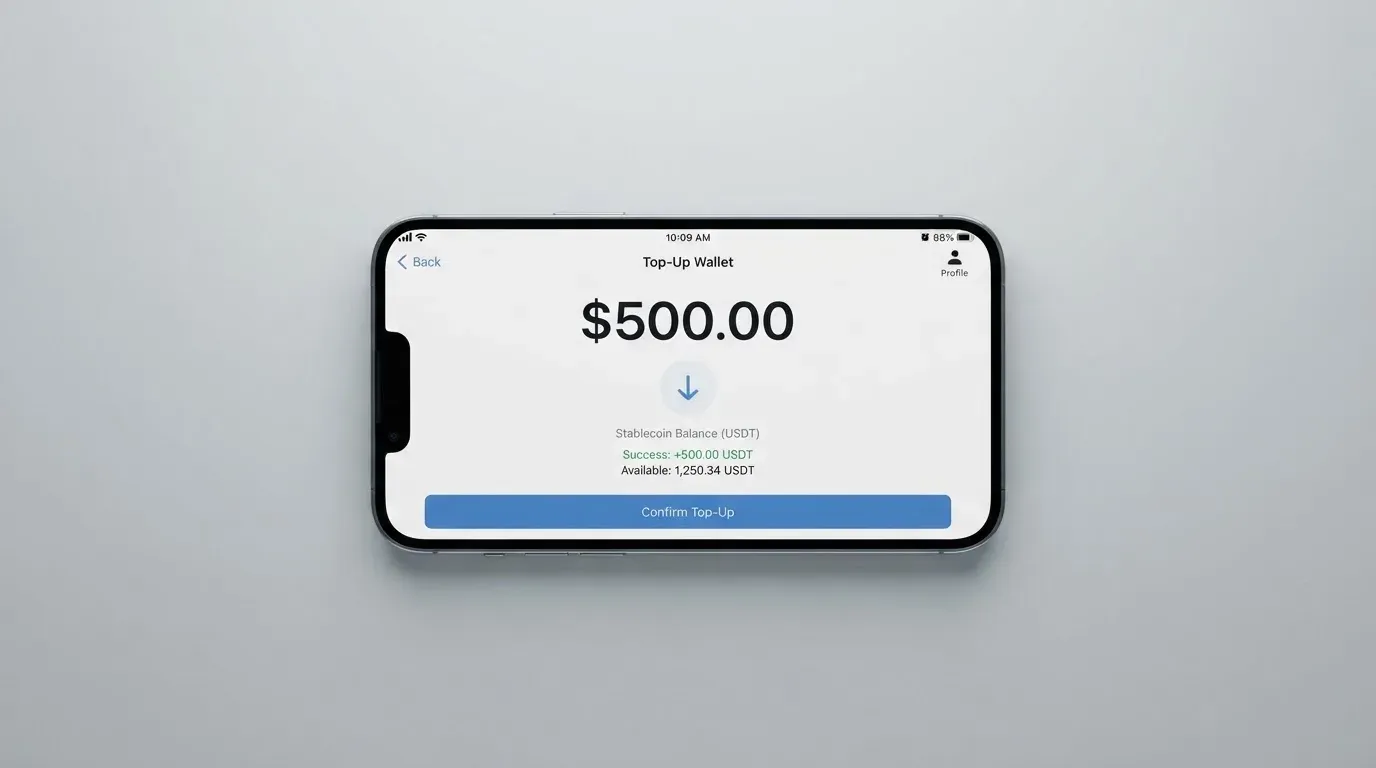
The usage terms say USDT (TRC20). The cards page names Bitcoin, USDT and “other cryptocurrencies”; an earlier check listed USDT, USDC, ETH, BTC, TON and BNB. Coins are converted into local currency at the moment of payment, not at top-up.
| Top-up route | What is stated |
|---|---|
| USDT (TRC20) | The named method in the usage terms; minimum $5 |
| Bitcoin, USDT and other cryptocurrencies | Named on the cards page |
| Coins listed at an earlier check | USDT, USDC, ETH, BTC, TON, BNB |
| Top-up fee | 0% on virtual, 1% USDT on the physical card |
| Currency for fees | Fees calculated in USDT |
| Fiat top-up | Not stated |
Two consequences follow. First, if you hold a non-Tron version of a token, do not assume the app will accept it — the card names TRC20 specifically, and blockchain transfers are irreversible. Sending the wrong network is the classic way to lose a deposit with no automatic recovery.
Second, deposits on the virtual plan are non-refundable, and an unused balance cannot be refunded to the wallet. The card expires after 24 months with the remaining balance still sitting on it. If you close the account, funds come out within “a reasonable period” less fees, and unclaimed funds are kept for three years.
So the top-up is cheap and easy, and it is also a one-way door. Load what you intend to spend.
Paying with it every day
It is a virtual card for online payments, and it plugs into the mobile wallets you already use.
The virtual plan card supports Apple Pay and Google Pay. Adding it to a wallet uses a $0 verification transaction, which may carry a small fee and can leave the balance slightly negative for a moment. Both wallets work as expected: the card number goes into the phone’s secure chip, and each payment uses a fresh one-time code rather than your actual number.
Some merchant categories are restricted: gambling, dating, money transfers, quasi-cash, fuel and EV charging, telecoms, gift cards, brokerage and charity. Charity carries a 30% penalty on the transaction value with a $5 minimum, which is a price, not a block.
There is no cashback, no points and no rewards programme — none is stated anywhere. There is no ATM access, because virtual cards are online-only; the FAQ mentions that withdrawals “may include small charges” for the future physical card, without amounts.
The everyday pattern is: load USDT, spend USD, repeat. For someone paying subscriptions, exchange fees and travel bookings out of a crypto balance, that fits. For someone who wants cash, or wants to earn something back, it does not.
What can go wrong
The single biggest thing to understand: the terms say transactions are final.
Clause 9.11 states that all Relopay Card transactions are final and may not be disputed, reversed or cancelled, except where the issuer or the law provides otherwise. Clause 9.13 says disputes about goods are between you and the merchant. In practice, if a shop takes the money and never delivers, or delivers something wrong, your route is the merchant — not a chargeback through a card network most buyers assume is behind them.
The rest of the risk picture is ordinary but worth naming.
Your balance is custodial. The fiat balance is held by the issuer, Xfers Pte. Ltd., which is not the same company as the brand on your screen. Control of funds depends on that institution staying solvent and secure. Historically, custodial platforms in crypto have failed badly — Mt. Gox (about US$350 million reported stolen 2011–2014), Coincheck (about US$400 million, 2018) and Ronin Network (US$625 million, 2022) are the standard examples. That is category context, not a claim about Relopay.
Card programmes get switched off. Visa terminated its global agreements with FTX on 13 November 2022, and the FTX US debit card was wound down by its issuer. WaveCrest, a Visa issuer that supplied crypto card brands, was suspended by Visa in Europe in 2018, closing all its Visa programmes. When a programme closes, the usual sequence is a notice period, then spending and loading stop, then you are asked to withdraw what remains.
None of that has happened to Relopay. I found no official incidents, and searches for Relopay card reviews on Trustpilot and Reddit returned only unrelated companies — RelayPay, Relay Payments, Lopay — and no user reports. There is no Trustpilot page for Relopay. For a card this young, “no complaints” means the opposite of reassurance: it means there is not yet a track record to judge from.
Some specific failure modes to keep in mind:
A declined payment can leave a hold on funds that stays for several days, typically up to seven. The $0.5 decline fee is separate from that.
Address verification is mainly offered in the US, Canada and the UK, and is generally unavailable for foreign-issued cards, which can cause declines. Merchants can also decline prepaid or foreign card numbers because a lookup of the first six digits reveals the card type and issuer country — the reason a card issued in one country can look “foreign” in a shop in another.
Support is Telegram-first: a support bot, a channel, plus X and Instagram. There is no App Store or Google Play app and no ratings anywhere. Freeze and two-factor authentication are not stated.
None of this makes the card dramatic in either direction. It makes the balance something you should not treat as a savings account.
What to take instead
If Relopay’s restrictions or its no-dispute rule rule it out, three alternatives exist in the same category. All are virtual-only, all convert crypto into a USD card balance, and each is cheaper or more permissive in a different way.
| Relopay | Azul Card | Telecard | OnCards | |
|---|---|---|---|---|
| Score | 6.0 / 10 | 5.3 / 10 | 6.1 / 10 | 4.6 / 10 |
| Who can get it | Supported countries only; about thirty exclusions for citizens and residents | Worldwide except Russia, Belarus, North Korea, Iran, Syria, Cuba, Sudan, Venezuela, Ukraine and the Crimea, Donetsk, Luhansk, Zaporizhzhia and Kherson regions | Usable in 150+ countries; terms bar only US-sanctioned persons | Not stated |
| Card | Virtual; physical “launching soon” | Virtual only, works anywhere Mastercard is accepted | Virtual Mastercard only | Virtual Mastercard / Visa in Telegram |
| Setup cost | 3 USD | $20 one-time, refunded after $2,000 in spending | $5 standard; VIP $49 setup | Not stated |
| Monthly | Free | $5 maintenance | Free on basic; $19/month on VIP | Not stated |
| Per transaction | $0.2 successful, $0.5 declined | $0.25 | 0.5 USDT gas fee per successful transaction | Not stated |
| Crypto top-up | 0% on virtual | 4% | Deposit fee advertised as 0% | Not stated |
| FX / conversion | Not stated | Not stated | 1.5% conversion; FX and cross-border “up to 3% each” | Not stated |
| Networks named | USDT (TRC20), plus coins on the cards page | Not named in pages read | USDT TRC-20 or ERC-20, USDC ERC-20; Polygon not supported | USDT BEP20 |
| Extras | — | Referral pays up to 40% of fees from referrals’ transactions | $99 minimum deposit to activate, stated as “NOT a fee”; referral points and cashback, rate unspecified | Bank transfers not accepted |
Reading that table honestly, each of these has a hole. Telecard scores highest at 6.1 but requires a $99 minimum deposit to activate, which it describes as “NOT a fee” because the money stays in your wallet — still $99 you cannot withdraw immediately. Azul is open to most of the world but costs $5 a month and 4% on every top-up, which punishes frequent loading. OnCards states the least of anything, which is itself the problem: no fee amounts, no country list, no card currency.
Azul has one clause worth quoting because it is unusual: the restrictions apply regardless of the user’s nationality, so the card cannot be used in those places by anyone, not merely by residents.
If your reason for wanting a card like this is that a bank will not open an account for you, country restrictions are what to check first and fees second.
Who I would recommend it to
I would recommend Relopay to three specific people.
Someone in Vietnam, Thailand or Indonesia who already holds USDT on Tron and spends online in small amounts — subscriptions, exchange fees, phone top-ups, travel bookings. The 0% top-up and the $0.2 transaction fee are the best in this group, the USD balance avoids a currency conversion on most payments, and Apple Pay and Google Pay cover the wallet part of daily life.
Someone who needs a card number rather than a bank account, accepts that the balance is custodial and that payments cannot be reversed, and has a use case that stays clear of the restricted merchant categories.
Someone testing the category cheaply. Issuance is 3 USD and the $5 minimum top-up keeps total exposure small — the lowest cost of entry in this comparison.
I would not recommend it to anyone who needs cash, needs a physical card, needs a chargeback, needs more than a few thousand dollars of monthly spending, or lives in an excluded country. Nor would I recommend it as your only card, precisely because of clause 9.11.
Frequently asked questions
What is Relopay card?
Relopay is a prepaid virtual payment card funded with crypto, mostly USDT, and used like an ordinary card online. You load a balance, and the card spends that balance — it cannot overdraw. The brand is a front end; cards are issued by Xfers Pte. Ltd. A physical card is listed as “launching soon”, but today you get the virtual one.
How does the Relopay card work?
You send USDT to the card, usually on Tron (TRC20), with a $5 minimum. The crypto is converted into local currency at the moment of payment, not at top-up, so the rate you get is whatever it is that day. The card then works as a prepaid USD card in shops and online, including through Apple Pay and Google Pay.
Is Relopay a bank?
No. It is a card programme on top of an electronic money issuer. Cards are issued by Xfers Pte. Ltd., and your fiat balance is held by that issuer. An electronic money institution can issue e-money and payment cards but cannot lend. Your balance is not a bank deposit and should not be treated as savings.
Who owns Relopay?
Two companies appear: 1507613 B.C. LTD, a FINTRAC-authorised payment services company in Canada, and RELOPAY PTE. LTD in Singapore (UEN 202514348M). Cards are issued by Xfers Pte. Ltd., which holds a Major Payment Institution licence from MAS according to a third-party profile — unofficial, and not confirmed by the card.
Is Relopay card available in my country?
Only in the “Supported Countries” listed inside the app; that list is not published in the text I could read. An earlier check showed Vietnam, Thailand and Indonesia plus a waitlist. Citizens and residents of around thirty places are barred, including Belarus, Russia, Canada, Hong Kong and the United States.
How do I get the Relopay card?
Open the Telegram mini app @RelopayBot, choose the region “All countries except USA”, pick your country and document, upload a photo, then complete a selfie or camera check. You must be 18 or older with full legal capacity. Docs say verification returns “in a few seconds”; there is one standard Sumsub check, with tiers and rejection reasons not stated.
Does the Relopay card require KYC?
Yes. The card states that “standard verification is required” and prepaid cards are labelled “KYC required”. Verification runs through Sumsub: document upload plus a selfie or camera check. Proof of address is not mentioned. KYC is a legal requirement for regulated businesses under anti-money-laundering rules, not a quirk of this card.
How much does the Relopay card cost?
Issuance is 3 USD. Annual, inactivity and cancellation fees are free. A successful transaction costs $0.2 and a declined one $0.5. Top-up is 0% on the virtual card. Two figures are missing: the crypto conversion rate is not published and the FX fee is not stated, so you cannot price a non-USD payment in advance.
How do I top up the Relopay card?
Send USDT on Tron (TRC20) with a minimum of $5. The cards page also names Bitcoin, USDT and other coins; an earlier check listed USDT, USDC, ETH, BTC, TON and BNB. Coins convert at the moment of payment. Deposits on the virtual plan are non-refundable, and the card expires after 24 months with any remaining balance.
Can I dispute a transaction or get a refund?
Not through the card, in most cases. Clause 9.11 says all Relopay Card transactions are final and may not be disputed, reversed or cancelled, except where the issuer or the law provides otherwise. Clause 9.13 puts disputes about goods between you and the merchant. Deposits are also non-refundable. Read this before loading money.
Virtual card fees – cryptocardfacts
Content created by the «cryptocardfacts» team