
Is the Sovrae card worth it without KYC? A straight look at the fees, limits and who should walk away
 Available in US
If you have tried to open an ordinary bank card and been turned down — or you would simply rather not hand over your documents to anyone — the Sovrae card is the kind of product you end up looking at. It promises a Visa and Mastercard card you can buy without identity verification, load with USDT or USDC, and spend anywhere the networks work. That promise is the whole pitch, and the whole risk. This review walks the card as the company’s own public pages describe it: who it is issued to, what it costs, how you fund it, what happens when you tap it in a shop, and what can go wrong. My overall mark is 6.5 out of 10. That is not a bad score — it is a fair one, and the rest of this page explains exactly where the points came from and where they did not.
The conditions described here are current as of October 28, 2026.
Verdict: a card built for privacy, priced like a luxury, backed by partners you cannot name
Six and a half out of ten. The Sovrae card does one thing very well — it lets you hold and spend crypto without KYC — and does the basic cardholder experience well too. It scores near the top on who can get it, on how you fund it, and on the everyday mechanics of paying. It scores near the bottom on cost, because a virtual card is not a free virtual card here: issuance alone is a serious one-off charge, and every payment carries fees the company does not put a number on. Reliability and complaints sit in the middle: no red flags surfaced, but also no track record and no named licences, which is its own kind of problem. Read on if you want the detail behind each mark, or jump to the sections on costs and risks if those are the ones keeping you up at night.
The card suits you if you already hold crypto, you want to spend it without a bank onboarding process, and you are comfortable paying a premium for that privacy. It does not suit you if card fees bother you, if you rely on chargebacks or consumer protection you cannot verify, or if you need a card that a shop will never think twice about.
| Criterion | Mark | Why |
|---|---|---|
| Who can get it | 9 / 10 | Worldwide except a list of restricted countries, because of Visa and Mastercard policies |
| Cost | 2 / 10 | $89 virtual / $349 physical issuance, a top-up fee, and unquantified FX and transaction fees |
| Top-up options | 9 / 10 | USDT or USDC on BEP-20, ERC-20 and TRC-20, an in-app swap for other coins, and a permanent deposit address |
| Reliability and complaints | 5 / 10 | Issued by partners in Hong Kong and Singapore, no licences named, no KYC, and no complaints or reviews found at all |
| Everyday use | 9 / 10 | Instant virtual card or physical in 5–7 days, Apple Pay and Google Pay on both, ATM on the physical card |
| Total | 6.5 / 10 | A capable card for a specific, privacy-minded user, at a price that gives pause |
The single sentence version: Sovrae is a well-built bridge from crypto to everyday spending for someone who values not being identified over not paying fees. If you are that person, read the funding and daily-use sections and you will find a lot that works. If you are not, the costs and the unnamed issuing partners will likely steer you to something else.
Will they give you the card? Almost everywhere, except a named list
The headline answer is yes, for a very large part of the world. Sovrae says it serves everywhere except a set of restricted countries, and it gives the reason plainly: the card networks’ own policies. The countries it names are Afghanistan, Belarus, Cuba, Iran, North Korea, Syria, Venezuela, Russia, Ukraine, Myanmar, Somalia and Yemen, “among others”. The full list, the company says, is available on request by email or Telegram. That last clause matters, because “among others” leaves room: the list you are quoted may be longer than the list you were shown on the marketing page, and the network policies change. If your country is anywhere near that set, ask for the current list before you spend anything.
Here is what the eligibility picture looks like in practice, as far as the company’s pages go:
- No identity verification at all. The card describes itself as verified at the point of purchase, and says personal details are never passed to third parties. No documents, no selfie, no upload.
- Citizenship versus residence is not stated. The pages do not say whether the restriction follows the country you live in, the country of your passport, or both. This is a genuine gap, and it is exactly the kind of gap that bites travellers and people with two nationalities.
- Restrictions come from Visa and Mastercard, not from Sovrae. That means the list can change without the company choosing to change it, and it is not something you can negotiate with support.
For a reader in, say, a country that is not on the list, the practical answer is that the card is open to you. The cards are described as “Visa & Mastercard worldwide”, virtual and physical, which suggests they are meant to be used across borders rather than pinned to one market. Whether a specific merchant or bank in your country will treat them kindly is a separate question, and the risks section comes back to it.
How to get it: buy it, fund it, use it
The process the company describes is unusually short, mostly because there is no verification step to slow it down. You buy the card, you fund it with USDT or USDC, and you are done. Documents and minimum age are not stated anywhere on the public pages, so if you are checking whether you personally qualify, that is a question for the company rather than for me.
Two card types, and they are not variations on a theme — they are different products:
| Card type | How it arrives | Validity | Top-up fee | ATM |
|---|---|---|---|---|
| Virtual | Instant on purchase | 3 years | 2% | Not available |
| Physical | Arrives in 5–7 days | 4 years | 1.5% | Yes |
A few details that only show up in the small print. The physical card carries no name on it by default, though you can ask for personalisation. The currency the card is denominated in is not stated. Delivery countries and delivery cost are not stated, and neither is the cost of a replacement if a physical card is lost or damaged. There are no card tiers beyond these two, and because there is no KYC, there is nothing to upgrade — no higher verification level unlocking higher limits.
The two cards are marketed as “Visa & Mastercard worldwide”, which reads as the networks being supported rather than two separate cards. The company does not break down which card runs on which network.
Fees and what a payment actually costs: this is where the 2 out of 10 lives
Here is the blunt version: the Sovrae card is not cheap, and the parts you would most want to know the price of are the parts the company does not price. Issuance is high, the top-up fee is real, and then there is a foreign exchange fee and a transaction fee on every single payment — both of which exist, both of which are unnamed in amount, with the full breakdown pushed to the app. You can check the app before you commit. But you cannot check the app before you buy the card, and you cannot compare Sovrae’s fee to a competitor’s from published figures.
| Fee or limit | Virtual card | Physical card |
|---|---|---|
| One-time issuance | $89 | $349 |
| Monthly fee | None listed | None listed |
| Top-up fee | 2% | 1.5% |
| Foreign exchange fee | Charged per transaction, amount not stated | Charged per transaction, amount not stated |
| Transaction fee | Charged per transaction, amount not stated | Charged per transaction, amount not stated |
| ATM fee | Not applicable | Yes, amount not stated |
| Spending limit per transaction | $80,000 | $80,000 |
| Spending limit per day | $1M | $1M |
| ATM limit per day | Not applicable | $3,750 |
| ATM limit per month | Not applicable | $80,000 |
| Card validity | 3 years | 4 years |
Let me walk three ordinary payments through that table, because the arithmetic is where a reader gets hurt.
Paying for a $30 coffee. You have already paid $89 or $349 for the card, so set that aside as a sunk cost. The $30 leaves your balance, and on the way it is charged the foreign exchange fee and the transaction fee. Neither has a published number, so I cannot tell you what the coffee costs you in total — I can only tell you it costs more than $30. If you top up before you go, add 2% (virtual) or 1.5% (physical) to the amount you load. Two dollars on a $100 top-up, or one and a half.
Paying for a $200 online purchase in a currency that is not your card’s. On top of the two unnamed per-transaction fees, you are exposed to whatever the exchange rate does between the moment you load and the moment the charge settles. The card currency is not stated, so I cannot even tell you which rate you are exposed to. This is the purchase most likely to surprise you, because the variable part of the cost is the one the company describes least.
Taking $100 out of an ATM. Only the physical card does this. The ATM fee is charged and not quantified; the ATM limits are $3,750 a day and $80,000 a month, which will not be your binding constraint. Everything else in the table — the $1M daily spend ceiling on both cards — is likewise generous enough that you will never approach it. Limits are not where this card is tight. Price is.
I want to be fair to the numbers: the absence of stated limits-by-KYC-level is not a gap here, because there is no KYC. And the $80,000-per-transaction and $1M-per-day limits, generous as they sound, are simply the card working as a prepaid balance does — it can only spend what you have loaded, so it cannot overdraw. The real question is not whether the limits allow your spending. It is whether the unnamed per-transaction fees make your spending worth it, and only the app can answer that.
One more category fact worth carrying into every comparison you make: on-chain network fees for your deposit are charged by the blockchain, not by the card company. So a top-up can cost you the 1.5% or 2% plus the network’s own gas or bandwidth fee, and the card page does not say who pays that network fee.
Top up: stablecoins on three networks, and a permanent address
Topping up is the part of this card that is genuinely well built, and it is the strongest section of the review. You fund the card with USDT or USDC, on any of three networks: BEP-20, ERC-20 or TRC-20. If you hold other coins, the in-app swap converts them. Each card comes with a permanent crypto deposit address, so you are not hunting for a new address every time. The card says funds stay in a non-custodial wallet until you top up, and that the top-up is instant, “reflecting in minutes”. There is no stated minimum, no statement of who pays the network fee, and no mention of fiat top-ups or of withdrawing money back out — those are simply not on the pages.
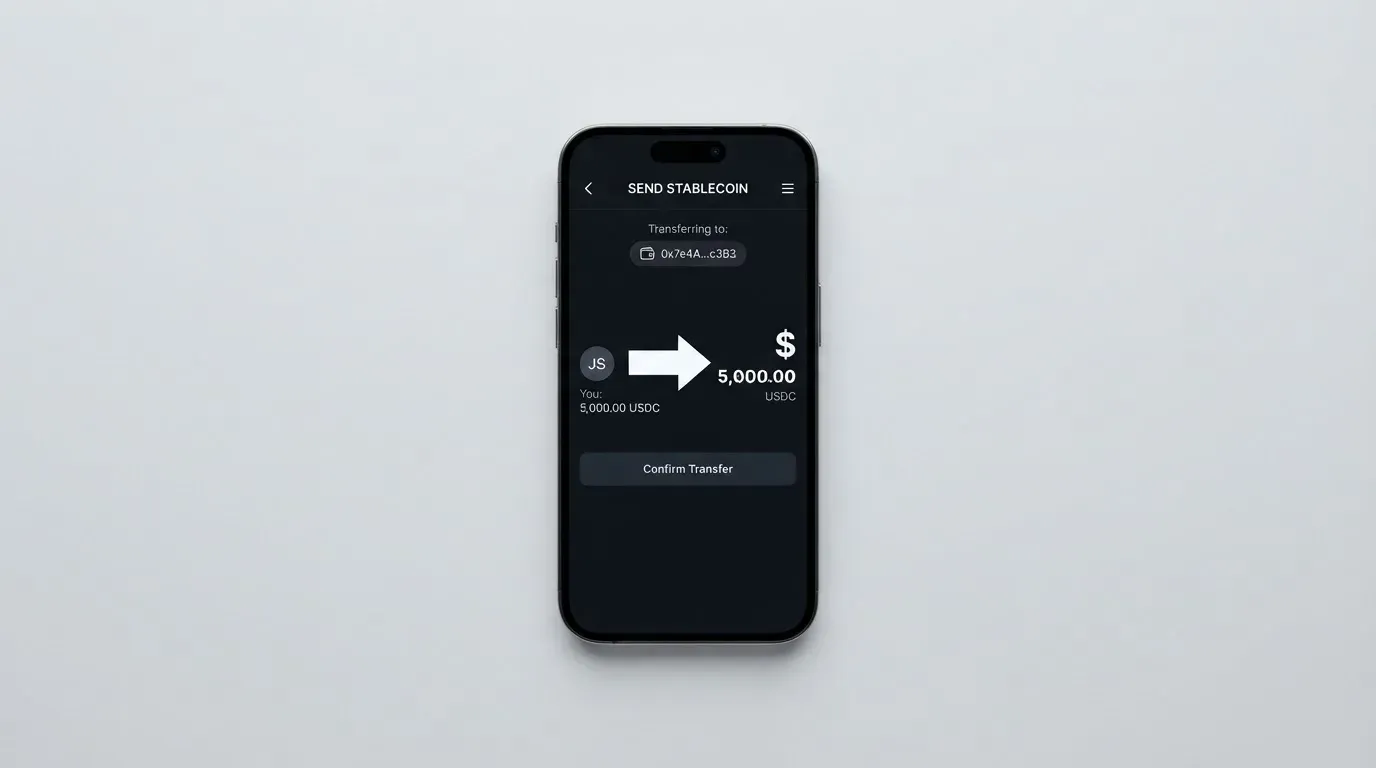
Two practical points before you send anything. First, the network matters and mistakes are expensive. Blockchain transfers are irreversible, so a deposit sent on a network the provider does not support, or sent to an address belonging to a different network, can be lost or need manual support recovery with no guarantee. Match the network exactly. Second, one of your three options has a catch: Circle stopped supporting USDC on Tron in February 2024, so “USDC over TRC20” is not a native option. USDT on TRC-20 is the stablecoin-network pair to use on Tron, not USDC.
A word on why USDT and USDC rather than something else. These two stablecoins made up about 90% of stablecoin market capitalisation as of the BIS in July 2025. Circle says USDC is redeemable 1:1 for USD and fully backed by cash and cash equivalents, mostly in an SEC-registered government money market fund, with monthly reserve attestations. Tether describes USDT as backed 1-to-1 by reserves. “Stable” is the aim, not a guarantee: TerraUSD collapsed in May 2022, and USDC briefly lost its peg in March 2023. And stablecoins are not censorship-proof — Tether says it disables tokens on wallets on the OFAC sanctions list and has frozen funds tied to illicit activity. You are trusting a dollar token, and the token has rules.
Paying with it every day: the mechanics are good
Day-to-day, this card does what you want. Apple Pay and Google Pay work on both the virtual and the physical card, so the phone-wallet experience most people actually use is covered. The physical card gives you an ATM. If you prefer the virtual card, you have it the instant you buy — useful for online subscriptions the day you sign up rather than a week later.
Set against that, there are blocked merchant categories: petrol, betting, crypto, military supplies, gaming credits, non-profits and government agencies. Read that list as a shape of life rather than a footnote. Petrol out means no fuel-station purchases; government agencies out means no fees paid directly to a public body; non-profits out means no donations. If your ordinary spending includes any of these, this is the wrong card. The betting and gaming blocks are common across crypto cards, but the petrol and government ones are worth noticing.
Two everyday features the pages do not cover. There is no cashback listed. There is a referral programme of up to $50 per card bought by people you refer, across three levels — I will leave it at that; judge it for yourself. Beyond that, the pages say nothing about an app listing, and nothing about how disputes and chargebacks are handled, which for a card with no KYC and unnamed issuers is not a small silence. You should assume you have to sort a problem with support yourself.
You should also expect the ordinary frictions of any prepaid, foreign-issued card. Merchants can look up the issuing institution and country from the card number, and some decline prepaid or foreign cards on that basis. Address verification is mostly a US, Canada and UK system and generally does not work for foreign-issued cards, which causes declines online. Online payments may carry a 3-D Secure step, and declined authorisations can leave a hold on your money for several days, typically up to seven. None of this is unusual; all of it is more likely on this card than on a card from your own bank, because the issuing country is not yours.
What can go wrong: unnamed issuers, no track record, irreversible transfers
This is the section that keeps the score at 6.5 rather than 8. There is no scandal attached to Sovrae — I found no official incidents, and searches for reviews and complaints turned up nothing at all about the company, including no Trustpilot page. In a sense that is the finding: a card with no history and no public feedback is not a card that has been proven safe. It is a card you are being asked to take on trust.
The trust you are extending has a specific shape. The cards are issued by partners in Hong Kong and Singapore, and no licences are named. The site carries a Sovrae copyright line for 2026. So the entity you deal with is a brand, and the licences that stand behind it are somewhere you are not shown. Card programmes have a track record of ending: Visa terminated its global agreements with FTX in November 2022 and the FTX US debit card was wound down; WaveCrest, a Visa issuer that supplied crypto card brands, was suspended by Visa in Europe in 2018, closing all its Visa programmes. When a programme winds down, spending and loading stop, and you are asked to withdraw what is left.
The currency layer is the part you cannot audit from outside. Who holds your funds between the moment you top up and the moment you spend? The pages say funds are held in segregated accounts with providers, and that your crypto sits in a non-custodial wallet until top-up — which is genuinely better than handing over a seed phrase. But segregated accounts are not the same as bank deposits, and money like that may not sit under a deposit guarantee scheme. Whether the app offers two-factor authentication and an instant card freeze — the two safeguards most people expect — is not stated. Do not assume them.
Then the sharp edges. Transfers are irreversible, and a wrong network or a wrong address can mean gone funds or a long support recovery with no guarantee. A stolen private key has no recovery mechanism; the network cannot freeze or return what was taken. And the fee you cannot see is the fee you cannot budget. Before any of this becomes a problem, the thing to check first is simple and unglamorous: open the app’s fee breakdown and the current restricted-country list before you buy, because those are the two things the marketing page will not give you.
What to take instead
None of these alternatives scores higher than Sovrae — they score 5.6, 4.9 and 4.7 — so this is not a case of my steering you to something better. It is a case of showing you what else exists, and where each one is clearer or cheaper on paper.
| Alternative | Score | Card | Cost | Fees | Funding |
|---|---|---|---|---|---|
| Sovrae | 6.5 / 10 | Virtual and physical, Visa and Mastercard | $89 / $349 issuance | Top-up 2% / 1.5%; FX and transaction fees unquantified | USDT, USDC on BEP-20, ERC-20, TRC-20 |
| Cardex | 5.6 / 10 | Debit card on VERVE, Visa, Mastercard, UnionPay; virtual and physical | Not stated | Conversion at payment time via a claimed best-rate scan; percentage not stated | USDT, USDC, BTC wallets; networks not stated |
| CardFlow | 4.9 / 10 | Virtual USD Mastercard in about 3 minutes | Free to create; monthly fee not stated | Not stated | Bitcoin, USDT, ETH or Naira bank transfer |
| HyperCard | 4.7 / 10 | Prepaid card; balance in USD or EUR | Not stated | Not stated | Deposit USDT, BTC, ETH in the app |
A few honest comparisons. Cardex markets itself across 200+ countries and leans on a claimed rate-scanning conversion at the moment you spend, which is the same idea as Sovrae’s conversion but advertised more loudly; its app is Naira-focused. CardFlow is aimed at Nigeria and gives you a free virtual Mastercard in minutes, which beats Sovrae’s $89 if virtual is all you need — but neither its fees nor its monthly cost are stated. HyperCard claims acceptance in more than 176 countries and lets you deposit common crypto, and again publishes no fees at all. The pattern is consistent: everyone in this corner publishes less about costs than you would like, and Sovrae at least names its issuance and top-up prices even if it omits the per-transaction ones.
Who I would recommend it to
I would recommend the Sovrae card to someone who already holds USDT or USDC, has decided that identity verification is a line they will not cross, and wants a card that is live today and works in Apple Pay without a week of waiting. If you fit that description, the 9s in this review are real: the funding is flexible, the everyday experience is smooth, and the eligible world is nearly everywhere. Budget for the issuance cost, load a little at a time, and treat the in-app fee breakdown as the deciding number rather than this review.
I would not recommend it to you if you are price-sensitive, if a car trip or a donation or a government fee is part of your normal card life, or if the unnamed Hong Kong and Singapore issuing partners and the absent complaint history make you uneasy — because in that case the absence of bad news is not reassurance, it is just absence. And if what you really want is to be able to dispute a charge, hold money in a deposit-guaranteed account, or pay a subscription for four years without wondering whether the programme still exists, an ordinary bank card remains the more durable answer, and this one is not a substitute for it.
Frequently asked questions
What is the Sovrae card?
Sovrae is a crypto payment card sold as “Visa & Mastercard worldwide” in two forms: a virtual card that activates instantly and lasts three years, and a physical card that arrives in five to seven days and lasts four years. You fund it with USDT or USDC and spend the resulting balance like an ordinary card. It requires no identity verification, and the physical card carries no name on it unless you request personalisation.
How does the Sovrae card work?
You buy the card, send USDT or USDC to its permanent crypto deposit address on BEP-20, ERC-20 or TRC-20, and the balance loads in minutes. The card then spends that stored balance, so it cannot overdraw — it behaves like a prepaid card. Other coins can be converted through the in-app swap. Every payment also carries a foreign exchange fee and a transaction fee whose amounts the company does not publish.
Is Sovrae a bank?
Not on the evidence of its public pages. The cards are issued by partners in Hong Kong and Singapore, and no licences are named. Under the usual arrangement, the card network sets the rules, a licensed issuer holds the card programme, and the crypto brand is a front-end and programme manager on top. Sovrae itself does not present as a bank, and your funds are described as sitting in a non-custodial wallet until top-up and then in segregated accounts with providers.
Does the Sovrae card require KYC?
No. The company states there is no identity verification and that cards are pre-verified upon purchase, with personal details never passed to third parties. Because there is no verification, there are also no verification tiers to upgrade through, and no documents or minimum age are specified on the public pages. That privacy is the product’s main appeal and its main unresolved risk.
How much does the Sovrae card cost?
Issuance is a one-time $89 for the virtual card and $349 for the physical card, with no monthly fee listed. Top-ups cost 2% on the virtual card and 1.5% on the physical card. Beyond that, each transaction carries a foreign exchange fee and a transaction fee with no published amounts, the ATM fee is unquantified, and on-chain network fees are paid to the blockchain. Check the app’s breakdown before buying.
How do I top up the Sovrae card?
Send USDT or USDC to the card’s permanent deposit address, choosing the network carefully — BEP-20, ERC-20 or TRC-20 — and the balance is said to reflect in minutes. Note that Circle stopped supporting USDC on Tron in February 2024, so use USDT rather than USDC on TRC-20. Transfers are irreversible, so a wrong network or wrong address can mean lost funds. No minimum, network-fee payer, fiat top-up or withdrawal method is stated.
Is the Sovrae card safe?
There is no scandal attached to it: no official incidents and no complaints or reviews found at all, including no Trustpilot page. But there is also no track record and no named licence, since the cards come from partners in Hong Kong and Singapore. Card programmes have been wound down before — the FTX card and WaveCrest’s Visa programmes both ended. Whether the app offers two-factor authentication and an instant freeze is not stated.
Can I use the Sovrae card in my country?
Probably, but check. Sovrae serves worldwide except restricted countries, citing Visa and Mastercard policy, and names Afghanistan, Belarus, Cuba, Iran, North Korea, Syria, Venezuela, Russia, Ukraine, Myanmar, Somalia and Yemen, “among others”. The full list is available on request. Whether the restriction follows your residence or your citizenship is not stated. Separately, some merchants decline foreign-issued or prepaid cards, so acceptance is not guaranteed even where eligibility is fine.
Where can I use the Sovrae card, and what is blocked?
Anywhere Visa and Mastercard are accepted, in-store and online, and through Apple Pay and Google Pay on both the virtual and physical card. The ATM works on the physical card only, with limits of $3,750 a day and $80,000 a month. Several merchant categories are blocked: petrol, betting, crypto, military supplies, gaming credits, non-profits and government agencies. Spending limits are $80,000 per transaction and $1M per day on both cards.
Is the Sovrae card worth it?
For the privacy-minded user who already holds stablecoins, the flexible funding and smooth everyday use are worth a premium, and the card is live immediately rather than in a week. For everyone else the $89 or $349 issuance plus unquantified per-transaction fees is hard to justify, and the blocked merchant categories may rule it out of your life entirely. Decide it on the app’s fee breakdown, not on the headline price — that breakdown is the number this review cannot supply for you.
Virtual card fees – cryptocardfacts
Content created by the «cryptocardfacts» team