
A free virtual Visa bolted onto a self-custody wallet — sensible for stablecoin spenders, thin on everything else
 Available in US

Tangem Pay is a Visa card that spends a stablecoin balance you hold yourself, issued through a programme run by a company most people buying a card will never have heard of. The pitch is simple and, in places, genuinely good: a virtual Visa at no monthly cost, funded with USDC, with a real percentage of cashback back. The catch is that almost everything you’d want to know about it is on a comparison table, a fee PDF, or nowhere at all — and that the people who can actually answer your questions are not the people who issue the card.
I went through the card’s own pages, its fee schedule, and the complaints people actually post about it. Here is what I found, what I could not confirm, and who I think should sign up.
The conditions described on this page are current as of October 28, 2026.
Verdict: 6.9 out of 10
Tangem Pay scores 6.9 / 10 overall. That is a card that does one thing — giving you a free Visa number you can top up with USDC and pay ordinary shops with — and does it without a monthly bill. Everything beyond that core is either thin, unstated, or not live yet.
If you already keep your crypto in a Tangem Wallet, you want a card that costs nothing to hold, and you spend mostly in dollars or in countries where Visa is accepted widely, this is one of the more sensible free options in the category. If you need a physical card in your hand, cash from ATMs, a card that works everywhere without surprises, or a published list of countries that can sign up — look elsewhere, or wait.
| Criterion | Mark | Why |
|---|---|---|
| Who can get it | 7 / 10 | Open in the US (not all states) and selected countries across LATAM, APAC, MEA and Africa; the country list is not published, and the UK and EU are planned for 2026 |
| Cost | 7 / 10 | Basic is $0 a month and Plus is $29.99 a month; $0 transaction fee, FX at the Visa rate plus 1.5%, ATM 4% on Basic, plastic delivery $14.53 to $82.10 |
| Top-up options | 6 / 10 | Native USDC on Polygon from any wallet or an in-app swap, plus ACH/FedWire bank top-ups in some regions; no minimum stated |
| Reliability and complaints | 7 / 10 | Issued by Third National, programme run by Rain, service delivered by Paera LLC, Tangem itself not regulated as a financial provider; complaints about petrol-station declines and KYC lockouts |
| Everyday use | 7 / 10 | Basic is virtual, Plus is plastic, Apple Pay and Google Pay via the card details; ATM 4% on Basic and 2% on Plus; unofficially, cash withdrawal is not available and physical cards are not broadly in circulation |
One thing to hold on to as you read: the card’s own pages do not publish the countries it is available in. They say “Visa-accepting merchants in over 150 countries” for where you can spend, and that eligibility “is determined based on your country and region of residence” — but the readable page never gives you the list. The app shows it during onboarding. That gap matters, and I’ll come back to it.
Will they give you the card?
Residence, not nationality, is the rule as stated. The card’s own words: eligibility “is determined based on your country and region of residence”, and the app displays what applies during onboarding. Available in the US, though not in every state, and in selected countries in Latin America, the Asia-Pacific region, the Middle East and Africa and Africa itself.
Beyond that, the public pages are silent on which countries those are. Some third-party sites compile a list — Argentina, Australia, the Bahamas, Barbados, Belize, Bolivia, Brazil, Chile, Colombia, Costa Rica, the Dominican Republic, Ecuador, El Salvador, Guatemala, Guyana, Honduras, Hong Kong, Jamaica, Japan, Mexico, New Zealand, Nicaragua, Panama, Paraguay, Peru, the Philippines, Singapore, South Africa, Trinidad and Tobago, the United Arab Emirates and Uruguay — with the UK, Andorra and the EU states marked as restricted. Treat that as unofficial: it is not confirmed by the card, and the app’s own answer during onboarding is the one that counts.
What I can tell you about shipping, because it surprised me. Tangem says physical card shipping covers nearly 200 countries except about 20, including China, Russia, North Korea and Palestine. That figure comes from press coverage of a Tangem statement rather than from a page I could read directly, so the date of the statement is not confirmed — but if you are in one of those excluded places, do not plan on plastic.
The obvious question follows: is Tangem Pay a bank? No. The card is a Visa issued by Third National, the programme is managed by Rain, described as a Visa Principal Member, and the service is delivered by Paera LLC. Tangem AG — the company that makes the non-custodial Tangem Wallet — is the programme’s front end and marketing side. Licences for these entities are not stated on the pages I read, and Tangem itself says it is not regulated as a financial services provider. That structure is normal for this category and not in itself a warning, but it does mean the entity you’d complain to is not the entity that issued your card.
How to get it
The route is the Tangem app, and it starts with identity verification. The card lists “ID verification and eligibility checks” as a step; the specific documents, whether proof of address is required, and the minimum age are not stated. So you cannot pre-plan your paperwork from the website — that’s something to ask support before you upload anything.
The check runs through Sumsub, the identity verification provider: a government ID plus a face verification, after you confirm your country of residence. This applies to the Pay account only — your Tangem Wallet itself is not verified through this flow. One reassuring detail: Tangem says it does not see the identity data. Your transaction limits then depend on your “risk profile, verification level, and account history” — note that the levels themselves are not named, so you cannot look up in advance what limit you’ll be placed in.
The tiers are where the design choices show. Basic is a Visa Platinum and comes as a virtual card; Plus is a Visa Signature in plastic; Prestige is a Visa Infinite available as virtual, plastic or metal, and is marked “coming soon”. Card currency is USD. Additional virtual cards cost $5, a replacement card $1, and a dispute costs $30.
One practical point on speed, from third-party reporting rather than the card: most virtual cards are said to issue within five minutes, with manual review taking up to 48 hours. Unofficially, the live product has been a virtual Visa only, with physical cards not generally available; Tangem press coverage has also mentioned a first physical batch capped at 5,000 cards. So if you’re reading this hoping for metal in your postbox, that’s a plan, not a product.
Fees: what it really costs
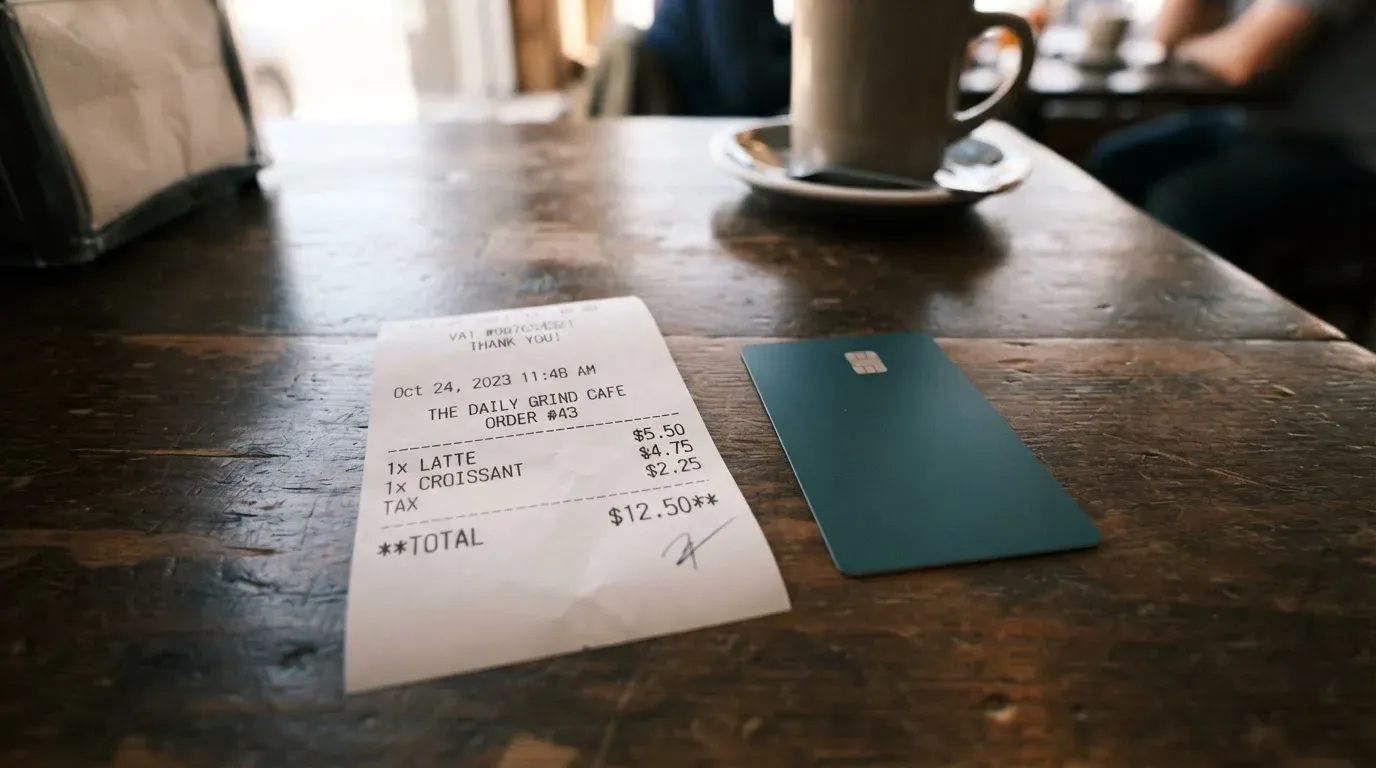
The headline is good and should not be buried: Basic is free, and card transactions carry a $0 fee. A free Visa with no per-transaction charge is not the norm in this category. Then the details start doing damage.
| Fee or limit | Value |
|---|---|
| Basic plan | $0 |
| Plus plan | $29.99 / month |
| Prestige plan | $999 / year |
| First physical card issuing fee | $0 (Basic) / $0 for the first card (Plus) |
| Additional virtual card | $5 |
| Replacement card | $1 |
| Physical card delivery | $14.53 to $82.10, depending on address |
| Card transaction fee | $0 |
| Foreign exchange, non-USD | Visa exchange rate + 1.5% |
| Crypto conversion | USDC converted 1:1 to USD |
| On-chain withdrawal | $0 |
| Bank top-up (onramp) | $1 ACH (Basic) / $0 (Plus); FedWire $10 (Basic) / $0 (Plus) |
| Bank withdrawal (offramp) | $1 ACH / $11 FedWire (Basic and Plus) |
| ATM | Available; 4% (Basic), 2% (Plus), 1% (Prestige); no free allowance stated |
| Dispute | $30 |
| Daily spend | $10,000 (Basic) / $50,000 (Plus) / $100,000 (Prestige) |
| Cards per user | 3 / 5 / 10 |
| Daily POS limit per card | $10,000 (Basic) / $50,000 (Plus) |
| Annual limit per card | $10,000,000 |
| Transactions | 100 per day, 1000 per month |
| Monthly spend limit | not stated |
The conversion fee is the one I’d flag hardest. USDC becomes USD at 1:1, so there’s no spread on the crypto side — but spending anything that isn’t dollars adds the Visa exchange rate and then 1.5% on top. The fee schedule is dated as applicable from September 25, 2026, though the document’s own title reads August 2026, which suggests it has been revised recently. If you live in a country where the dollar is not your currency and you pay locally, that 1.5% is the price of the convenience.
Now three everyday payments, so the table becomes real:
Coffee in New York, dollars. Basic tier, $5 spent. The $0 transaction fee applies and the balance is USDC converted at 1:1, so $5 leaves your balance as $5. Cashback of 1% would eventually return $0.50 against a monthly cap of $100. The fee that does *not* apply is the FX one — you’re already in dollars.
A hotel in Tokyo, charged in yen, on Basic. The yen amount is converted at the Visa exchange rate, then 1.5% is added. A ¥30,000 stay — roughly $200 — carries about $3 in pure FX fee. Then add the 1% cashback, and look at your remaining balance. If the terminal also puts a pre-authorisation hold on the card, that hold is not a fee but it will sit on your balance, and declined authorisations can leave holds that linger for days.
Cash from an ATM abroad, on Basic. The card prices ATM use at 4% of the withdrawal, capped at three withdrawals per 24 hours and $250 each. That is the number that makes me uneasy, because unofficial reporting says ATM withdrawals are “not available” on Basic in practice, and that higher tiers advertise ATM pricing that is not live either. So the 4% may be a price for a service you cannot currently use. Unofficially, for Basic, the maximum card balance is $10,000 with a daily load total of $100,000 and 24 loads per day / 150 per month.
On cashback, the tiers are 1% (Basic, cap $100 a month), 2% (Plus, cap $300) and 4% (Prestige, cap $1,000), with boosted 5% / 10% / 15% on the first $500 marked “coming soon”. What currency the cashback is paid in is not stated, which matters more than it sounds — if it lands as a crypto balance rather than spendable dollars, the 1% is worth less than it appears. A welcome bonus of “up to $75” is also flagged as coming soon.
Top up: where the money comes from
Two routes, and the first is the one the card is actually built around: native USDC on the Polygon network, from any wallet that supports it, or an in-app swap. The card’s framing is “stablecoins or directly from your bank account”. Specific coins beyond USDC and specific networks beyond Polygon are not named on the page.
A detail worth internalising: Polygon gas is paid by you, to the network. If you send USDC from an exchange or a wallet that has no MATIC or POL for that chain, the transfer can stall. On Ethereum the equivalent problem is worse, because ERC-20 fees are paid only in ETH — a wallet holding USDT with no ETH cannot send it at all. Pick Polygon deliberately and keep a little of the network’s own token in the sending wallet.
The second route is bank rails, where availability varies by jurisdiction: ACH costs $1 on Basic and $0 on Plus, FedWire $10 on Basic and $0 on Plus. Cash out runs the other way — $1 by ACH, $11 by FedWire from Basic and Plus. The minimum top-up is not stated, which means you cannot tell whether a $20 load is worth the $1 ACH fee. On Basic it is 10% of your deposit; on Plus it is nothing.
The reassuring part is what happens to the balance. USDC “sits in a smart contract you control”, and Tangem’s footer states that it does not hold, custody or control users’ assets. The remaining balance “stays in the account you control” when you withdraw. The procedure for closing an account is not stated, though — if you want to leave, you are relying on a support channel for the exit.
Paying with it every day
The mechanics are standard. You add the card to Apple Pay or Google Pay using the card details shown in the app, and from then on it behaves like the card it is. Merchant categories are restricted: gambling, online casinos and liquor stores are among those blocked. The full list was not read out on the page I had, so if a specific category matters to you, ask.
The app is a genuine plus. The Tangem app requires iOS 16.4 or later, or Android, and Tangem Pay needs version 5.35 or later. The App Store listing for the wallet app reads 4.9/5 from 25K ratings — though note that’s the whole wallet app, not the Pay feature, and I read it on 2026-10-20.
One of the more reassuring mechanics: freezing the card in the app disconnects it from Visa but does not touch the on-chain balance. If someone lifts your phone, the worst they get is a dead card number.
Where everyday use gets awkward is the merchant side, and this is not Tangem’s fault so much as the nature of a foreign BIN. A payment card number starts with a 6- or 8-digit issuer identification number; merchants look it up, see which institution and country issued the card, and may apply extra scrutiny when the issuer country differs from the billing address. Add Address Verification Service, which compares the street number and ZIP the buyer typed against issuer records and is generally unavailable for foreign-issued cards, and you have a decent explanation for why a perfectly funded card gets declined at a counter. Some merchants decline prepaid or foreign BINs simply on that lookup.
What can go wrong
Let me separate what the card tells you from what users report, because they are different weights of evidence.
Declines at petrol stations and hotels. This is the most consistent complaint. A user report collected by a secondary aggregator from Reddit — not verified — describes declines at fuel pumps, hotels and restaurants, which is where pre-authorisation holds are heaviest. The same report mentions a $175 hold at a fuel pump. Third-party coverage also cites KYC lockouts after the card was already issued, and activation problems where support asked for video proof of identity. These are individual accounts, not statistics.
Trustpilot for the brand. Tangem overall reads 4.1/5 from 876 reviews — I found no Tangem Pay-specific Trustpilot page. So when you read that rating, you are reading about the wallet, not this card.
Who stands behind it. Third National issues, Rain manages, Paera LLC runs onboarding, KYC and AML, Tangem AG makes the wallet. Tangem is not regulated as a financial services provider, and it says so. Insurance of funds is not stated. Three named companies in one product is not a red flag by itself — it is how this category is built — but it does mean that “who do I email” is a genuine question, and unofficial reports suggest Paera handles Pay account questions.
Identity and KYC friction. KYC is not optional: regulated businesses must verify customers and assess risk, with ongoing monitoring and suspicious-activity reporting. In the US the customer identification programme requires name, date of birth, address and an identification number, with electronic systems also validating proof-of-address documents. Nationality is screened separately from residence, because sanctions screening and issuer risk policy apply to citizenship and country of birth as well as address. If due diligence can’t be completed, EU rules require the institution to hold back — which is exactly why accounts get frozen pending documents. A lockout after issuance is painful, but it’s the system working, not a quirk you can argue your way out of. I am not going to suggest ways around any of that; if your documents don’t match your address of residence, the honest path is to sort that out with support.
The stablecoin underneath. USDC is dollar-pegged and Circle says it is redeemable 1:1 and fully backed by cash and equivalents, mostly in a government money market fund, with monthly reserve attestations. But stablecoins are not guaranteed stable: TerraUSD collapsed in May 2022, and USDC lost its peg briefly in March 2023. About 90% of stablecoin market capitalisation sits in USDT and USDC, per the BIS in July 2025. And blockchain transfers are irreversible — send to a network the provider doesn’t support, or to an address belonging to another network, and the money may be gone or may need manual recovery with no guarantee. Tether also says it disables tokens in wallets on the OFAC sanctions list, so stablecoins are not censorship-proof in either direction.
Disputes. The fee is $30. Timeframes are not stated. If you have a bad charge, you are paying to argue.
What to take instead
I want to be careful here: these are not better cards, they are different shapes of the same problem. Read the scores alongside my notes.
| Option | Score | Shape of it |
|---|---|---|
| Tangem Pay | 6.9 / 10 | Free virtual Visa, USDC on Polygon, not published country list |
| MetaMask Card | 7.1 / 10 | Mastercard, virtual free and Metal $199/year, 45 listed countries, clear fee stance |
| KAST | 6.1 / 10 | Tiered membership with cashback in USD, published FX band, annual-only pricing |
| TokenPocket | 5.8 / 10 | Lowest cost, but a 1% deposit fee and a refund-through-rewards model |
MetaMask Card scores highest in this set at 7.1 / 10, and the difference is mostly disclosure. It is open in 45 listed countries and territories — Andorra, Argentina, Brazil, Canada, Mexico, Germany, France, Spain, Uruguay among the examples — with other regions on a waitlist, proof of residency required, and US and UK sign-ups temporarily closed per its FAQ. The virtual card is free with no annual or maintenance fee; Metal is $199/year. It charges a “minimal fee for each transaction” with no additional MetaMask fees and no foreign transaction fee. It spends directly from the connected wallet across Linea, Base, Monad and Solana, holding mUSD, wETH, EURe, GBPe, USDC and USDT. Cashback is paid in mUSD: 1% on Virtual, and on Metal a headline 3% limited by a footnote to the first $10,000 spent then 1%. One card per user, issued by Monovate with Crypto Life as card provider.
KAST at 6.1 / 10 is the most interesting for anyone who wants their fees spelled out as numbers. Standard is free, Premium $1,000/year, Private $10,000/year — billed annually upfront, no monthly option. Stablecoin top-up 0%, USD spend 0%, transaction fee 0%, Apple and Google Pay 0%, non-USD FX 0.5%–1.75% depending on your residence country, transaction country and card programme, a flat $0.10 on non-USD transactions under $25, and $0.50 for a declined transaction. Cashback is USD: 1.5% on the first $2,000 a month (Standard), 2% on the first $10,000 (Premium), 3% on the first $40,000 (Private). It accepts USDT, USDC, PYUSD and RLUSD. Its eligibility rule is unusually well explained: if your country isn’t listed at KYC it isn’t available, and living in a supported country while holding an ID from a restricted region may still make you ineligible. A VPN does not bypass it.
TokenPocket at 5.8 / 10 is the cheapest to start and the most awkward. It issues Visa debit for European countries and territories and Mastercard debit for Australia, Canada, Hong Kong, Japan, Taiwan, New Zealand, Singapore, South Korea and the UK, with the Americas planned. Cards run on Arbitrum with balances in EUR24 and USD24. Beyond a partly covered NFT creation fee where you pay “a small portion”, it charges no additional fees — but there is a 1% fee on depositing cryptocurrency into the card, to be refunded later through rewards or reduced transaction fees. No cashback is stated as such; the refund is the reward.
Three pros and three cons, plainly:
- Pros: $0 monthly on Basic, $0 per transaction, real cashback from month one, USDC converted 1:1, funds in a smart contract you control, freeze without touching the balance.
- Cons: the country list isn’t published, the FX surcharge is 1.5% on top of the Visa rate, ATM is 4% and possibly not working, the dispute fee is $30, and monthly spend limits are not stated anywhere.
Who I would recommend it to
I’d recommend Tangem Pay if you’re already a Tangem Wallet user, you’re spending dollars or stablecoins rather than local currency, and you want a card that costs nothing to hold and nothing per transaction. The 1% cashback with a $100 monthly cap is real money at a supermarket, and the fact that your USDC sits in a contract you control rather than on someone’s balance sheet is the strongest thing about the product.
I’d steer you away if you need cash regularly, if a 1.5% FX surcharge on every local purchase would eat your budget, if you travel to countries where prepaid and foreign-issued cards routinely get declined at the pump, or if you want to know exactly which countries you can join before you download anything. For an ATM-dependent life, MetaMask or KAST at least present clearer fee structures; for a wallet-first experience with published eligibility, KAST’s documentation is the most honest of the three.
And I’d wait on Prestige. It is marked “coming soon”, its $999 is shown as a single yearly payment, and its headline benefits — 8 lounge visits a year, baggage insurance, a metal card — are promises in a comparison table, not something you can hold today.
Whichever way you go, check the fee PDF yourself before your first payment. It is the only place the numbers are, it was revised as of September 2026, and it is where the parts of this card that are still coming soon will eventually be confirmed or quietly disappear.
Frequently asked questions
What is the Tangem Pay card?
Tangem Pay is a Visa card that spends a stablecoin balance you hold in a smart contract you control. It comes in tiers: Basic, a free virtual Visa Platinum; Plus, a $29.99-a-month Visa Signature in plastic; and Prestige, a Visa Infinite in virtual, plastic or metal, marked “coming soon”. It is issued by Third National, the programme is managed by Rain, and the service is run by Paera LLC.
Is Tangem Pay a bank?
No. Tangem is a wallet maker, not a bank, and states plainly that it is not regulated as a financial services provider. The card itself is issued by Third National under a Visa programme managed by Rain. In practice you are dealing with a payment card programme that has a crypto company as its interface, not with a bank account.
Who owns Tangem Pay?
Several companies, which is normal for this category. Tangem AG, the maker of the non-custodial Tangem Wallet, markets and fronts the product. Third National issues the Visa card, Rain manages the programme as a Visa Principal Member, and Paera LLC delivers the service including onboarding and KYC. Licences for these entities are not stated on the pages I read.
Does Tangem Pay require KYC?
Yes. It lists “ID verification and eligibility checks”, and the check runs through Sumsub — a government ID plus a face verification — after you confirm your country of residence. This applies to the Pay account only, not to your wallet. Which documents, whether proof of address is required, and the minimum age are not stated.
Is the Tangem Pay card free?
The Basic tier is $0 a month, the first physical card has a $0 issuing fee, and card transactions cost $0. Things that are not free: Plus at $29.99 a month, additional virtual cards at $5, a replacement card at $1, physical delivery from $14.53 to $82.10, a $30 dispute fee, ATM at 4%, and non-USD spending at the Visa exchange rate plus 1.5%.
Which countries can I use Tangem Pay in?
The card’s own pages don’t publish the list. They say eligibility is based on your country and region of residence, shown in the app during onboarding, and that the card is available in the US (not all states) plus selected countries in LATAM, APAC, MEA and Africa. Spending works at Visa-accepting merchants in over 150 countries. Third-party lists exist but are not confirmed by the card.
How do I top up the Tangem Pay card?
The main route is native USDC on the Polygon network, sent from any wallet that supports it, or swapped inside the app. Polygon gas is paid by you to the network, so the sending wallet needs a little of the chain’s own token. Bank top-ups are also offered where available: $1 via ACH or $10 via FedWire on Basic, free on Plus. Minimum top-up is not stated.
Can I add the Tangem Pay card to Apple Pay?
Yes — the card can be added to Apple Pay or Google Pay using the card details shown in the Tangem app. The app needs version 5.35 or later, and requires iOS 16.4 or later, or Android. Certain merchant categories are blocked, including gambling, online casinos and liquor stores; the complete list was not published on the page I read.
Is the Tangem Pay card safe?
Safeguards are real: funds sit in a smart contract you control, Tangem says it does not custody user assets, identity data goes to Sumsub rather than Tangem, Elliptic monitors transactions, and freezing the card in the app kills the Visa link without touching the balance. Against that: Tangem is not regulated as a financial provider, insurance of funds is not stated, USDC can lose its peg, and blockchain transfers cannot be reversed.
Why does my Tangem Pay card get declined at petrol stations?
Pre-authorisation holds are the usual reason, and user reports collected by a secondary aggregator from Reddit describe exactly this pattern, plus KYC lockouts after issuance. Address Verification Service also compares the street number and ZIP you typed against issuer records and is generally unavailable for foreign-issued cards, which causes declines on its own. Declines are single reports, not rates — but petrol stations are where this pattern shows up most.
Wallet card fees and costs – cryptocardfacts
Content created by the «cryptocardfacts» team