
A payroll crypto card with an online-only virtual Visa, published costs, and ten-country limits
 Available in US
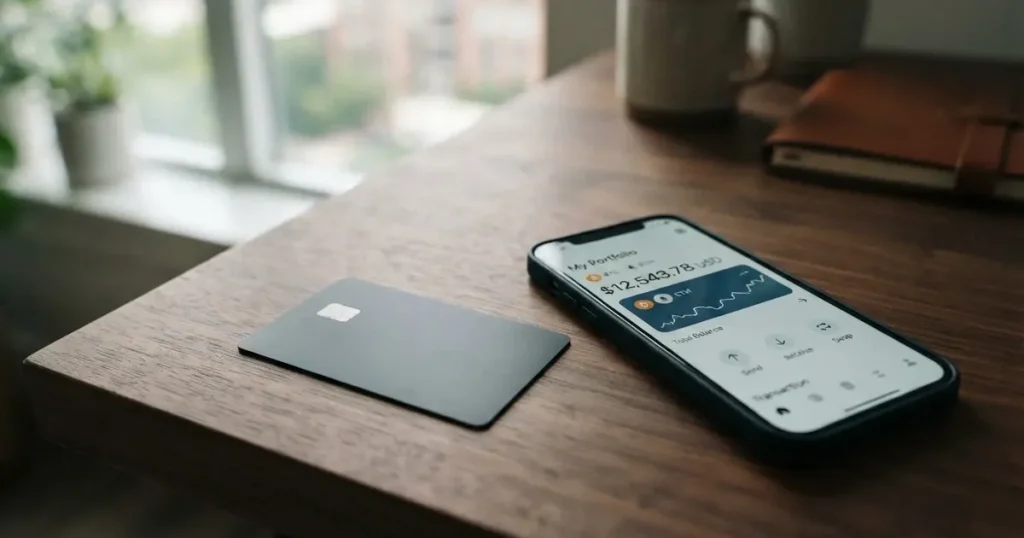
Thera Wallet is not a general crypto card you can open from anywhere. It is the card that comes with a Thera payroll account, and it is aimed at people who are already paid through that platform — employees and contractors whose salary arrives there. On top of that narrow base, the product itself is thin: a virtual Visa that works online, a wallet holding USDC and USDT, and a conversion step between the two that the card’s own pages do not price. My score for it is 4.9 out of 10, and most of the reasons for that number come from what is missing rather than from what is broken.
The conditions described here are current as of October 28, 2026.
Verdict: 4.9 out of 10
The score breaks into five criteria, and I have kept each mark exactly as it was set. The reasons below are mine, in my own words; the numbers are not.
| Criterion | Mark | Why |
|---|---|---|
| Who can get it | 3 / 10 | Ten countries, and only people paid through Thera payroll |
| Cost | 5 / 10 | Issuance and fees are not published; foreign transactions “may incur FX fees” with no figure |
| Top-up options | 6 / 10 | Transfer from account to wallet to card in 5-10 minutes, but payouts limited to USDC and USDT on Ethereum and Tron |
| Reliability and complaints | 6 / 10 | Issuer and legal entity not named, KYC through partner AiPrise, Trustpilot 4.7 from 100 reviews |
| Everyday use | 5 / 10 | Virtual Visa with Apple Pay and Google Pay; online purchases only, no in-store, no ATM, physical card only planned |
That first row is the one to read twice. A 3 out of 10 on eligibility is not a flaw in the product — it is a description of who it is for. If your salary does not arrive through Thera, nothing else on this page matters to you. If it does, the question becomes whether an online-only virtual card funded from a stablecoin wallet fits how you actually spend.
The audience this suits, plainly, is freelancers and contractors in Latin America paid through Thera payroll. For them the fit is direct: money lands in the platform, moves to a wallet, becomes card balance, and pays for things online in local currency. For everyone else the practical answer is that this is not a general-purpose card, and the alternatives below serve a wider public better.
Who you need to be to get the card
The card is available in ten countries: Argentina, Bolivia, Brazil, Colombia, Dominican Republic, Ecuador, Guatemala, Mexico, Peru and the United States. The card’s own wording is that availability is “based on local banking and regulatory availability” — which means the list is not a promise of the same experience in each place, but a statement that the platform operates there at all.
The eligibility rule underneath is stricter than the country list. The card is for people paid through Thera payroll, as employees or contractors. It is not described as a general retail product you can sign up for on its own. So when you see “available in ten countries”, read it as: within those ten countries, for that particular group of people. Everyone else reading a comparison of crypto cards online should skip the rest of this review and look further down.
Worth saying once, because it comes up in almost every question about this kind of service: the card’s public pages do not state the card currency, and they do not state how proof of address or age is handled. I did not find those points stated, and I am not going to fill them in.
How to get it
The verification process runs on mobile only, through a QR code, and it is handled by a partner called AiPrise rather than by Thera’s own team. You start from your phone, and the flow asks for your ID type and issuing country, a photo of the front and back of the document, and then a selfie. Accepted documents are a driver’s licence, resident ID, voter ID, national ID and passport.
There are two checks in total — the document verification and the selfie — and each ends in one of two outcomes, “Verified” or “Declined”. A standard review takes a few minutes; if extra verification is needed, 24-48 hours. The card does not list the reasons a check can be declined, which is worth keeping in mind if yours goes wrong. If your employer requires it, withdrawals stay blocked until KYC is approved.
There is a tax step as well, and it comes before you withdraw rather than at signup: non-US residents fill in a W-8BEN or W-8BEN-E, US tax residents a W-9.
The wallet itself is created under Payroll > Wallet, and approval “typically takes a few business days”. That is the part of the timeline to plan around. The card itself is a virtual Visa, usable for online purchases “where Visa is accepted” and not in stores. A physical card is planned, not available.
Fees: what it really costs
The honest answer here is that the card does not tell you. Issuance cost is not stated, the crypto conversion fee is not stated, and foreign transactions “may incur foreign exchange (FX) fees” with no figure attached. Cash is not addressed at all, which is consistent with the card not working in-store. Card spending limits are not stated either.
What is stated is a limit of a different kind: a maximum of 10 withdrawals in any rolling 30-day period. There is a single virtual card and no tiers, so there is nothing to compare against.
| Fee or limit | What the card states |
|---|---|
| Issuance | Not stated |
| Monthly fee | Not stated |
| Crypto conversion | Not stated |
| Foreign exchange | Foreign transactions “may incur FX fees”, no figure |
| ATM | Not stated |
| Card spending limits | Not stated |
| Withdrawals | Maximum 10 in any rolling 30-day period |
| Card currency | Not stated; the wallet holds USDC and USDT, the payroll balance is in USD |
Three everyday payments, and what applies to each:
- A subscription in your own currency. This is the cleanest case. The balance sits in the card, the payment goes through, and no conversion is involved — unless the merchant prices in something other than your currency, which brings the unpriced FX fee into play.
- Anything bought in a currency other than the card’s. You are told FX fees may apply, and you are not told how much. This is the payment where the missing number hurts you most.
- Anything you want to withdraw to your own crypto. This sits under funding rather than fees, but it is where a third unpriced cost lives: payout fees are not stated, and a wrong address can mean permanent loss.
Three “not stated” lines in a fee table is not a formatting quirk. It is the single most useful thing to know before you commit, because it means you cannot model your cost per payment from public information. Ask.
Top up: how the money reaches the card
The route is internal and it has two legs. First you move funds from your Thera account to your Thera Wallet — “Transfer to Wallet” — and then from the wallet to the card with “Add Funds”. The card says it takes 5-10 minutes for this to reflect. In practice that means a short wait between paying yourself and being able to spend.
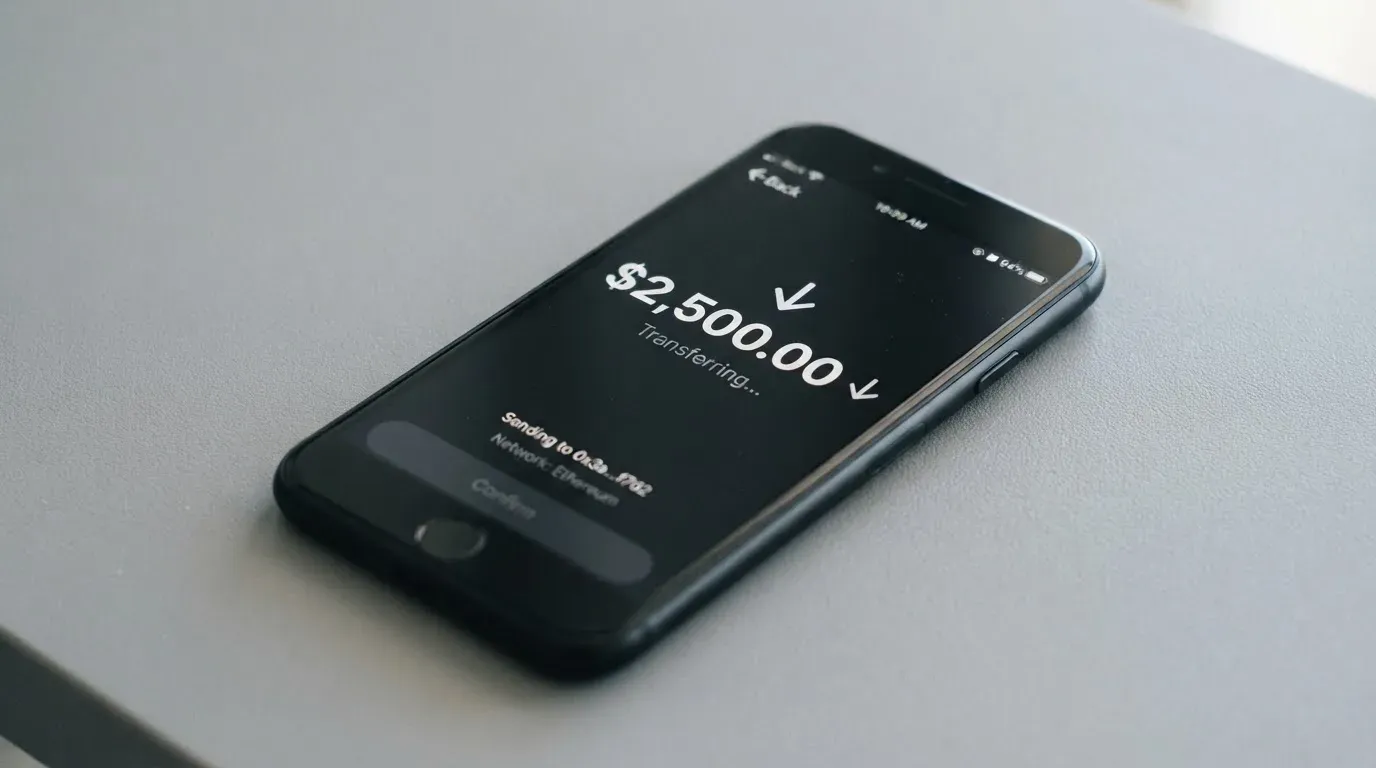
The currency layer is narrower than it looks. Wallet payouts support USDC and USDT on the Ethereum and Tron networks only. There is no mention of fiat top-up options, no minimum, and no fee for the transfers themselves. On the other side, a payout to an external crypto address is added as a method (“Add Method”), again in USDC or USDT on Ethereum or Tron.
Two things to hold onto here. Blockchain transfers are irreversible — send on a network the provider does not support, or to an address belonging to another network, and the money can be lost or need manual support recovery with no guarantee. And Tron deserves a specific note: Circle stopped supporting USDC on Tron in February 2024, so “USDC over TRC20” is not a native option. Check which of the two coins your payout address actually expects before you send anything. I am not telling you how to work around anything — I am telling you that a wrong network here is a real and common loss.
Paying with it day to day
The card can be added to Apple Pay and Google Pay through the card settings, which is what makes it feel like a normal payment card rather than a number you paste into a checkout page. It works online wherever Visa is accepted, and it cannot be used in stores. Cash is not available.
Some categories of merchant are not stated — no list of blocked merchant types is published — and the card cannot be used for peer-to-peer transfers via payment links. There are no rewards, no cashback, and nothing stated about the app beyond it being a web dashboard, whose ratings I did not read. Disputes, chargebacks and what happens when a merchant refuses to refund you: not stated.
So the honest picture of daily use is narrow. Online purchases, plus mobile wallets at online merchants. No offline, no ATM, no peer-to-peer. If you spend mostly in shops, this is not that card. If you spend on subscriptions, services and online invoices, it does the job — within the limits of an online-only Visa whose currency nobody has published.
What can go wrong
The company itself: Thera is a payroll and payments platform. The pages I read do not name the legal entity behind it, the card issuer, or any licences held. The KYC partner is AiPrise. When the issuer is not named, you cannot check that issuer’s record, and that is not a small gap — it is the entity that would stand behind the card.
Complaints: I found no official incidents. On Trustpilot the card’s service sits at 4.7 from 100 reviews, all of them in the last twelve months, as read on 21 October 2026. Only one complaint was visible in detail — a user report from 6 August 2026 that a withdrawal marked completed never arrived, with slow, repetitive support replies. The company has not replied to negative reviews.
Security on the card itself is more ordinary: card number, expiry and CVV are shown in the Wallet section and auto-hide when you leave the page, identity verification is required, and custody arrangements are not stated. Support: the card article names no channel at all; the KYC guide points to email support.
Against that, the general risks of this category apply. Programme closures are a real pattern — Visa terminated its global agreements with FTX on 13 November 2022 and the FTX US debit card was wound down by its issuer, and WaveCrest, a Visa issuer that supplied crypto card brands, was suspended by Visa in Europe in 2018, closing all of its Visa programmes. A closure typically means a notice period, then spending and loading stop, then you are asked to withdraw what is left. One 2026 closure reported by a secondary source ended new loads on 8 July 2026 and spending on 8 August 2026 — that is a single unconfirmed source, and I am flagging it as such rather than treating it as fact.
Money that is stuck is money that is stuck. Declined authorisations can leave a hold that stays for several days, typically up to seven.
What to take instead
If the Thera route is closed to you, or you need a card that works in shops, these are the three comparable products, scored on the same basis.
| Alternative | Score | Card | Issuance and monthly | Foreign exchange | Rewards |
|---|---|---|---|---|---|
| International Visa Card | 6.7 / 10 | U.S.-issued Platinum Visa, virtual, pays in USD; physical “Coming soon” | $5 one-time virtual issuance, no maintenance fee; plans Classic free, Pro $9.00/month, Max $19.00/month | “Visa exchange rate + 2% FX fee”; card use in USD free on all plans | No cashback stated |
| UNi Card | 6.1 / 10 | Multicurrency card on the Mastercard network, spends from the UNi.Global account balance | “No annual fee”; issuance fee not stated | “No annual fee or foreign transaction fee”; converted at “live OTC (Over-the-Counter) rates”, “No hidden exchange fees” | “Spend-to-Earn rewards” up to 3% |
| Whop Cards | 5.2 / 10 | Visa, works anywhere Visa is accepted online and in stores | Page says “No extra fees”; no issuance or monthly amounts listed | Not stated | 5% cashback at select merchants, currently Uber |
On eligibility, which is the whole game for these three:
- International Visa Card — account and card not available to residents or legal registrants of Belarus, mainland China, North Korea, Cuba, India, Iraq, Iran, Israel, Myanmar, Nepal, Nicaragua, Russia, Syria, Turkey, Ukraine, Venezuela and Vietnam. FATF grey-list countries are reviewed case by case with compliance approval. Purchases are blocked in North Korea, Cuba, Iran, Russia, Syria, Ukraine and Venezuela. The rule follows residence or registration; citizenship is not mentioned. Funding: deposit USDC or USDT into the USD account free at 1:1, plus USD, EUR, SEPA, SWIFT and FedNow deposits. Networks are not stated.
- UNi Card — eligibility is not stated. Funding is not stated either, which is a large hole in a card whose selling point is a multicurrency balance. Card type and currency are not stated.
- Whop Cards — consumers are covered in 31 US states (Alabama, Alaska, Arkansas, California, Colorado, Connecticut, Florida, Hawaii, Illinois, Indiana, Iowa, Kansas, Kentucky, Maine, Massachusetts, Michigan, Minnesota, Montana, Nebraska, New Hampshire, New Jersey, New York, North Carolina, Oklahoma, Pennsylvania, South Carolina, Texas, Utah, Virginia, West Virginia, Wyoming) and businesses in 41. Unsupported consumer countries: Belarus, China (Mainland), Cuba, Hong Kong, India, Iran, Iraq, Israel, Myanmar, Nepal, Nicaragua, North Korea, Russia, Syria, Turkey, Ukraine, Venezuela, Vietnam. Whether the basis is citizenship or residence is not stated. It spends from a Whop balance, and a pending balance is usable as soon as a payment arrives while standard withdrawals use settled funds. The starting data is described as backed by stablecoin collateral from a linked wallet; coins and networks are not stated.
Read that table with the score column in mind: all three score higher than Thera Wallet. The reason is not that they are better products — it is that they publish. International Visa Card states $5 issuance, a free plan, and a 2% FX fee. UNi Card states no annual fee and no FX fee. Whop Cards says “No extra fees”. Thera Wallet, on the core question of what a payment costs, says nothing.
Who I would recommend it to
I would recommend the Thera Wallet card to exactly one person: someone in Argentina, Bolivia, Brazil, Colombia, the Dominican Republic, Ecuador, Guatemala, Mexico, Peru or the United States, already paid through Thera payroll, who spends most of their money online and is comfortable holding the balance in USDC or USDT rather than in a bank account. For that person it removes friction between getting paid and spending what you were paid — that is a real convenience, and I would not talk myself out of it.
I would not recommend it as a first crypto card, and I would not recommend it to anyone whose spending includes shops, cash or peer-to-peer transfers. I would not recommend it to anyone who cannot get a clear answer, before signing up, on four questions the public pages leave open: what the conversion costs, what a foreign-currency payment costs, what the card currency is, and which legal entity and issuer stand behind it. Those are not pedantic questions. They are the difference between a card you can budget with and one you cannot.
If you need this card, the sensible order is: confirm your payroll actually runs through Thera; ask about the four unknowns in writing and keep the answers; put in a small amount first rather than your whole balance; and check that the payout network you intend to use is one of the two supported before you send anything out. None of that is clever — it is what you do with any prepaid product whose fees are not on the page.
Frequently asked questions
What is the Thera Wallet card?
It is a virtual Visa card linked to a crypto wallet inside the Thera payroll platform. You get paid through Thera, move money from your account to your Thera Wallet, then add funds to the card, which pays for online purchases where Visa is accepted. It is not a general crypto card open to anyone, and there is no physical card yet — one is planned.
How does the Thera Wallet card work?
Your payroll balance moves to the wallet, then from the wallet to the card balance, and the card spends that balance online. The wallet holds USDC and USDT, and payouts go out in those two coins on the Ethereum and Tron networks only. The transfer from account to wallet to card takes five to ten minutes to reflect, so there is a short wait after you are paid.
Is Thera Wallet a bank?
The card’s own pages describe Thera as a payroll and payments platform, not a bank. They do not name the legal entity behind it, the card issuer, or any licences held. Identity verification runs through a partner called AiPrise rather than through a bank’s own process. So if the question is whether your money sits in a regulated bank deposit, the public material does not say that.
Who owns Thera Wallet, and who issues the card?
Thera is the platform, and it markets the product and manages the programme. The pages I read do not name the card issuer or the legal entity, and that matters: the issuer is the entity that would stand behind the card and whose record you could check. I did not find it stated, so I am not going to guess at it.
Is the Thera Wallet card available in my country?
Support is listed for ten countries: Argentina, Bolivia, Brazil, Colombia, Dominican Republic, Ecuador, Guatemala, Mexico, Peru and the United States, subject to local banking and regulatory availability. Within those countries it is still restricted to people paid through Thera payroll — employees and contractors. If you are not on that payroll, the country list does not help you.
Does the Thera Wallet card require KYC, and how long does it take?
Yes. Verification is on mobile only, via a QR code, through the partner AiPrise. You submit your ID type and issuing country, photos of the front and back, and a selfie; accepted documents are a driver’s licence, resident ID, voter ID, national ID and passport. A standard review takes a few minutes, or 24-48 hours with extra verification. Wallet approval typically takes a few business days.
What does the Thera Wallet card cost to use?
The public pages do not give you numbers. Issuance cost is not stated, the crypto conversion fee is not stated, card spending limits are not stated, and foreign transactions “may incur FX fees” without a figure. Card currency is also not stated. The only published number is a cap of 10 withdrawals in any rolling 30-day period. You cannot build a per-payment cost from this, so ask before you commit.
How do I top up the Thera Wallet card, and can I use it in stores?
Topping up is two internal steps: “Transfer to Wallet” from your Thera account, then “Add Funds” from the wallet to the card, which takes five to ten minutes. There is no mention of direct fiat top-ups, and no minimum or transfer fee is stated. The card cannot be used in stores at all — online purchases only, plus Apple Pay and Google Pay at online merchants.
Is the Thera Wallet card safe, and what about withdrawals?
I found no official incidents, and Trustpilot shows 4.7 from 100 reviews in the last twelve months as read on 21 October 2026. The one detailed complaint visible was a user report from 6 August 2026 that a completed withdrawal never arrived, with slow support. Card details auto-hide when you leave the page, identity verification is required, and custody arrangements are not stated. Custodial balances carry counterparty and hack risk in general.
Who is the Thera Wallet card actually worth it for?
For someone already paid through Thera payroll who spends online and is comfortable with a USDC or USDT balance — mostly freelancers and contractors in Latin America. Not as a first crypto card, not if you spend in shops or need cash, and not if you need published fees. Compare International Visa Card, UNi Card or Whop Cards instead; all three scored higher and all three state their costs.
App and neobank card fees – cryptocardfacts
Content created by the «cryptocardfacts» team