
Toku card review — a payroll card, not a general crypto debit card
 Available in US

The Toku card sits in an unusual corner of the crypto-card market. It is not a product you sign up for as an individual looking to spend your own Bitcoin or stablecoin balance at a coffee shop. It is a Visa card that ships only to payroll recipients whose employer already pays them through Toku, and it draws on a balance settled into a connected Rain wallet rather than on anything you top up yourself. That single fact shapes almost everything else about it: where it is available, how the money arrives, what it costs (nobody outside the employer relationship knows, because the fees are not published), and who should even consider it.
The conditions described here are current as of October 28, 2026.
Verdict
Toku scores 5.2 out of 10, and the score is best read as a verdict about a narrow product rather than a bad card. If you are a contractor or employee whose pay arrives through Toku’s stablecoin payroll, the card is a tidy way to turn that pay into everyday spending. If you are anyone else — someone who heard about it, someone who wants a crypto debit card in Europe, someone who wants cashback, someone who wants to add a card to Apple Pay and walk into a shop — Toku is not built for you, and the score reflects that gap.
| Criterion | Score | Why it lands there |
|---|---|---|
| Who can get it | 5 / 10 | Issuance is open now in the US and Latin America (Mexico, Colombia, Brazil are named); APAC is listed for Q2 2026, which is not the same as available. |
| Cost | 5 / 10 | Issuance fee, monthly fee, conversion fee, FX fee and ATM fee are all unstated on the public pages. |
| Top-up options | 4 / 10 | You do not top it up. Your employer pays you in stablecoins through a connected Rain wallet, and the card spends from the settled balance. Rain accepts USDG, USDC and RLUSD. |
| Reliability and complaints | 6 / 10 | The card is a Visa product issued by a partner under Visa licence, and one Trustpilot review sits at 3.2 out of 5 — too few reviews to call it a pattern. |
| Everyday use | 6 / 10 | A virtual card is available right away; a physical card exists “where applicable”. Apple Pay, Google Pay and ATM access are not mentioned on the card’s pages. |
The score is not adjusted for any particular reader. It treats the product as a payroll card funded by Toku customers, as the card’s own pages describe.
Who they will give the card to
The card is a payroll product, and the eligibility rules follow from that. Issuance is “available now” for recipients based in the United States and Latin America; the page names Mexico, Colombia and Brazil. The Asia-Pacific region is listed as “APAC Q2 2026”, which in product-roadmap language means it is not live yet and the exact date is not committed. Other regions are not addressed on the public pages at all, and citizenship or residence rules beyond those geographic lists are not stated.
The “recipients” language matters. The card is offered to people who are paid through Toku by an employer or client that already uses Toku for payroll or contractor payments. A freelance designer in Berlin who heard about Toku, or a remote worker in the Philippines, cannot simply apply on Toku’s site and expect a card. The eligibility question, in practice, is the same as the employment question: does your employer pay you through Toku, in a country Toku already supports, with a stablecoin-to-fiat flow that lands in a connected Rain wallet.
That is the core audience. If you are reading this review because you are trying to find a crypto debit card you can sign up for on your own, Toku is not in that market, and the rest of this review will mostly explain what you are looking at instead.
How to get the card
There is no general sign-up flow that the card’s pages describe. The card is issued to payroll recipients of Toku customers, meaning your employer or your client must already be using Toku to pay you in stablecoins, and you receive an invitation or a link into the card experience as part of that onboarding.
The pages describe identity verification in general terms only. They refer to a “standard KYC process at issuance” and say recipients verify identity once. They do not list the specific documents, whether proof of address is required, what the minimum age is, or how the KYC levels are tiered. There is only a single “standard KYC at issuance” mention; tiers and graduated limits are not published.
Once identity is verified, the card comes in two forms. A virtual card is available immediately. A physical card is shipped “where applicable” in supported regions; the card’s pages do not give a delivery time or a delivery cost. The card is a Toku-branded Visa, and the pages mention only the Visa network — Mastercard is not mentioned for this product. The card’s billing currency is not stated on the public pages.
Apple Pay, Google Pay and ATM access are not mentioned on the card’s pages. That does not necessarily mean they are unavailable, but if you are choosing a card specifically because you want to tap to pay with your phone, you should treat the absence of any mention as a gap rather than an oversight.
What it really costs: Fees and everyday payments
Toku does not publish its fees. The card’s public pages provide no stated numbers for the issuance fee, the monthly maintenance fee, the conversion fee from stablecoin to fiat at point of sale, the foreign-exchange fee, the ATM fee, or the daily and monthly spending limits. Tiers are not published either; there is no Standard/Premium table to compare.

| Fee or limit | What the card’s pages say |
|---|---|
| Issuance | not stated |
| Monthly fee | not stated |
| Conversion (crypto to fiat) | not stated |
| Foreign-exchange (FX) fee | not stated |
| ATM fee | not stated |
| Daily limit | not stated |
| Monthly limit | not stated |
| Tiers | not published |
Because there is no published fee table, the only honest thing to do is treat Toku as a card whose cost is opaque. If your employer is using Toku to pay you, the cost question is best answered by your employer’s payroll team or by Toku’s onboarding, not by a public review. The “not stated” wording above is not me hedging — it is what the card’s pages say when you read them carefully.
For the same reason I cannot walk you through three everyday payments the way a normal review would, naming the conversion fee at a café in Mexico City or the ATM fee at a Bangkok airport. The fees that would attach to those purchases are not on the public pages. What I can do is tell you the structure of the cost, so you know what to ask.
The card is described as a “spending layer” on a connected Rain wallet. Rain is named in the card’s pages as the wallet provider, and the card draws on a settled balance in that wallet. The cost you pay, then, is whatever Rain charges to convert stablecoins to the merchant’s currency at the moment of payment, plus whatever the card issuer charges on top. Both numbers are not stated.
If you are the employer, this is less of a mystery: Toku is a payroll and compliance product, and the costs are typically priced in your contract with them. If you are the employee, you are downstream of that, and the lack of a public fee schedule is a real gap. A card you cannot price before you use it is harder to budget than a card with a published 1% FX markup.
How to top up the card: funding and top-up options
The card is not topped up in the usual sense. There is no “deposit” button. Funding arrives because your employer pays you, and the payment settles in stablecoins into a connected Rain wallet, and the card draws on that settled balance when you pay for things. This is true whether you are a salaried employee or a contractor; what changes is who the payer is.
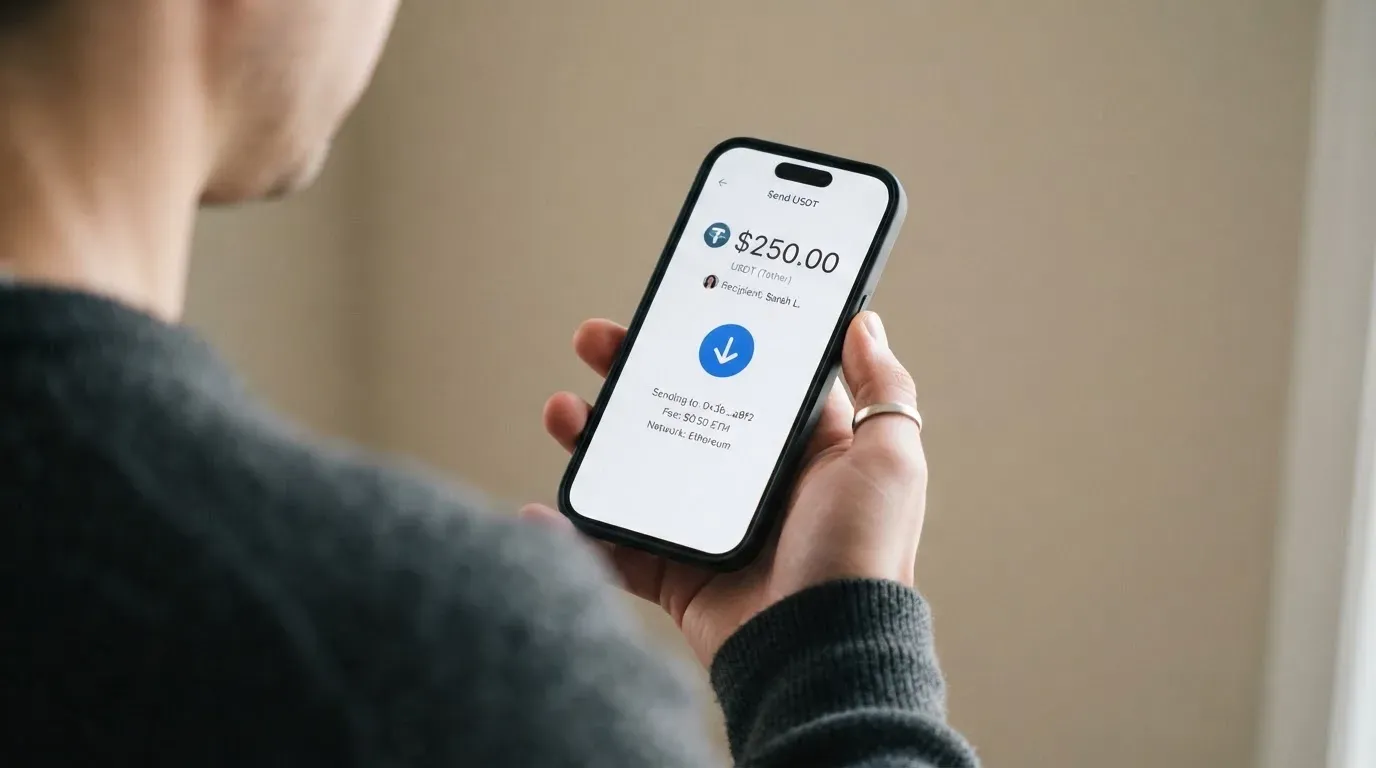
Rain supports three stablecoins for the wallet the card is connected to: USDG, USDC and RLUSD. The pages do not list the networks those tokens are accepted on, but Rain as a product accepts tokens across multiple chains, and the wallet you connect during onboarding is the one the card will read from. If your employer is paying you in USDC on a network Rain supports, the card will see a balance; if they are paying you in a token or on a network that Rain does not list, the card will not see a balance until the situation is resolved.
There is no user-side top-up. The card’s pages do not describe a “buy crypto, deposit, spend” path typical of consumer crypto debit cards. The card’s whole point is that the money arrives as a salary, not as a transfer you initiate.
The withdrawal path is also not stated. Some payroll cards let you move the settled balance out to a bank account; whether Toku does, and on what timeline, is not on the public pages.
Paying with the card every day
In the narrow case Toku is built for — being paid in stablecoins and spending the result — the day-to-day looks straightforward. The virtual card is available right after verification, so you can start spending online or over the phone as soon as your first payment settles. The physical card arrives in supported regions and works wherever Visa is accepted, which is most point-of-sale terminals worldwide.
What the pages do not describe is the experience around that spend. There is no stated cashback, no stated rewards rate, no stated staking yield and no stated bonus for spending in a particular category. There is no mention of a dedicated card app, no public app-store ratings, and no features like spend notifications, merchant category locks, or in-app statements described. It is confirmed there is no dedicated card app.
A few practical consequences follow.
Online checkout, especially in the US, often relies on Address Verification Service (AVS) and 3-D Secure. AVS is mainly offered in the US, Canada and the UK, and is generally unavailable for foreign-issued cards, which can cause declines for cards with a non-US BIN. 3-D Secure, by contrast, adds a confirmation step (Visa Secure on the Visa side) and is the standard way issuers fight fraud. Neither is mentioned by name on Toku’s pages, but a Visa card will inherit the network behaviour either way. The card currency is not stated, so it is not clear whether your settled balance is in US dollars, Mexican pesos, or another currency — and the merchant’s experience with a card whose billing currency they cannot read is the kind of detail that can matter at checkout.
If you want contactless phone payments, Apple Pay and Google Pay are not mentioned on the card’s pages. This absence is a gap rather than a confirmed “not supported”. For people who rely on tapping their phone to pay, that is something to ask Toku about before you assume the card will work that way.
What can go wrong
The card’s main risks are the standard risks of a payroll product whose fees are not published and whose roadmap is regional. I will walk through the specific ones.
The first is geography. Toku is open now in the US and Latin America, and listed for APAC in Q2 2026. If you are a contractor working for a US-based company and you are based in, say, the Philippines, you may find that the card is not yet available in your country even though the payroll product on the employer side is. The card’s availability and the payroll’s availability are not the same thing, and the card’s pages do not promise they will line up.
The second is the issuer relationship. The card’s pages say “Card issued by partner under Visa licence”. Rain’s own Visa debit cards are issued by Cross River Bank, Member FDIC, under a Visa U.S.A. Inc. licence, and Rain Products, Inc. is the program manager, not a bank. Whether that Cross River Bank detail applies to the Toku card specifically is not stated. If the issuer is the same, the card sits inside Cross River’s BIN range and inherits Cross River’s compliance and outages. If it is a different partner, the same question applies differently. Either way, Visa retains the right to suspend a programme, as it did with FTX’s card in November 2022 and with WaveCrest’s programmes in Europe in 2018. A programme suspension is a tail risk, not a daily one, but it is real.
The third is balance risk. The card draws on a connected Rain wallet, and Rain’s own pages describe it as not a bank, exchange or asset custodian. The card sits on top of a non-bank balance, which means the funds are not FDIC-insured the way a US bank account would be. EMIs in the EU are required to safeguard customer funds, but the safeguard regime is not the same as deposit insurance, and Toku’s pages do not promise any specific safeguarding. If Rain or Toku were to fail, the recovery path for card balances is not a deposit-insurance claim; it is a creditor claim, like any other.
The fourth is stablecoin risk. Rain accepts USDG, USDC and RLUSD for the wallet the card reads from. Tether’s USDT and Circle’s USDC together held about 90% of stablecoin market capitalisation in mid-2025, according to the BIS. USDC’s reserve composition is published monthly by a Big Four firm, and the token is redeemable 1:1 for US dollars; USDT’s reserves are described by Tether as intended to back the token 1-to-1. USDG is newer and smaller. Stablecoins can depeg — TerraUSD collapsed in May 2022 and USDC briefly lost its peg in March 2023 — so the value of your settled balance can move against you in a stressed market, even though the everyday experience is meant to feel like dollars in a wallet.
The fifth is sanctions and frozen funds. Tether has publicly described disabling tokens in wallets on the OFAC sanctions list and freezing funds tied to illicit activity, and the same tools exist in principle for any issuer of a regulated stablecoin. Your card’s balance is, in operational terms, a balance a regulated entity can freeze. If your employer pays you through a sanctioned counterparty, or your wallet ends up on a list, the freeze is on the stablecoin, not on the card.
The sixth is the complaint picture. There are no Reddit or forum complaints to be found. The only third-party review platform with any data is Trustpilot, and the score there is 3.2 out of 5 from a single review. One review is too few to call a pattern, but the detail is worth flagging: a business applicant reports being told in January 2026 that Toku was “not right fit for your business at this time” after a KYB (know-your-business) inquiry. That suggests Toku screens its business side, and that not every employer who tries Toku gets through.
The seventh is the regulatory backdrop. In the EU, MiCA’s stablecoin rules applied from 30 June 2024 and the rest of the regime, including CASP rules, from 30 December 2024. There is a transitional period running until 1 July 2026 for providers already operating under national law. None of this is a problem Toku has caused, but it is the regulatory weather the card is operating in, and it is what gives an EU-based contractor pause: if your employer’s payroll provider is in a different jurisdiction, the legal standing of your wallet balance is something to ask about.
The eighth, and smallest in probability, is a programme-level event. If the Visa-licensed partner that issues the card changes, or if the programme winds down, the standard pattern is a notice period, then a stop on new spending and loading, then a request to withdraw remaining balances. A single unconfirmed 2026 closure reported by a secondary source is a tail risk, not a forecast for Toku.
What to take instead
If you are reading this because you want a crypto-funded card and Toku’s payroll model is not your situation, here are three alternatives that offer comparable services.
TokenPocket (TP Card), 5.8 / 10
TokenPocket offers a Mastercard/Visa debit card that runs on the Arbitrum network, with virtual Fiat24 cards and balances in EUR24 and USD24. It is open to a published list of European countries and territories for the Visa debit (Germany, France, Spain and Switzerland are named), and to a different list for the Mastercard debit that includes Australia, Canada, Hong Kong, Japan, Taiwan, New Zealand, Singapore, South Korea and the UK; the Americas are “planned for Q2 2025”. The cost structure is mostly free: the NFT creation fee for the card is partly covered by TokenPocket and the user pays only “a small portion”, and “apart from these, TP Card does not charge any additional fees”. The trade-off is the deposit fee: a 1% fee is charged when depositing cryptocurrency into the TP Card, which the page says will be refunded through rewards or reduced fees later, but which is a real cost in the meantime. FX fee is not stated on the page. Funding is from the TokenPocket wallet, and the FAQ does not list every supported coin or network. No cashback is stated.
MetaMask Card, 7.1 / 10
MetaMask’s card is a Mastercard that is open for sign-up in 45 listed countries and territories, with other regions joining a waitlist. Proof of residency is required, and the eligibility is by residence, not by citizenship; sign-ups in the US and UK are temporarily closed. The card is virtual-first, with a Metal tier available for pre-order in the app after Virtual approval, and is issued by Monovate with Crypto Life as card provider. The virtual card is free with no annual fee, and Metal costs $199 a year. Transaction fees are described as “minimal” with a fee table linked; “no additional MetaMask fees” and no foreign-transaction fee, using the Mastercard rate. Funding is direct from the connected wallet on Linea, Base, Monad and Solana, with named tokens including mUSD, wETH, EURe, GBPe, USDC and USDT (the page says nine). Cashback is paid in mUSD into the Money Account: 1% on Virtual and 3% on Metal for the first $10,000 spent, then 1% (the headline 3% on Metal is footnoted to that cap). A Blackbird dining $FLY bonus is 5X for Virtual and 7X for Metal.
KAST, 6.1 / 10
KAST is a multi-card programme with up to 10 cards per user, available in Standard (Visa Platinum), Premium (Visa Infinite metal) and Private (Visa Infinite gold plated), plus a handful of themed designs (Pengu, Solana, Bitcoin). The account balance is in US dollars, with stablecoin deposits converted 1:1 at 0% spread. Annual membership is 0 USD for Standard, 1,000 USD for Premium and 10,000 USD for Private, all billed annually upfront. Standard physical cards have a 0 USD card fee plus 40 USD delivery; Premium and Private physical cards are included. There is a 1 USD monthly inactivity fee after 12 months, a 2 USD fee for extra virtual cards (“in some regions” 2 USD also on included Standard virtual cards), and renewal/reactivation fees whose amounts are not stated. Fees on the spending side are mostly zero: stablecoin top-up 0%, card spend in USD 0%, transaction fee 0%, Apple/Google Pay 0%, and a non-USD FX fee of 0.5%–1.75% depending on residence, transaction country and card programme, with a 0.10 USD fee on non-USD transactions under 25 USD and a 0.50 USD declined-transaction fee. Non-stablecoin tokens may be auto-converted at a fee shown in the app. Funding is in USDT, USDC, PYUSD and RLUSD on Ethereum, Solana, Polygon, Arbitrum and TRON, although the Terms state only USDT and USDC are currently acceptable. Cashback is paid in USD: Standard 1.5% on the first 2,000 USD per month, Premium 2% on the first 10,000 USD, Private 3% on the first 40,000 USD, with extra KAST Points of 1% on Premium and 2% on Private. Eligibility is by country, and the country list is shown only at KYC.
Toku is the right card for none of the audiences above. TokenPocket is the most general-purpose for a user who already keeps crypto in TokenPocket. MetaMask is the best fit if you want a self-custody card with published cashback. KAST is the choice if you want multiple cards and a published fee structure, and you are willing to pay for a tier.
Who I would recommend it to
The honest short list is short.
The card is worth recommending if you are a contractor or an employee whose pay is already being routed through Toku, you are based in the US, Mexico, Colombia or Brazil, your employer’s stablecoin of choice is one of USDG, USDC or RLUSD, and you do not need cashback, Apple Pay, or a published fee schedule. In that case the card is a convenient spending layer on the salary you are already receiving in stablecoins, and the rest of the comparison is academic.
The card is not worth recommending if you are a private individual looking for a crypto debit card you can sign up for on your own; if you are based outside the US, Latin America and the still-future APAC launch; if you want a card with a published fee table, cashback or staking rewards; if you want contactless phone payments and treat Apple Pay or Google Pay as a deal-breaker; or if you want a card whose balance sits in a regulated bank account with deposit insurance. In all of those cases, the alternatives above are better fits.
A final word on reading reviews like this one. The honest version of a review tells you both what the product does and what the product’s own pages do not say. For Toku, the gaps are not edge cases — they are the cost, the limits, the ATM behaviour, the mobile wallet support, the card currency, the issuer, and the dispute process. Until those are published, the score above is the best I can do, and the recommendation above is the honest one.
Frequently asked questions
What is the Toku card?
The Toku card is a Visa-branded card issued to payroll recipients of Toku customers, designed to spend a balance that is paid in stablecoins through a connected Rain wallet. It is a payroll product, not a general consumer crypto debit card.
How does the Toku card work?
Your employer or client pays you in stablecoins through Toku, the payment settles into your connected Rain wallet, and the card draws on that settled balance when you pay. There is no user-initiated top-up; the funding arrives as salary.
Is Toku a bank?
Toku is not a bank. The card’s pages describe it as a payroll and compliance product, and the card itself is issued by a partner under a Visa licence. The connected Rain wallet is also described as not a bank, exchange or asset custodian.
Who owns Toku?
The card’s pages describe Toku as the provider of the payroll and compliance infrastructure behind the card. Ownership details beyond the company name itself are not published, and the issuer is described only as a Visa-licensed partner.
Is the Toku card available in my country?
Issuance is open now in the United States and Latin America (Mexico, Colombia, Brazil are named). APAC is listed for Q2 2026. Other regions are not addressed on the public pages, so the answer for most readers is “not yet” or “not stated”.
How do I get a Toku card?
You cannot apply for a Toku card as an individual. The card is offered to payroll recipients of Toku customers, so the practical path is to ask your employer or client whether they pay through Toku and whether your country is on the supported list.
Does the Toku card require KYC?
Yes. The card’s pages describe a “standard KYC process at issuance” and say recipients verify identity once. The specific documents, the age minimum and any tiered limits are not stated on the public pages.
How do I top up the Toku card?
You do not top it up. The card is funded by employer payroll in stablecoins, and the money arrives as a payment to your connected Rain wallet. Rain supports USDG, USDC and RLUSD for that wallet.
How do I add the Toku card to Apple Pay or Google Pay?
The card’s pages do not mention Apple Pay or Google Pay, so the safest answer is to ask Toku directly through the support link before you assume the card will tokenise into a mobile wallet.
Is the Toku card safe?
The card is a Visa product issued by a partner under a Visa licence, and it draws on a Rain wallet that is described as not a bank, exchange or asset custodian. The risk picture is the standard one for a payroll card on a non-bank balance: no deposit insurance, and a stablecoin balance that can in principle be frozen. Treat it as a spending tool for salary, not as a savings account.
Wallet card fees and costs – cryptocardfacts
Content created by the «cryptocardfacts» team