
Quick USD card from a Telegram bot: strong top-ups, thin paperwork
 Available in US
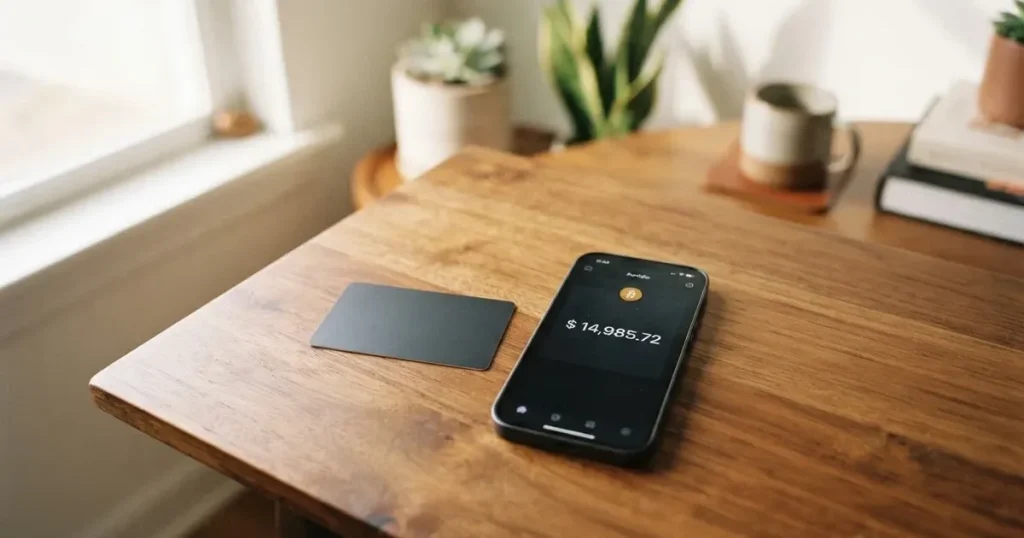
If you have crypto sitting in a wallet and no ordinary bank card you feel comfortable using, VantaCard is a card-shaped way to spend it in dollars. The pitch is unusually direct: open a Telegram bot, pass a quick identity check, and about 2 minutes later you are holding a Visa number that works in Apple Wallet and at contactless terminals. There is no shipping, no physical-card wait and no separate app. What you get in exchange is a card whose fee schedule is only partly public, whose issuer is never named, and whose terms still contain placeholders. My score for the whole package is 5.9 out of 10.
The conditions described on this page are current as of October 28, 2026.
Read on if you want to know whether this is the right tool for your situation, or whether the gaps in the paperwork will cost you more than the convenience is worth. If you would rather have a card from an outfit that publishes its issuer and its full price list, I point you to three alternatives near the end.
The score: 5.9 out of 10
Here is how the card breaks down against the six things I actually check before recommending anything in this category.
| Criterion | Mark | Why |
|---|---|---|
| Who can get it | 6 / 10 | Not available to residents of “certain countries and territories”; the list is shown inside the app, and the number of countries is not disclosed |
| Cost | 3 / 10 | Issue 20 USDT (Online) or 125 USDT (USD + ATM); top-up 1 USD + 3.8% or 4.5%; monthly fee and conversion are not disclosed |
| Top-up options | 9 / 10 | 14 cryptocurrencies across 38 deposit networks (BTC, ETH, USDT named), balance updates automatically |
| Reliability and complaints | 6 / 10 | Vanta Group Ltd, England and Wales, company number 16546788; issuer named only as “card issuing partners”, licences not disclosed; no complaints or Trustpilot pages found, placeholders left in the terms |
| Everyday use | 7 / 10 | A real Visa, issued in about 2 minutes, Apple Wallet and contactless; cash machine only on the USD + ATM tier, up to 750 USD a day; the app is a Telegram bot |
| Total | 5.9 / 10 | — |
The strongest column is the one most crypto cards get wrong. Fourteen currencies across 38 networks is a genuinely wide deposit map, and the balance updating by itself means you are not re-sending funds between wallets. The weakest is cost, and it is weak for a structural reason rather than because the numbers are bad: the two fees you would most want to know — the monthly fee and the currency conversion fee — are simply not on the public pages. You cannot budget a card whose conversion charge is undisclosed, and that is why the cost column sits at 3.
Reliability sits in the middle at 6 rather than at either extreme. There is a real registered company behind it, with an address in Newark and a company number, which is more than many projects in this category offer. But the issuer behind the Visa programme is described only as “card issuing partners”, no licences are stated, and I could not find a single independent review, complaint thread or Trustpilot page for VantaCard by name. Absence of complaints from someone nobody has written about is not a clean record; it is an empty one.
Everyday use earns 7 because the mechanics are genuinely good. This is a Visa, not a novelty card: it goes into Apple Wallet, it taps, it works wherever Visa is accepted. Two minutes from opening the dashboard to a usable card number is faster than anything I have seen from a physical-card issuer. The deduction is for the cash machine, which exists only on the more expensive tier, and for the fact that the whole interface is a Telegram bot — convenient if you live in Telegram, limiting if you do not.
Who this suits, in one line: Telegram users who want a quick USD Visa that works with Apple Pay. Who it does not suit: anyone who needs to see an issuer name, a monthly fee and a conversion rate before committing money, anyone who wants cash from a machine without paying the top-tier issue fee, and anyone whose country might be on that undisclosed list.
Will they give you the card
Yes for a lot of people, with one caveat you cannot resolve from outside.
Issuance is subject to identity verification and eligibility, and the pages describe a quick identity check after you open the dashboard. Which documents count, and what age you must be, is not stated. That matters more than it sounds: identity checks fail for all sorts of ordinary reasons — an unreadable passport photo, a name spelled differently from your bank record, an address you have not updated anywhere else. If you are someone whose details have ever been rejected by a bank or a crypto exchange, expect to retry here.
The country rule is the real caveat. VantaCard is not available to residents of “certain countries and territories”, and the list is shown inside the app. So the honest position is this: you cannot tell from the public pages whether your country is excluded. There is no number given either — how many countries are on the list is not disclosed, which tells you it is not a short list of obvious outliers. You only find out after you install the bot and look.
It would be reasonable to expect the usual sanctions screening underneath, since that is how every regulated issuer in this category operates, and nationality is often screened separately from residence. But that is my expectation about how this business must work, not a promise from the card. Treat the in-app list as the only reliable answer.
If your country is clearly outside the grey zone and you hold a document that matches your other records, the odds are good. If you are a resident of a country with a history of financial isolation, do not order anything until you have seen that list.
How to get it
The whole journey happens in Telegram. There is no separate app — the product runs inside a Telegram bot, and support is also “ask in the app” through that bot.
There are two products, and the choice between them matters more than it first appears:
- Online & Apple/Google Pay — a USD virtual card, issue fee 20 USDT, starting balance 3 USD, minimum top-up 20 USD, no cash machine access.
- USD + ATM — issue fee 125 USDT, minimum top-up 5 USD, and cash machine withdrawals up to $750 a day.
Both are described as “A real Visa card”, in USD, available in 16 designs, valid 36 months. Whether the USD + ATM tier is physical or virtual is not stated — which is worth asking about directly in the bot if cash is your reason for choosing it.
There is no shipping step at all. The card is issued in about 2 minutes according to the page, and it becomes usable once funded. That is the single most convenient thing about the product: no waiting for an envelope, no courier to chase, no activation call.
The order of operations is roughly: open the dashboard in Telegram, complete the quick identity check, pick a tier and a design, pay the issue fee, receive the card number, add it to Apple Wallet, and fund it. Identity verification is required and no KYC tier levels are published, so I cannot tell you whether you will face enhanced checks later or not.
One thing I would do before paying anything: have your identity document in front of you and check the name on it matches what you will type. And read the terms in the bot on a screen you can scroll, because the terms contact address is still a placeholder — there is no functioning published email or phone to escalate to.
Fees: what it really costs
This is the section I would read twice. Two of the fees that decide whether a card is cheap or expensive for your usage are simply not published.
| Fee or limit | Online & Apple/Google Pay | USD + ATM |
|---|---|---|
| Issuance | 20 USDT | 125 USDT |
| Monthly fee | not stated | not stated |
| Conversion fee | not stated | not stated |
| FX fee | not stated | not stated |
| ATM fee | not on this tier | not stated |
| Top-up fee | 1 USD + 3.8% | 4.5% |
| Minimum top-up | 20 USD | 5 USD |
| Starting balance | 3 USD | — |
| Per-transaction limit | $10,000 | $50,000 |
| Monthly spend limit | $150,000 | $100,000 |
| ATM withdrawal | — | $750/day |
Read the top-up line carefully because it is the one that compounds. 1 USD plus 3.8% means a 1,000 USD top-up costs you 1 USD plus 38 USD, so 39 USD of that 1,000 is gone before you buy anything. On the USD + ATM tier the percentage rises to 4.5%. If you top up weekly, that is roughly a fifth of a large balance leaving annually just to hold money in the card.
The per-transaction and monthly limits are unusual and worth pausing on. The Online tier caps a single transaction at $10,000 but lets you spend $150,000 a month. The USD + ATM tier raises the single-transaction ceiling to $50,000 but lowers the monthly ceiling to $100,000. Those are generous numbers for personal use; neither pattern suggests a consumer product designed around normal household spending, which fits with the idea that this is aimed at people moving money rather than people budgeting it.
Now three everyday payments, and which fees actually bite:
- Coffee, $4, in your local currency. This is where the missing conversion fee matters most. On any card, paying dollars in a euro or sterling shop means the network or issuer converts at some rate and possibly takes a percentage. Both the conversion rate and any markup are not stated. Your $4 might cost more or less than the dollar amount, and the public pages will not tell you which. Apple Wallet does not fix this — tokenisation protects the card number, not the exchange rate.
- Weekly grocery run, $60. Still a non-USD payment, same unknown conversion. Over a year of weekly shops the unspecified percentage is the single largest number in your cost model, and it is the one you cannot compute.
- Cash from a machine, $200. Only possible on the USD + ATM tier, and only up to $750 a day. The ATM fee is not stated. Add the 4.5% top-up percentage and the 125 USDT issue fee, and cash is the most expensive thing this card can do for you.
One thing that is not VantaCard’s cost: the on-chain network fee for your deposit. Gas or bandwidth is charged by the blockchain you send on, not by the card provider. That is a small comfort given the above.
My practical advice: before you rely on the card, top up a small amount, make one payment in your local currency, and compare the amount debited against the true exchange rate for that day. That single test tells you the conversion markup that the website will not.
How to top it up
Topping up is the part VantaCard does best, and the reason I scored it 9.
You can fund the card with 14 cryptocurrencies across 38 deposit networks, with BTC, ETH and USDT named among them, and the balance updates automatically once the deposit lands. Thirty-eight networks is the widest deposit map in this comparison, and automatic crediting means you are not watching a screen waiting for a balance to move.
The minimum is 20 USD on the Online tier and 5 USD on the USD + ATM tier, and the fee is the one in the table above. Whether you can add fiat directly is not stated, so plan on converting to crypto first.
Automatic credit is convenient, and it is also where the risk hides. Blockchain transfers are irreversible. If you send on a network the provider does not support, or send USDT on one chain to an address built for another, the deposit can be lost or need manual recovery with no guarantee — and the support route is a Telegram bot. So the 38 supported networks are not a shortcut to “any network will do”. Check the exact network the app tells you to use for your coin, and check it twice, especially with USDT, which exists on many chains.
The reverse direction is the gap worth knowing about. Withdrawing back to crypto or to a bank is not stated — I could not find any published description of how to get money off the card and back to your own wallet. The terms do say the provider may suspend or terminate access, and they do not say what happens to your balance in that event. That is a real hole. If the card were the only route back to your own wallet, a suspended account would be a problem. If you can always withdraw directly from your own wallet instead, the card becomes a spending tool rather than a custody arrangement, and it is worth planning it that way.
Paying with it every day
In daily use this behaves like a normal Visa, which is the strongest thing I can say about it.
You can add the card to Apple Wallet or your phone wallet for contactless payment, and Apple Pay works the way Apple Pay always works: the card number is replaced by a device-specific number stored in the phone’s secure hardware, and each payment carries a one-time code. That is good security practice and it is not specific to this card.
The mechanics that will shape your day:
- In stores and online, anywhere Visa is accepted. No surprises here, which is the point.
- At a cash machine, only on the USD + ATM tier. Up to $750 a day, with an undisclosed fee. The Online tier simply has no ATM access.
- In your own currency. Conversion is the card’s open secret, as covered above.
- Online payments may ask for 3-D Secure — Visa’s name for the step-up check. The issuer decides per transaction whether to let it through or challenge you with a code. I cannot tell you from the public pages how strict that is here.
- Declined payments can leave holds. A declined authorisation may leave a hold on your funds that can stay for several days, sometimes up to seven. Worth knowing if a big purchase fails and you wonder where the money went.
- Prepaid and foreign-issued cards get refused. Some merchants decline cards whose issuing country differs from the billing address, because the card’s identification numbers reveal the issuer and its country. A card that looks foreign can fail at the counter for no reason you can fix.
Two things are not stated that you would want for daily use. Blocked spending categories are not published — you could assume gambling and similar categories are restricted, as many issuers do by policy, but the card does not say. And whether card rewards or cashback exist is not stated at all, so assume none.
The interface deserves one more word. Everything — opening, checking balance, freezing if something goes wrong, contacting support — happens through a Telegram bot. For someone who lives in Telegram that is a genuine advantage: no app install, no password manager juggling, no separate login. For someone who does not, it means your entire financial control surface is a chat window in a messaging app, with no independent recovery if your Telegram account is compromised. That is a structural trade-off, not a bug, but it is a trade-off.
One more daily-use warning, and it is the sharpest one here. The card’s own terms say crypto and card transactions are generally irreversible once confirmed, and no dispute process is described. If a shop takes your money and never delivers, the card terms give you no stated route to reverse it. Chargeback rights in the US come from Regulation E for debit cards and Regulation Z for credit cards, and prepaid-card coverage varies and should not be assumed. Plan your payments accordingly: small amounts first, larger ones once you trust the setup.
What can go wrong
Let me separate what I verified from what worries me.
What I verified. There is a registered company: Vanta Group Ltd, England and Wales, company number 16546788, at 17 Montgomery Road, Newark, NG24 4HA. A search for reviews and complaints by name found nothing about VantaCard — no Trustpilot page, no Reddit thread, no reported incident. And in the terms, the contact address is still a placeholder.
That last combination is the finding I would weigh most. A young product can legitimately have no complaint history. But an empty complaint record combined with unpublished issuer names and placeholder contact details tells me the operation is early, and early operations are the ones most affected by the classic failure mode in this category: programmes closing.
What worries me, and why it is not hypothetical. Card programmes do shut. In November 2022 Visa terminated its global agreements with FTX and the FTX US debit card programme was wound down by its issuer. WaveCrest, a Visa issuer that supplied crypto card brands, was suspended by Visa in Europe in 2018, closing all WaveCrest-issued Visa programmes. The pattern in both cases: notice, then spending and loading stop, then you are asked to withdraw your balance. A 2026 closure reported by a secondary source — single source, unconfirmed — ended new loads on 8 July 2026 and spending on 8 August 2026. If VantaCard’s issuer is unnamed and its terms allow suspending access without saying what happens to the balance, you cannot plan around that. That is exactly the information you would want and do not have.
The regulatory position. Here I can only tell you the framework, because the card discloses no licences. A card is a payment service regulated under e-money and payments law, and the crypto side is regulated separately, so a product like this normally rests on two licences. In the EU, MiCA took legal effect in June 2023; its rules on stablecoins applied from 30 June 2024 and the remaining provisions from 30 December 2024. Under MiCA, e-money tokens may be issued only by a credit institution or an electronic money institution. Providers operating under national law have a transitional window until 1 July 2026 or until they are authorised or refused, whichever comes first. ESMA keeps a public interim register of authorised crypto-asset service providers, white papers and non-compliant entities, and that register is worth checking any provider against — including this one. I have not found VantaCard’s authorisations, and I would not assume they exist.
The custody question. The terms say the balance is “held in your name”, which is reassuring phrasing. Whether that is a segregated customer balance under e-money rules, or simply a claim against a company, depends on the issuer’s licence — not disclosed. Two facts keep the risk real. Custodial platforms have failed repeatedly: Mt. Gox (about US$350 million reported stolen, 2011–2014), Coincheck (about US$400 million, 2018), Ronin Network (US$625 million, 2022). And stablecoins themselves can break their peg: TerraUSD collapsed in May 2022, and USDC temporarily lost its peg in March 2023 during the US banking crisis. About 90% of stablecoin market capitalisation sits in USDT and USDC, per the BIS in July 2025. A dollar balance built from those tokens is a dollar balance with a dependency chain, not a bank deposit.
Sanctions and screening. Nationality is recorded and screened separately from residence, because sanctions screening is applied to citizenship and country of birth as well as address. It is fair to assume the standard screening happens. It is not fair to assume which countries are on VantaCard’s undisclosed list. If your situation is sensitive, ask first.
Loss of access. The terms reserve the right to suspend or terminate access. Your balance’s fate in that event is not stated, and the terms contact is a placeholder, so “ask in the app” is the whole support route. There is no published security detail on two-factor authentication or an instant card freeze either — those are standard safeguards in this category and their absence from the documentation is notable.
Money movement only goes one way, apparently. Withdrawals back to crypto or bank are not described. If the card is a closed loop, every dollar you spend has to arrive first as crypto, and every dollar you want back must go through a channel the card does not document.
What to take instead
Three alternatives came up in the same category. None is perfect, and I want to be straight about that — this is a thin, young market.
| VantaCard | Azul Card | Telecard | OnCards | |
|---|---|---|---|---|
| Score | 5.9 / 10 | 5.3 / 10 | 6.1 / 10 | 4.6 / 10 |
| Card | Real Visa, USD, 16 designs, valid 36 months | Virtual only; works anywhere Mastercard is accepted | Virtual Mastercard, instant; no physical or metal card | Virtual Mastercard or Visa in Telegram |
| Issue cost | 20 USDT / 125 USDT | $20 one-time, refunded after $2,000 in spending | $5 one-time standard; $49 setup then $19/month VIP | not stated |
| Ongoing fee | Monthly fee not stated | $5 monthly maintenance | Main page says no monthly fee on the basic plan | not stated |
| Top-up | 14 coins, 38 networks, auto credit | Crypto to the card in Telegram; coins and networks not named | USDT on Tron or Ethereum, USDC on Ethereum; ETH and TRX also listed on the main page | USDT BEP20 only |
| Top-up fee | 1 USD + 3.8% / 4.5% | 4% plus $0.25 per transaction | Deposit fee advertised as 0% | not stated |
| Conversion / FX | not stated | not stated | 1.5% currency conversion on non-USD payments; FX and cross-border up to 3% each | not stated |
| Cash machine | USD + ATM tier only, $750/day | none | none | none |
| Rewards | not stated | No cashback; referral pays “up to 40% of our fees” from referred spending | Referral points (Fiorini) and cashback on referred spending; rate not specified | not stated |
| Who it’s for | Telegram users wanting a quick USD Visa with Apple Pay | Anyone outside a long exclusion list who wants a low-maintenance Mastercard | Users who want the fees spelled out | Telegram users already on BEP20 |
Reading across the row that matters most, only Telecard publishes a conversion fee — 1.5% on non-USD payments, plus 0.5 USDT gas per successful card transaction, and FX and cross-border fees “up to 3% each”. That is the number VantaCard does not give you, and it is the number your bank statement will be built from. Telecard also states that a $99 minimum deposit is required to activate and explicitly says this is “NOT a fee” because it stays in the wallet. Its downsides are real: the VIP tier is $49 to set up plus $19 a month, reissuance is $15, and bank transfers are “coming soon”.
Azul Card’s strength is disclosure of a different kind. It publishes an explicit exclusion list — Russia, Belarus, North Korea, Iran, Syria, Cuba, Sudan, Venezuela, Ukraine and the Crimea, Donetsk, Luhansk, Zaporizhzhia and Kherson regions — and states that the restrictions apply regardless of nationality. That is a firmer answer about where you stand than a list hidden inside an app. Its weaknesses are a $20 creation fee refunded only after $2,000 in spending, $5 monthly maintenance, and virtual-only with no cash machine.
OnCards I would mention mainly to rule out. It is a virtual card in Telegram funded by USDT on BEP20 only, with no fees published at all, no country information, no card currency stated, and no rewards stated. Its 4.6 is the lowest of the four.
None of the four publishes the issuer’s licence, and none of the four has a body of independent reviews. That is the honest state of this category in 2026: you are choosing between young products on the strength of what they publish, and the ones that publish least are the ones you learn least about.
Who I would recommend it to
I would recommend VantaCard to you if all four of these are true.
First, you live in Telegram anyway. If the bot interface is where you already spend your day, then “the app is a Telegram bot” stops being a weakness and becomes the main convenience — no app, no second login, support in the same window.
Second, you want a USD Visa with Apple Pay quickly, and you value speed over certainty. Two minutes from dashboard to a card in your wallet is the fastest setup in this comparison, and if you need to pay someone this week, that matters more than a footnote in the terms.
Third, you mostly pay in dollars, or in places where a dollar card is the natural choice. The undisclosed conversion fee is a small worry if you spend USD; it is the central worry if you spend anything else, because you are paying an unknown rate on every purchase.
Fourth, you treat this as a spending tool, not a savings account. Top up what you need for the week, spend it, and keep your actual funds in your own wallet where you hold the keys. This is the single most important piece of advice on this page: if the card were ever to suspend access, your money should already be somewhere the card cannot reach. Keep the balance in your own self-custody wallet and let the card hold only what you plan to spend.
I would not recommend it if any of the following describes you.
If you need the numbers before you commit — monthly fee, conversion percentage, issuer name, licence — this card will frustrate you, and you should pay a few dollars more elsewhere for disclosure. If cash from an ATM matters, you are paying 125 USDT to get a capability whose fee is unpublished. If you are in a country that might be on the undisclosed exclusion list, find out inside the app before you send anything. If you are planning to hold a balance on the card for weeks or months, remember that stablecoins depeg, custodial balances have a history of catastrophic failure, and this card’s terms do not say what happens to your money if access is suspended. If your country, income or purpose makes you sensitive to sanctions screening, tell me and I will not pretend this is a card for you — the screening rules in this category apply to citizenship and country of birth, not just address.
Frequently asked questions
What is VantaCard?
VantaCard is a USD Visa card you obtain and manage through a Telegram bot rather than a conventional app. It converts or accepts crypto into a dollar balance that the card spends like an ordinary Visa, with no shipping and no physical-card wait. It comes in two versions: a virtual Online card with Apple and Google Pay, and a more expensive USD + ATM version with cash machine access up to $750 a day.
How does VantaCard work?
You open the dashboard in Telegram, pass a quick identity check, pay an issue fee of 20 USDT or 125 USDT, and receive a card number in about 2 minutes. You then fund the balance with crypto — 14 currencies across 38 deposit networks — and the balance updates automatically. The card is added to Apple Wallet or used online wherever Visa is accepted, and spending draws down that stored balance.
Is VantaCard a bank?
Not one that it names. VantaCard describes its issuer only as “card issuing partners”, without naming a bank, and the operator is Vanta Group Ltd, a company registered in England and Wales. Visa and Mastercard do not issue crypto cards themselves; they licence issuers, who are normally regulated banks or electronic money institutions. Because VantaCard discloses no licence, I cannot tell you which regulatory category, if any, it falls into.
Is VantaCard safe?
Safety here comes down to what is undocumented. The terms say your balance is held in your name, and the operator is a registered company with a Newark address. But no issuer name, no licences, no two-factor or freeze details are published, and the terms contact is still a placeholder. Custodial balances in this category have a poor history. If you use it, keep only spending money on it.
Who owns VantaCard?
The published operator is Vanta Group Ltd, registered in England and Wales under company number 16546788, at 17 Montgomery Road, Newark, NG24 4HA. The bank or institution that actually issues the Visa is not named, described only as “card issuing partners”.
Which countries can use VantaCard?
The card says it is not available to residents of “certain countries and territories”, and the actual list is shown inside the app. The number of countries is not disclosed. So the only way to know whether you are eligible is to open the bot and look. Assume, as a working precaution, that a reasonable set of sanctioned jurisdictions is excluded.
How much does VantaCard cost?
Issuance costs 20 USDT on the Online tier or 125 USDT on the USD + ATM tier. Top-ups cost 1 USD plus 3.8% on Online, or 4.5% on the ATM tier. The monthly fee, the currency conversion fee and the FX fee are all not stated in the public material, as is the ATM fee. That gap, rather than any single number, is what holds the cost score down.
Does VantaCard require KYC?
Yes. Issuance is subject to identity verification and eligibility, described as a quick identity check after you open the dashboard. Which documents are accepted and what minimum age applies are not stated. Expect the standard package: identity document, a matching name and address, and screening against sanctions lists.
How do I add VantaCard to Apple Wallet?
Because it is a Visa, you add it the same way as any card: open Wallet on iPhone, choose Add Card, and enter the card details or scan the code the bot gives you. Apple Pay then replaces the card number with a device-specific number held in the phone’s secure hardware, and each tap uses a one-time code. The Online tier is built for this; the ATM tier is the one to consider only if you need cash machines.
Can I withdraw money from VantaCard?
That is the question the card does not answer. Withdrawing back to crypto or to a bank account is not stated anywhere in the published material, and the terms reserve the right to suspend or terminate access without saying what happens to the balance. Before you rely on this card, ask in the Telegram bot how money leaves it. If the answer is “it doesn’t”, that changes what the card is for you.
Virtual card fees – cryptocardfacts
Content created by the «cryptocardfacts» team