
A free digital Visa debit card that draws on a stablecoin balance, with a real bank behind it and a few blank spots in the small print
 Available in US
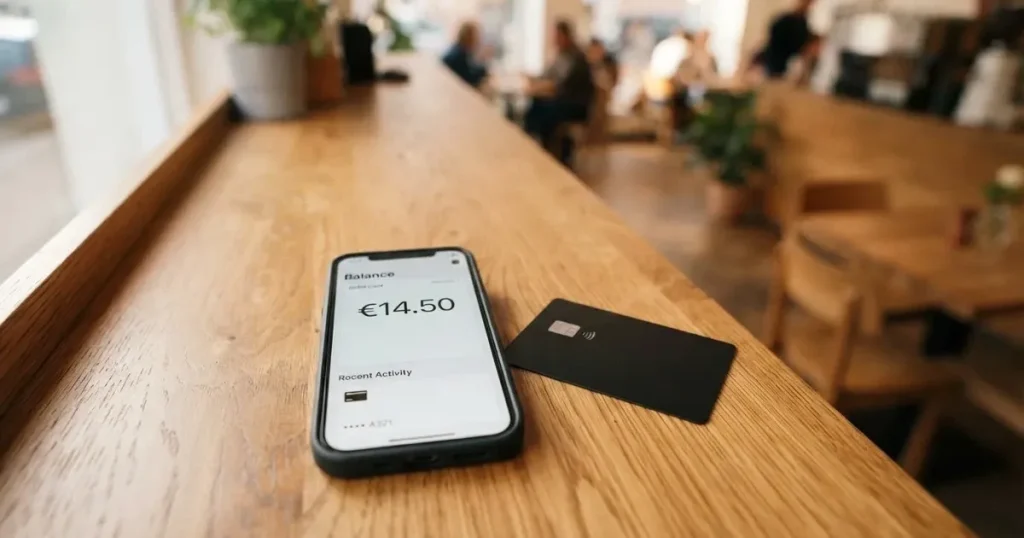
Wayex is one of the more interesting newcomers in the crypto-card space. The pitch is simple: a free digital Visa debit card, a balance held in a tokenised US dollar (USDB), and top-ups from the four biggest stablecoins. The score from the table below is 7.5 out of 10, and the way I get there is by going through who can actually get one, what it costs, and the things the company has not spelled out yet.
The conditions described here are current as of October 28, 2026.
Verdict
If you already hold stablecoins and want a free Visa to spend them, Wayex is a real option. It is not for people who need a heavyweight bank account, and it is not for people who want every fee printed in advance. The card is issued by Lead Bank, a chartered US bank, under a Visa licence, and the programme is run by Bridge Ventures LLC, so the rails are conventional. The wrap around them, the Wayex app and the on/off ramps, is still rolling out across new regions, and you can see the seams.
| Criterion | Mark | Why it lands there |
|---|---|---|
| Who can get it | 5 / 10 | Live in 18+ regions today, with plans to expand to 100+; the regions themselves are not named, and people who are citizens or residents of countries sanctioned by the UN, FATF, the EU or the US (OFAC) are excluded. |
| Cost | 9 / 10 | Digital card is free, opening the account is free, there is no monthly fee, and the page advertises “0% on USD spending”. The price of the physical card, FX fees for non-USD spending, and the cost of converting crypto are not stated on the main site. |
| Top-up options | 9 / 10 | DAI, USDT, USDC and PYUSD across “10+ blockchains”, plus fiat top-ups in USD, EUR, GBP, MXN and BRL. The specific networks are not named on the public pages. |
| Reliability and complaints | 7 / 10 | The card sits on a real bank (Lead Bank) under a real network licence (Visa). Trustpilot is 3.9 out of 5 from 61 reviews, with the same themes repeating: account verification blocks without explanation, slow payments, and account closures that drag on. |
| Everyday use | 8 / 10 | Free digital Visa, physical card where supported, and both Apple Pay and Google Pay. ATM access for the global card is not described on the public pages. |
The audience that fits best is stablecoin holders who want a no-monthly-fee digital Visa for daily spending. The audience that does not fit is anyone who needs a fully published fee schedule, anyone who needs ATM access in many countries, and anyone who lives in a country the company has not opened up yet.
Who will they give you the card
Wayex’s own pages say the card is “live in 18+ regions today”, with an ambition to reach 100+. The list of those regions is not on the main site. A third-party review (CoinCodeCap, February 2026, marked unofficial here and not confirmed by Wayex) describes the core product as Australia-only and the wider rollout as an early-access one. The app is downloadable in 160+ countries, but downloading the app is not the same as being able to finish the sign-up. Treat any specific regional availability you see elsewhere as unofficial until Wayex says it themselves.
What is stated is who is excluded: you cannot open an account if you are located in, or are a citizen or resident of, a country sanctioned by the UN, FATF, the EU or the US (OFAC), or in a jurisdiction that bars crypto services. That rule is broader than the card’s geographic reach, because it touches citizenship and residency, not just the country your phone happens to be in. If any of those apply, the application will not progress. There are no published tiers of access beyond that, and there is no published list of what counts as “sanctioned” beyond the four bodies named.
The practical takeaway: before you download anything, check whether you actually meet the residency and citizenship rules. If your country is not on the 18+ list and you have not seen Wayex confirm it in writing, assume the sign-up will not finish, and treat any FAQ or forum claim to the contrary as unofficial.
How to get it
The sign-up is built around a standard KYC flow, and the company says it can take “as little as 2 minutes”. That figure is the best case, not the median, and the same Trustpilot reviews that praise the product also include people stuck for weeks waiting on verification. Applicants must be 18 or older, and the documents Wayex asks for are not listed on the public pages — the only stated requirement is to complete KYC.
Once you are through KYC, you can get a free digital Visa debit card. The card is a prepaid-style debit card: it draws on a USDB balance, which Wayex describes as held 1:1 against the US dollar. A physical card is available “where supported”, with no shipping detail on the main site. The Australian help centre (for a separate Australian product) lists a physical card and delivery at AUD 14.99 and a free lost/stolen and expired-card replacement, but the global card’s price, where it ships and how long it takes are not stated.
There are no account levels described on the pages I read, and there is no published list of rejection reasons. The terms do bar anyone located in, or a citizen or resident of, a sanctioned country. If your application stalls, the company’s published process is to acknowledge a complaint within three business days and resolve within 30 business days, with disputes handled by binding arbitration in Panama City, in English. That is where things go if KYC goes wrong, not a forum or a phone line.
The order is straightforward: download the app, complete KYC, get the digital card immediately, top up from a stablecoin or fiat, and start spending. Add the card to Apple Pay or Google Pay at that point. The physical card, if your region supports it, is a separate step.
What it really costs — Fees
The cost story is the strongest part of the pitch: a free digital card, a free account and no monthly fee, with “0% on USD spending” advertised on the page. What is not on the page matters just as much, and that is where the gap between the marketing and the small print shows.
| Fee or limit | Amount | Notes |
|---|---|---|
| Digital card issuance | Free | Stated on the main site. |
| Physical card issuance | Not stated | The Australian help centre shows AUD 14.99 for the local product; the global card’s price is not on the public pages. |
| Account opening | Free | Stated on the main site. |
| Monthly fee | None | Stated on the main site. |
| Crypto conversion fee | Not stated | Not on the main site. The Australian help centre’s trading-fee tiers run from 0.40% down to 0.00% by 30-day volume. |
| FX fee (non-USD spending) | Not stated | The Australian help centre says “No foreign exchange fees on Wayex” for that product; the global card’s FX fee is not on the public pages. |
| USD spending | 0% | Stated on the main site as “0% on USD spending”. |
| ATM fee | Not stated | The Australian product lists $0 Wayex fee in Australia, with operator fees, and AUD 1,000 per day; applicability to the global card is not stated. |
| Daily / monthly limits | Not stated on global card | Australian product: AUD 10,000 per transaction, AUD 100,000 per day for crypto buy/sell. A third-party review (unofficial) lists a USD 1,000 per-transaction cap and a USD 150,000 lifetime spend before free replacement, which contradicts the Australian help-centre number. |
| Lost / stolen / expired card replacement | Free | Per the Australian help centre; the global card’s policy is not stated. |
| Footer disclaimer | “Fees may apply.” | At the foot of the main pages. |
A few everyday examples walk through the table above. Paying a USD 50 invoice in USD from a USDC top-up should cost nothing on the Wayex side, beyond the gas fee you paid sending USDC from your own wallet. Buying EUR 30 of coffee in Berlin from a USDC top-up triggers two unknowns: the crypto-to-USDB conversion, if you started in USDC, and the EUR side of the payment, where FX is not published on the main site. Taking cash out of an ATM in Sydney is, per the Australian help centre, free from Wayex plus whatever the ATM operator charges, capped at AUD 1,000 a day; for the global card the ATM picture is blank.
The pattern to take away: the headline number is genuinely zero, and the things that look free on the page can carry a fee somewhere else. Before you commit a meaningful balance, run one small test payment in your real currency and check what actually shows up.
How to top it up — Top up
Top-ups come in two flavours. The first is stablecoins: Wayex lists DAI, USDT, USDC and PYUSD across “10+ blockchains”, without naming the networks on the public pages. The second is fiat, with deposits in USD, EUR, GBP, MXN and BRL. The Australian help centre (for the Australian product, page dated 12 August 2026) describes crypto deposits as free from Wayex, with network or gas fees charged by the blockchain, AUD deposits as zero-fee, and no deposit limit. The global card’s minimum top-up is not stated.
This is the part of the flow where the most money is silently lost. Three rules that hold across the category, and that the Wayex pages do not contradict. First, on-chain transfers are paid for by the network, not by Wayex, so the gas you pay depends on the chain you choose. Second, ERC-20 tokens on Ethereum need ETH in the sending wallet to pay gas, so a wallet holding USDT with no ETH cannot send. Third, USDC is no longer supported by Circle on Tron, so “USDC over TRC20” is not a real option any more. The networks Wayex does support will be the ones you can verify inside the app, and you should match the network in your wallet to the network Wayex shows you before you confirm anything. A deposit sent on the wrong network, or to an address of another network, is not something the support team can usually reverse.
Fiat top-ups in the named currencies go through the standard rails. Cash-out to fiat is described as “where supported”, via PIX (Brazil), SPEI (Mexico), Faster Payments (UK), SEPA (Europe), Wire and ACH (US), with ACH and Wire explicitly enabled. Fees and times for those rails are not on the main site. The Australian help centre’s cash-out numbers are 0.40% to 0.00% conversion by 30-day volume on the trading side, no fee on AUD cash-out, and a maximum of AUD 100,000 per cash-out with a AUD 10 minimum; the global card’s equivalents are not stated. The terms add that the company “may withhold withdrawals pending further investigation”, and the timeline for getting a balance back after closing the account is not stated.
Paying with it every day
The digital card is a Visa Debit that draws on a USDB balance. Both Apple Pay and Google Pay are supported, and tokenising the card in a mobile wallet does not share your real card number with the merchant. The balance is held in USDB, which the company describes as 1:1 against the US dollar; the card supports spending in USD, EUR, GBP, MXN and BRL. “0% on USD spending” is the headline, and there is no cashback or rewards programme attached to the card itself.
The published blocked-merchant list is empty. In practice that means a few things. A prepaid-style debit card can be declined at merchants that run an address-verification check (AVS), because AVS is mainly available in the US, Canada and the UK and tends to misfire on foreign-issued BINs; the card is a US-issued Visa, so this matters less than for an EU-issued one but is not zero. Online 3-D Secure checks will sometimes challenge you, and the cardholder-side friction (a one-time code, a biometric prompt) sits with you, not the merchant. A merchant that does an MCC-level block, gambling being the obvious example, will decline the card regardless of the issuer. ATM access for the global card is not described on the public pages; the Australian product’s help centre describes ATM withdrawals inside Australia only, free from Wayex, with operator fees on top, and a AUD 1,000 daily cap.
If a payment goes wrong, the help-centre FAQ carries a “What if I have a problem with a transaction” entry with no answer, and the complaints policy is acknowledgement within three business days and resolution within 30 business days. Disputes are handled by binding arbitration in Panama City, in English, and the page does not list chargeback timeframes. The bottom line is that you can spend the card anywhere Visa is taken, including via mobile wallet, and you should expect a small number of declines that have nothing to do with you.
What can go wrong
The most important risk is the part of the stack you do not see. Wayex is the platform provider and is “not a bank”. The card is issued by Lead Bank, a US-chartered bank, under licensing by Visa U.S.A. Inc. The programme manager is Bridge Ventures LLC. That is a real bank, on a real network, but it is also a structure where the brand on the front of the app is not the entity that holds the regulatory licence, and the terms push disputes into binding arbitration in Panama City, in English. If something goes seriously wrong, the venue is Panama.
A second risk sits in the customer-experience reports. Trustpilot is at 3.9 out of 5 from 61 reviews as of 20 October 2026, with 74% five-star and 10% one-star. The same themes show up in multiple reviews: accounts stuck in verification without a clear reason in May and June 2026, an account closure requested in February 2026 still unresolved by late May 2026, a EUR 5 transfer that took more than ten days in March 2026, and sign-out bugs going back to October 2025. The positive reviews lean on a small number of things: the support team replies, the product is easy, and there are no FX fees on the Australian product. Trustpilot also notes the company has not sent recent review invitations, so the average reflects the people who chose to leave one. The company responds to negative reviews, usually by pointing people to private support channels. A second-hand review marked unofficial (CoinCodeCap, February 2026, updated April 2026) lists a USD 1,000 per-transaction cap, a USD 150,000 lifetime spend before free replacement, and a USD 1,000 daily ATM cap in Australia; that conflicts with the AUD 10,000 per-transaction cap on the Australian help centre, so do not take the unofficial numbers at face value.
A third risk is the stablecoin layer the card sits on. DAI, USDT, USDC and PYUSD are all US-dollar-pegged, but “stablecoin” is a description, not a guarantee; the category has historical depegs. Network choice matters: a deposit sent on a chain Wayex does not support, or to an address of another chain, is not reversible on the blockchain and is rarely recoverable through support. The on-chain part of the deposit is paid by the network, not by Wayex. Tether has frozen wallets tied to sanctioned addresses in the past, which means censorship-resistance is not a property of these tokens.
A fourth risk is the unresolved blanks in the public pages. FX fees for non-USD spending on the global card, the crypto conversion fee on the global card, ATM access for the global card, daily and monthly limits on the global card, the price of the physical card outside Australia, the shipping regions, and the minimum top-up are all not stated on the pages I read. The footer of the main pages says “Fees may apply.” You should not assume that a “0% on USD spending” headline means every payment is free in practice.
A fifth risk is regulatory drift. The card runs through a US bank and a US network, with arbitration in Panama. EU users in particular are living through the run-up to the MiCA transitional deadline of 1 July 2026, after which providers operating only under national law are no longer grandfathered. The card’s regulatory structure is not the same as a MiCA-authorised CASP issuing e-money tokens under Article 48, and Wayex’s own registration country is not stated. If your priority is a fully EU-licensed stack, this is not it.
A sixth, smaller risk is the dispute path itself. The published complaints flow is three business days to acknowledge and 30 to resolve, with binding arbitration in Panama City in English and no stated chargeback timeframes. Chargebacks on prepaid cards are not the same as on credit cards under Regulation Z or on bank debit cards under Regulation E, so the protections are not guaranteed.
What to take instead
Three alternatives come up often alongside Wayex, and they fit different jobs.
| Card | Score | Who it is for | Headline difference |
|---|---|---|---|
| International Visa Card | 6.7 / 10 | People who want a US-issued virtual Visa and are happy to pay for a plan | Virtual only today (physical “coming soon”); USD 5 one-time to issue; free Classic, USD 9/month Pro, USD 19/month Max; 2% FX on non-USD; residency blocklist of 17 countries, plus FATF grey-list case-by-case. |
| UNi Card | 6.1 / 10 | People who want a multicurrency Mastercard with no foreign transaction fee | Mastercard network; no annual fee, no FX fee, “live OTC” conversion; up to 3% spend-to-earn; availability and funding details not stated. |
| Whop Cards | 5.2 / 10 | People in the US who want a Visa with merchant cashback | Consumer availability in 31 US states; blocked-consumer list of 18 countries; spends from a Whop balance backed by stablecoin collateral; 5% cashback at selected merchants (Uber for now); no fee or conversion schedule published. |
If you only need a digital Visa and you already live where Wayex works, the free digital Wayex is a strong default. If you want a physical card now and ATM access, the alternatives are not necessarily better — Whop does not publish ATM access either — but International Visa Card’s published fee schedule and explicit blocklist make it easier to model. If you live in the EU and want a multicurrency Mastercard with no foreign transaction fee and a published “no hidden exchange fees” line, UNi Card is the closer fit. None of these is a substitute for a bank account, and none of them is a way around the KYC and sanctions rules that apply to all of them.
Who I would recommend it to
I would recommend the Wayex card to a stablecoin holder who already lives in a region Wayex has opened up, who is happy to test the card with a small balance first, and who is comfortable that some fees and limits are not yet on the public page. The free digital card, the Apple Pay and Google Pay support, the stablecoin top-ups across multiple chains, and the Lead Bank / Visa foundation are the reasons to give it a try.
I would not recommend it to someone who needs a fully published fee schedule before they commit funds, who relies on ATM access in multiple countries, who lives in a country the company has not named on its 18+ list, or who needs a strong EU-style regulatory wrapper. For those readers, the alternatives above are worth a look, and so is waiting for Wayex to publish the missing pieces of the small print.
Either way, the practical order is the same. Confirm your country is in. Run a small top-up. Make one real payment in your real currency, from a real merchant, and check what landed on the statement. Add the card to your mobile wallet before you rely on it in the wild. Keep enough balance in USDB that a routine payment does not depend on a conversion you have not costed yet. If any of that does not work the way you expected, you have not lost much, and you have learned more than any review can tell you.
Frequently asked questions
What is the Wayex card?
The Wayex card is a Visa Debit card, available as a free digital version and as a physical card where supported, that draws on a USDB balance held 1:1 against the US dollar. The card is issued by Lead Bank under a Visa U.S.A. Inc. licence, with Bridge Ventures LLC as programme manager and Wayex as the platform provider.
How does the Wayex card work?
You complete KYC, top up your USDB balance with stablecoins (DAI, USDT, USDC, PYUSD) or with fiat (USD, EUR, GBP, MXN, BRL), and the card spends that balance wherever Visa is accepted. In everyday use it behaves like a prepaid debit card, with Apple Pay and Google Pay supported.
Is Wayex a bank?
No. Wayex describes itself as a platform provider, not a bank. The card is issued by Lead Bank, a US-chartered bank, and the programme is run by Bridge Ventures LLC under licensing by Visa U.S.A. Inc.
Who owns Wayex?
The company behind the platform is Wayex, with Bridge Ventures LLC as the programme manager and Lead Bank as the issuing bank. Wayex’s own registration country is not stated on the public pages.
Is the Wayex card available in my country?
Wayex says the card is “live in 18+ regions today” and is expanding to 100+, but the list of regions is not on the main site. The app is downloadable in 160+ countries, but downloading the app is not the same as being able to finish sign-up. Treat any specific country claim that does not come from Wayex as unofficial.
How do I get the Wayex card?
Download the app, complete KYC (the company says “as little as 2 minutes”, though reviews show it can take much longer), and a free digital card is issued. A physical card is available “where supported” for a fee that is not stated on the global pages (AUD 14.99 on the Australian help centre for that product).
Does the Wayex card require KYC?
Yes. KYC is required for everyone, applicants must be 18 or older, and people who are located in, or are citizens or residents of, countries sanctioned by the UN, FATF, the EU or the US (OFAC) are not allowed to open an account. The specific documents Wayex asks for are not listed on the public pages.
How do I top up the Wayex card?
You can top up with DAI, USDT, USDC or PYUSD across “10+ blockchains” (the networks are not named on the public pages), or with fiat in USD, EUR, GBP, MXN or BRL. Match the network shown in the app to the network in your own wallet before you send anything, and remember that the blockchain, not Wayex, charges the gas fee.
Is the Wayex card free?
The digital card is free, the account is free, and there is no monthly fee, with “0% on USD spending” advertised. The price of the physical card, FX fees for non-USD spending, the crypto conversion fee, ATM fees, and daily or monthly limits on the global card are not stated on the public pages, and the site footer adds “Fees may apply.”
Is the Wayex card safe?
The card is issued by Lead Bank, a US-chartered bank, under a Visa licence, and the company describes its custody as transparent with optional self-custody, encryption and 24/7 monitoring. The unresolved parts are the missing fee schedule, the arbitration clause in Panama City, the live Trustpilot score of 3.9 out of 5 with consistent complaints about verification blocks and slow payments, and the fact that the platform provider is not a bank.
App and neobank card fees – cryptocardfacts
Content created by the «cryptocardfacts» team