
Open to nearly everyone, virtual only, and quiet about who issues it
 Available in US
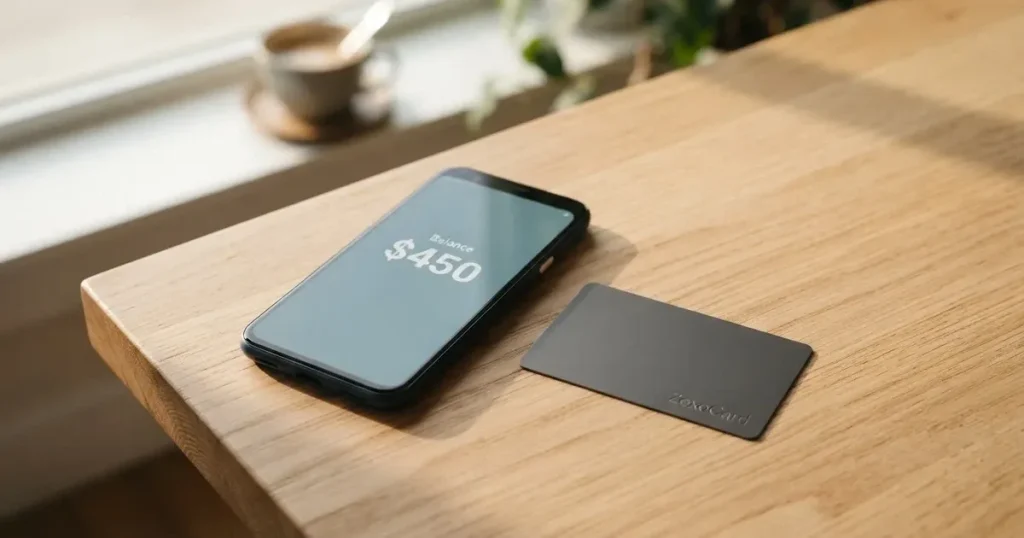
If you have been turned away by a normal bank — a country of address that raises flags, a paperwork problem, a business that only accepts cards — then a card like ZexoCard exists precisely for that situation, and I have read its public pages closely to see whether it deserves your trust. My verdict: it scores 7.3 out of 10. That is a good score for a product whose shape is unusual, but it is not a score you get from a product with nothing left unanswered. The card is genuinely open, genuinely cheap to hold, and genuinely flexible about what you load it with. What it does not do is tell you who issues it. That single silence shapes everything below.
Below I walk through who gets the card, how you register, what each payment costs you, how you top it up, what a normal week looks like, and the specific ways this thing can go wrong. The conditions described are current as of October 28, 2026.
Verdict: 7.3 out of 10, strong on access and cost, thin on who is behind it
Here is my score broken down the way I worked it out, criterion by criterion, with the reasons in my own words.
| Criterion | Mark | Why, in my reading |
|---|---|---|
| Who can get it | 9 / 10 | Open from any location except a named list of restricted jurisdictions |
| Cost | 7 / 10 | $10 one-time issuance, free maintenance, $0.25 a transaction on the Everyday card, no per-transaction fee on the other two, funding fee shown in the final quote |
| Top-up options | 9 / 10 | Bitcoin, Ethereum, USDT, USDC, Solana and others, payable through MetaMask, Phantom and TronLink |
| Reliability and complaints | 5 / 10 | Issuer, registered entity and licences are not named; partners are licensed; no complaints found; 2FA through an authenticator app |
| Everyday use | 6 / 10 | Virtual only; Apple Pay, Google Pay, Samsung Pay; no plastic and no ATM |
| Total | 7.3 / 10 |
The card suits you if you are paying for subscriptions and advertising platforms — advertising platforms like Meta or Google, where a normal card in your name, in your country, may not be accepted — and you would rather fund those payments from crypto you already hold than move money through a bank. It also suits you if you travel and want a card that is not tied to one country’s billing address, or if you simply cannot open a mainstream account and need a card that answers to your location rather than to your citizenship.
It does not suit you if you need to withdraw cash, if you need a plastic card for a situation where taps are not accepted, if you want to spend from a balance you do not first load, or if the absence of a named issuer makes you uneasy. It also does not suit you if you want rewards: no cashback is listed anywhere in the public material. That last point surprises people, because most cards in this category advertise something. ZexoCard advertises access instead.
Will they give you the card
Yes, from almost anywhere — and this is the strongest thing about it. Registration is by email from any location outside the restricted jurisdictions: North Korea, Iran, Syria, Cuba, Belarus, Afghanistan, Myanmar, and the Crimea, Donetsk and Luhansk regions of Ukraine. No account opening, card issuance or loading is offered in those places.
Read that carefully, because the rule is about where you are, not what is on your passport. The restriction is location-based and citizenship is not mentioned. The site also warns against false location details to bypass the restrictions. I am not going to describe how anyone might get around that, and you should not either: the moment you lie about your location to a platform that is not a bank, you have built a relationship on a false foundation, and the withdrawal of your balance when it is discovered is a matter of the platform’s discretion rather than any right you can lean on. The straightforward path is the only one worth taking here.
Two details you should hold on to for later. The restricted list is the whole eligibility rule as published — there is no second list of countries where approval is likely but not promised. And the fact that the rule is written by location rather than citizenship means someone with a passport from a restricted country who genuinely lives elsewhere is, on the face of it, inside the rules. Whether a reviewer reads it that way in practice is not something I can tell you from public pages, and that uncertainty is itself worth weighing.
How to get it
There is no routine identity-document submission for standard onboarding. You register with an email address, you must be 18 or older, and the country restrictions above apply to you. The sequence the card describes is: register, fund your wallet in crypto, create the card, load it.
What you end up with is virtual only. There are three card types and all of them are reloadable:
- Everyday — the network it runs on is not stated.
- Subscriptions — Visa.
- Campaigns — Visa.
Since there is no physical card, delivery is not applicable. That single fact reshapes everything you might otherwise expect from a card: no ATM, no card in an envelope, nothing to hand over at a counter when a terminal refuses a tap.
Two things the public pages do not say. There are no KYC levels described at any tier, so I cannot tell you what triggers a document request or what would move you into one. And the processing time and the rejection reasons are not stated. You are not told how long a card takes to appear, and you are not told on what grounds an application might be refused. That is an uncomfortable gap for anyone who has been refused elsewhere and is bracing for a second refusal.
What it really costs: Fees
Here is everything I could put a number against, drawn from the card’s own material.

| Fee or limit | What ZexoCard states |
|---|---|
| Card issuance | $10 one-time, per card, all three types |
| Registration | Free |
| Monthly maintenance | Free |
| Balance checks | Free |
| Support | Free |
| Everyday card, per merchant transaction | $0.25 |
| Subscriptions and Campaigns, per merchant transaction | No merchant transaction fee |
| Funding fee | Shown in the final quote |
| Network and conversion costs | May apply |
| Foreign exchange fee | Not stated |
| ATM | Not stated |
| Purchase limit | Up to $100,000 per purchase |
| Monthly limit | $500,000 per calendar month, per card |
| Daily limit | No separate daily cap |
Now let me put that table to the work of three ordinary payments, because fees on this card are easy to misjudge from the headline numbers.
A $30 subscription renewal. If you run it on the Subscriptions card, there is no merchant transaction fee at all. The cost to you is the conversion of your crypto into the amount charged, plus whatever network and conversion costs may apply. On the Everyday card, add $0.25, and this fee is more noticeable on a $3 monthly tool.
A $400 advertising platform top-up. On Campaigns, no merchant transaction fee. On Everyday, $0.25, which sounds trivial — but the same $0.25 is 25 cents every single time, and someone paying daily for a month of ads pays it thirty times.
A $900 purchase. The $0.25 Everyday fee still applies. The per-transaction fee is not the thing that will hurt you at this size; the spread inside the conversion rate is far more likely to matter, and that is the part of the cost the card does not print on a page. FX is not stated at all, which matters more for you if you are spending outside the dollar.
The limits are generous in the way that suggests they are not the constraint: $100,000 per purchase and $500,000 per calendar month per card, with no separate daily cap. Almost nobody hits those. Treat them as a ceiling rather than a promise.
Two structural points about cost that the table does not convey. First, there are no card tiers, but there are account groups — Free, Silver and Gold — which set pricing. What differs between them is not detailed on the public pages, and this is not a rolling spending tier where you unlock perks by spending over 30 days. Do not assume Gold buys you anything specific until you have seen the schedule yourself. Second, the card currency is not specified, though amounts are shown in $. If you spend heavily outside the dollar, that missing detail is one you should resolve by asking support before you rely on the card.
How to top it up
Top up with Bitcoin, Ethereum, USDT, USDC, Solana and other supported cryptocurrencies. An earlier check of the material also listed LTC and around 95 tokens. Payment can be made from a wallet through MetaMask, Phantom or TronLink where available. The sequence matters: deposit first, then load the card.
The single most important operational rule here is that the network must match the deposit instructions. Send on the wrong network and the money is very likely gone. This is not a ZexoCard peculiarity — it is how every blockchain transfer works. Transfers are irreversible, the network cannot freeze or return them, and a deposit sent to an address belonging to a different network can be lost outright or need manual recovery by support with no guarantee of success. Read the instructions on screen, every time, and check the network twice. I would also keep a small test amount first.
Which network you should pick has its own sharp edges, and this is where card users get hurt. If you send USDT, it exists on Ethereum, Tron, Solana, Polygon, Avalanche and others. Circle stopped supporting USDC on Tron in February 2024, so “USDC over TRC20” is not a native option — that is a detail that catches people out. On Ethereum, fees are paid only in ETH, so a wallet holding USDT but no ETH cannot send at all. On Tron, fees are paid through bandwidth and energy, often burning TRX. Whichever network the card names, you need a small amount of that network’s own token available to pay for the transfer.
What top-up costs you: the funding fee is shown in the final quote rather than printed on a page, and network and conversion costs may apply. Sending-network charges are separate — the blockchain charges those, not the card. No fiat top-up is stated, which is a real limitation if you were hoping to fund the card from a bank account; the card’s own design points at crypto, not at a bank transfer. No minimum is stated either.
One more thing about getting money back out: no withdrawal procedure is described. Remaining funds on closure depend on applicable law and account circumstances, and sending funds to other users is not offered. For someone loading meaningful balances, that is the sentence on this page I would underline.
Paying with it every day
Everyday use is where this card is at its most ordinary. Add the card to Apple Pay, Google Pay or Samsung Pay on a supported device. From there, tapping to pay in a shop feels like any other card payment, and the mobile wallet stores a device-specific number rather than your card number, with a fresh one-time security code on each payment.
The limitation is structural: the Everyday card does not support subscriptions or recurring payments. If recurring charges are your main use, that is exactly what the other two card types are for, and the fact that Subscriptions and Campaigns carry no merchant transaction fee makes the split sensible rather than confusing.
There is no mobile app listed. What exists is a web panel and a Telegram bot — and the Telegram bot is presumably also how you reach support. No cashback or rewards are listed. Nobody at this card is going to give you money back for spending.
When something goes wrong with a payment, the route described is: contact support with a description and the transaction reference. For a problem with goods or a service, you go to the merchant first. No chargeback process is described, and “chargeback abuse” is prohibited. That combination deserves a moment’s attention. A chargeback is a refund ordered by the card issuer to settle a dispute, with reason codes for fraud, duplicate billing or goods not received. If this card has no chargeback process, a cardholder who is treated unfairly by a merchant has no published route to a refund through the card — which is precisely the dispute that crypto card users most often need help with. Whether rights exist for you depends on the issuer and the law applying to it, and prepaid-card coverage varies and should not be assumed. Treat this as a real gap, not a formality.
One practical thing to expect: because the card is virtual and funded from crypto, a foreign-issued BIN can be declined by some merchants who look at what the BIN reveals about the issuer and country. Address verification is mainly offered in the US, Canada and the UK and is generally unavailable for foreign-issued cards, which can cause declines on its own. Gambling merchants carry their own category code, and many issuers block that category by policy rather than by law, with the blocked list differing by issuer — so do not assume a declined gambling payment is a fault in your setup.
What can go wrong
The risk picture has one large entry and several smaller ones, and I want to start with the large one.
Nobody is named. The company describes itself as “a card platform connecting customers with financial and digital asset services.” Licensed external partners provide the cards, custody and conversion. The issuer, the registered entity and its licences are not named. This is the single biggest reason I cannot score this card higher than a 7.3. In this category, the structure is usually: the card network — Visa or Mastercard — routes messages and sets the rules; the issuer, a bank or e-money institution licensed to issue under that network’s licence, holds the card programme; and the crypto brand is often only a programme manager or front-end that markets it. When the second and third are the same visible entity, you can check things. Here they are not. ZexoCard says its partners are licensed; I have no way, from the public pages, to verify which licence or which regulator.
That structure has a track record of going wrong. Visa terminated its global agreements with FTX on 13 November 2022 and the FTX US debit card was wound down by its issuer. WaveCrest, a Visa issuer that supplied crypto card brands, was suspended by Visa in Europe in 2018, closing all WaveCrest-issued Visa programmes. Programme closures follow a pattern: a notice period, then loading and spending stop, then users are asked to withdraw remaining balances. One 2026 closure reported by a secondary source ended new loads on 8 July 2026 and spending on 8 August 2026 — a single unconfirmed source, so treat it as an illustration of the pattern rather than a fact. With no withdrawal procedure described on this card, ask support what happens to your balance before you load more than you need.
Crypto transfers cannot always be reversed. This is the second structural risk. It applies to every wrong-network deposit, and it is not something support can always undo.
The custodian behind the balance. Control of crypto belongs to whoever holds the private key or seed phrase. With a custodial wallet the provider holds the credentials, so you must trust them completely. Custodial platforms have a real record of failure: Mt. Gox, about US$350 million reported stolen in 2014; Coincheck, about US$400 million in 2018; Ronin Network, US$625 million in 2022. A seed phrase — typically 12 to 24 words — is the private key in plain form, and anyone who obtains it can restore the wallet and spend from it. Here custody is by partners and not detailed, so you cannot judge it from outside.
What protection you do have. Two-factor authentication through an authenticator app, otherwise an account PIN. Card details show only the last four digits, with full details behind the PIN. Passwords and PINs are hashed, and login is rate-limited. Those are ordinary, decent, entirely conventional safeguards, and they are the reason this section is not longer. What is not stated: an instant card freeze. A card you can freeze from your phone is the first thing I would want, and it is not on the list.
Support. A Telegram channel at @zexocard, an email address, a help centre and a knowledge base, seven days a week, with replies usually within 24 hours. That is a genuine strength for anyone who has dealt with card platforms that go quiet.
Complaints. I found no official incidents on the site, and no Trustpilot or Reddit results for “zexocard” — no page was found at all. Read that narrowly. No complaints is not the same as a good track record; for a product with this little visible footprint, it is closer to absence of evidence, and it is also exactly what you would see if complaints were being handled privately in Telegram.
Regulatory context worth knowing. A card is a payment service regulated separately under e-money and payment-services law, while MiCA covers the crypto side — custody, exchange, transfer — which is why a crypto card often depends on two licences. In the EU, MiCA took legal effect in June 2023; rules on asset-referenced tokens and e-money tokens applied from 30 June 2024, and the remaining provisions, including rules for crypto-asset service providers, from 30 December 2024. Under MiCA, e-money tokens may be issued only by a credit institution or an electronic money institution. Providers that were already operating under national law could continue only until 1 July 2026 or until they received or were refused a MiCA authorisation, whichever came first. ESMA keeps an interim register of authorised providers, white papers and non-compliant entities, and checking a provider there is a reasonable step before you load. Electronic money institutions must safeguard customer funds by segregating them or insuring them, but such funds are not bank deposits and may not be covered by a deposit guarantee scheme.
Where you stand on identity checks. KYC rules require regulated businesses to verify customers and assess risk under anti-money-laundering law, including ongoing monitoring and suspicious-activity reporting. In the EU that covers name, address, date of birth, nationality and identity documentation, a sanctions check, and a politically-exposed-person check. In the US the customer identification programme requires name, date of birth, address and an identification number. Nationality is recorded and screened separately from residence because sanctions screening and issuer risk policy are often applied to citizenship and country of birth as well as to country of address. This card does not describe routine document submission at standard onboarding, and no levels are described. That is not a workaround for anyone — if you need to clear a check, you clear it; what it means is that you should ask, in writing, what triggers a document request here, and keep the answer.
Stablecoin risk. USDT and USDC are the two dollar-pegged coins the BIS put at about 90% of stablecoin market capitalisation in July 2025. USDC is described by Circle as redeemable 1:1 for USD and fully backed by cash and cash equivalents, mostly in an SEC-registered government money market fund, with monthly reserve attestations. TerraUSD collapsed in May 2022 and USDC temporarily lost its peg in March 2023 during the US banking crisis. And stablecoins are not censorship-proof — Tether says it disables tokens in wallets on the OFAC sanctions list and has frozen funds tied to illicit activity.
One tax note, not advice. The IRS treats digital assets as property, so exchanging them for goods, services or dollars generally produces a taxable gain or loss. Gain is measured in local fiat currency at fair market value on the date of the transaction, which means each card payment funded from crypto may be a separate disposal event. Your own jurisdiction works similarly in outline. What applies to you depends on where you are — treat that as a prompt to ask a professional, not as an answer.
What to take instead
I looked at three other cards in this category and they are all, on the published material, weaker or narrower. Here is the honest comparison.
| ZexoCard | Cardex | CardFlow | HyperCard | |
|---|---|---|---|---|
| My score | 7.3 / 10 | 5.6 / 10 | 4.9 / 10 | 4.7 / 10 |
| Who it is open to | Any location outside a named restricted list | “One crypto card, 200+ countries”; no country list or exclusions | Aimed at Nigeria; “Nigerians and global users”; no exclusions stated | No country list; App Store says it works in “more than 176 countries” — acceptance, not eligibility |
| Card type | Virtual only: Everyday, Subscriptions (Visa), Campaigns (Visa) | Debit crypto card on VERVE, Visa, Mastercard, UnionPay; virtual and physical per App Store | Virtual USD Mastercard, created in about 3 minutes | Prepaid; network not stated on the App Store page |
| Card currency | Not stated; amounts shown in $ | Naira per the App Store listing | USD | Balance in USD or EUR |
| Issuance and upkeep | $10 one-time; registration, maintenance, balance checks and support free | Not stated | Creating a virtual card is free; monthly fee not stated | Not stated; App Store page lists no fees |
| Per-transaction fee | $0.25 on Everyday; none on Subscriptions and Campaigns | Real-time crypto-to-fiat conversion; an “AI-Powered Conversion Rate” scans exchange rates and picks the best; no percentage stated | Not stated | Not stated on the pages I could read |
| Top-up | Bitcoin, Ethereum, USDT, USDC, Solana and others; MetaMask, Phantom, TronLink | USDT, USDC and BTC wallets; networks not stated | Bitcoin, USDT, ETH or Naira bank transfer; networks not stated | Crypto such as USDT, BTC, ETH in the app, converted to USD or EUR; networks not stated |
| Rewards | Not stated | Not stated | Not stated | Not stated |
Read that table and you see why ZexoCard comes out on top for this particular reader. Cardex’s “200+ countries” is a marketing line with no exclusion list behind it, and its App Store listing is Naira-focused, so a card billed in dollars is not obviously what you get. CardFlow is built for Nigeria and does not tell you what it excludes. HyperCard’s “176 countries” describes where the card is accepted, which is a completely different claim from who may hold one, and it will convert to dollars or euros.
The honest caveat is that all three rivals are also vague where ZexoCard is vague — none of them publishes a full fee schedule, and none lists fees on HyperCard’s App Store page at all. Choosing ZexoCard over them is a choice between the least-bad documented option and three less-documented ones, not a choice between documented and undocumented. And the thing that would move any of them ahead — naming the issuer — is the thing none of them does.
If you want a different shape of answer entirely, the alternative to a card at all is holding your own keys and paying through services that accept it directly. That puts the risk on you instead of on a custodian, and I am not recommending it as better. Self-custody carries its own losses: key loss, phishing, and clipboard-hijacking malware that swaps a copied address. Read this as a description of the trade, not a recommendation.
Who I would recommend it to
I would recommend ZexoCard to someone in a specific situation, and not vaguely to “people who like crypto.”
I would recommend it if you are paying for subscriptions and advertising platforms and your current card is not accepted, and you would rather settle those invoices from crypto you already hold than route money through a bank that will not open an account for you. The three-card split is genuinely built for this: Subscriptions and Campaigns carry no per-transaction fee, and Everyday is deliberately excluded from recurring payments, so the design points at exactly the use case the audience note describes.
I would recommend it if you travel across countries and want a card that is not bound to one billing address — with the clear expectation that some merchants will read a foreign BIN as a reason to decline, and that address verification is largely unavailable for foreign-issued cards.
I would not recommend it if you need cash, if you need plastic, if you want cashback, if you plan to load a large balance you may want back, or if you are the kind of person who needs to read an issuer’s licence before pressing a button. That last one is not a small preference. The card’s cost structure and its access policy are genuinely good; its silence on the issuer is the thing that stops me from recommending it without the caveat attached.
If you do go ahead, my order of operations would be: register and read the account-group pricing yourself rather than assuming; ask support in writing what withdrawal looks like and what triggers a document check; make a small test deposit on the exact network named in the instructions; check the provider against the ESMA interim register if you are in the EU; and keep loaded balances at a level you would be willing to see stuck for a while.
Frequently asked questions
What is ZexoCard?
ZexoCard is a reloadable virtual crypto card sold in three forms: Everyday for ordinary spending, and Subscriptions and Campaigns, both on Visa, for recurring charges and advertising platforms. You register by email, fund a crypto wallet, create a card and load it. There is no physical card. ZexoCard describes itself as a card platform connecting customers with financial and digital asset services, with licensed external partners handling cards, custody and conversion.
How does ZexoCard work?
You hold crypto, it is converted into a balance, and the virtual card spends that balance — the prepaid model, so it cannot overdraw. At payment, the crypto-to-fiat conversion happens and fees may apply on top. You add the card to Apple Pay, Google Pay or Samsung Pay and tap. The Everyday card does not support subscriptions or recurring payments, so recurring charges belong on Subscriptions or Campaigns.
Is ZexoCard a bank?
No. It describes itself as a card platform connecting customers with financial and digital asset services, and says licensed external partners provide the cards, custody and conversion. The issuer, the registered entity and its licences are not named on the public pages. So I could not tell you which institution actually holds your balance, and you should ask support before loading anything substantial.
Who owns ZexoCard?
I could not find this stated. The public pages describe the platform and mention licensed partners, but no registered entity, owner or issuer is named. There are also no Trustpilot or Reddit results for “zexocard” — no page at all, which means no visible complaint history rather than a clean one. Treat that absence as a reason to ask questions, not as reassurance.
Does ZexoCard require KYC?
No routine identity-document submission is required for standard onboarding. You register by email, must be 18 or older, and pass the country restrictions. No KYC levels are described, so what would trigger a document request is not stated, and neither are the rejection reasons. If you need to clear a check at some point, ask in advance what documents would be accepted.
Is ZexoCard available in my country?
From any location except North Korea, Iran, Syria, Cuba, Belarus, Afghanistan, Myanmar, and the Crimea, Donetsk and Luhansk regions of Ukraine, where no account opening, issuance or loading is offered. The restriction is written by location, not citizenship — citizenship is not mentioned. The site also warns against false location details, and I would not recommend testing that boundary with your own money.
How do I get a ZexoCard card?
Register by email, fund your wallet in crypto, create the card, then load it. Issuance costs $10 one-time per card, and registration, monthly maintenance, balance checks and support are free. Processing time for card creation is not stated. There is no mobile app — you work through a web panel and a Telegram bot, and support answers seven days a week, usually within 24 hours.
How much does ZexoCard cost to spend?
Issuance is $10 one-time, everything about holding the card is free, and the Everyday card charges $0.25 per merchant transaction while Subscriptions and Campaigns carry no merchant transaction fee. The funding fee is shown in the final quote, and network and conversion costs may apply. Foreign exchange fees are not stated and the card currency is not specified, though amounts appear in dollars — worth resolving before you rely on it.
How do I top up ZexoCard?
Send Bitcoin, Ethereum, USDT, USDC, Solana or other supported coins, from a wallet such as MetaMask, Phantom or TronLink where available, then load the card. The network must match the deposit instructions exactly, or the transfer is likely lost — blockchain transfers are irreversible. Chain fees are separate and charged by the network, and note that fees on Ethereum are paid only in ETH, and Circle stopped supporting USDC on Tron in February 2024.
Is ZexoCard safe?
It uses 2FA through an authenticator app, a PIN for full card details, hashed passwords and PINs, and rate-limited login — all sensible. But the issuer and licences are not named, no instant card freeze is described, custody sits with unnamed partners, and crypto transfers cannot always be reversed. No complaints are visible anywhere. My score for reliability is 5 out of 10, and that gap is about disclosure rather than about anything going wrong.
Virtual card fees – cryptocardfacts
Content created by the «cryptocardfacts» team