
A virtual card funded by crypto through a Telegram bot, with a lot of the important numbers left unpublished
 Available in US
If you cannot get an ordinary bank card, or you would rather not spend an afternoon in a video-verification queue, the CinCin card looks like an answer: a virtual Mastercard that you fund with crypto, opened from a Telegram bot in a few minutes. That is genuinely the appeal, and I am not dismissing it. What I am doing here is reading the card’s own public pages closely, comparing them against what users say afterwards, and telling you which parts you can rely on and which parts are simply not written down anywhere. CinCin scores 5.4 out of 10 on my scale. It is a usable tool for a narrow job, offered with unusually little disclosure for a financial product.
The conditions described here are current as of October 28, 2026.
Verdict: 5.4 out of 10
Here is the score broken down by criterion, so you can see where the marks come from rather than taking the total on trust.
| Criterion | Mark | Why |
|---|---|---|
| Who can get it | 6 / 10 | Not offered in the UK, UAE, Japan, the US; a longer list of restricted countries; sanctions screening applies |
| Cost | 4 / 10 | $25 issuance, $55 minimum to open, “no hidden fees” claimed, but percentages never disclosed |
| Top-up options | 9 / 10 | Balance lives on a USDT TRC20 address, 24 coins accepted including USDC and USDT |
| Reliability and complaints | 4 / 10 | Sonder INC in the Marshall Islands, issuer and licences unnamed, Trustpilot 3.1 out of 5 from 17 reviews |
| Everyday use | 5 / 10 | Virtual only, Apple Pay works, Google Pay unmentioned, ATM story never told |
| Total | 5.4 / 10 | Strong on funding, weak on disclosure and on what users report afterwards |
The two ends of that table explain the total. On the funding side this card is unusually open: you can load it from a long list of coins, and the underlying network choice is explicit. On everything to do with disclosure, it is unusually closed: no named issuer, no named licences, no conversion percentage, no monthly fee, no ATM information, no statement about how you get your balance back. The complaint themes on Trustpilot concentrate on exactly that gap — deposits not returned and no clear route to resolution.
Who does it suit? Someone who already holds crypto, already uses Telegram daily, and wants a card number for ordinary online spending this week rather than this quarter. Someone who is comfortable sending funds to a deposit address before seeing any product, and who treats the balance as spending money rather than savings. If that is you, the top-up mechanics are the strongest part of the offer.
Who does it not suit? Anyone for whom a payment card has to sit behind a bank deposit guarantee scheme, or anyone who needs to answer an awkward question about where the money came from. It does not suit you if you need Google Pay, if you need a physical card, if you need to know what a payment will cost before you make it, or if you want a number you can call. It is also a poor fit for a first crypto purchase: you are being asked to trust an unnamed issuer in the Marshall Islands before you have any history with anyone in this chain.
Who will they give the card to
Not everybody. The card’s terms name countries it is not offered in — the United Kingdom, the UAE, Japan and the United States — and then a longer restricted list that reads, verbatim: Iran, North Korea, Syria, Venezuela, Afghanistan, Belarus, Cuba, Myanmar, Somalia, and Ukraine. Users on the FATF blacklist or under OFAC sanctions are barred outright. The terms also reserve the right to add countries at any time, which means the list you read today is a floor, not a ceiling.
Two things you should notice about how that rule is written. First, it is applied by the country of the user, and the terms do not specify whether they mean citizenship or residence. If you are a national of one country and live in another, you are in a grey area that the card has not resolved in writing. Second, Russia is not in the list of restricted countries in the terms I read. An earlier check told me the Apple Pay variant is blocked in Russia, but that is not confirmed here, so treat it as unresolved rather than as permission.
The practical effect: the short answer to “is this available in my country” is sometimes yes on paper and no in practice, because the issuer behind the card has its own risk appetite that the card does not publish.
How to get it
There is no application form in the usual sense. The route the card describes is: sign in to the Telegram bot, create a USDT TRC20 address, send at least $55, and open the card. The site claims no delays, no complex verification, and about 2 minutes to set up.
On identity checks, the position is unusual and worth understanding before you start. The terms state that CinCin does not independently perform KYC verification for users. What it does say is that it runs anti-money-laundering checks with third-party providers, may restrict access, and may apply enhanced due diligence. In practice that means a card you can open quickly can also be reviewed, limited, or closed later, and the card’s public pages say nothing about what documents, proof of address, or age requirement you may be asked for. The card’s public pages do not state a KYC level, an age floor, or a document list. Do not read “no complex verification” as “no verification”.
That is the whole onboarding. No email confirmation flow, no app to install, no delivery to wait for.
Fees: what it really costs
Start with the two numbers you are given. Opening a virtual card costs $25, and the minimum you must send to open it is $55 — the extra $25 lands on your card balance. There is no stated monthly fee. There is no stated ATM fee for the virtual card, and no stated card currency, which means you do not know in advance what currency your balance is denominated in or which rate applies when you spend it.
The card says “no hidden fees”. The terms soften this considerably: fees are shown in the bot before you confirm, quoted prices are indicative, and the final price is the rate shown before confirmation. That is a promise that you will see a number at the moment of purchase, not a promise that the number will be small or predictable. The conversion and foreign-exchange percentages are not stated. So if you are the kind of person who wants to compute a cost before committing to it, this card does not support that.
What I could find about fees beyond the official pages comes from a third-party aggregator, and I am giving it to you as unofficial — the card has not confirmed it. That source, updated in July 2026, lists a top-up fee of 4.5% and, on a physical card variant, a transaction fee of $1.025 plus 0.4%. Treat these as leads worth asking support about, not as your price.
Here is the full picture of costs and limits, with every published value and every silence marked as such.
| Item | What the card publishes | Note |
|---|---|---|
| Issuance (virtual card) | $25 | Charged to open |
| Minimum to open | $55 | The other $25 goes to card balance |
| Monthly fee | not stated | No figure published |
| Top-up fee | not stated | Unofficial third-party figure: 4.5% |
| Conversion fee | not stated | Terms say the rate shown before confirmation is final |
| FX fee | not stated | No percentage published |
| Transaction fee | not stated | Unofficial figure on a physical variant: $1.025 + 0.4% |
| ATM fee | not stated | No ATM information for the virtual card |
| Card currency | not stated | Unknown which currency the balance is in |
| Single transaction limit | $50,000 | |
| Daily limit | $200,000 | |
| Monthly limit | $2,000,000 | Per KYC level: not stated |
Now three everyday payments, and what I can and cannot tell you about each.
A $20 online subscription paid in a currency that is not your own. You hit the card currency question first, since it is not stated, then the conversion question, since the percentage is not stated. What is stated is that the rate you are shown before confirming is the rate you pay. So you can watch the number appear in the bot and decide in the moment — but you cannot budget for it.
A $60 grocery shop with a card terminal in your own country. This is the cleanest case. It is a virtual card, Apple Pay works, and the amount is small enough that whatever conversion applies is modest in absolute terms. The daily and monthly limits are nowhere near binding.
A $40 subscription to an online game or a related service. Here I want to be careful. The card does not publish its list of blocked categories. I was told that online-game donations are not on the allowed-services list, and the company’s response was to point to its own authorized-services list. So the practical position is that some service categories may fail at the payment step, and you will find out which ones only by trying.
One more limit that sits above the table: the terms allow CinCin to decline transactions above internal volume or frequency limits that are not published. Your $200,000 daily headline is therefore a ceiling, not a guarantee of acceptance.
Top up: how the balance gets there
This is the part the card does well. Your balance is a USDT TRC20 address. You fund it in crypto, and the Telegram bot handles the exchanges “within seconds”. The supported coin list is long and specific: ADA, ALGO, AVAX, BCH, BNB, BTC, DOT, ETH, HBAR, HT, KRRX, LINK, LTC, MATIC, NEAR, SHIB, SUSHI, TON, TRX, UNI, USDC, USDT, XLM and XRP. Twenty-four coins, with the two dollar-pegged ones among them.
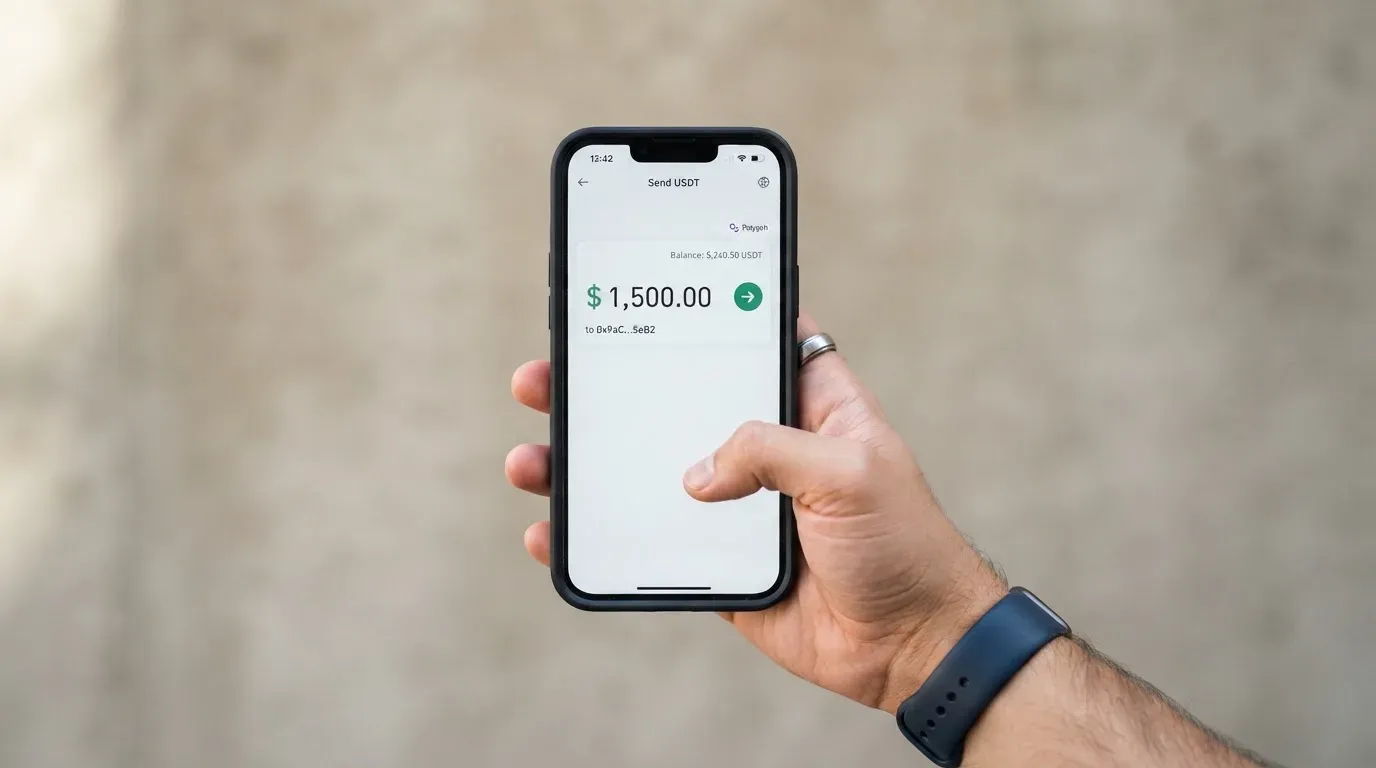
Deposits can be made in USDT TRC20 or in any of those listed coins through the bot. The minimum to open is $55. Two things are not stated: the top-up fee, and who pays the blockchain network fee for the transfer. The network fee is charged by the blockchain itself, not by the card, so on a busy network it can vary. Fiat top-up is also not stated — the card’s pages describe crypto routes only.
One background point that matters more than it looks. Blockchain transfers are irreversible. If you send on a network the card does not support, or to an address belonging to another network, the funds can be lost or need manual recovery with no guarantee. Note also that Circle stopped supporting USDC on Tron in February 2024, so “USDC over TRC20” is not a native option even though USDC appears on the card’s coin list. Check which chain your coin actually uses before you send anything.
And the question that comes up more than the others: how do you get money out? The card’s public pages do not say how a balance is returned. The terms say executed transactions are final, non-cancelable and non-reversible, that fees for a completed service are non-refundable, and — in Section 9.3 — that on termination users “are not refunded”. Read that alongside the first deposit complaints below, because that is exactly where the two meet.
Paying with it every day
In store, the virtual card works wherever Mastercard is accepted, and you can add it to Apple Pay. Google Pay is not mentioned anywhere in the pages I read, so if your phone is Android and your wallet of choice is Google’s, this card does not speak to you. There is no physical card — the official pages are virtual only, and a physical variant appears only in third-party listings.
There is no standalone app. Everything happens in the Telegram bot. That means no store ratings to read, and also no in-app experience to judge: no spending charts, no notification feed, nothing to screenshot.
Rewards are not stated. Cashback is not stated. No referral scheme is described on the official pages.
On blocked categories, the honest answer is that the list is not published. I was told that online-game donations are not on the allowed-services list, and the company pointed to its authorized-services list instead. If a payment of yours is declined for service-type reasons, that is likely why.
If something goes wrong, the route is support first — Telegram or a support email. CinCin has up to 30 calendar days to respond. Anything unresolved goes to LCIA arbitration in London under English law. Requests for refunds of unauthorized or incorrectly executed payments caused by a CinCin error must be raised within 12 months under Section 15. Chargebacks are not mentioned. That gap matters: a chargeback is the mechanism most cardholders assume will be there, and its absence changes what happens when a payment goes wrong.
A last everyday detail worth knowing, because it applies to cards like this generally rather than to CinCin alone. When a card payment is declined, an authorisation hold can remain on your balance for several days, typically up to 7. Declined payments are not as harmless as they look on a stored-balance card.
What can go wrong
I found no official incidents to report. What I did find is a thin, negative set of user reports, and a company structure that leaves you with few places to complain to.
On Trustpilot the card sits at 3.1 out of 5 from 17 reviews, read on 2026-10-21, with 23% one-star, and the company replying to about 25% of negative reviews. The themes are consistent: unrefunded first deposits (April 2026), no refund for the card itself plus online-game donations not on the allowed-services list (October 2025), and slow support, up to an hour (September 2025). On the April deposit complaint the company asked the reviewer to contact support on 14 May 2026. That is a thin response record on a small sample — seventeen reviews is not a statistically meaningful picture of a company — but the direction is not encouraging, and the deposit complaint is precisely the one that should worry you most.
The company behind it is Sonder INC, a digital assets services provider incorporated in the Marshall Islands, registered at Trust Company Complex, Ajeltake Road, Ajeltake Island, Majuro MH96960, registration number 130414. The site footer carries the brand “Cin-Cin Pay”. The cards are “issued and managed by a licensed third-party card issuer” — and that issuer is not named. No licences are named either.
Here is why that is not a technicality. A card number identifies an issuer through its first six or eight digits, and a merchant can look that up. When the issuer country differs from your billing address, some merchants apply extra scrutiny or decline outright. So the identity of the unnamed issuer is exactly the thing that affects whether your payment goes through. The card’s own support contact is not obliged to be the party that answers when money is missing.
On custody and security: the arrangement is custodial — the balance is held by the service and the card is operated through the bot. That means the provider holds the credentials, and you trust them completely. The site claims end-to-end encryption and that sensitive payment details are not stored. Two-factor authentication, in-app freeze, and safeguarding arrangements are not stated. Custodial platforms have a real history of failure: Mt. Gox, around US$350 million reported stolen between 2011 and 2014; Coincheck, about US$400 million in 2018; Ronin Network, US$625 million in 2022.
Support is Telegram plus an email address. The site runs in English, Ukrainian, Russian, Spanish and Portuguese. Hours are not stated — so the “up to an hour” complaint may be a complaint about a bad day rather than the norm, or may be your experience at 3 a.m.
What I could not find: no news record, no incident record, and no independent audit or register entry is mentioned in the pages I read.
What to take instead
Four comparable cards, all virtual, all crypto-funded, all Telegram-native to some degree. I include them because the comparison is more useful than a single verdict — you can see which trade-off each one makes.
| Card | Score | Card type | Cost | Where it can be used |
|---|---|---|---|---|
| CinCin | 5.4 / 10 | Virtual Mastercard | $25 issuance, $55 minimum to open | Not the UK, UAE, Japan, US; also restricted list applies |
| Azul Card | 5.3 / 10 | Virtual only, works where Mastercard is accepted | $20 creation (refunded after $2,000 in spending), $5 monthly | Worldwide except Russia, Belarus, North Korea, Iran, Syria, Cuba, Sudan, Venezuela, Ukraine and the Crimea, Donetsk, Luhansk, Zaporizhzhia and Kherson regions |
| Telecard | 6.1 / 10 | Virtual Mastercard, no physical or metal | Standard $5 one-time; VIP $49 setup then $19/month; $99 minimum deposit, stated as “NOT a fee” | Over 150 countries where Mastercard is accepted; terms bar US-blocked or OFAC-sanctioned users |
| OnCards | 4.6 / 10 | Virtual Mastercard or Visa, in Telegram | not stated | not stated |
Three observations from that table.
Azul Card is the closest structural match and it publishes what CinCin does not: a monthly maintenance fee of $5, a crypto top-up fee of 4%, and a per-transaction fee of $0.25. It also states its timing — first top-up up to 10 minutes, later ones 1 to 5 minutes — and notes that a referral programme pays “up to 40% of our fees from every transaction made by your referrals”. Its restrictions are stated more bluntly than CinCin’s, including that they “apply regardless of the user’s nationality”. Its card balance is in USD. What it does not state is its FX fee.
Telecard scores highest of the four at 6.1, largely because it publishes its percentages: currency conversion 1.5% on non-USD payments, a gas fee of 0.5 USDT per successful card transaction, and FX and cross-border fees “up to 3% each”. It has no physical card, a $99 minimum deposit to activate, and a VIP tier at $19 a month. Its country position is the softest — over 150 countries, identity check “available in most major regions”, and no list of what is excluded. It also runs a points scheme, Fiorini, for referrals and friend spending.
OnCards is the thinnest offering of the four. Its fees are “simple and clear” with no amounts given, its country availability is not stated at all, its card currency is not stated, and it funds only via USDT BEP20 with no bank transfers. I would not choose it over the other three on the strength of its published pages.
CinCin’s own advantage in this group is the funding breadth: 24 coins including BTC, ETH, SOL-adjacent options, BNB and TON, on a named network. If you hold something outside the two stablecoins and want to spend it, that matters.
Who I would recommend it to
I would recommend CinCin to one specific person: someone who already has crypto sitting in a wallet, already lives in Telegram, needs a card number for ordinary spending soon, and treats everything on the balance as money they are willing to lose. If that is you, the mechanics are good, the coin list is generous, and the $55 opening floor is low.
I would not recommend it to someone building a routine, to anyone who needs Google Pay or a physical card, or to anyone who wants a published conversion rate before committing to a purchase. I would be especially careful if the money on the card is money you cannot replace, or if you are based in a country the terms do not clearly cover — citizenship and residence are not distinguished, and the restricted list can grow at any time.
The decision I would actually make is not “CinCin good” or “CinCin bad”. It is: does the card publish the numbers I need to budget with? For the ones I care about — conversion, FX, monthly fee, ATM, card currency, KYC level, withdrawal route — the answer is mostly no, and the balance-back question is answered only by a clause saying termination brings no refund. That combination, with an unnamed issuer and a 3.1 rating on 17 reviews, is why this lands at 5.4 rather than higher. If transparency matters to you more than speed of onboarding, Telecard and Azul Card publish more and are worth a look first.
Frequently asked questions
What is the CinCin card?
CinCin is a virtual Mastercard you fund with cryptocurrency, operated through a Telegram bot rather than an app. You open it by sending at least $55 in USDT TRC20 to an address the bot gives you; $25 is the issuance fee and $25 lands on your card balance. There is no physical card in the official offering, and you add the virtual card to Apple Pay for in-store spending. The company behind it is Sonder INC, incorporated in the Marshall Islands.
How does the CinCin card work?
The balance is a USDT TRC20 address on your side of the system, and you can fund it with any of 24 listed coins, including BTC, ETH, BNB, USDC and USDT. The Telegram bot converts what you send into a spendable balance within seconds, and the virtual card then draws on that balance like a prepaid card. Payments work wherever Mastercard is accepted. The terms say executed transactions are final, non-cancelable and non-reversible.
Is CinCin a bank?
No. It is a digital assets service provider, Sonder INC, registered in the Marshall Islands, which markets a card programme. The card itself is described as issued and managed by a licensed third-party card issuer, but that issuer is not named, and no licences are named either. So CinCin is not a bank, the bank behind the card is not identified, and your balance is not a bank deposit.
Does CinCin require KYC?
Partly, and the wording is unusual. The terms say CinCin does not independently perform KYC verification for users, while also stating it runs anti-money-laundering checks with third-party providers and may apply enhanced due diligence or restrict access. The public pages do not state a KYC level, a document list, a proof-of-address requirement or an age floor. Treat the “no complex verification” marketing as a description of onboarding speed, not an absence of checks.
How much does the CinCin card cost?
Opening the virtual card costs $25, and the minimum you must send to open it is $55. Beyond that the card publishes no numbers: no monthly fee, no conversion percentage, no FX percentage, no ATM fee and no card currency. An unofficial third-party aggregator, updated July 2026, lists a 4.5% top-up fee, but the card has not confirmed it. The terms promise you will see the final price before you confirm, not that it will be small.
How do I top up the CinCin card?
Open the Telegram bot, create your USDT TRC20 address, and send at least $55 in USDT TRC20 or one of the 23 other listed coins. The bot handles the exchange within seconds. Network fees are charged by the blockchain rather than the card, and who pays them is not stated. Fiat top-up is not described. Check the chain before sending: USDC over TRC20 is not a native option since Circle stopped supporting it in February 2024.
Is the CinCin card safe to use?
It is custodial, so your balance is held by the provider and you trust them with it entirely. The site claims end-to-end encryption and says sensitive payment details are not stored; two-factor authentication, an in-app freeze and any safeguarding arrangements are not stated. Support lives on Telegram and email with unstated hours, disputes can take up to 30 calendar days, unresolved cases go to LCIA arbitration in London under English law, and chargebacks are not mentioned.
Can I use the CinCin card in my country?
Not everywhere. It is not offered in the United Kingdom, UAE, Japan or the United States, and it is also restricted in Iran, North Korea, Syria, Venezuela, Afghanistan, Belarus, Cuba, Myanmar, Somalia and Ukraine. FATF-blacklisted and OFAC-sanctioned users are barred, and CinCin may add countries at any time. The rule is by the user’s country, but the terms do not say whether that means citizenship or residence, and Russia is not on the restricted list in the terms themselves.
How do I get my money back out of CinCin?
The card’s public pages do not describe how a balance is returned. What the terms do say is that executed transactions are final, non-cancelable and non-reversible, that fees for a completed service are non-refundable, and that on termination users “are not refunded” under Section 9.3. If returning your balance matters to you, ask support directly in writing before you fund the card, and keep the answer.
Is the CinCin card worth it?
For a narrow case, yes: you already hold crypto, you live in Telegram, and you want a working card number this week. For a routine, I would not build on it. It scores 5.4 out of 10, its Trustpilot rating is 3.1 from 17 reviews with unrefunded first deposits among the themes, the issuing bank and licences are not named, and most of the numbers you would need to budget with are unpublished.
Virtual card fees – cryptocardfacts
Content created by the «cryptocardfacts» team