
A quiet, well-priced AUD card for Australian crypto spenders, weighed against the catches
 Available in US
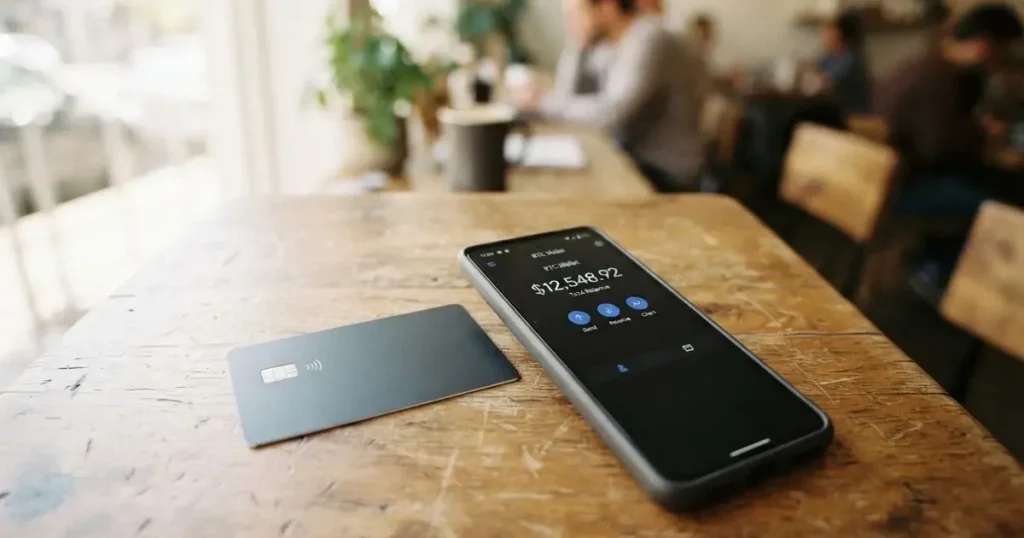
CoinJar’s prepaid Mastercard is one of the more straightforward crypto cards on the market. You hold crypto inside a CoinJar account, you pick one of those coins as your “Spend” account, the app converts it to Australian dollars at CoinJar’s rate when you tap or insert the card, and the merchant receives ordinary AUD. There is no separate wallet to learn, no DeFi yield to chase, and no foreign debit network to compare. If that picture fits how you want to spend, the rest of this review is about the bits that decide whether the card is actually worth having: who CoinJar will issue it to, what the fees look like in everyday life, how the top-up flow works under the bonnet, and where the product quietly stops being convenient.
The conditions described here are current as of October 28, 2026.
Verdict
CoinJar scores 5.5 out of 10 in my reading of it. That is not a damning number; it is the score of a card that does the simple things well and then closes its doors. On the everyday-use side it earns 9 out of 10: a free physical Mastercard, a free digital Mastercard, Apple Pay and Google Pay, a 1% cashback paid in CoinJar Rewards points, ATM withdrawals at 1%, and no monthly fee in the PDS fee table. Reliability earns 7 out of 10 because the card itself sits inside a regulated EML-issued programme in Australia, and a Trustpilot scan of the exchange turns up the kind of complaints you would expect from any large crypto venue (transfers paused for review, identity re-checks, slow support) rather than a pattern of card-specific failures. Top-up options get 5 out of 10 because the mechanics work, but CoinJar does not publish a list of supported coins or networks, and the headline “1% conversion” in the 2021 launch press release is a different number from the in-app fee you actually pay today. The lowest mark is for who can get it, 3 out of 10: the eligibility rules live in the Australian Product Disclosure Statement rather than the card page itself, the card page does not name countries, and there is no obvious path for non-Australian residents. Cost is 5 out of 10, again because the headline numbers are friendly but the foreign-transaction fee is set as “2.99%+” with a plus sign that has nowhere to land in writing.
| Criterion | Mark | Why I scored it this way |
|---|---|---|
| Who can get it | 3 / 10 | Card page lists no countries; eligibility lives in the AU PDS, not the card page. |
| Cost | 5 / 10 | Free to issue and replace; 1% purchase fee, 2.99%+ foreign transactions, 1% ATM, $27.50 disputes. |
| Top-up options | 5 / 10 | “Spend” account auto-converts at CoinJar’s rate, but the supported coin list is not published. |
| Reliability and complaints | 7 / 10 | Issued by EML (AFSL 404131) under an Australian PDS; only one card-specific complaint in third-party reviews. |
| Everyday use | 9 / 10 | Free physical and digital Mastercard, Apple Pay and Google Pay, ATM withdrawals at 1%. |
| Total | 5.5 / 10 | A solid everyday card for Australian residents paying with crypto in AUD, with rough edges around eligibility and disclosures. |
If you live in Australia, hold crypto on CoinJar, and want to spend it in AUD with a card that simply works at the supermarket, the verdict tilts positive. If you live outside Australia, want to know exactly which coins you can top up with, or need a card you can take travelling without surprise mark-ups, the verdict tilts negative. The rest of the review walks through each of those questions in order, so you can match them against your own situation.
Will they give you the card
This is the part where CoinJar asks the most of you and tells you the least. The card marketing page does not state eligibility or list supported countries. If you read the marketing page alone, you would not know that the card is only for Australian residents. The actual rule sits in the Australian Product Disclosure Statement: the card is available to people who are 18 or older, are Australian residents, and hold a verified CoinJar account. CoinJar Australia Pty Ltd is the authorised representative of the issuer, EML Payment Solutions Limited, which holds Australian Financial Services Licence number 404131.
A few things follow from that. The card is denominated in Australian dollars: every fee in the PDS fee schedule is quoted in AUD and is inclusive of GST. If your everyday spending is in AUD and your income or savings are in AUD, that is comfortable. If you live in another currency, the AUD denomination is one of two cross-border mark-ups you would face on every transaction, and the foreign-transaction fee described later is the other. There is no public statement on the card page about whether CoinJar will consider residents of other countries, and the language of the PDS does not invite non-Australian applications. Treat the residency rule as a hard one and avoid the disappointment of filling in an application only to be refused at verification.
Identity verification is part of the process, but CoinJar does not spell out which documents you will be asked for, how long the review takes, or the most common reasons applications are refused. The PDS only confirms that a verified CoinJar account is required, and that the level of verification is set inside the CoinJar account, not by the card programme itself. If you have already passed CoinJar’s standard exchange verification, you are most of the way there; if you have not, expect the card to wait until that step is finished.
A practical note for the reader: if you are weighing this card against a competitor and your country of residence is not Australia, you can stop here and look at the alternatives section instead, because the residency requirement is set by the product, not by you.
How to get it
There is no application form to fill in for the card on its own. The path runs through the CoinJar account, in roughly this order.
First, you open and verify a CoinJar account, satisfying the platform’s standard KYC checks to whatever level the platform requires. CoinJar does not publish the document list on the card page, and a refusal at this stage blocks everything that follows.
Second, once your account is verified, the card becomes available in the CoinJar app: a free digital Mastercard is issued immediately for online use and for Apple Pay and Google Pay, and a free physical Mastercard is sent to your Australian address. Both the card issue fee and the replacement card fee are listed as “Free” in the PDS fee table. The card page does not state delivery countries or a delivery time, so the physical card is implicitly Australian-only.
Third, you pick a cryptocurrency to act as your “Spend” account. The card then draws on the AUD value of that coin via the CoinJar Everyday Account, with conversion happening at CoinJar’s rate at the moment of purchase. There is no manual “load” button: you choose a coin, the app tracks its AUD value, and the card spends against that balance.
The card is prepaid and reloadable. That matters for two reasons. As a prepaid card it cannot overdraw: if your chosen coin’s AUD value is below the purchase amount, the transaction is refused. As a reloadable card it is not a one-shot disposable; you can change the “Spend” coin over time, and the digital and physical cards are managed in the same CoinJar app.
The card may be cancelled by you at any time, and by the issuer on 14 days’ notice, or immediately if the issuer suspects misuse or false information. If the card is cancelled, the balance left on it is paid back into your CoinJar Everyday Account in Australian dollars once no authorisations are pending and you have asked CoinJar to release it. That is the recovery path, and it is in AUD rather than in the original crypto, which is worth keeping in mind before you load large amounts.
Fees and what they really cost in everyday payments
The fee table in the PDS is short and friendly. The way the same fees land on a real-world transaction depends on three things: whether the purchase is in AUD or a foreign currency, whether it is in a shop or at an ATM, and whether anything goes wrong that requires a dispute.
| Fee or limit | Value as stated |
|---|---|
| Card issue fee | Free |
| Replacement card fee | Free |
| Account-keeping or monthly fee | Not stated on card page; no account keeping fee line charged in the PDS |
| In-store and online purchase fee | 1% (returned in Rewards points) |
| Foreign-transaction fee | 2.99%+ (Mastercard rate plus 2.99% FX fee) |
| ATM withdrawal fee | 1% of withdrawal (physical card only), plus any ATM operator fee |
| Disputed-transaction fee | $27.50 AUD per unsuccessful dispute |
| Maximum point-of-sale transaction | $5,000 |
| Daily point-of-sale limit | $5,000 (includes ATM withdrawals) |
| Daily ATM limit | $1,000 |
| Per-withdrawal ATM range | $20 minimum, $1,000 maximum |
| Free ATM allowance | Not stated |
A few of those rows need explaining.
The 1% purchase fee is technically charged and then returned to you in the form of CoinJar Rewards points, at one point per Australian dollar spent. The points offset future trades or are redeemed in the Rewards Store. If you treat the card as a 1% cashback card, that is the right framing, but it is worth knowing that the cashback is in points rather than direct AUD credit, and the value of a point depends on what you redeem it for.
The foreign-transaction fee is presented as “2.99%+” on the card page, with the plus sign doing a lot of quiet work. The PDS explains that the fee is the Mastercard exchange rate plus a 2.99% foreign exchange fee, so the 2.99% is the issuer’s slice and the rest is the network rate. The plus sign is a hedge: it leaves the door open for the rate CoinJar or EML applies to the conversion from your chosen crypto to AUD before the foreign-transaction step kicks in, and for any spread between CoinJar’s quoted rate and the rate at which the trade is actually executed.
The 1% ATM fee is on top of any fee the ATM operator charges, and it is the issuer’s fee, not a refund in points. There is no free allowance published, so the 1% is taken on every withdrawal.
A dispute fee of $27.50 AUD applies per unsuccessful dispute. If you raise a chargeback and lose, you pay $27.50. The dispute process itself follows the Mastercard scheme rules, with a window that is generally 90 days from the transaction, and a 10-day window for extra information once the issuer asks. A chargeback you win does not incur the fee.
To put that in three everyday scenes:
- A $100 AUD grocery shop in Melbourne: you pay nothing up front in fees. The 1% purchase fee is taken and returned in Rewards points, so the net cost is zero in dollar terms and the receipt is the same AUD amount your card was charged.
- A $200 AUD online subscription to a service billed in USD: the foreign-transaction fee of 2.99% applies on top of the Mastercard rate, the spread between CoinJar’s quoted rate and its executed rate on the crypto-to-AUD conversion is not stated, and the Rewards points keep coming. The total cost depends on how the conversion is described to you in the app, but a back-of-the-envelope read is that you pay roughly $6 AUD in FX margin before you even count the Mastercard rate movement.
- A $300 AUD ATM withdrawal overseas: you pay a 1% issuer fee ($3 AUD) plus whatever the local ATM operator charges, and the underlying $300 is also subject to the 2.99%+ foreign-transaction fee, so the round trip is more than $12 AUD on a $300 withdrawal before the operator’s own surcharge.
If you do most of your spending in AUD in Australia, the day-to-day fees are easy to live with. If you travel, the foreign-transaction fee and the lack of a published free ATM allowance make the card noticeably more expensive abroad than it looks on paper.
Top up: how the card actually gets loaded
The card does not have a balance in the way a regular prepaid card does. It draws on what CoinJar calls your “Spendable Balance” in the CoinJar Everyday Account, and that balance is the AUD value of a cryptocurrency you have chosen as your “Spend” account. When you pay, the app sells just enough of that crypto to cover the purchase at CoinJar’s rate, and the merchant receives AUD.
In practice, the flow looks like this. You fund your CoinJar account the way you fund any CoinJar account: by depositing crypto from another wallet, by buying crypto through CoinJar, or by receiving it from another CoinJar user. Within the account, you pick one coin to act as your “Spend” account; the app then tracks its AUD value in real time and the card spends against that tracked value. The 2021 launch press release says the card was made available across 30 digital currencies at a flat 1% conversion; CoinJar’s current card page and PDS do not republish that list, so the supported coins today are not officially enumerated. Treat “pick a coin, the card spends it” as the working model, and treat the specific list as something you have to confirm inside the app before you load.
The conversion is where the real cost of the top-up sits. CoinJar charges its normal trading fee when it sells your chosen crypto to fund the purchase; the card’s own 1% purchase fee is collected at the merchant and returned in Rewards points, but the trading fee is the price of the conversion. The card page does not state a separate “top-up fee,” does not state a minimum top-up, and does not state which network fees, if any, CoinJar passes through when you deposit crypto into the account. On-chain network fees for the deposit itself are charged by the blockchain you send on, not by CoinJar, and choosing a different network for the same coin is a common way to lose a deposit: blockchain transfers are irreversible, and a deposit sent on a network CoinJar does not support, or to an address belonging to a different network, may not be recoverable. There is no stablecoin bypass either, in the sense that the card always spends AUD at the merchant, even if your “Spend” coin is a USD-pegged stablecoin; the conversion to AUD still goes through CoinJar’s rate.
One implication worth spelling out: because the card’s “balance” is the AUD value of a chosen coin, that balance moves with the market. If you pick a volatile coin as your Spend account and the price drops between loading and spending, you have less AUD to spend than you intended. If you pick a stablecoin and CoinJar’s quoted rate differs from the rate you saw when you set it, you take that spread. This is not unique to CoinJar; it is the standard design of an auto-converting crypto card. But it is a design choice that affects how you fund the card, and the card page is quiet about it.
There is no separate “add money” button, no manual load, and no scheduled top-up. The top-up is the act of having crypto in your CoinJar account and having a coin selected as your Spend account. That simplicity is the product.
Paying with it every day
Once the card is loaded, everyday use is uneventful, which is the highest praise a payment card can earn. You tap the physical card or the phone, you insert the chip, you enter the PIN at the ATM. Contactless transactions under $100 AUD are covered by the standard Australian contactless limit. The digital card sits in Apple Pay and Google Pay, and because it is a tokenised number stored in the device’s Secure Element rather than the real card number, the issuer can also lock down the tokenised card for specific channels if it needs to.
There is no published list of blocked merchant category codes, so there is no public way to know in advance whether the card will work at, say, a gambling site or a fuel station. In practice, crypto cards in this category tend to inherit the issuer’s standard blocked-MCC list, but CoinJar does not document it on the card page, so the safe assumption is to test before you rely on it for a specific merchant type.
For online shopping, 3-D Secure applies: the issuer may either approve the payment frictionlessly or ask for a one-time code or biometric confirmation. This is standard for prepaid Mastercard programmes in Australia, and it is a feature, not a bug, even if it adds a step at checkout. Address Verification Service, the older address-matching system used in the United States, Canada and the United Kingdom, is generally unavailable on foreign-issued cards; that is not a CoinJar quirk, it is how AVS works.
The CoinJar app is where the card is managed. You can hold and unblock the card, change the PIN, view the transaction history, and switch the “Spend” coin. App ratings from third-party sources are useful as a rough health check, not as a binding judgement: the iOS app is rated 4.1 out of 5 from 123 reviews according to one pricing data source (last updated 7 March 2026), while the Android app is rated around 3.91 from roughly 2.6 thousand ratings on another. Both of those are unofficial numbers from third-party app data sites, and the iOS sample is small enough that a one-star or five-star review moves the average visibly. Use them as a hint that the apps are usable rather than as a guarantee.
When something goes wrong, the dispute path is the Mastercard scheme route via the issuer EML: notify the issuer as soon as possible, generally within 90 days of the transaction, and supply the extra information requested within 10 days or risk losing the dispute. A lost dispute costs you $27.50 AUD. Merchant refunds are paid back into your CoinJar Everyday Account in AUD, not in the original crypto, so the round trip of “purchase, refund, reconvert” is a two-step process rather than a one-step cancellation.
What can go wrong
Crypto cards fail in three broad ways: the underlying platform fails, the card programme is shut down, and the card is misused. CoinJar’s exposure to each is different.
The underlying platform is CoinJar, an Australian exchange that has been operating since 2013. The card is a thin layer on top of the exchange, and the exchange carries the standard counterparty risk of a custodial crypto venue: deposits are not the same as bank deposits, and there is no deposit guarantee scheme coverage. The card itself does not insulate you from that. The CoinJar exchange has a TrustScore of 3.3 out of 5 on Trustpilot from 2,549 reviews, with about 17% one-star reviews (read on 20 October 2026). The themes in those negative reviews are not card-specific: transfers and withdrawals being held “under review” or paused for Travel Rule checks (reports from June to October 2026 include a Bitcoin transfer paused for more than four days in August 2026), identity re-checks and account freezes (May to September 2026), and slow support (June to October 2026). CoinJar replies to 100% of the negative reviews, which is a meaningful signal that the company is engaging with criticism, even if the underlying experiences are real. The only card-specific complaint in the third-party review set I found was a single report from 18 October 2026 that a virtual Mastercard was “constantly having technical issues.” One report is not a pattern, but it is the kind of report you should expect to see occasionally in any card product.
The card programme is run by EML Payment Solutions Limited, an Australian e-money issuer regulated by AUSTRAC and holding AFSL 404131, with CoinJar Australia Pty Ltd as the authorised representative. That is a more reassuring setup than an unregulated card, and the PDS structure (rather than a one-page marketing page) is the right shape for a regulated product. Card programmes can still be shut down: Visa terminated its global agreements with FTX in November 2022 and the FTX US debit card was wound down by its issuer, and WaveCrest, a Visa issuer that supplied several crypto card brands, was suspended by Visa in Europe in 2018, closing all its programmes. The CoinJar card sits under Mastercard, issued by EML, and there is no public 2026 programme change to report; the CoinJar blog from February 2026 still describes the card in active terms. The 2026-10-20 news scan found no announcement of a programme closure.
Misuse is the third bucket, and it is the one the card handles in the app. You can freeze and unfreeze the card, change the PIN, and view the history. Tokenised cards in Apple Pay and Google Pay can be restricted by the issuer to specific channels. The PDS does not describe insurance or safeguarding for the funds in your CoinJar account, so the assumption to make is that you are relying on CoinJar’s operational security for the crypto side and on EML’s e-money safeguarding for the card balance side; the two are not the same and are not interchangeable.
Two specific risks are worth flagging because they are easy to miss on the marketing page. The first is currency risk on the top-up: your “Spend” coin moves with the market, and the AUD value at the moment of purchase is what gets spent, not the AUD value at the moment you deposited the coin. The second is the lack of a published list of supported coins and networks, which means a deposit sent on a network CoinJar does not support may be lost or require manual recovery with no guarantee of success; blockchain transfers are irreversible, and this is the standard rule of the asset class, not a CoinJar-specific quirk.
If something does go wrong and the standard support path does not resolve it, the complaint escalation runs through CoinJar ([email protected]), with an attempted resolution within 5 days, a written response within 30 days if it takes longer, and then escalation to the Australian Financial Complaints Authority. Issuer-level support is available from EML at [email protected].
What to take instead
Three cards are worth weighing against CoinJar, each for a different reason. The numbers below come from third-party reviews of the same family of products and are not CoinJar figures.
| Card | Score | Headline difference from CoinJar |
|---|---|---|
| Young Card | 5.7 / 10 | Cashback paid in YNG tokens, with the rate set by club tier (Essential 0.1%, Gold 1.8%, Platinum 3.6%). |
| MSX | 6.4 / 10 | Sits above CoinJar in the category score, on the back of factors not stated officially in the public materials I could read. |
| Bybit Card | 6.0 / 10 | Multi-region card (Argentina, AIFC/Kazakhstan, Georgia, Australia, Mexico, Brazil, Peru, Asia Pacific) with tiered cashback from Base 2.00% to Infinite 10%, but eligibility is region-locked and the fee schedule is region-specific. |
Young Card is the natural comparison if the CoinJar 1% in Rewards points feels stingy. The trade is that Young’s cashback is paid in a token, the YNG token, and the rate depends on which club tier you are in. If you already hold YNG and want to be paid in it, the rate beats 1% at the higher tiers; if you do not, the comparison is more about how much you want to take on a second token.
MSX scores above CoinJar in this category, but the public materials I could read do not state the cards, fees, or funding in enough detail to explain the gap cleanly. If MSX is on your shortlist, the most useful step is to look at the live product page for the version available in your country, because the published score is a category judgement, not a side-by-side in the way the CoinJar fee table is.
Bybit Card is the comparison to make if CoinJar’s Australian-only residency rule is a problem for you. Bybit issues cards across more regions, including Australia, but the card currency, the issuance and replacement fees, the FX margin, and the cashback rates are all region-specific, and the eligibility rules are region-locked. If you are in one of the listed regions and you want a more feature-rich rewards structure (the tiers go up to 10% cashback at the top end), Bybit is a reasonable next step; if you are in a region the card does not support, the only available answer is “register your interest” through the application.
For a reader who is not in Australia and not in one of the Bybit-listed regions, the honest answer is that the mainstream crypto card market is still thin outside Europe, the United Kingdom and a handful of Asia-Pacific markets, and CoinJar’s residency rule is a common shape rather than an outlier. In that case, the question is less “which of these three cards” and more “which crypto card has a programme in your country today,” and the alternatives section is a starting point, not a final answer.
Who I would recommend it to
I would recommend the CoinJar card to a reader who is an Australian resident, has already decided to use CoinJar as their exchange, holds a meaningful portion of their portfolio in crypto, and wants a Mastercard that converts to AUD at the till without a separate wallet or a separate funding step. For that reader, the card is a clean fit: free to issue, free to replace, a friendly 1% in Rewards points on AUD spending, ATM access at 1%, and a CoinJar app that already holds the rest of the crypto. The 5.5 score reflects everything around the edges, not the core use case.
I would not recommend it to a reader who is not an Australian resident, who needs a published list of supported coins before they are comfortable funding the card, who plans to use the card as a travel card in foreign currencies, or who wants a card that can be loaded from a self-custody wallet rather than from inside the exchange. For those readers, the foreign-transaction fee (2.99%+), the daily limits, the AUD-only refund model, and the residency rule are not quirks to live with; they are the wrong product.
The in-between reader is the most interesting case. If you are an Australian resident who splits your time between AUD spending and overseas travel, the card is fine for the AUD side and expensive on the foreign side. The cost calculation is yours, not mine: a 2.99%+ FX fee is competitive with some bank cards and worse than others, and the lack of a free ATM allowance means the card is not the right tool for cash-heavy travel. If the foreign side matters more than the AUD side, look at a travel-focused card first and use CoinJar as the funding account rather than the spending card.
A final point that is easy to forget on a review like this: holding crypto on a custodial exchange so that you can spend it with a card means trusting the exchange to be there tomorrow, in addition to trusting the card programme. That is true of every card in this category, including the alternatives, and CoinJar’s regulatory setup (EML as issuer, AFSL 404131) is on the more reassuring end of the spectrum rather than the less, but the underlying exchange risk is not removed by the card. The card is a way to spend, not a way to keep your crypto safe.
Frequently asked questions
What is the CoinJar card?
The CoinJar card is a prepaid reloadable Mastercard that spends the Australian-dollar value of a cryptocurrency you have chosen as your “Spend” account inside the CoinJar app. There is a free digital card for online use and mobile wallets, and a free physical card posted to an Australian address. The card is issued by EML Payment Solutions Limited, with CoinJar Australia Pty Ltd as authorised representative.
How does the CoinJar card work?
You hold crypto in a verified CoinJar account, pick one of those coins as your “Spend” account, and the card converts just enough of that coin to AUD at CoinJar’s rate when you make a purchase. The merchant receives AUD; you see the deduction in your CoinJar app; CoinJar charges its normal trading fee on the conversion, and the 1% purchase fee is taken at the merchant and returned in Rewards points.
Is CoinJar a bank?
No. CoinJar is a cryptocurrency exchange, and the card is a prepaid Mastercard issued by EML Payment Solutions Limited, which is a separate e-money issuer licensed in Australia. Card funds are not bank deposits and are not covered by a deposit guarantee scheme. CoinJar Australia Pty Ltd is the authorised representative of the issuer under AFSL 404131.
Who owns CoinJar?
The CoinJar Group operates the exchange, and the card programme sits under EML Payment Solutions Limited as issuer, with CoinJar Australia Pty Ltd as the authorised representative. The card page does not publish a corporate ownership chart, so for the reader the relevant ownership facts are the issuer (EML) and the programme representative (CoinJar Australia), both of which appear on the PDS.
Is the CoinJar card available in my country?
The card page does not list supported countries, but the Australian Product Disclosure Statement limits eligibility to Australian residents aged 18 or over with a verified CoinJar account. The card is denominated in AUD and the PDS fee table is in Australian dollars, both of which point to an Australia-only programme. If you are not an Australian resident, treat the residency rule as a hard one.
How do I get a CoinJar card?
You open and verify a CoinJar account, then request the card inside the app. The digital Mastercard is issued immediately; the physical Mastercard is posted to an Australian address. There is no separate application fee; the card issue fee and the replacement card fee are both listed as Free in the PDS fee table.
Does the CoinJar card require KYC?
Yes. A verified CoinJar account is required, and the card is not issued until the account is verified to the platform’s standard. The PDS does not list the documents you will be asked for or the processing time, so the practical step is to complete CoinJar’s standard exchange verification first and request the card afterwards.
How do I top up the CoinJar card?
You do not “top up” the card in the usual sense. You fund your CoinJar account by depositing crypto or buying it, then choose a coin to act as your “Spend” account; the card then spends the AUD value of that coin at the point of sale. CoinJar does not publish a list of supported coins on the card page, and blockchain transfers are irreversible, so a deposit sent on a network CoinJar does not support may not be recoverable.
Is the CoinJar card free?
The card itself is free to issue and free to replace, and the PDS fee table does not charge a monthly or annual account-keeping fee. The cost of using the card sits in the 1% purchase fee (returned in Rewards points), the 2.99%+ foreign-transaction fee, the 1% ATM fee, the $27.50 dispute fee on unsuccessful chargebacks, and CoinJar’s normal trading fee on the crypto-to-AUD conversion.
Is the CoinJar card safe?
The card sits inside a regulated Australian e-money programme, with EML as the issuer and CoinJar Australia Pty Ltd as the authorised representative under AFSL 404131. You can freeze and unfreeze the card in the app, change the PIN, and use the card through Apple Pay or Google Pay, where the number is tokenised. The card does not insure or safeguard the crypto in your CoinJar account, so the safety of the funds ultimately depends on the operational security of the exchange, not the card programme.
Exchange card fees – cryptocardfacts
Content created by the «cryptocardfacts» team