
A premium metal Visa on a credit line, repaid in USDT
 Available in US
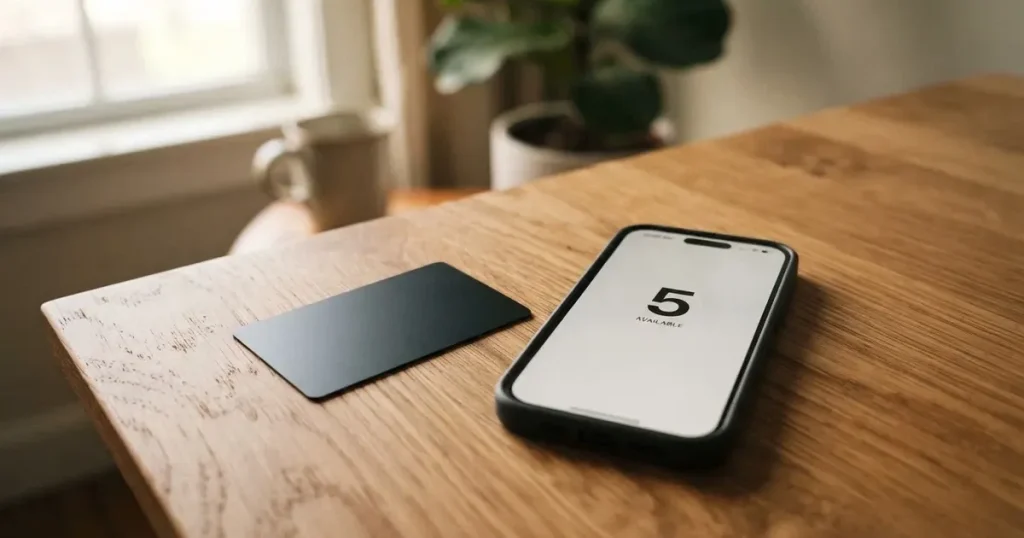
Decard is a Singapore-based financial brand, and its flagship product — DeCard Luminaries — is a premium metal Visa credit card whose balance you repay with USDT or USDC. That single sentence is the whole card, and also the whole problem with it. It is not a prepaid crypto card where you load funds and spend them down. It is a credit line, in Singapore dollars, whose debt can be settled in stablecoins through the D-Vault page. Whether that is a clever arrangement or an expensive one depends almost entirely on what you spend and what you would otherwise pay US$388 a year for.
I went through the card’s own pages and terms document to write this, and my score for it is 4.8 out of 10. Not because the product is dishonest or broken — as far as I can tell it is a real, functioning Visa with a real annual fee and a real metal card — but because the price is extreme, several load-bearing numbers simply are not published, and the issuer and its licences are not named on the pages I read.
The conditions described below are current as of October 28, 2026.
Who it suits, in one line: someone who wants a premium metal credit card, already transacts in crypto, and is comfortable paying US$388 a year for the privilege. Who it does not suit: almost everyone else — and especially anyone whose main goal is spending stablecoins cheaply, since the annual fee alone can swamp a year of modest spending.
Score at a glance
| Criterion | Mark | Why |
|---|---|---|
| Who can get it | 5 / 10 | Countries not named, age 21–65, access by invitation or application; Singapore citizens and PRs go through Singpass |
| Cost | 2 / 10 | US$388 annual fee, cannot be waived, metal card included; FX 0% on the site, but the terms carry a Foreign Exchange Conversion Charge |
| Top-up options | 4 / 10 | It is a credit line and crypto only repays the debt: USDT and USDC via D-Vault, networks not named |
| Reliability and complaints | 7 / 10 | DCS Card Centre Pte. Ltd. (Singapore), terms follow MAS recommendations, issuer and licences not named; no complaints found |
| Everyday use | 7 / 10 | Physical metal and virtual Visa, bank ATMs treated as cash advance outside Singapore; Apple Pay and Google Pay not disclosed |
| Total | 4.8 / 10 | A functioning premium card at a price most people cannot justify |
The two lowest marks are the two that matter most to a first-time reader. Cost gets 2 because of the annual fee and because the FX story contradicts itself between the product page and the terms. Top-up gets 4 because “top up” is the wrong mental model here — you do not top this card up, you repay it, and the repayment side of the arrangement is thin on detail.
Let me take those in the order you will actually meet them.
Will they give you the card
The short answer is: probably, if you are 21 to 65, but the card does not tell you where you have to live, and it will not tell you why you were refused.
The card’s own pages set an age range of 21 to 65 and state no minimum income. Access is by invitation or by application, and every application is reviewed before approval. That is the honest version — there is no published list of eligible countries, so if you are outside Singapore you cannot check a box and confirm you qualify. You apply and find out. I would treat that as the practical answer to “is Decard available in my country”: unstated, so ask before you commit any effort.
Singapore Citizens and Permanent Residents verify identity through Singpass. Everyone else uploads identity and proof-of-address documents, with a passport given as the example. That is standard, and worth saying plainly: this card requires KYC, as any regulated card does. There are no levels, no published processing time and no stated rejection reasons — which means if you are turned down, you will not be told why, and you cannot appeal on the basis of a rule that was never written down.
The credit limit is where the discretion sits. DCS sets the starting credit limit, and the terms say it does so “at our sole and absolute discretion” and may revise it without notice. No figure is published. So you are applying for a credit line of unknown size, and the size determines what the card is actually worth to you day to day.
How to get it
Apply through the card’s site, or by invitation. Singapore citizens and PRs authenticate via Singpass; other applicants upload a passport and proof of address. Applications are reviewed, and approval is a decision made by the card, not something you can speed up with better documents — though complete documents obviously help.
What you get after approval, and this is where the card is unusually generous on hardware:
- A physical metal card described as a “22-gram alloy” with laser engraving
- A virtual card issued once the annual fee is paid
- Both on the Visa network
- The account denominated in SGD
The physical card is sent after the annual fee is paid. Countries of delivery, delivery time and delivery cost are not stated. If you need the card in a specific country fast, that is an unanswered question you should chase before paying. Replacement of a lost or damaged card is handled “on terms we stipulate” under clause 15.6, and that fee is not stated either — so treat a second card as a cost you do yet know.
One thing worth understanding before you apply: the virtual card is issued after approval but activated only once the annual fee is paid. Approval alone gets you nothing you can spend with. That is normal, but it means the US$388 comes due at the moment you least feel like paying it.
Fees: what the metal card actually costs you
US$388 a year, charged in Singapore dollars, described as something that “cannot be waived”. The metal card is included in that membership and separately valued at US$100, and there is no separate issuance fee stated. So the headline is not a trick — you pay US$388, you get a metal card, and nobody can discount it.

Then the parts that are genuinely unclear.
| Item | What the card says |
|---|---|
| Annual fee | US$388, charged in SGD, cannot be waived; metal card included |
| Separate issuance fee | Not stated |
| Foreign exchange | Product page: 0%, “No foreign transaction fees on any overseas spending”. Terms clause 1.5.3: converted at the “DCS retail rate of exchange” plus a “Foreign Exchange Conversion Charge” |
| Crypto conversion fee | Not stated (terms PDF not read) |
| ATM / cash advance | Service fee per advance, rate not stated; only “at any automated teller machine outside Singapore”, up to a limit set by DCS; ATM withdrawals earn no rewards |
| Spending / ATM limits | Not stated |
| Credit limit | Set by DCS at its sole discretion, may be revised without notice, no figure published |
| Other charges in the terms | Late payment charges, interest after the Due Date, inactivity fee after 90 days, early termination fee within 180 days, cash advance service fee, foreign exchange conversion charge — amounts published in the website FAQ, not in the PDF |
The FX contradiction is the one I would not let slide. The marketing page promises no foreign transaction fees on overseas spending; the terms provide for a Foreign Exchange Conversion Charge. The amounts of the late-payment, interest and inactivity charges live in the website FAQ rather than the contract. That is not disqualifying — plenty of issuers do this — but it means the two places you must read are the site and the PDF, and neither alone is the whole deal.
Now three everyday payments, to make the abstract concrete.
Coffee abroad, roughly US$5. You have an account in SGD, so the purchase is converted. Under the terms, that conversion happens at the DCS retail rate of exchange plus a foreign exchange conversion charge. Under the product page, it costs you nothing extra. Which of those is true for your transaction is exactly what I could not resolve. This is the question to ask support before you rely on the card outside Singapore.
A month of ordinary spending, say US$300. Annual fee of US$388 exceeds it. Even with cashback of up to US$200 a month described in the benefits — a cap, not a typical earning, and the cashback rate is described as “up to 10%” — the arithmetic does not rescue a low-spend year. At low spend this card is a cost, full stop.
Withdrawing cash outside Singapore. The terms treat this as a cash advance at any ATM outside Singapore, up to a limit DCS sets, with a service fee per advance whose rate is not published, and no rewards on it. Inside Singapore is treated differently; outside, you are in credit-card cash-advance territory, which is the most expensive way to get money.
Top up: how you fund it, and why that word is misleading
You do not top this card up. You repay it.
Decard Luminaries is a credit line. Crypto’s job is to pay the debt down, not to fund the purchases directly. On the D-Vault page there is a “Pay to card” function, and USDT and USDC are the assets named for repayment or prepayment. The card’s own pages do not state which networks to send on, which is the single most practical piece of information you would want. A third-party aggregator mentions Polygon; I am not treating that as confirmed by the card, and you should not either.
Whether you can also prepay, and what the repayment fee or minimum is, is not stated. And the credit side is not free: late payment charges and interest apply if the full Outstanding Balance is not paid by the Due Date, with rates published in the website FAQ rather than in the terms PDF.
Getting out of the card is worth knowing too. Termination runs through DeCard Live Chat or the app. You cannot close within 90 days of issuance unless the card agrees to it, an early-termination fee may apply within 180 days of approval, and on termination fees including the annual fee are not refunded while outstanding liabilities must be repaid immediately. An inactivity fee can apply after 90 days without transactions. So the US$388 is a year of commitment, and leaving early has teeth.
This is where general knowledge of stablecoins matters, because the wrong move is unrecoverable. USDT and USDC are dollar-pegged tokens — the BIS in July 2025 put about 90% of stablecoin market capitalisation in these two, which is a concentration risk worth knowing about. USDC is natively supported on 38 networks as of 16 September 2026, including Ethereum, Solana, Base, Polygon PoS, Avalanche, Arbitrum and Stellar; USDT has been issued on networks including Ethereum, Tron, Solana, Polygon and Avalanche. Blockchain transfers are irreversible. A deposit sent on a network the provider does not support, or to an address belonging to a different network, can be lost or need manual recovery with no guarantee. Circle also stopped supporting USDC on Tron in February 2024, so “USDC over TRC20” is not a native option. And stablecoins can depeg — TerraUSD collapsed in May 2022, and USDC temporarily lost its peg in March 2023.
One practical note that saves real money: network fees for your deposit are charged by the blockchain, not by the card provider, but they are still yours. On Ethereum those fees are paid in ETH, so a wallet holding USDT and no ETH cannot send at all. On Tron, fees are paid through bandwidth and energy, often burning TRX.
Paying with it every day
Day to day it behaves like a normal premium Visa, with a few specifics.
The hardware and network. Physical metal card plus a virtual one, both Visa, on an SGD credit account.
Rewards. Cashback described as up to 10%, capped at up to US$200 per month, plus 1 DePoint per US$1 spent. The payout currency for cashback is not stated. On top of that, two complimentary DragonPass lounge visits and travel accident cover up to US$1,000,000. There is a single tier — Luminaries is described as a premium evolution of DeCard rather than a tiered ladder, so there is nothing to upgrade to.
Wallets. Apple Pay and Google Pay are not disclosed. I would not assume either works. Blocked merchant categories are also not stated — and that matters more than it sounds: gambling, for instance, sits in MCC 7995, and many issuers block it by policy rather than law, with the list varying by issuer. If you expect to decline certain categories of purchase, ask.
App. iOS “DCS DeCard” and Android com.dcs.decard.android. Store ratings were not read, so I am not quoting them.
Disputes. The terms tell you to raise a dispute with the merchant directly and not withhold payment. Disputed charges unresolved by the statement date do not qualify for promotions. No chargeback time frames are stated. Governing law and courts are Singapore’s.
Declines and holds. If you know the general model, some declines will not surprise you. A declined authorisation can leave a hold on funds that stays for several days, typically up to 7. Address verification is mainly offered in the US, Canada and the UK and is generally unavailable for foreign-issued cards, which can cause declines — a real consideration for a Singapore-issued card used elsewhere. Some merchants decline prepaid or foreign BINs because the BIN lookup reveals the issuer and country. Under 3-D Secure (Visa calls it Visa Secure) liability for fraudulent online payments can shift from merchant to you or your bank.
What can go wrong
Ranked by how much it should worry you.
The price, permanently. US$388 that cannot be waived, against an unpublished conversion fee, an unpublished cash-advance fee, and unpublished interest and late charges. This is the dominant risk. Everything else is smaller.
An unstated credit limit. Set at DCS’s “sole and absolute discretion” and revisable without notice. Your effective daily usefulness is a number nobody will tell you in advance.
An unnamed issuer and unnamed licences. The site’s copyright is DCS Card Centre Pte. Ltd., “Powered by DCS Group”, with DCS SERV PTE. LTD. also listed. The homepage says the product is “Backed by regulated issuing infrastructure”, but the issuing bank and the licences are not named on the official pages I read. For a card that handles a credit line, that is a gap I cannot fill from the card’s own material.
Counterparty exposure. Whatever the legal structure, your money sits with an entity in Singapore. Custodial platforms have a real record of failure: Mt. Gox (about US$350 million reported stolen, 2011–2014), Coincheck (about US$400 million, 2018), Ronin Network (US$625 million, 2022). The card’s own security model is a little unusual and worth understanding — the terms follow the Monetary Authority of Singapore E-Payments User Protection Guidelines, and liability for a lost or stolen card is limited only if you notify immediately and file a police report or statutory declaration. In-app freeze and insurance of funds are not stated.
Programmes disappearing. This is a category risk, not a DeCard risk. Visa terminated its global agreements with FTX on 13 November 2022 and the FTX US debit card was wound down by its issuer. WaveCrest, a Visa issuer that supplied crypto card brands, was suspended by Visa in Europe in 2018, closing all WaveCrest-issued Visa programmes. Closures typically mean a notice period, then spending and loading stop, then you are asked to withdraw remaining balances. One 2026 closure reported by a secondary source — new loads ending 8 July 2026, spending stopping 8 August 2026 — is single-source and unconfirmed.
Complaints: none found, and that cuts both ways. I searched for Decard and DCS Card Centre complaints on Trustpilot, Reddit and news and found nothing: no Trustpilot profile, no Reddit threads, no news coverage (the results were unrelated sellers). A second search on 2026-10-20 returned only press releases and app-store pages. Official incidents are not stated. That is genuinely reassuring and genuinely thin — a young product with no public complaint history has no track record either.
Regulatory backdrop, for context. MiCA took legal effect in June 2023; its stablecoin rules applied from 30 June 2024 and the crypto-asset service provider rules from 30 December 2024, with a transitional period running until 1 July 2026 or until a provider is authorised or refused, whichever comes first. Under MiCA, e-money tokens may be issued only by a credit institution or an electronic money institution. A crypto card often depends on two licences — one for the card as a payment service, one for the crypto side — and neither is named here. ESMA keeps an interim register of authorised providers you can check.
On safety in general. I cannot promise you a crypto card is safe, and this review is not advice about your own tax position. What I can say is that the standard safeguards in this category are known: app-based two-factor authentication, instant card freeze, spending limits, 3-D Secure confirmation and tokenised mobile wallets. Check which of those DeCard actually has — the terms confirm transaction alerts with a notification threshold; the rest are not stated.
What to take instead
If you want a card tied to crypto, the honest comparison is against cards that spend a balance you hold rather than a credit line you repay. All three below scored higher in my review than Decard did.
| Decard | Sponge | Nexo | Xplace | |
|---|---|---|---|---|
| My score | 4.8 | 4.9 | 6.3 | 7.7 |
| What it is | SGD credit line repaid in USDT/USDC | Virtual card issued by Rain, a Visa Principal Member | Virtual and physical Mastercard, issued by DiPocket UAB | Visa, virtual and physical |
| Who | Countries not stated, age 21–65 | No country list; platform terms set minimum age 13 | Residents and citizens of selected European countries, incl. EEA and UK | Country list not stated; not available in all jurisdictions |
| Cost | US$388/year, cannot be waived | Not stated | No monthly, annual or inactivity fee | Basic free, Silver $99, Gold $249, Platinum $999 per year |
| FX | 0% on site, charge in terms | Not stated | 0.2% weekday / 0.7% weekend in EEA, UK, Switzerland; 2% / 2.5% rest of world | 0% on Platinum; other tiers not stated |
| Rewards | Cashback up to 10%, capped up to US$200/month | Not stated | Cashback in Credit Mode above $5,000 holdings: 2%/0.5% Platinum down to 0.5%/0.1% Base, in NEXO or BTC | Credit-mode cashback 0.5% Basic to 2% Platinum, paid in USDC |
| Networks | Not stated for USDT/USDC | Base, or Solana optional (SDK) | Not applicable | Solana |
The pattern in that table is the argument. Decard is the only one of the four that charges a four-figure annual fee, and the only one whose core feature is borrowing rather than spending what you hold.
Sponge is the closest structural idea — USDC collateral moved from the wallet with card fund, an example on base — but its card pages state almost nothing: no country list, no cost, no fees, no rewards. Its 4.9 is barely different from Decard’s.
Nexo has no monthly, annual or inactivity fee at all, which is the single biggest structural advantage for someone spending rather than borrowing. The catch is gating: the virtual card needs at least $50 in the account to activate, and the physical card is free to ship but requires a balance above $5,000 in digital assets and at least Gold tier. Its FX fee is 0.2% on weekdays in the EEA, UK and Switzerland, higher at weekends. One thing to know, reported by Cointelegraph rather than by Nexo: a 2025-era Bulgarian police raid on Nexo’s Sofia office over alleged Russia-sanctions and AML violations, with no official Nexo statement about Russians found.
Xplace is the strongest of the four on my numbers, at 7.7. Free Basic tier, $99 Silver with a physical card already live, Gold and Platinum coming with 7–14 business day delivery. Cash mode spends a stablecoin balance; Credit mode borrows against your holdings with no origination fee. You deposit BTC (cbBTC), ETH (wETH), SOL, JitoSOL, USDC, USDT and xStocks on Solana. Credit-mode cashback runs 0.5% to 2% by tier, paid in USDC to the wallet at settlement, with 0% FX on Platinum and what it calls no hidden spread on stablecoin spending. Its weaknesses are the same category-wide ones: no country list, and not available in all jurisdictions.
Who I would recommend it to
Decard Luminaries makes sense in a narrow band, and I would rather name that band than inflate it.
I would point it at someone who wants a premium metal credit card specifically — the 22-gram laser-engraved hardware, the lounge visits, the travel accident cover up to US$1,000,000 — and who already holds and transacts in USDT or USDC, so that settling the bill in stablecoins is a convenience rather than a project. If you spend heavily enough that US$200 a month of cashback is realistic and you would otherwise pay a similar fee for a comparable metal card, the math can work. If you are in Singapore, the Singpass route is straightforward and the SGD base makes the annual fee less painful.
I would not point it at someone whose problem is “I cannot get an ordinary bank card”. The premise of that need is that you want reliable everyday spending, and this is a credit line with an unpublished limit, an FX clause that contradicts its own website, unpublished cash-advance and interest rates, a US$388 non-waivable fee and an early-termination fee inside 180 days. It is an expensive, unusual instrument, not a substitute for a debit card.
And I would not point it at anyone who intends to treat it as a way to spend stablecoins cheaply. The annual fee alone decides that for all but heavy spenders, and the whole category has better-shaped options at a third of the price.
Before you apply, ask support three questions in writing: which network do I send USDT and USDC on, and to what address; what is the Foreign Exchange Conversion Charge in clause 1.5.3, given the product page promises 0%; and what credit limit will I actually be assigned. Keep the answers. Then pay.
Frequently asked questions
What is the Decard card?
DeCard Luminaries is a premium metal Visa credit card issued in Singapore and denominated in Singapore dollars. You get a physical “22-gram alloy” laser-engraved card plus a virtual one. It is not a prepaid crypto card: crypto does not fund your purchases. USDT and USDC are used to repay or prepay the credit line through the D-Vault page.
Is Decard a bank?
The card’s copyright is held by DCS Card Centre Pte. Ltd., “Powered by DCS Group”, with DCS SERV PTE. LTD. also listed. The homepage says the product is “Backed by regulated issuing infrastructure”, but the issuing bank and the licences are not named on the official pages I read. The terms are written to follow Monetary Authority of Singapore E-Payments User Protection Guidelines, and Singapore law and courts govern.
How much does the Decard card cost?
US$388 a year, charged in SGD, described as something that “cannot be waived”. The metal card is included in that membership and separately valued at US$100, with no separate issuance fee stated. The terms also provide for a Foreign Exchange Conversion Charge, a cash advance service fee, late payment charges, interest after the Due Date, an inactivity fee after 90 days and an early termination fee within 180 days, with amounts published in the website FAQ rather than the PDF.
Which countries can get a Decard card?
The card’s own pages do not state any country list. What they do state: ages 21 to 65, no minimum income, and access by invitation or application subject to review. Singapore Citizens and Permanent Residents verify through Singpass; other applicants upload identity and proof-of-address documents such as a passport. So outside Singapore, you find out by applying.
Does Decard require KYC, and how do I activate the card?
Yes — verification is required either way, through Singpass for Singapore citizens and PRs or by uploading a passport and proof of address for everyone else. Applications are reviewed before approval; no processing time or rejection reasons are stated. After approval the virtual card is issued, but it activates only once the annual fee is paid, and the physical card is sent at that point too.
How do I top up the Decard card?
Strictly speaking you do not top it up — you repay it. USDT and USDC are used through the “Pay to card” function on the D-Vault page, and the card does not state which networks to use. A third-party aggregator mentions Polygon; that is unconfirmed by the card. Because blockchain transfers are irreversible, a wrong network or a wrong address can mean lost funds.
Is the Decard card free, and is it worth it?
No. US$388 a year is not waived under any circumstances, and it exceeds a year of moderate everyday spending before you earn anything. It is worth it only if you specifically want a premium metal credit card with lounge access and travel cover, spend heavily enough to approach the stated cashback cap of up to US$200 a month, and already settle balances in USDT or USDC.
Can I use the Decard card in Apple Wallet or Google Pay?
Neither is disclosed on the card’s pages, so I would assume nothing. Blocked merchant categories are also not stated, which matters because gambling sits in MCC 7995 and issuers commonly block it by policy rather than law, with the blocked list differing by issuer. Cash withdrawals at any ATM outside Singapore are treated as cash advances with an undisclosed service fee.
Is Decard safe, and what about lost or stolen cards?
The terms follow the MAS E-Payments User Protection Guidelines and provide transaction alerts with a notification threshold, but liability for a lost or stolen card is limited only if you notify immediately and file a police report or statutory declaration. In-app freeze and insurance of funds are not stated. For context, custodial platforms have failed before — Mt. Gox, Coincheck, Ronin — so counterparty risk is real.
How do I close a Decard account?
Termination runs through DeCard Live Chat or the app. You cannot close within 90 days of issuance unless the card agrees, an early-termination fee may apply within 180 days of approval, and on termination fees including the annual fee are not refunded while any outstanding balance must be repaid immediately. An inactivity fee may apply after 90 days without transactions, which can effectively close the account for you.
Credit and cashback card costs – cryptocardfacts
Content created by the «cryptocardfacts» team