
DPT Card: A Stablecoin Payment Card with Clear Fees and Broad Reach
 Available in US
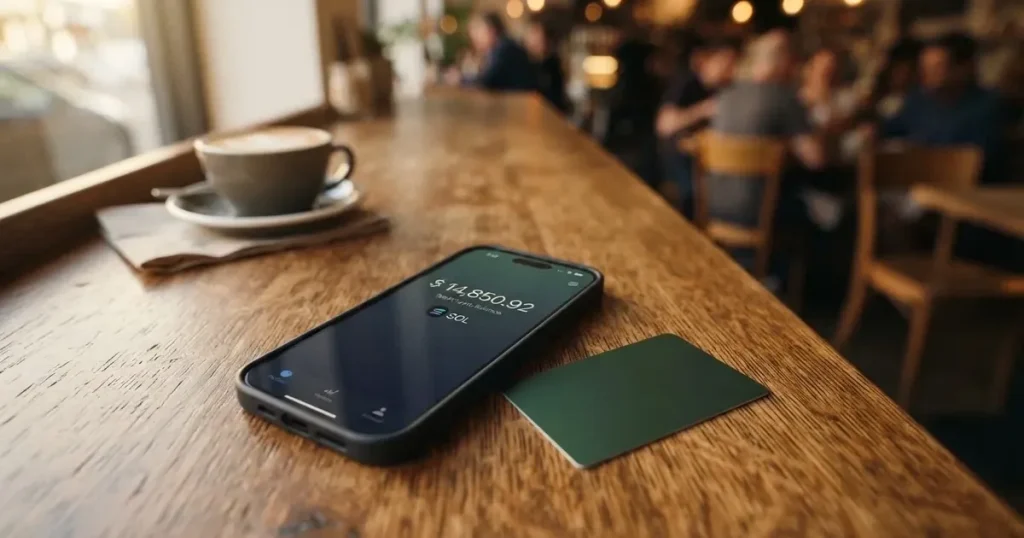
If you’ve been looking for a way to spend your crypto without converting it first — a card that draws straight from a stablecoin balance — the DPT card is worth a serious look. It runs on the Visa network, issues through U.S. Bank, and works in “150+ countries.” That’s an unusually solid foundation for a crypto card. But is it right for you? That’s what I set out to answer.
The conditions described in this review are current as of October 28, 2026.
The Score: 8.5/10 — Who It Suits, Who It Doesn’t
DPT scores 8.5 out of 10 overall. Here’s the breakdown across the five criteria that matter:
| Criterion | Mark | Why |
|---|---|---|
| Who can get it | 9/10 | Spending works in “150+ countries” wherever Visa is accepted; services are not offered in the United States, Canada, or comprehensive-sanctions jurisdictions |
| Cost | 8/10 | Issuance and monthly fee are not disclosed; USD transactions are free, other currencies carry 0–2.00% FX; no DPT top-up fee |
| Top-up options | 9/10 | USDC or USDT on Ethereum, Polygon, Tron, and Solana; Base, BNB, and fiat are roadmap items |
| Reliability and complaints | 9/10 | Operator is DPT (HK) Limited with a TCSP licence (TC010834); card is issued by U.S. Bank under Visa licence; custody with BitGo; no complaints found |
| Everyday use | 7/10 | Virtual (Apple Pay/Google Pay) and physical (chip/contactless) cards; ATM details and wallet availability not fully disclosed |
Who it suits: Stablecoin holders who want a straightforward Visa card for everyday spending, particularly those already holding USDC or USDT. If you value knowing your issuer is a regulated US bank and your custody partner is BitGo, that matters to you.
Who it doesn’t suit: Anyone in the United States or Canada — services are explicitly not offered there. It’s also not for people in comprehensive-sanctions jurisdictions. And if you need bank-grade fee transparency upfront (the exact issuance cost, ATM availability, or spending limits visible before you sign up), the public information here is thinner than you’d like.
Who Will Give You the Card?
The short answer: if you’re not in the US, Canada, or a sanctioned jurisdiction, and you can pass identity verification, DPT is designed for you.
Geographic eligibility. DPT says spending works in “150+ countries” wherever Visa is accepted. That’s about *where you can use the card*, not necessarily *who can sign up*. Those are two different things, and it’s worth being precise about it. The card’s terms say services are not offered to persons located in, incorporated in, or resident of the United States or Canada, or in comprehensive-sanctions jurisdictions. Your eligibility depends on your country of residence, and the app checks this during sign-up. If verification fails, one of the reasons can be an “unsupported jurisdiction.”
What that means for you: if you’re reading this outside the US or Canada, your address alone doesn’t disqualify you — but the app will decide. If you’re in a sanctioned region, the answer is a clear no.
How to Get It
Applying is straightforward, but there’s one wrinkle worth knowing about.
Minimum requirements. You need to be 18 or older, and you can hold one DPT account per individual.
What you submit. The app asks for a government-issued ID and a live selfie. Typically this takes minutes; sometimes up to 24 hours. There’s a detail here that may trip you up: the Learn guide also mentions proof of address (a utility bill or bank statement no more than three months old), but the app’s stated requirements don’t include it. The two pages differ on this point. If your verification fails, the common reasons are blurry or expired IDs, mismatched personal information, or an unsupported jurisdiction.
Why KYC is required. The card, deposits at full capacity, and payouts all require identity verification. This isn’t unusual — it’s how regulated financial services operate. Banks and e-money institutions are required to verify customers and assess risk as part of anti-money-laundering rules, including ongoing transaction monitoring. If verification can’t be completed, accounts are typically frozen or closed pending documents.
Card options. You’ll choose between a virtual card (works with Apple Pay and Google Pay) or a physical card (chip and contactless). The card currency is USD — that’s implied by the fee structure (USD transactions are free) rather than stated outright, but you can plan on it. Specific DPT tiers are not described on the public pages; spending limits appear in the app after verification, and higher tiers have higher limits.
One gap to note: shipping times and cost for a physical card, and replacement cost if you lose it, are not described on the public pages. If you need the physical card urgently, this uncertainty might matter to you.
Fees and Costs: What You Actually Pay
This is where DPT does well. USD spending is free, and the other fees are transparent — with a few exceptions.

| Fee or limit | What it costs |
|---|---|
| USD transactions | Free |
| Foreign-currency transactions | 0% to 2.00% FX fee depending on currency |
| Small transactions ($25 or less) | $0.10 fee (currently waived as a limited-time promotion) |
| Declines | First 3 per calendar month free; $0.50 each after |
| ATM withdrawal | 2% of the amount, plus 0–1.75% FX surcharge depending on location, plus any ATM operator fee |
| DPT deposit fee | None |
| Issuance fee | Not stated (fee schedule is in the app) |
| Monthly fee | Not stated; no monthly fee mentioned |
| Spending limits | Not stated; shown in the app after verification |
Three everyday payments:
- Buying coffee in New York ($4.50). USD transaction, so $0 in fees. The whole $4.50 comes off your stablecoin balance.
- A hotel in Tokyo (¥50,000, roughly $330). Foreign-currency transaction. Your effective cost is the ¥50,000 amount plus an FX fee between 0% and 2.00% depending on the currency pair.
- Withdrawing cash in Berlin (€200, roughly $215). This is the priciest common action: 2% of the amount ($4.30), plus 0–1.75% FX depending on location, plus whatever the ATM operator charges. You could pay $8–$10 in total fees on a $215 withdrawal.
What the hidden costs are: the issuance fee and monthly fee are in the app but not on the public pages. The ATM free allowance — if there is one — is also not stated. Check the in-app fee schedule before you commit.
How to Top Up the Card
Adding funds is straightforward: you send USDC or USDT to the card, and you pay no DPT deposit fee.
Networks currently live: Ethereum, Polygon, Tron, and Solana. You can fund with either USDC or USDT on any of these.
Minimums: 1 USDC or 1 USDT on Ethereum, Polygon, or Solana; 10 USDT on Tron. The higher Tron minimum makes sense because Tether’s USDT on Tron is cheaper to send.
Timing: credited about 1 minute after confirmation.
Who pays the gas: you do. The blockchain network charges the fee, not DPT. On Ethereum that gas can run a few dollars; on cheaper networks it’s much less.
Card balance and account balance are the same thing. Your stablecoin balance converts at the Visa transaction, so there’s no separate “load” step.
On the roadmap, not live: Base network, BNB Chain, and fiat deposits (via card or bank). If you need those, they’re not available yet.
One important warning: send on the right network to the right address. Blockchain transfers are irreversible — a deposit sent on an unsupported network or to the wrong address can be lost. If you’re unsure, check the app’s deposit instructions carefully before sending.
Paying With It Every Day
How the card performs in routine use depends on what form it takes.
Virtual card (Apple Pay / Google Pay). Both wallets are supported “where available” — whether they’re supported for physical cards specifically isn’t stated. Apple Pay replaces your card number with a device-specific number stored in the phone’s secure chip, never on Apple’s servers, and each payment uses a one-time security code. That means a virtual DPT card in Apple Pay is genuinely secure for online and contactless spending.
Physical card. Chip and contactless, standard Visa. Use it wherever Visa is accepted.
Rewards and cashback. No card cashback is stated. There is a Rewards and Referral Program (referral commissions, points, elite rewards) and a “DPT Earn” stablecoin yield vault, but neither is described in detail on the public pages.
Tiers. There are two named tiers, though the public pages don’t explain how you qualify:
- Oxygen (Visa Platinum): travel accident insurance up to US $500,000, instant digital cards, member prize draws. Top-spending Oxygen holders are automatically upgraded.
- Obsidian (Visa Infinite), invite-only: insurance up to US $1.5 million, 24/7 concierge, dedicated lifestyle manager, Priority Pass lounge access, DPT events.
Declines. The first 3 declined transactions per calendar month are free; each one after that costs $0.50. Why would a transaction decline? Common reasons: insufficient balance, a merchant category your card blocks, or a fraud-prevention check. Blocked merchant categories aren’t listed on the public pages — the help centre has articles on merchant restrictions but they’re not summarized.
App. Available on the Apple App Store and Google Play (plus a direct Android APK at download.dpt.xyz). Store ratings weren’t found — no listing was located by search.
What Can Go Wrong
The honest risks to consider:
Account closure with short notice. DPT’s terms allow the company to delete an account on 7 days’ notice. What happens to your balance if that happens isn’t stated on the public pages. This is worth knowing if you’re holding a meaningful amount.
Withdrawal costs. If you withdraw crypto back to your own wallet, DPT charges 0.1% plus network gas (Ethereum about $2.00, Polygon $1.00, Solana $1.00, Tron $5.00). Bank payouts have provider fees per corridor: India 0.30%, Nigeria 0.80%, Vietnam 0.60%, Philippines 0.50%, Brazil 0.45%, Mexico 0.50%, Indonesia 0.55%, Thailand 0.40%, Europe SEPA Instant 0.35%, UK Faster Payments 0.35%.
Currency exposure. If you’re not spending in USD, you pay an FX fee of 0–2.00%. Over many transactions, this adds up. Multi-currency balances aren’t stated — it sounds like you hold one balance, and conversion happens at the transaction.
Merchant declines. Some merchants decline prepaid or foreign-issued cards because the BIN lookup reveals the card type and issuer country. This is more common for crypto cards than people expect.
3-D Secure friction. Online payments sometimes trigger an identity check (a one-time code or biometric). This is normal fraud protection, but it can be annoying if you’re in a hurry.
Address verification gaps. AVS (Address Verification Service) compares the billing address you type with issuer records, and is mainly offered in the US, Canada, and the UK. For a foreign-issued card, it’s generally unavailable — which can cause declines at some online merchants.
Disputes. For unauthorised charges, the Learn guide says file with support within 60 days of the statement posting date. The Terms say disputes or chargebacks within 90 days of the transaction date. The two timelines differ — take the shorter one (60 days) to be safe. Decisions by DPT or its Service Partners are generally final; disputes go to Hong Kong courts or LCIA arbitration in London.
The bigger picture on custody. Assets are held with BitGo, a “qualified custodian” with coverage up to $250M subject to terms. But the Terms also say users don’t deposit funds with DPT on a custodial basis — this is about the card programme structure, not a standard savings account. Custodial platforms have a history of failures (Mt. Gox, Coincheck, Ronin Network), so holding funds with any custodian carries counterparty risk.
What to Take Instead
If DPT doesn’t fit your situation, here are three alternatives I looked at:
| DPT | Cardex | CardFlow | HyperCard | |
|---|---|---|---|---|
| Score | 8.5/10 | 5.6/10 | 4.9/10 | 4.7/10 |
| Card network | Visa (U.S. Bank) | VERVE, VISA, Mastercard, UnionPay | Mastercard (virtual USD) | Not stated |
| Who it’s for | Stablecoin holders worldwide | General crypto users | Nigerians and global users | General users |
| Card currency | USD | Naira | USD | USD or EUR |
| Funding | USDC/USDT: Ethereum, Polygon, Tron, Solana | USDT, USDC, BTC | Bitcoin, USDT, ETH, or Naira bank transfer | Crypto (USDT, BTC, ETH) |
| Fees | USD free; 0–2% FX elsewhere | Not stated | Creation free; other fees not stated | Not stated |
| Physical card | Yes | Yes | Virtual only | Prepaid |
| Notable | 24/7 support; tier system | “AI-Powered Conversion Rate” | ~3 minute card creation | Not stated |
Cardex (5.6/10): A multi-network card (VERVE, VISA, Mastercard, UnionPay) aimed at a general audience, with virtual and physical options. Its app listing is Naira-focused. Funding with USDT, USDC, and BTC. The site claims an “AI-Powered Conversion Rate” but no fee percentage is stated.
CardFlow (4.9/10): A virtual USD Mastercard targeted at Nigeria (“Nigeria’s smartest fintech card platform”). Card creation takes about 3 minutes and is free. Funds with Bitcoin, USDT, ETH, or Naira bank transfer. Other fees aren’t stated.
HyperCard (4.7/10): A prepaid card in USD or EUR. No country list on official pages; the app claims use in “more than 176 countries.” Deposit crypto like USDT, BTC, or ETH in the app, converted to USD/EUR on the card. Fees aren’t stated on pages I could read.
My honest comparison: DPT edges ahead because it discloses more — specific fee percentages, specific network support, named tier benefits, and a clear issuer and custody partner. The alternatives say less about what they’ll charge you, which makes them harder to plan around.
Who I’d Recommend It To
Recommended if: you hold USDC or USDT, you want a Visa card you can spend anywhere Visa works, you’re comfortable with an app-based custodial structure, and you’re based outside the US/Canada/sanctioned jurisdictions.
Maybe wait if: you need a physical card quickly (shipping times aren’t disclosed), you want to know the exact issuance and monthly fees before signing up (they’re in the app, not on the public pages), or you need fiat deposits (they’re not live yet — only USDC/USDT on four networks).
Not recommended if: you’re in the US or Canada, you need to avoid all FX fees (they range 0–2% on non-USD spending), or you’re looking for guaranteed principal protection on your stablecoin balance (that’s not what this card promises).
Frequently asked questions
What is DPT card?
DPT is a Visa payment card funded from a stablecoin balance rather than a bank account. You load USDC or USDT, and the card converts to fiat at the point of sale. It’s issued by U.S. Bank under Visa’s licence and issued through DPT (HK) Limited, a Hong Kong company with a TCSP licence.
Is DPT a bank?
No. DPT is not a bank. The operator is DPT (HK) Limited, licensed as a Trust or Company Service Provider (TCSP no. TC010834) under Hong Kong’s AMLO law. The card itself is issued by U.S. Bank, which is a separate entity. DPT arranges issuance through a Service Partner and operates under Hong Kong law.
How do I get a DPT card?
You’ll need to be 18 or older with one account per person. The app asks for a government-issued ID and a live selfie, which usually takes minutes but can take up to 24 hours. You can then choose a virtual card (Apple Pay/Google Pay) or a physical one. Eligibility depends on your country of residence, checked in-app.
What countries can I use the DPT card in?
The card works in “150+ countries” wherever Visa is accepted. However, the service itself isn’t offered to people located in, incorporated in, or resident of the United States, Canada, or comprehensive-sanctions jurisdictions. Your sign-up eligibility depends on where you live, not just where you’d like to spend.
Does the DPT card require KYC?
Yes. Identity verification is required for the card, deposits at full capacity, and payouts. The app requires a government-issued ID and a live selfie. The Learn guide also mentions proof of address (utility bill or bank statement no more than three months old). If verification fails, common causes are blurry or expired IDs, mismatched information, or an unsupported jurisdiction.
How do I top up the DPT card?
Send USDC or USDT to the card on one of four live networks: Ethereum, Polygon, Tron, or Solana. Minimums are 1 USDC/USDT on Ethereum, Polygon, and Solana; 10 USDT on Tron. Funds credit about 1 minute after confirmation. There’s no DPT deposit fee — you pay the blockchain gas, which varies by network. Make sure you’re sending on the correct network to the correct address; transfers are irreversible.
Is the DPT card free?
USD transactions are free. Foreign-currency transactions cost 0% to 2.00% depending on the currency. The $0.10 fee on transactions of $25 or less is currently waived as a limited-time promotion. ATM withdrawals are 2% of the amount plus 0–1.75% FX surcharge, plus any ATM operator fee. Issuance and monthly fee amounts aren’t stated publicly — they’re in the app.
Can I add the DPT card to Apple Wallet?
Yes, Apple Pay is supported “where available.” Whether it’s available for physical DPT cards specifically isn’t stated. Apple Pay replaces your card number with a device-specific number stored in the phone’s secure element, and each payment uses a one-time security code — so it’s genuinely secure for contactless spending.
What happens if I need to dispute a charge?
For unauthorised charges, file with DPT support within 60 days of the statement posting date (the Learn guide) or 90 days of the transaction date (the Terms). The two timelines differ — use the shorter 60-day window. Decisions by DPT or Service Partners are generally final. Disputes go to Hong Kong courts or LCIA arbitration in London.
Is the DPT card safe?
DPT says assets are held with BitGo, a qualified custodian with coverage up to $250M subject to terms. The card supports instant freeze, 3 wrong PIN/CVV attempts trigger a 24-hour lock, and the help centre mentions 2FA, anti-phishing, and spending alerts. No official incidents or credible complaints were found in searches. As with any custodial platform, there is inherent counterparty risk — but the operational safeguards appear solid.
Virtual card fees – cryptocardfacts
Content created by the «cryptocardfacts» team