
What I found checking AnomaCard's fees, limits and paperwork
 Available in US
I scored this card 7.8 out of 10. Before the number, the shape of it: AnomaCard is a crypto payment card aimed at people who hold bitcoin, ether, solana or stablecoins and want to spend them without a bank asking for papers. It does the thing it says — a virtual Visa Platinum, a physical card if you want one, Apple Pay and Google Pay, and a signup that asks for no identity documents at all. On price and everyday use it is genuinely good. What holds it back is not the product; it is that the pages describing the terms and the frequently asked questions return errors, and the company behind it names neither its issuer nor its licence nor the country it is registered in. You are being asked to hold money with an operator you cannot locate on paper.
AnomaCard is not a bank, and it does not claim to be one. It describes itself with the operator name “AnomaCard Protocol”. The card runs on Visa’s rails, but Visa and Mastercard do not issue crypto cards to consumers themselves — they license issuers and can suspend a programme, as they did with FTX in November 2022. So somewhere behind this front end there is a licensed issuer, and the card’s public pages do not name it.
The conditions described here are current as of October 28, 2026.
| Criterion | Mark | Why |
|---|---|---|
| Who can get it | 9 / 10 | Stated as global; no excluded-country list and no citizenship or residence rules found; Apple Pay and Google Pay described as working in 180+ countries |
| Cost | 8 / 10 | Activation 0%, servicing 0 USD, top-up from 0.60% (Starter) to 0.30% (Elite), no FX markup; physical card 120.00 USD once; 50 USD minimum |
| Top-up options | 8 / 10 | BTC, ETH, SOL, USDT (ERC-20 and SPL), USDC (ERC-20 and SPL); Arbitrum, Polygon and BNB Chain “coming soon” |
| Reliability and complaints | 5 / 10 | Operator is AnomaCard Protocol; issuer, licences and country of registration not named; terms and FAQ pages are currently unreachable; no complaints found |
| Everyday use | 9 / 10 | Virtual Visa Platinum plus a physical card, Apple Pay and Google Pay, ATMs worldwide |
| Total | 7.8 / 10 | Strong product, thin disclosure |
Who this suits: you already hold crypto, you cannot or will not give a bank your documents, you spend in a currency the card converts into, and you are comfortable that nobody will answer the phone if a transfer goes wrong. Who it does not suit: anyone whose income depends on this card being reliably funded by a regulated institution, anyone who needs consumer protection or chargeback rights they can actually enforce, and anyone planning to put their savings rather than their spending money on it.
Will they give you the card?
The card’s starting data is the single word “Global”. For online use it says “wherever Visa/Mastercard is accepted”. Apple Pay and Google Pay tap-to-pay is described as working in 180+ countries.
I went looking for the things that usually get quietly buried — a list of excluded countries, a citizenship test, a residence requirement. I found none. That is a real finding rather than a gap in my reading, but read it for what it is: the absence of a restriction, not a guarantee of an approval in your country. The card also mentions Visa and Mastercard in places while describing the product as a Visa Platinum debit card, which reads more like loose copywriting than a second network.
Two things are simply not stated and I will not fill them in for you. The issuing country of the card is not stated, and neither is the card currency. Both matter more than they sound. The issuing country sits in the first six or eight digits of the card number — the BIN, which any merchant’s payment terminal can look up. Shops can read from it which institution and which country issued the card, and some apply extra scrutiny when that issuer country differs from the billing address on file. That single unknown is the difference between a card that sails through an ordinary payment and one that gets declined at the till for looking foreign. If you cannot find it in your own card settings after you sign up, ask support.
How to get it
This is the shortest section on the page, and the reason the card scored well above its competition: there is no verification. The card’s wording is blunt — “No ID scans, no passports, no utility bills.” You sign in with a Web3 wallet, MetaMask or Phantom being the two named, or with a username and password, with two-factor authentication optional. Issuance is advertised as taking under 60 seconds.
There are no KYC levels on this card, so the usual “tier 1, tier 2, tier 3” structure that other crypto cards use to unlock higher limits simply does not exist here. What it has instead is VIP tiers, which affect fees rather than verification, and which I come to in the costs section.
The card is a virtual Visa Platinum debit card, with an optional physical version. The physical card costs 120.00 USD as a one-time issuance and shipping charge, deducted straight from your crypto balance. Where it ships to and how long it takes are not stated — a real gap if you are outside the United States, because you have no idea whether to wait weeks or not order.
The age requirement is not stated either. That is worth pausing on. Prepaid and debit cards are generally available to adults, 18 and over, and some issuers set higher limits; a card that asks for no documents and no birth date is not following the usual pattern, and the absence of a number is the absence of a promise.
Fees: what it really costs
Here is the full published cost picture. I have put in only what the card states.
| Fee or limit | Value |
|---|---|
| Activation | 0% |
| Monthly servicing | $0.00, no inactivity fees |
| Minimum deposit to unlock the full card | $50 |
| Deposit fee | 0.60% (Starter) to 0.30% (Elite), by VIP tier |
| Foreign exchange markup | none claimed |
| Foreign transaction fees | none claimed |
| ATM withdrawal fee | not listed |
| ATM allowance | not stated |
| Physical card | $120.00 one-time, issuance and shipping |
| Daily limit | $5,000 |
| Monthly limit | $20,000 |
| Limits by KYC level | not applicable — no KYC |
Two of these rows deserve a second look rather than a shrug. The no-FX-markup claim is the card’s own claim; a banner on the same site also cites “0.3% low deposit fee”, which matches the Elite tier but is not the entry-level number. And the ATM row is empty in a way that is genuinely unhelpful: no fee listed and no allowance stated, on a card advertised for worldwide ATM withdrawals. A cash withdrawal is where cards get expensive, and this is exactly the number you would want before you stand at a machine in another country.
Now three ordinary payments, so the percentages land on something real.
A $40 supermarket shop, paid from a stablecoin balance on the Starter tier. Your deposit fee of 0.60% is charged on the way in, not on the purchase — so if you had already topped up, this purchase itself carries no card fee that the card publishes. The real question at the till is conversion: if your balance is in USDT on Ethereum and the shop wants dollars in, the card converts at the network rate it describes with no markup added. The 2% cashback would return $0.80 if it applies to that purchase. What the cashback is paid in is not stated, and that matters more than the percentage if your spending is in a currency other than dollars.
A $25 coffee abroad. Same arithmetic, with one extra variable. If the shop’s local price is not in your card’s currency — and the card currency is not stated, so I cannot tell you what it is — then a conversion sits in the path, and the card says there is no foreign transaction fee on top. What I cannot verify is whether that claim covers every corner of the network, so the honest advice is to watch the first few foreign purchases rather than assume the tenth behaves like the first.
A $200 night out, or a $200 online subscription. Neither should hit a limit; the daily $5,000 and monthly $20,000 ceilings are far above that. The thing to watch is the merchant side. Online merchants classify businesses with a four-digit merchant category code defined in ISO 18245, and gambling (MCC 7995) is the one most often blocked by policy rather than by law — but the card does not state which categories are blocked here, if any. That same row also explains a decline you may see at a stranger’s shop: a merchant can decline a prepaid or foreign BIN because the lookup reveals what it is.
VIP tiers exist to shave the deposit fee, and they are worth knowing because the gap is not trivial:
- Starter — 0.60% deposit fee, cashback up to $500
- Explorer — 0.50% deposit fee, cashback up to $5,000
- Voyager — 0.40% deposit fee, cashback up to $10,000
- Elite — 0.30% deposit fee, cashback over $10,000
Top up: how the money gets in
You fund the card with crypto, and the supported list is specific. Live now: BTC, ETH, SOL, USDT on both ERC-20 and SPL, and USDC on both ERC-20 and SPL. Promised as “coming soon”: Arbitrum (ARB), Polygon (POL) and BNB Chain (BNB). That is a good spread for someone holding majors, and the two stablecoins covering both Ethereum and Solana is generous for this category.
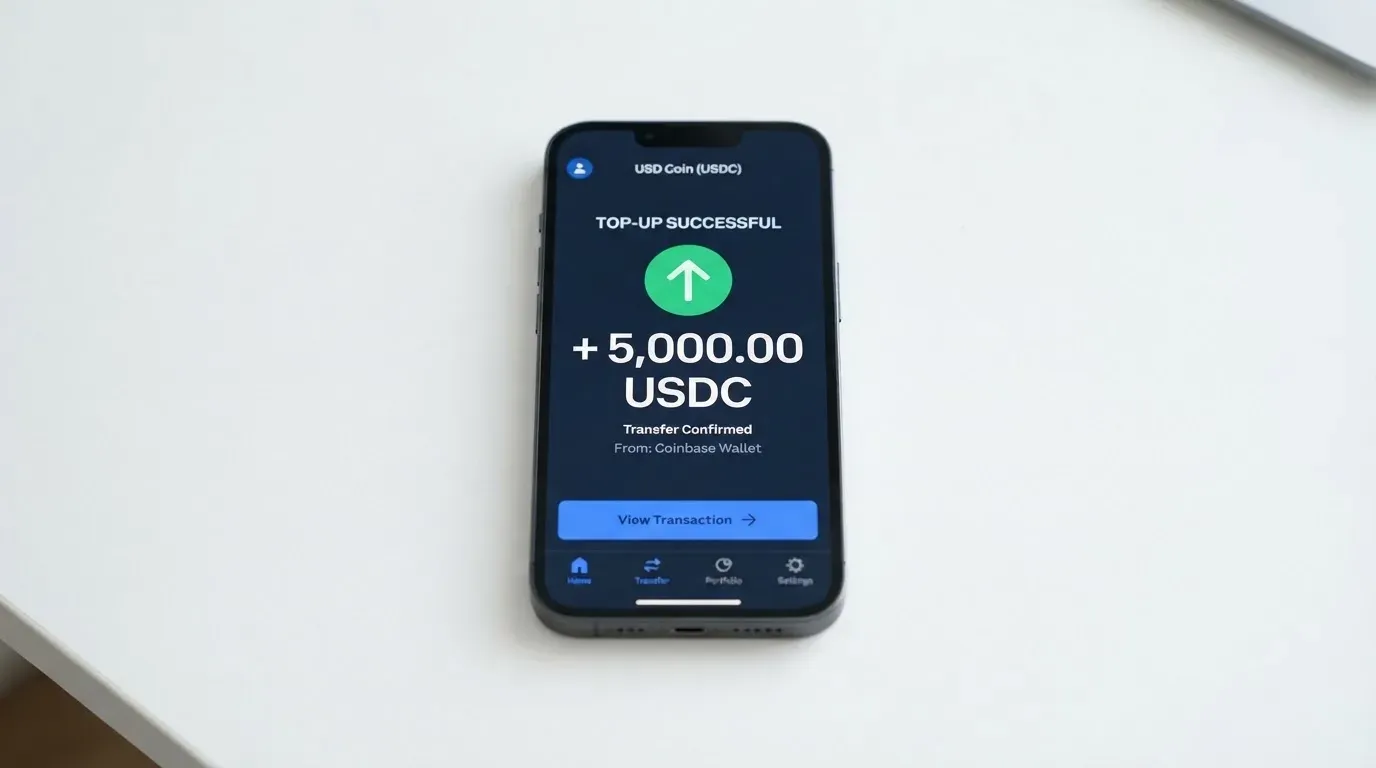
The mechanics matter more than the list. You send to a generated address specific to the network you choose, and the funds unlock after one blockchain confirmation. The deposit fee is 0.30–0.60% by tier, and the $50 minimum deposit is what unlocks the full card. Withdrawals carry only standard blockchain network fees per the FAQ.
Two cautions, both of them ordinary crypto cautions rather than card-specific ones. First, blockchain transfers are irreversible: a deposit sent on a network the provider does not support, or to an address belonging to a different network, can be lost or need manual support recovery with no guarantee. Copy the address; do not type it from memory. Second, if you pay network fees in ETH on an Ethereum network, a wallet holding USDT and no ETH cannot send at all — the fee is paid only in ETH. On Tron, fees come out of bandwidth and energy and often burn TRX instead. Whichever network you use, keep a little of its own native token in the sending wallet.
Fiat top-up is not stated. If your plan is to buy the crypto through a bank transfer into an exchange first, that is the route most people will take, but the card does not describe it.
Paying with it every day
Day to day, the card behaves like a normal contactless card, which is the honest summary of its strongest section. Apple Pay and Google Pay work for online payments and tap-to-pay. There is no native app — you use a web dashboard plus your phone’s wallet — so this is a browser-based experience rather than something in your pocket, and that is worth weighing if you are the kind of person who checks their spending several times a day.
The rewards line is short: 2% cashback on purchases, described on the page as involving “no staking or lockup”. No lockup matters — it means you are not being paid in something you have to hold through a lock period to withdraw. But the card does not say what the cashback is paid in, and if it is not the currency you spend in, 2% stops being 2%.
The underlying payment rails have habits you will recognise if you have used any card abroad. When you add a card to Apple Pay, the number is replaced by a device-specific Device Account Number held in the phone’s Secure Element, never on Apple’s servers, and each payment carries a one-time dynamic code — so sharing your card number is not the same risk as sharing your phone. The issuer can restrict that tokenised number, for example blocking it on website use. Online payments may also run through 3-D Secure, Visa’s version of which is called Visa Secure: the issuer assesses the risk and either waves you through or challenges you with a one-time code or a biometric prompt. Address Verification Service, which compares the numeric parts of the billing address you typed against issuer records, is mainly offered in the US, Canada and the UK and is generally unavailable for foreign-issued cards — a common and confusing cause of declines abroad.
One more thing to know, because it surprises people: a declined authorisation can still leave a hold on your funds, and it can sit there for several days, typically up to seven. Declined payments cost nothing but time, and sometimes they cost you the money’s availability for a week.
Disputes and chargebacks are not stated. There is no published description of what happens when goods never arrive, so treat that as unknown rather than as absent.
What can go wrong
I looked for trouble and found very little, which cuts both ways.
No official incidents are publicly documented. Reviews searches return no Trustpilot page or Reddit discussions. A brand with no visible complaint history can be young; it can also be too small to have collected one, so the absence of records is not a guarantee of a clean track record.
The bigger risk is structural. The operator is named as AnomaCard Protocol (copyright 2026). The issuer, the BIN sponsor, the licences and the place of registration are all not named. That is the single thing I would want answered before I moved real money, and I want to say plainly why it matters rather than as a slogan: a card is a payment service regulated separately from the crypto side, so a product like this usually depends on two licences — one under crypto law for custody, exchange and transfer, and one under e-money or payments law for the card itself. If the payments licence sits in the European Union, an electronic money institution must safeguard customer funds by segregating them in dedicated accounts or insuring them, and those funds are not the same as bank deposits and may not be covered by a deposit guarantee scheme. If it sits somewhere else, the protections are that country’s. Not knowing which means not knowing what you have.
The terms and FAQ pages are not accessible online. Several things reported above as not stated are simply absent rather than negative, and some of them — card currency, ATM fee, blocked merchant categories, dispute process — are exactly the details a terms page exists to carry.
Security-wise the card describes a non-custodial wallet address model, optional two-factor authentication at login, and a “Privacy & Zero-Log Architecture Policy” page. Non-custodial is the strong claim: if it holds, the funds stay in a wallet you control. But note what non-custody does and does not solve. It does not protect you from a phishing page that harvests your seed phrase, and a seed phrase — typically 12 to 24 words — is an unencrypted private key that anyone holding can use to restore the wallet and spend everything in it. Transfers are irreversible and no one can freeze or return them. Freeze and spending controls are not stated, so do not assume you can switch the card off in a hurry; the typical safeguards in this category are app-based 2FA, instant card freeze, spending limits, 3-D Secure and tokenised mobile wallets, and I can confirm only the 2FA and the wallet tokens from this card’s pages.
Support is email, at [email protected], with a stated average response under two hours. The languages available are not stated. The withdrawal procedure and what happens to a leftover balance at closure are not stated either.
One structural fact about the category that belongs here: programmes do close. In November 2022 Visa terminated its global agreements with FTX and the FTX US debit card programme was wound down by its issuer. In 2018 Visa suspended WaveCrest in Europe, closing all WaveCrest-issued Visa programmes. The usual pattern is a notice period, then spending and loading stop, then you are asked to withdraw what is left. That is the scenario to imagine when you ask whether a card is safe — not whether it is honest this month, but what happens to your balance the month it stops.
Finally, the part that surprises newcomers: the tax treatment does not go away because no one asked you for your documents. In the United States the IRS treats digital assets as property, so exchanging them for goods, services or dollars generally produces a taxable gain or loss, measured in local currency at the fair market value on the date of the transaction — which can make every single card payment its own disposal. I am not giving you tax advice and you should take your own advice on this; I am only flagging that a no-KYC card still spends taxable assets. And one regulatory note for the other side of the world: under EU markets-in-crypto-assets rules, MiCA took legal effect in June 2023, with the stablecoin provisions applying from 30 June 2024 and the crypto-asset service provider rules from 30 December 2024. MiCA’s transitional period lets providers operating under national law continue only until 1 July 2026 or until they are authorised or refused authorisation, whichever comes first — so the European landscape is still settling, and a card that names no home jurisdiction is harder to place in it.
What to take instead
The three alternatives I compared all scored lower, and it is worth being honest about why rather than reaching for a recommendation anyway.
Cardex scored 5.6. It advertises “one crypto card, 200+ countries” with no country list and no exclusions, runs cards on VERVE, VISA, Mastercard and UnionPay, and lists both virtual and physical versions. Its App Store listing is Naira-focused — you pay in naira — which is a large clue about who it actually serves. Card creation is free per its site FAQ; there is no monthly fee stated. On fees it is vaguer than AnomaCard rather than cheaper: real-time conversion at the moment of payment, with what it calls an “AI-Powered Conversion Rate” scanning global exchange rates and picking the best one. No percentage is published anywhere I could read, and no rewards are stated. That is the trade — fewer specifics, but at least a card list including UnionPay for markets where Visa is thin.
CardFlow scored 4.9 and is aimed squarely at Nigeria — “Nigeria’s smartest fintech card platform”, also serving “Nigerians and global users”. It is a virtual USD Mastercard created in three minutes, free to create per its FAQ, funded with Bitcoin, USDT, ETH or a naira bank transfer. Networks for the crypto options are not stated, and neither are fees or rewards.
HyperCard scored 4.7. It is a prepaid card with a balance in USD or EUR, the network is not stated on the App Store page, and the listing says it works in “more than 176 countries” — which, read carefully, describes acceptance, not eligibility. Official pages give no country list. You deposit crypto such as USDT, BTC or ETH in the app and it converts to USD or EUR. No fees and no rewards are stated on the pages I could read.
| AnomaCard | Cardex | CardFlow | HyperCard | |
|---|---|---|---|---|
| Score | 7.8 | 5.6 | 4.9 | 4.7 |
| Who it targets | Stated as global | Nigeria-focused listing, “200+ countries” | Nigeria and global users | Not stated; 176+ countries of acceptance |
| Networks | Visa Platinum | VERSE, Visa, Mastercard, UnionPay | Mastercard (USD) | Not stated |
| Card creation | Under 60 seconds, no KYC | Virtual and physical | Free virtual card, about 3 minutes | Prepaid, virtual and physical |
| Deposit fee | 0.30–0.60% by tier | Not stated | Not stated | Not stated |
| Rewards | 2% cashback | Not stated | Not stated | Not stated |
| Physical card cost | $120.00 one-time | Not stated | Not stated | Not stated |
None of the three beats AnomaCard on the things most people would count first: none has a published fee schedule anywhere near this detailed, none has a stated daily and monthly limit, and none describes its cashback. If you are choosing on transparency alone, the comparison is not close. If you are choosing on whether the card works where you live — and the answer here is genuinely unknown, because no country list is published for any of them — the alternatives are no better stated. That is the uncomfortable finding: in this corner of the market, thin disclosure is normal, and AnomaCard is the least thin of the set.
One more thing to weigh before switching, because it is the option nobody puts on a list: an ordinary bank card funded by a bank transfer. It costs you identity documents, an account review, and possibly nothing at all. What it gives you is a named institution, consumer protection you can actually invoke, and a support line that has to answer to a regulator. If the reason you are reading about crypto cards is that you are locked out of banking, that comparison is not available to you and the question is moot. If the reason is convenience, it deserves a look.
Who I would recommend it to
I’d recommend AnomaCard to someone who has already made their peace with holding crypto outside a bank, who spends from a balance they can afford to lose while they test it, and who wants to move BTC, ETH, SOL or stablecoins straight to a card without handing over a passport. For that person the card is good value: no monthly fee, no activation fee, no claimed FX markup, a stated $5,000 daily and $20,000 monthly limit, 2% cashback with no lockup, Apple Pay and Google Pay across 180+ countries, and a signup that takes under a minute.
I’d hold off if any of these are true of you. You want to know the name of the institution that issued your card, the country it was issued in, and what licence it holds — because the card does not tell you. You plan to keep more in there than you would in a current account. You need chargeback rights and the card does not describe a dispute process. You need cash machines, and the ATM fee and allowance are not stated. You are in a jurisdiction that bans crypto cards and you were hoping “Global” meant the regulator had approved it. Or you simply want a company you can ring.
What I would do, concretely, if it were me: fund it small, top up with the $50 minimum and no more, make a few ordinary payments including one foreign one and one tap-to-pay, and ask [email protected] the four questions their own FAQ page does not answer — who is the issuer, what licence does it hold, what currency is the card denominated in, and what does a dispute look like. Judge the card on the answers and on whether the balance moves when it says it will.
Frequently asked questions
What is AnomaCard?
AnomaCard is a crypto payment card rather than a bank account. You send it bitcoin, ether, solana or supported stablecoins, and it converts and holds that as spendable balance you can use anywhere a Visa card is accepted online, or tap with Apple Pay or Google Pay. The operator is named as AnomaCard Protocol. It is a virtual Visa Platinum debit card by default, with an optional physical card.
How does AnomaCard work?
You create an account, get a card, and top it up. Deposits go to an address generated for the network you choose, and the funds unlock after one blockchain confirmation. At payment the card converts the balance and charges it. The card describes a non-custodial wallet address model, meaning the address belongs to a wallet rather than an internal ledger, with optional two-factor authentication at login. There is no native app; you manage it through a web dashboard and your phone’s wallet.
Does AnomaCard require KYC?
No, and it is unusually direct about it — “No ID scans, no passports, no utility bills.” You sign in with a Web3 wallet such as MetaMask or Phantom, or with a username and password, and two-factor authentication is optional. There are no KYC levels at all, which is why the card has no per-level limits. The consequence to understand is that if something goes wrong, no document trail links your account to you.
Is AnomaCard a bank, and who owns it?
No, it is not a bank. The operator is named as AnomaCard Protocol, and the card’s pages do not name the issuer, the BIN sponsor, the licences or the country of registration. That matters because Visa and Mastercard do not issue crypto cards to consumers themselves — they license issuers and can suspend a programme. There is a licensed institution somewhere behind this; its identity is simply not stated.
Is AnomaCard free?
Mostly. Activation is 0%, monthly servicing is $0.00 with no inactivity fees, and the card claims no hidden FX markup and no foreign transaction fees. Two charges do exist: a deposit fee of 0.60% on Starter falling to 0.30% on Elite, and a one-time $120.00 for the physical card covering issuance and shipping. A $50 minimum deposit is needed to unlock the full card.
How much can I spend, and what are the limits?
Stated limits are $5,000 per day and $20,000 per month. Because there is no KYC, limits are not arranged by verification tier. Two important unknowns sit alongside those numbers: the ATM fee is not listed and the ATM allowance is not stated, despite worldwide ATM withdrawals being advertised. The card currency is also not stated, which affects what a foreign purchase really costs you.
Can I use AnomaCard in my country?
The card’s stated starting data is “Global”, with online use “wherever Visa/Mastercard is accepted” and Apple Pay and Google Pay tap-to-pay in 180+ countries. No excluded-country list and no citizenship or residence rules were found. Treat that as no restriction being published, not as an approval: if your country regulates crypto cards, the issuer may still be bound by rules the card does not print.
How do I top up, and which coins work?
Live: BTC, ETH, SOL, USDT on ERC-20 and SPL, and USDC on ERC-20 and SPL. Coming soon: Arbitrum, Polygon and BNB Chain. Send only to the address generated for the network you chose, and keep a little of that network’s own token in the wallet — Ethereum fees are paid only in ETH, so USDT with no ETH cannot move. Transfers are irreversible, and funds unlock after one confirmation.
Is AnomaCard safe?
No evidence of trouble, and no evidence of track record either — no official incidents surfaced, and one reviews search found no Trustpilot page and no Reddit discussion. The safety question is structural rather than reputational. The card describes non-custodial addresses, optional 2FA and a zero-log policy, but the issuer and its licence are not named, the terms and FAQ pages return errors, and dispute handling is not stated. Fund it small until you can get answers.
How do I withdraw money or close the account?
Withdrawals carry only standard blockchain network fees, per the FAQ. The withdrawal procedure itself is not stated, nor is what happens to a leftover balance at closure, and the Terms and FAQ pages are currently unreachable. Support is by email at [email protected] with a stated average response under two hours; languages offered are not stated. Ask those questions before you need them.
Virtual card fees – cryptocardfacts
Content created by the «cryptocardfacts» team