
The card that spends crypto without asking many questions
 Available in US
FlexCard is a custodial crypto card aimed at people who want a virtual card they can load with stablecoins and spend like an ordinary payment card — and who cannot get, or do not want, a normal bank card that links to a crypto balance. It registers with an email address, issues virtual cards in USD, EUR and GBP, and takes payment for advertising platforms and SaaS services. That last point is what its audience is really built around.
Conditions are current as of October 28, 2026.
My verdict: 5.1 / 10. Not a bad product for its specific job; a thin, poorly documented service that asks you to trust it with your money while telling you very little about who runs it. The score table below breaks down where the marks came from.
Verdict
| Criterion | Mark | Why |
|---|---|---|
| Who can get it | 7 / 10 | The terms name no list of allowed or excluded countries — only prohibited advertising topics |
| Cost | 3 / 10 | Issue fee from 2.5 USD, terms say 2-4 USD/EUR, 10 free ADS cards on registration; top-up commission from 3.5% |
| Top-up options | 8 / 10 | USDT (TRC20), USDT (ERC20), USDC (ERC20) and bank transfer in EUR and USD |
| Reliability and complaints | 3 / 10 | Legal entity, address and issuer not named; Trustpilot 4.2 from 51 reviews, complaints about accounts blocked without warning and silent support |
| Everyday use | 5 / 10 | Virtual cards only, in USD, EUR and GBP; no ATM described; unofficial: Google Pay and Apple Pay can be added |
Two of the five criteria land at 3, which tells you where to look first. Cost is cheap at the front and potentially expensive at the moment you load. Reliability is the bigger worry, and it is not a matter of a bad review here or there: the card’s own pages do not name a legal entity, a registered address or an issuing bank.
Who it suits: media buyers paying for ads and SaaS, and anyone who needs a virtual card in USD, EUR or GBP funded by stablecoin today, with a minimum of paperwork and a low entry fee. Who it does not suit: anyone whose money must be safe on the strength of a company’s balance sheet, anyone who needs cash from an ATM, anyone who wants a physical card in the post, and anyone who intends to hold a large balance there for a long time.
Will they give you the card?
The card’s public pages do not state which countries are supported or excluded. That is the honest answer, and it is unusual — you are being asked to find out by applying rather than by reading. What the terms do contain is a list of advertising subjects that are not permitted, not a map of where the service operates.
There is also nothing in the public material that ties the service to a particular regulator or licence. Combined with the missing company details, this means you cannot check the card against any register before you commit money to it. If you are in the EU, the general background is worth knowing: crypto assets fall under MiCA, while a card is a payment service regulated separately, so a crypto card often depends on two licences — and ESMA keeps an interim register of authorised crypto-asset service providers that you can consult. FlexCard does not appear to point you at any such register.
Prepaid and debit cards are generally available to adults aged 18 and over, and some issuers set higher limits. FlexCard’s own pages do not publish an age statement either.
So the practical test is simple: if you have read this and still cannot tell whether your country is allowed, the answer will arrive either at sign-up or not at all.
How to get it
Registration is email-based. The terms say the service does not verify user data unless required by law or needed to provide the services (s.2.3), and no tiered KYC levels are published. Unofficially, per an AffNinja review updated December 2025, registration needs only an email address with no document verification, and no KYC documents are requested at sign-up — consistent with the official line, but it is a third-party claim, not something the card confirms.
After registering, you top up and the cards appear in the cabinet, which is the account area on the website. There is no App Store or Google Play listing — the card does not state one.
What you get is virtual cards in USD, EUR and GBP. The payment network is not specified in the terms; what they do say is that cards are issued on a BIN in the currency you select (s.4.2). Unofficially, AffNinja describes them as Visa Business debit cards with European BINs in Estonia, the UK and Spain plus Latin American options, and a Geonode partner page from 2026 claims more than 20 BINs. Treat the network as unconfirmed until you hold a card and see the network mark on it.
There is no physical card and no delivery. If you are waiting for a plastic card in the post, this is not it.
One thing to understand about how this card is built: a card number begins with a six- or eight-digit issuer identification number that tells the merchant which institution and country issued it, and merchants can look that up and apply extra scrutiny when the issuer country differs from your billing address. Cards on this kind of service are typically issued through BINs in a small number of jurisdictions precisely to make acceptance broad. That is a fact about the mechanics, not a trick — but it does mean a decline from an unfamiliar merchant is a normal outcome rather than a malfunction.
Fees
The entry fee is low and the ongoing fees are where you should look. Issue fee from 2.5 USD on the home page; the terms put it at 2-4 USD/EUR depending on card type (s.4.11); 10 free ADS cards on registration. No monthly fee is stated. Top-up commission from 3.5%, varying with deposit amount and spending volume (s.4.10). The page claims there are no hidden conversion fees but gives no FX rate. Refunds come back reduced by payment-system fees. ATM use is not described at all. Unofficially, per AffNinja in December 2025, the minimum top-up is USD 50, and several affiliate blogs repeat it.

| Fee or limit | Value |
|---|---|
| Card issue | From USD 2.5 (home page); terms: 2-4 USD/EUR depending on card type (s.4.11) |
| Monthly fee | Not stated |
| Top-up commission | From 3.5%, depends on deposit amount and spending volume (s.4.10) |
| Conversion / FX | No conversion fee stated; no FX rate given; fee for paying in another currency not stated |
| ATM | Not stated |
| Card count, cardholders, spend per user | Unlimited (s.4.6-4.9) |
| Card limits | Adjustable free of charge (s.4.12) |
| Minimum deposit | Set by the service, amount not stated (unofficially USD 50 per AffNinja, Dec 2025) |
| Decline rate | Above 20% can lead to suspension |
Three everyday payments, worked through with only the fees the card actually names:
- A USD 50 subscription renewal, card denominated in USD, same currency as the charge. The load costs 3.5% of 50, so 1.75, before any blockchain network fee charged by the network itself rather than by the card provider. The payment itself carries no fee the card states. (Unofficially, per AffNinja in December 2025, the minimum top-up is USD 50, though this is not confirmed by the card’s official terms.)
- A EUR 40 subscription on a GBP card. Here you are paying in a currency other than the card’s BIN currency. The fee for paying in another currency is not stated, and the site says only that there are no hidden conversion fees. Nobody can tell you what this costs from the public pages — that is the point of the row in the table above.
- A USD 30 top-up of 20 separate small ad charges, or an attempted ATM withdrawal. The ATM is the sharper illustration: no ATM terms exist at all, so whether you can take cash, at what cost, is simply unknown. On the ad charges, a decline rate above 20% can lead to suspension (s.4.7), so repeated failed authorisations are a route to losing the account rather than to retrying.
On-chain network fees for your deposit are charged by the blockchain, not by the card provider — on Ethereum those fees are paid in ETH, so a wallet holding USDT but no ETH cannot send.
Top up
The funding routes are the strongest part of the product: USDT (TRC20), USDT (ERC20), USDC (ERC20) and bank transfer in EUR and USD. The terms confirm the same four methods (s.4.13). Commission on the top-up is from 3.5% (s.4.10).
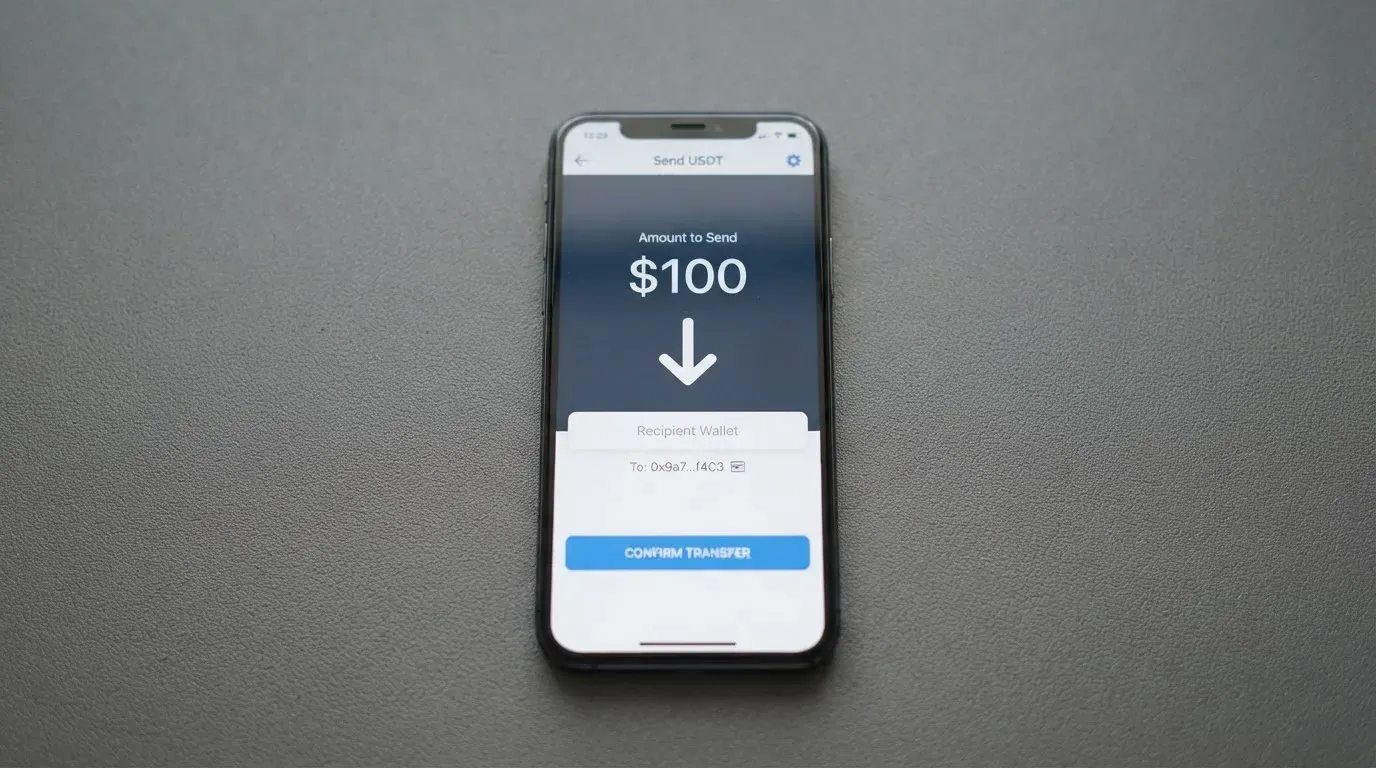
Two of those routes carry a trap that is worth understanding before you send anything. Stablecoins are not censorship-proof — Tether says it disables tokens in wallets on the OFAC sanctions list and has frozen funds tied to illicit activity — and they can depeg: TerraUSD collapsed in May 2022, and USDC temporarily lost its peg in March 2023. Also, USDC over TRC20 is not a native option at all: Circle stopped supporting USDC on Tron in February 2024. Only USDT is available on TRC20; USDC is ERC20 only, as the card’s own list already shows correctly.
The terms are unusually blunt about the failure modes. Deposits below the minimum, or sent with the wrong asset, network, amount or address, may be rejected or lost (s.5.2). The minimum is set by the service and may be changed by it; the amount is not published. Blockchain transfers are irreversible, so a deposit sent on an unsupported network or to another network’s address can be lost or need manual recovery with no guarantee.
Getting money back out is a different story, and not a withdrawal feature. There is no withdrawal function at all. What exists is a refund: request it through the support or feedback form, it is handled manually (s.4.14, 5.3), it is allowed only if the total balance of all team accounts is zero or positive (5.4), payment-system fees are deducted (5.5), and it goes back to the original deposit method — not to cash (5.6), and never to a third party (5.7). You may close your account with 30 days’ notice (6.1); the service may close it with five days’ notice (6.3a). Accounts suspended or terminated under 6.3 get no refund at all. The site mentions a commission refund on unused funds, without explaining the conditions.
Paying with it every day
The card works as a prepaid instrument: you load a balance and the card spends that balance, so it cannot overdraw. In practice that means the merchant’s money arrives as fiat from a stored balance, and the crypto side is finished by the time the payment is made.
Apple Pay and Google Pay are not stated officially. Unofficially, per AffNinja in December 2025, cards can be added to both. That is a normal convenience — Apple Pay replaces the card number with a device-specific number held in the phone’s secure hardware rather than on Apple’s servers, and each payment carries a one-time code — but the issuer can restrict a tokenised number, blocking it on magnetic-stripe, phone or website use. On this card’s public pages, you cannot see whether anyone has done that.
The service restricts advertising topics rather than merchant categories: human trafficking, CSAM, illegal substances, weapons and malware are named as prohibited, and there is no MCC list. Accepted services named are Facebook, TikTok, Google ads, OpenAI, Midjourney, Adobe and Zoom. That is a meaningful difference from cards that block entire verticals: many issuers block the gambling category (MCC 7995) by policy rather than by law, and the blocked list varies by issuer. FlexCard publishes no such list, so you will find out by trying.
There is no cashback. The only reward mentioned anywhere is a 30% referral share.
Two payment realities to expect. Address verification compares the numeric parts of the billing address a buyer typed — street number, ZIP — with the issuer’s records; it is mainly offered in the US, Canada and the UK and is generally unavailable for foreign-issued cards, which causes declines. And a declined authorisation may leave a hold on your funds that can stay for several days, typically up to seven. Combined with the 20% decline threshold, a run of failed payments is genuinely dangerous to the account.
If something goes wrong, disputes with the service are resolved by email (s.8.2) and the jurisdiction is the service’s location (8.3) — a place the card does not name. Claims involving third parties on issued payment solutions are yours to resolve yourself (6.2). Refunds follow the rules above. Chargebacks are not addressed in the terms at all.
What can go wrong
Start with the company, because there is nothing to check. The service is called “Flexcard.cards”; no legal entity, registration or address is given, and the issuer is not named. When you cannot identify the entity that holds your balance, you cannot answer the first question any review should ask: whose money is this?
Then the custody. This is a custodial service — the balance sits with the provider, which is why two-factor authentication, instant freeze and spending controls are not described; the only control mentioned is that card limits can be adjusted free of charge (4.12). You are responsible for your credentials and card details (2.7), and crypto sent to a wrong address is irreversible (7.1, 7.3). No insurance or safeguarding is stated. For context on what that means in this category: custodial platforms have a genuine record of failure — Mt. Gox (about US$350 million reported stolen, 2011-2014), Coincheck (about US$400 million, 2018), Ronin Network (US$625 million, 2022) — and self-custody simply moves the risk to you, including key loss, phishing and malware that swaps copied addresses. There is no safe option here, only a choice of who carries the risk. EMIs must safeguard customer funds by segregating them in dedicated accounts or insuring them, but such funds are not the same as bank deposits and may not be covered by deposit guarantee schemes — and nobody has told you FlexCard is an EMI.
Next, the complaints. Trustpilot showed 4.2 out of 5 from 51 reviews as I read them, 41 of those in the previous twelve months, with 72% five-star and 18% one-star. The company replies to negative reviews within about 24 hours. The themes repeat: accounts blocked or frozen without notice — including on September 3, 2026 after automatic-payment declines, and July 23, 2026 — and support that does not answer. One detailed report describes a crypto top-up, a failed card payment, an ignored withdrawal request for five days, then an account block with no explanation, and a support reply citing a “$100 penalty” the reviewer says is not in the terms; the company then asked for the account email via Telegram.
Read that pattern against the terms and it stops looking like a run of bad luck. The terms do allow suspension without refund above a 20% decline rate or for links to blocked accounts (s.6.3c), and the company’s replies on the negative reviews cite policy violations — prohibited categories, high decline rate — and say that closed cards kept generating decline fees, leaving a negative balance. In other words: on this card, a payment that fails can become a debt, and a debt can become an account you cannot get money back from.
Support itself is Telegram (@flexcard_support1 and @flexcardClientManager), email ([email protected]) and a feedback form in the cabinet. Languages and hours are not stated officially; unofficially, per AffNinja in December 2025, support runs 10:00-22:00 GMT+3 by email and Telegram, with languages unspecified. There is no news page, blog or dated programme-change log on the official pages, so you will not be told in advance when anything shifts.
Worth knowing that even established programmes end: Visa terminated its global agreements with FTX on 13 November 2022 and the FTX US debit card was wound down, and WaveCrest, a Visa issuer that supplied crypto card brands, was suspended by Visa in Europe in 2018, closing all WaveCrest-issued Visa programmes. Closures typically mean a notice period, then loading and spending stop, then users are asked to withdraw remaining balances. On FlexCard, “withdraw” means the manual refund route described earlier, subject to a zero-or-positive team balance and payment-system fees.
A final tax note, offered as context and not as advice: the IRS treats digital assets as property, so exchanging them for goods, services or dollars generally produces a taxable gain or loss, measured in local fiat currency at the value on the date of the transaction. Each payment funded from crypto may be a separate disposal. What that means for you depends on where you live — check with someone qualified in your jurisdiction.
What to take instead
None of the three alternatives below is dramatically safer; they are different shapes of the same trade. Read the table, then read the notes.
| FlexCard | Cardex | CardFlow | HyperCard | |
|---|---|---|---|---|
| Score | 5.1 / 10 | 5.6 / 10 | 4.9 / 10 | 4.7 / 10 |
| Countries | Not stated | “200+ countries”, no list; App Store listing Naira-focused | Aimed at Nigeria; no list | No list on official pages; App Store says works in “more than 176 countries” (acceptance, not eligibility) |
| Card | Virtual USD, EUR, GBP; network not specified | Debit card on VERVE, VISA, Mastercard, UnionPay; virtual and physical; currency Naira per listing | Virtual USD Mastercard, created in about 3 minutes | Prepaid; network not stated; balance in USD or EUR |
| Issue fee | From USD 2.5; terms 2-4 USD/EUR | Not stated | Free to create (site FAQ) | Not stated; App Store lists no fees |
| Fees | Top-up from 3.5%; conversion/FX rate not given | Real-time conversion at payment; an “AI-Powered Conversion Rate” scans global rates; no percentage stated | Not stated | Not stated |
| Top-up | USDT (TRC20), USDT (ERC20), USDC (ERC20), bank transfer EUR/USD | USDT, USDC and BTC wallets; networks not stated | Bitcoin, USDT, ETH or Naira bank transfer; networks not stated | Crypto such as USDT, BTC, ETH in the app; networks not stated |
| Rewards | No cashback; 30% referral share mentioned | Not stated | Not stated | Not stated |
Notes on each:
- Cardex scores slightly higher at 5.6. It publishes actual card networks, offers physical as well as virtual cards, and describes conversion behaviour in some detail. Its weaknesses: no stated issue fee, no fee percentage at all, and a Naira-first App Store listing that may not describe what a customer elsewhere actually gets. “200+ countries” with no list tells you no more than FlexCard’s silence does.
- CardFlow at 4.9 is the cheapest to open, with free virtual card creation in three minutes, and it accepts Bitcoin, USDT, ETH or Naira bank transfer. But it is aimed at Nigeria, and every fee beyond “free to create” is unstated — a free card with no published pricing is not cheap, it is unpriced.
- HyperCard at 4.7 publishes almost nothing: no country list, no network, no fees on the App Store page. Its one substantive claim is acceptance in “more than 176 countries”, which is a statement about where the card works, not about who can open an account.
The honest conclusion: switching between these four changes which unknowns you accept. If your priority is published card networks and a physical option, Cardex is the one to look at first. If it is a genuinely free entry point, CardFlow. If you are comparing all four, notice that none of them publishes a legal entity either — and that is the single check I would still be unable to complete on any of them.
Who I would recommend it to
I would recommend FlexCard to a media buyer who spends on ad platforms and SaaS today, needs a virtual card in USD, EUR or GBP this week, and treats the balance as working money rather than savings. The audience is exactly that: media buyers paying for ads and SaaS. For them the product does its job — a USD 2.5 entry point, ten free ADS cards at registration, four sensible funding routes including two stablecoin networks, and a spend experience that behaves like a prepaid card.
I would not recommend it as a place to hold money you cannot afford to lose blocks. The absence of a named legal entity, address and issuer is not a paperwork nitpick; it is the reason the reliability score is 3. Add a documented pattern of unannounced account blocks, a refund process that returns you to the original deposit method after payment-system fees, no withdrawal feature, and terms that permit suspension without refund above a 20% decline rate — and the arithmetic stops being attractive for anything beyond a working float.
The clearest reasons to walk away: you need cash from an ATM, you need a physical card, you want to know what a payment in a second currency costs, or you want a company that will tell you its name. On the last point, no amount of good Trustpilot scores substitutes.
Frequently asked questions
What is FlexCard?
FlexCard is a custodial crypto payment card. You register with an email address, send USDT or USDC — or a bank transfer in EUR or USD — and spend the resulting balance on virtual cards issued in USD, EUR and GBP. Its main audience, by its own positioning, is media buyers paying for ads and SaaS. It offers virtual cards only, with no physical card.
How does FlexCard work?
You load a balance and the card spends it, so it behaves like a prepaid card rather than a debit card linked to your bank. The card is issued on a BIN in the currency you choose (s.4.2), the payment network is not specified, and top-ups arrive as USDT (TRC20), USDT (ERC20), USDC (ERC20) or a bank transfer. There is no withdrawal function — money comes back only as a manual refund.
Is FlexCard a bank?
No bank is named, and no legal entity, registration or address appears on the public pages; the issuer is not identified either. So it should not be treated as a bank, and your balance should not be treated as a bank deposit. It is best understood as a custodial prepaid card programme where the crypto brand is the front end.
Who owns FlexCard?
The service is named “Flexcard.cards” and describes itself by that name. The public pages name no company behind it — no entity, no registered address, no issuer. I could not establish ownership, and that absence is the single largest reason for the low reliability mark.
Does FlexCard require KYC?
Not at sign-up, as far as the public material shows. The terms say the service does not verify user data unless required by law or needed to provide the services (s.2.3), and no verification tiers are published. An AffNinja review updated December 2025 says registration needs only an email with no document checks — unofficial, but consistent with the terms. Verification can still be demanded later.
What are the fees?
The issue fee is from USD 2.5 on the home page; the terms say 2-4 USD/EUR depending on card type (s.4.11), with ten free ADS cards on registration and no monthly fee stated. The top-up commission is from 3.5%, varying with deposit amount and spending volume (s.4.10). No FX rate or fee for paying in another currency is published.
Is FlexCard safe?
I would not call it safe, on the evidence available. No legal entity or safeguarding is stated, funds are custodial, two-factor authentication and card freeze are not described, and the terms allow suspension without refund above a 20% decline rate. Trustpilot showed 4.2 from 51 reviews, with recurring reports of accounts blocked without warning. Keep only working money here.
How do I top up FlexCard?
Send USDT on TRC20 or ERC20, USDC on ERC20, or make a bank transfer in EUR or USD. Commission starts at 3.5%. The minimum deposit is set by the service and may change, with no amount published — unofficially USD 50. Read s.5.2 twice: a deposit below the minimum, or sent with the wrong asset, network, amount or address, may be rejected or lost.
Can I withdraw money from FlexCard?
Not directly — there is no withdrawal feature. Refunds are requested through support or the feedback form and handled manually, allowed only if the total balance of all team accounts is zero or positive, reduced by payment-system fees, and returned to the original deposit method rather than as cash, never to a third party. You may close your account with 30 days’ notice; suspended accounts get no refund.
Is FlexCard available in my country?
The card’s pages do not say. No list of supported or excluded countries is published — only prohibited advertising topics. In practice you find out by registering. Card acceptance is a separate question from eligibility: the App Store claim of “176 countries” that some services make refers to where a card works, not who can open an account.
Virtual card fees – cryptocardfacts
Content created by the «cryptocardfacts» team