
Kardpay looks cheap to open and usable everywhere, but its fees are the weak point
 Available in US

Kardpay is a crypto payment card aimed at people who want to spend a stablecoin balance like ordinary money: a virtual card you can hold within minutes, a physical card on higher tiers, Apple Pay and Google Pay everywhere, and acceptance in “180+ countries”. That headline figure is the strongest thing about the card. What I could not pin down is the price of actually using it. The subscription is published, the top-up percentage is published, the limits are published — but the conversion and foreign-exchange fees are not, and those are the numbers that decide what a payment really costs you.
I gave it 6.8 out of 10. It is not a bad card; it is an incompletely explained one. If you already hold USDT or USDC on Tron and you mostly spend in dollar-pegged currencies, the value proposition holds together. If you need to know the exact all-in cost of a purchase before you make it, you will not find it on the public pages, and that is a real gap.
The conditions described here are current as of October 28, 2026.
Verdict: 6.8 out of 10 — strong on access and daily use, weak on disclosed costs
Let me lay out the score first, then explain who this suits and who should walk away.
| Criterion | Mark | Why |
|---|---|---|
| Who can get it | 9 / 10 | “180+ countries”; only sanctioned and embargoed territories recognised in DIFC are excluded |
| Cost | 3 / 10 | Yearly plans: Core $2.42/mo, Pro $8.25, Elite $16.58, Physical Elite $24.92; top-up 5%, 4%, 3%, 4% by tier; virtual issuance 28; conversion not disclosed |
| Top-up options | 8 / 10 | USDT/USDC on TRC-20 and ERC-20; credited in under 10 minutes; no other coins |
| Reliability and complaints | 6 / 10 | KRDPAY FZE LLC (Ajman, UAE) with no registration number; issuer named only as a “network-licensed issuer”; no complaints found; smart contract audited by CTDSEC |
| Everyday use | 9 / 10 | Virtual card instantly, physical on Elite, Apple Pay and Google Pay on all plans, $1,500/day ATM |
| Total | 6.8 / 10 |
The single highest-scoring part of the card is access. That matters enormously for the person this review is written for: someone who cannot get an ordinary bank card in their country, or who has been refused one, and who therefore treats a prepaid crypto card not as a novelty but as the way to buy groceries. On that measure, Kardpay does well — a virtual card is issued instantly, there is a physical option, mobile wallets work on every plan, and the geographic claim is extremely broad.
The single weakest part is cost, and specifically disclosure, not raw price. The subscription numbers are low — Core at $2.42 a month billed annually is cheaper than almost any conventional premium card — and the top-up percentages (5%, 4%, 3%, 4%) are at the sharp end of what this category charges. But the conversion fee and the foreign-exchange fee are simply not stated anywhere on the public pages. When you fund a card with stablecoins and spend it in a non-dollar currency, those two numbers usually decide the final cost of the purchase. I cannot tell you what they are, and neither, on this evidence, can the card’s own marketing.
Who it suits: you hold USDT or USDC, you are happy sending it on Tron or Ethereum, you spend mostly in dollars or dollar-pegged currencies, and you want a card that works in as many places as possible. Who it does not suit: you spend heavily in a local currency and need to know the exact all-in cost of a purchase; you want a physical card immediately rather than on a higher tier; you need a named, registered issuer you can point to; or you plan to hold a large balance and want chargeback protection that is spelled out.
Will they give you the card?
Kardpay says the card is available in “180+ countries”. That is the extent of the eligibility information: there is no country list on the site, and the exclusions are described only in the broadest terms — sanctioned and embargoed territories, as recognised in DIFC. “Not stated” is the honest answer to the follow-up questions: which countries, whether citizenship and residence are treated differently, and what the basis of the count is.
That single fact is doing a lot of work in this review, and it is worth pausing on it. A card’s issuing country matters in ways a shopper never sees until a payment is declined. Every card number begins with six or eight digits that identify the issuing institution, and any merchant can look that up — and may apply extra scrutiny if the issuer country differs from the billing address. That is precisely why a card issued in one country can look “foreign” to a shop in another. Broad availability is genuinely valuable for someone with no alternative. It is also a reason a payment might occasionally fail at a merchant that would happily accept a local card.
So the answer to “will they give you the card” is: almost certainly yes wherever you live, with the two caveats that the country list is not published and that your citizenship is screened separately from your address. Sanctions screening and issuer risk policy are routinely applied to country of birth and citizenship as well as residence — this is standard practice across regulated providers, not something specific to Kardpay, but it does mean “180+ countries” is a floor rather than a guarantee.
How to get it
The route is short. A virtual card is issued instantly on signup, and there are four tiers: Core (green) and Pro (white), and Elite (black), plus a Physical Elite card. The card brands are stated as Visa or Mastercard, and the Physical Elite card is a black Mastercard. Card validity is given as one year, though one features line says five years for the physical card — the public pages disagree with each other there, and I would not rely on either figure until you see your own card’s expiry date.
Two things you will look for and not find. Verification is not described: the terms mention only “standard cardholder verification” for Apple Pay and Google Pay, and records kept under anti-money-laundering rules for five years. Age is not stated. And delivery is not stated — there is no published delivery time or shipping cost for the physical card. If you need a physical card quickly, you are working without that information.
This is also where the KYC question deserves a plain answer rather than a reassuring one. Anti-money-laundering law requires regulated businesses to verify customers and assess risk, including ongoing monitoring and reporting of suspicious activity. In the EU that due diligence normally covers name, address, date of birth, nationality and identity documents, a sanctions check, the purpose of the relationship, and whether you are a politically exposed person; in the US the customer identification programme requires name, date of birth, address and an identification number, with electronic systems also validating proof of address. Where due diligence cannot be completed, rules require the institution to refrain from the transaction or the relationship, and where necessary to end an existing one. That is why accounts get closed or frozen pending documents, everywhere, including here. Prepaid and debit cards are generally available to adults aged 18 or over, and some issuers set higher limits.
I mention this because “not described” and “no checks” are not the same thing. Kardpay’s own terms assume a regulated framework exists. If you hold crypto through an exchange, that exchange almost certainly verified you already; if you do not, expect to be asked for documents before your balance becomes spendable.
Fees: what a Kardpay payment really costs
Here is the whole published cost picture in one place.
| Item | What the card states |
|---|---|
| Subscription, billed annually | Core $2.42/month, Pro $8.25/month, Elite $16.58/month, Physical Elite $24.92/month |
| Virtual card issuance | 28 |
| Top-up fee | Core 5%, Pro 4%, Elite 3%, Physical Elite 4% |
| Conversion fee | Not stated |
| FX / foreign-exchange fee | Not stated |
| ATM withdrawal fee | Not stated |
| ATM daily limit (Physical Elite) | $1,500 |
| Annual limit | Core $10,000; Pro $50,000 |
| Monthly limit | Elite $500,000; Physical Elite $150,000 (features line: physical “up to $1M / month”) |
| Authorization attempt | USD 0.50 (terms, Art. 8) vs USD 0.25 (Appendix 1) — the documents disagree |
Note that the plans are billed annually, and the page also describes issuance as a “one-time fee”. The virtual-card issuance figure is given as 28 without a currency symbol on the page as published; I reproduce it exactly as the card states it. The top-up percentage is 5%, 4% or 3% in the terms, with Appendix 1 saying 4% — again, the documents disagree, and the higher-risk reading is that you should assume 5% on Core.
Let me follow three ordinary payments through this.
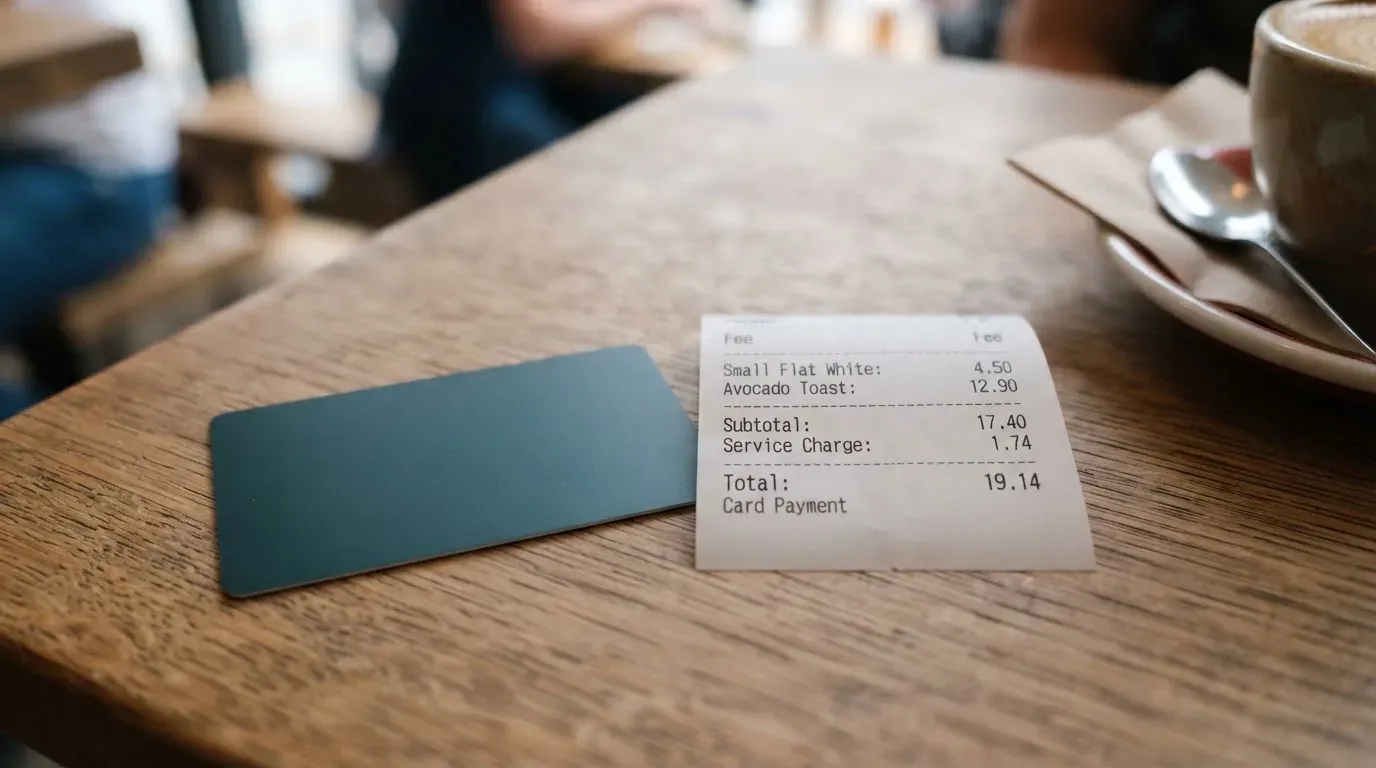
Coffee, dollars, Core tier. You top up $100 and are charged the 5% Core top-up fee, leaving $95 loaded. You spend a small amount on coffee. On top of that fee, any conversion or FX the card charges applies at the point of payment — and since it is not disclosed, I cannot tell you whether that amount cost you the original price or more. What I can tell you is that the top-up fee alone is the largest known cost, and on small everyday purchases it is the one that quietly accumulates.
A monthly online subscription, dollars, Pro tier. The Pro top-up fee is 4%. Here the missing conversion number matters more than usual, because subscriptions are the classic case of a recurring charge at a merchant that may decline a foreign-issued BIN. Some merchants do decline prepaid or foreign BINs because the BIN lookup reveals the card type and the issuer country. A card with Apple Pay set up sidesteps the most fragile of those interactions, since tokenised mobile wallet numbers are what the merchant actually sees.
A cash withdrawal abroad, Physical Elite, dollars into a local currency. The withdrawal limit is $1,500 a day and the fee is not stated; the FX rate the card uses is not stated either. This is the single scenario where I would caution you most strongly, because you are exposed twice — to an undisclosed cash fee and to an undisclosed spread on the currency — and because ATM withdrawals are exactly where the wider category has disappointed people. Note also that card documents sometimes limit ATM withdrawals on the physical tier in ways the app does not surface, so check your own limits in the app before you rely on them.
One more number deserves flagging because it is unusual: an authorization attempt of USD 0.50 in the terms versus USD 0.25 in Appendix 1. An “authorization attempt” is the moment a merchant asks the card to reserve funds, which can happen on a payment that is later declined — sometimes several times for one purchase, as a shop’s till retries. Some merchants also put a temporary hold on funds after a declined authorization that can stay for several days, typically up to seven. Two prices for the same event in the same document set is a documentation problem, and it costs you real money.
The honest summary is this: the subscription is genuinely cheap, the top-up percentage is competitive, and two of the largest cost drivers are invisible. If you spend in dollars only, you may well pay close to the top-up fee and little else. If you spend in another currency, you are spending without a published price.
How to top up the card
Topping up is the part of Kardpay that works cleanly, and it is the reason the top-up score is high. You fund with USDT or USDC, on either the TRC-20 network or the ERC-20 network, and the balance is credited in under ten minutes. Those are the only coins supported — there is no Bitcoin, no Ethereum native balance, no bank transfer option in the card’s own materials.
The fee is the tier fee shown above: 5% on Core, 4% on Pro, 3% on Elite, 4% on Physical Elite. The minimum top-up is not stated, and neither is who pays the network fee.
That last point deserves attention because it is where new users most often lose money. Network fees for your deposit are charged by the blockchain, not by the card provider. On ERC-20 — the Ethereum token standard, proposed in November 2015 — gas is paid only in ETH, so a wallet holding USDT but no ETH cannot send at all. On Tron, fees are paid through internal resources, bandwidth and energy, often by burning TRX. So sending USDC on ERC-20 from an exchange account that holds no ETH means the transfer fails; sending it from Tron is usually the cheaper path. Kardpay accepts both, which is generous, but the choice is yours and it has a cost.
There is a genuine trap in the wording “USDC on TRC-20”. Circle stopped supporting USDC on Tron in February 2024, so “USDC over TRC20” is not a native option — you are dealing with a bridged or wrapped representation of the asset, and the exact token contract you hold matters more here than it would for USDT. USDT, by contrast, is genuinely issued across networks including Ethereum, Tron, Solana, Polygon and Avalanche. Before your first deposit, confirm which specific token and network your balance sits on, because blockchain transfers are irreversible: a deposit sent on an unsupported network, or to an address belonging to a different network, can be lost or need manual support recovery with no guarantee. This is the step where five minutes of checking saves a real loss.
Two more things about the balance. There is no withdrawal procedure described — no way is given for taking money back off the card. And on closure, the terms say the net balance may be deferred and fees deducted first, with no interest paid. I would read that as: money in, spending out, and no clear route back. Treat the balance as a spending float, not as savings.
Paying with it every day
Daily use is Kardpay’s other strong suit, and for a lot of people it is the reason to stay. Apple Pay and Google Pay work on all plans, including the free-ish Core tier, and adding a card to your phone wallet is the single most useful thing you can do with it. It replaces the card number with a device-specific number stored in the Secure Element, never on Apple’s servers, and each payment uses a one-time dynamic security code. That is a real reduction in exposure compared to typing your card number into websites, and it is why I would set the card up that way even if you also keep the plastic.
The card is prepaid in behaviour: it draws on a stored balance, and it cannot overdraw it. In the pre-loaded balance model you convert or top up first and the card spends only that, which is a genuine comfort — no overdraft, no credit line, no bill arriving. Many crypto cards behave this way; Kardpay is one of them.
Rewards are staking-based, not automatic. You stake $KDY for 180 days and get cashback: Tier 1 gives 1% at a $3,000 stake, Tier 2 gives 1.5% at $6,000, Tier 3 gives 2% at $18,000. Read that as a yield product attached to your spend, not as a discount — the money is tied up for half a year, and $KDY is a token whose price you carry risk on. I would ignore the rewards entirely when deciding whether the card is worth it; the cashback rates are modest and the stake is not trivial money. Separately, the support ladder runs standard support on Core and Pro, Elite support on Elite and Physical Elite, and a private concierge on Physical Elite; the stake tiers also add per-transaction and monthly limits ($5K/$50K, $10K/$100K, $50K/$1M) and either 50% off or a free physical card.
What is not stated: which merchant categories are blocked, the currency the card is denominated in, and where to find the app. There is a web app at app.kardpay.app; no App Store or Google Play listing was found on the site, which for many people is the difference between a card they use daily and one they abandon. If you rely entirely on your phone, check that the web app works well on mobile before you commit.
What can go wrong
I looked for official incidents and for user complaints, and found neither: no official incidents, and no user reports for Kardpay. I also could not find a Trustpilot page (checked 2026-10-21). That absence cuts both ways — it may mean a young, clean card, or simply a small one nobody has written about yet. Do not treat quiet as proof.
The company details are thinner than I would like. The operator is KRDPAY FZE LLC, registered in Ajman, UAE, at Amber Gem Tower, with no registration number published. The issuer is not named — only described as a “network-licensed issuer”. Governing law is DIFC law and the forum is DIFC Courts. Under EU law, an electronic money institution may issue e-money, payment cards and e-wallets but cannot lend, and must safeguard customer funds in dedicated accounts or insure them — and such funds are not the same as bank deposits and may not be covered by a deposit guarantee scheme. A card is regulated as a payment service separately from the crypto side, so a crypto card often rests on two licences at once. Here, the crypto side and the licence numbers are not published, and the issuer is unnamed. That is a documentation gap rather than evidence of wrongdoing, but it means you cannot easily verify who stands behind your balance.
The contract does mention freezing of funds. Custody is not described, so I cannot tell you whether your deposit is held by Kardpay, by the unnamed issuer, or in a wallet structure. What I can say is that the smart contract was audited by CTDSEC, which is a point in the card’s favour, and that having an audit of the contract is not the same as knowing who can move your money off-chain.
On the consumer side, the terms are firm in ways worth knowing before you need them. A claim is barred unless brought within one month of your initial complaint. A chargeback costs a flat USD 30. Fees are non-refundable. Liability is capped at three months’ fees. Read those together: the practical cost of disputing a transaction is USD 30 plus the risk of losing, against a liability ceiling that assumes the card’s own fees are the most you can lose. For a chargeback to work at all, the merchant category and reason code matter — a refund ordered by the issuer to settle a dispute, with codes for fraud, duplicate billing or goods not received. In the US, debit reversal rights come from Regulation E and credit card rights from Regulation Z; prepaid-card coverage varies and should not be assumed. If your balance is large relative to your monthly spending, cap what you keep on the card.
Finally, the category’s own history is a reason for caution about any crypto card. Custodial platforms have failed repeatedly — Mt. Gox (about US$350 million reported stolen, 2011–2014), Coincheck (about US$400 million, 2018), Ronin Network (US$625 million, 2022). Control of crypto belongs to whoever holds the private key; with a custodial wallet the provider holds the credentials, and you must trust them completely. A seed phrase, typically 12 to 24 words, is an unencrypted private key that anyone who obtains it can use to restore the wallet and spend its funds — and blockchain transfers are typically irreversible, with no built-in recovery. Card programmes themselves have been switched off: Visa terminated its global agreements with FTX on 13 November 2022 and the FTX US debit card was wound down; WaveCrest, a Visa issuer that supplied crypto card brands, was suspended by Visa in Europe in 2018, closing all its Visa programmes. Closures typically mean a notice period, then spending and loading stop, then you are asked to withdraw what remains. Kardpay’s own terms already anticipate this: on closure, net balance may be deferred and fees deducted first.
Support is claimed as 24/7, with channels on Telegram (t.me/appkardpay), X, Instagram and LinkedIn; the languages offered are not stated. Social channels are not a substitute for a formal complaints process, and given the one-month deadline above, the route you use to complain may determine whether you keep your rights.
What to take instead
I looked at three other crypto cards that come up in the same searches. None is a knockout, and the comparison is more useful for seeing where Kardpay sits than for picking a winner.
| Kardpay | Cardex | CardFlow | HyperCard | |
|---|---|---|---|---|
| My score | 6.8 / 10 | 5.6 / 10 | 4.9 / 10 | 4.7 / 10 |
| Reach | “180+ countries”; no list or exclusions | “One crypto card, 200+ countries”; no list or exclusions | Aimed at Nigeria (“Nigeria’s smartest fintech card platform”) and “Nigerians and global users”; no list stated | No country list on official pages; App Store says the card works in “more than 176 countries” (acceptance, not eligibility) |
| Card | Virtual instantly; Core, Pro, Elite, Physical Elite; Visa/Mastercard | Debit crypto card on VERVE, VISA, Mastercard and UnionPay; virtual and physical; card currency Naira per listing | Virtual USD Mastercard, created in about 3 minutes | Prepaid “HyperCard”; network not stated on the App Store page; balance in USD or EUR |
| Stated cost | Yearly plans from $2.42/month; top-up 5%/4%/3%/4%; conversion not disclosed | Not stated | “Creating a virtual card is completely free”; monthly fee not stated | Not stated; App Store lists no fees |
| Fees detail | Top-up % published; conversion and FX not | Real-time crypto-to-fiat conversion at payment; an “AI-Powered Conversion Rate” scans global exchange rates and picks the best when you spend; no percentage stated | Not stated | Not stated on the pages I could read |
| Funding | USDT/USDC on TRC-20 and ERC-20; under 10 minutes | USDT, USDC and BTC wallets; networks not stated | Bitcoin, USDT, ETH or Naira bank transfer; networks not stated | Crypto such as USDT, BTC, ETH deposited in the app, converted to USD or EUR; networks not stated |
| Rewards | Cashback by staking $KDY for 180 days: 1% at $3,000, 1.5% at $6,000, 2% at $18,000 | Not stated | Not stated | Not stated |
The pattern is striking. Cardex is broader in network choice (VERVE, UnionPay as well as Visa and Mastercard) and takes three coins rather than two stablecoins, and it describes its conversion approach at length — but it publishes no fee percentage either, and its App Store listing is Naira-focused. CardFlow is the cheapest to open by its own account (“Creating a virtual card is completely free”) and takes a bank transfer as well as crypto, but it is built for Nigeria and publishes nothing about fees or rewards. HyperCard is the vaguest: no fees, no network, no reward terms, and its country figure describes where the card is accepted rather than who can get one.
My honest read is that Cardex is the one worth a look if multi-network support and a broader coin list matter to you, and CardFlow if you are in Nigeria and want a free virtual Mastercard quickly. But none of them improves on Kardpay’s central weakness — you still will not find a published all-in conversion cost. And Kardpay remains the only one of the four with a stated physical option, a stated ATM limit, a stated support ladder and a named audit. Its score reflects that: highest here, and not by a small margin.
Who I would recommend it to
I would recommend Kardpay to someone specific: you already hold USDT or USDC, most of it on Tron, you spend in dollars or dollar-pegged currencies, you have had difficulty getting a normal bank card, and you want something that works in as many shops and countries as possible. Add a virtual card to Apple Pay or Google Pay on day one, keep your balance small enough that losing it would not ruin you, and keep your main exchange account separate from what you load onto the card.
I would not recommend it to someone who needs certainty about cost. If you spend in a local currency, the undisclosed conversion and FX fees mean you are paying a price you cannot calculate in advance — and for a person living on a fixed income, an unknown spread on every transaction is not an acceptable trade for access, however limited your alternatives. I would also hesitate if you intend to keep a substantial balance on the card: no registration number for the operator, an unnamed issuer, no described custody, a USD 30 chargeback fee, a one-month window to bring any claim, liability capped at three months’ fees, and no withdrawal procedure described. And if you want cash, the $1,500 daily ATM limit applies to the physical tier only, with no stated fee.
The wider regulatory picture is worth a sentence, because it explains why these cards exist at all and why their paperwork looks the way it does. In the EU, MiCA — Regulation (EU) 2023/1114 — took legal effect in June 2023; its rules on asset-referenced and e-money tokens applied from 30 June 2024 and the remaining provisions, including crypto-asset service provider rules, from 30 December 2024. Under it, e-money tokens may be issued only by a credit institution or an electronic money institution, and the transitional period lets providers already operating under national law continue only until 1 July 2026 or until they are authorised or refused authorisation, whichever comes first. ESMA keeps an interim register of authorised providers that you can check. A licensed provider in one member state can serve the whole EU. In the US, FinCEN guidance (FIN-2013-G001) treats administrators and exchangers of convertible virtual currency as money transmitters, while ordinary users buying things are not. None of this makes a card issuer’s paperwork transparent; it makes the absence of transparency the norm rather than the exception.
On stablecoins themselves, one last expectation to set: the aim is a stable value, but stablecoins are not necessarily stable. Tether’s USDT and Circle’s USDC are dollar-pegged, and the BIS put about 90% of stablecoin market capitalisation in these two as of July 2025. Circle says USDC is redeemable 1:1 for USD and fully backed by cash and cash equivalents with monthly reserve attestations. That is reassuring about the asset, not about the card. Stablecoins have depegged before — TerraUSD collapsed in May 2022, and USDC temporarily lost its peg in March 2023 during the US banking crisis. And Tether says it disables tokens in wallets on the OFAC sanctions list and has frozen funds tied to illicit activity, so a stablecoin is not censorship-proof. Anything you load onto Kardpay should be money you are willing to hold as spending float, not savings.
Frequently asked questions
What is Kardpay card?
Kardpay is a prepaid crypto payment card. You load it with stablecoins — USDT or USDC, on the TRC-20 or ERC-20 networks — and the balance converts to spendable fiat value on a Visa or Mastercard card number, virtual or physical. There are four tiers: Core, Pro, Elite and Physical Elite. It exists mainly for people who want to pay everyday bills with crypto, including those who cannot get an ordinary bank card.
How does Kardpay card work?
You create an account, get a virtual card instantly, and transfer USDT or USDC to the address the card gives you, on either Tron or Ethereum. The balance is credited in under ten minutes and converts to a fiat balance the card spends from. Because it is prepaid, it can only spend what is loaded — it cannot overdraw. Payments convert at whatever rate and fee the card applies, and those fees are not disclosed publicly.
Is Kardpay a bank?
No. Kardpay is operated by KRDPAY FZE LLC, a company registered in Ajman, UAE, at Amber Gem Tower, and the card issuer is described only as a “network-licensed issuer” without being named. Kardpay publishes no registration number. It is a payment card programme with crypto top-ups, not a bank account, and your balance is not a bank deposit with deposit-guarantee protection.
Who owns Kardpay?
The operator is KRDPAY FZE LLC in Ajman, UAE. Beyond the company name, the public pages do not say who owns it or who ultimately stands behind it, and the issuing institution is unnamed. Governance is stated to be DIFC law with DIFC Courts as forum. If ownership transparency matters to you, this is the first thing to ask support directly and in writing.
Does Kardpay card require KYC?
The public pages do not describe a verification process; the terms refer only to “standard cardholder verification” for Apple Pay and Google Pay, and to keeping anti-money-laundering records for five years. Age is not stated, though prepaid cards generally go to adults aged 18 or over. Assume checks may be requested: regulated providers must verify identity, screen for sanctions, and can freeze an account when due diligence cannot be completed.
How much does Kardpay card cost?
Plans are billed annually: Core $2.42 a month, Pro $8.25, Elite $16.58, Physical Elite $24.92. Top-up fees are 5% on Core, 4% on Pro, 3% on Elite and 4% on Physical Elite. Virtual card issuance is listed as 28. Conversion and foreign-exchange fees are not stated, and an ATM authorization attempt is quoted as USD 0.50 in one place in the terms and USD 0.25 in another — an inconsistency worth asking about.
How to top up Kardpay card?
Send USDT or USDC to the card’s deposit address, choosing either the TRC-20 (Tron) or ERC-20 (Ethereum) network; credit usually takes under ten minutes. Check the exact token and network before sending, because transfers are irreversible. On Ethereum you need ETH for gas; on Tron fees are usually paid by burning TRX. Note that Circle stopped supporting USDC natively on Tron in February 2024, so an ERC-20 USDC is usually the cleaner choice.
Is Kardpay card safe?
There is no clean yes or no. In its favour: no official incidents and no user complaints found, a Trustpilot page was not found, and the smart contract was audited by CTDSEC. Against it: the operator publishes no registration number, the issuer is unnamed, custody is not described, and the terms contemplate funds being frozen. Treat the balance as spending money, not savings, and do not hold more there than you could afford to lose.
Is Kardpay card free?
Not quite, although it is close on the entry tier. Core costs $2.42 a month when billed annually, and there is a listed virtual-card issuance charge of 28. The ongoing costs that matter more are the top-up fee — 5% on Core, less on higher tiers — plus whatever conversion and FX fees apply, which are not disclosed. So there is no monthly drip of five dollars a month; there is a percentage that quietly rides on every deposit you make.
Is Kardpay card worth it?
Worth it if you hold USDT or USDC, spend in dollar-pegged currencies, and want a card accepted widely, including where a normal bank card is hard to get. Not worth it if you spend in a local currency and need a known price per transaction, if you want a physical card immediately, or if you plan to hold a large balance — the chargeback fee is USD 30, claims must be brought within a month, and liability is capped at three months’ fees.
Virtual card fees – cryptocardfacts
Content created by the «cryptocardfacts» team