
A virtual Visa fed by nine-plus coins, weighed against the cost and the complaints
 Available in US

Kazawallet pitches itself as a payment card you load from a crypto balance, and at first glance it looks unusually open: the official FAQ says the card is issued worldwide, two tiers (Basic in USD, Plus in SGD) cover different needs, and nine-plus coins including BTC, ETH, SOL, USDT and USDC are accepted as funding. The picture gets more complicated once you look past the headline. The issuing bank is not named on the public pages, the KYC process is not described officially, and third-party reviewers report the only form factor is a virtual Visa, with no plastic card to put in your wallet. Some of those reviewers also describe declined transactions at large merchants, support runarounds and account freezes.
This review walks through what is actually confirmed on Kazawallet’s own pages, what is only on third-party sites, and what that mix means in practice if you are choosing a card.
Conditions are current as of October 28, 2026.
Verdict
The card scores 6.1 out of 10 in our rating. That middle-of-the-pack score reflects a real tension: the top-up range is wide, the geographic reach is broad on paper, and the operator surfaces a UK company number, all of which suggest a serious product. At the same time, the most consequential details for a cardholder — who issues it, what KYC actually requires, what the issuance and monthly fees are, what the FX margin is — are not stated in official materials and come from a single third-party source. Until those gaps close, the card is a reasonable fit for a fairly specific reader, and a poor fit for several common ones.
| Criterion | Mark | Why it sits there |
|---|---|---|
| Who can get it | 8 / 10 | The official FAQ says the card is issued worldwide, with the only public caveat being an unofficial note that UK residents are excluded. |
| Cost | 5 / 10 | Issuance, monthly fees, FX and top-up fees are not stated officially. Unofficial figures put Basic issuance at $15, the Plus tier free to issue, both free monthly, FX at 2% and Basic top-up at 1.5% (Plus top-up free). |
| Top-up options | 7 / 10 | Nine-plus coins including BTC, ETH, SOL, USDT and USDC are converted into the card currency. The networks the provider supports are not named officially, which is the main gap. |
| Reliability and complaints | 5 / 10 | The operators are KASROAD LTD (UK, company no. 16721888) and Kasroad FZ-LLC (UAE); the issuing bank is not named. User reports describe a Microsoft decline with a slow support reply, an account suspension after a security incident, rude Telegram support and AML-related freezes. |
| Everyday use | 5 / 10 | Only a virtual Visa is available (per third-party reporting), and Apple Pay and Google Pay are supported. Cashback is listed as “Coming Soon”. |
| Total | 6.1 / 10 |
Who the card suits. A user with crypto in several different coins who is happy to live inside a virtual card and a mobile-wallet setup, who does not need cash from an ATM, and who is willing to treat the unofficial fee schedule as the working assumption.
Who it does not suit. Anyone who needs a physical card for a shop or an ATM; anyone who wants the basic numbers — issuer, KYC steps, fee schedule — written down on the operator’s own page before they sign up; anyone based in the UK, if the unofficial exclusion is correct; anyone who wants cashback today rather than on a roadmap; and anyone who plans to spend heavily at merchants known to be picky about foreign-issued or prepaid BINs.
Who Kazawallet will issue the card to
Kazawallet’s own FAQ says the card is available worldwide — that is the official position and it is unusually broad for a crypto card, many of which run a list of accepted and excluded countries. The only public counter-signal is unofficial: a third-party crypto-cards site (cryptocards.so) states in 2026 that UK residents are excluded, and the operator is indeed registered in the UK, so the two are not inconsistent, but neither side has explained the exclusion in writing.
Beyond the country question, the card is offered in two tiers. Basic settles in USD and Plus settles in SGD, so the choice also picks a card currency. That has practical consequences for FX once you start spending outside the United States or Singapore: the further you are from the card currency, the more often the conversion mark-up will bite, and on this card the FX mark-up is not stated officially.
The single biggest gap in this section is the issuing bank. Kazawallet’s public pages name the operators (KASROAD LTD in the UK and Kasroad FZ-LLC in the UAE) but do not name the licensed institution that actually issues the card. Without that name, you cannot easily check a regulator’s register to confirm the programme is supervised the way you would expect. If a card you are considering does not tell you who issues it, that is a reasonable question to ask support before you load any meaningful balance.
How to sign up
The signup flow itself is not described in Kazawallet’s official pages, which is a notable gap. Third-party reporting from cryptocards.so (2026) describes the Basic tier as requiring an email, a phone number, a government ID document, proof of address and a selfie, and labels the Basic tier as “Full KYC (Level 4)”. None of this is confirmed on Kazawallet’s own materials, and the Plus tier’s KYC steps are not stated at all.
In practical terms, that means you should expect to be asked for the usual set of identity and address documents, and you should not expect the operator to publish the exact list or the order in which checks are performed. If you would rather know in advance which documents you will need, that is another question to put to support before you start.
The card itself, per third-party reporting, is a virtual Visa only — there is no physical card option. That is a real constraint, and it pairs with an absence of any stated delivery timeline: there is nothing to deliver. Once issued, the card is added to a mobile wallet for online or in-store spending.
If you do go through the flow, two more details are worth knowing up front. First, the issuer of the card is not named publicly, so a regulator’s register is something you would have to look up yourself. Second, the app experience on Android is described in third-party reviews as a website wrapper rather than a native app, which is a small thing but tends to make push notifications, biometrics and offline access less reliable.
Fees: what the card really costs
This is the section where the gap between official and unofficial information is widest, and the one you should read most carefully. None of the fees below are stated on Kazawallet’s public pages. Every number in the cost table comes from a single third-party source (cryptocards.so, 2026) and should be treated as unofficial, pending confirmation from the operator.

| Fee or limit | Basic (USD) | Plus (SGD) |
|---|---|---|
| Card issuance | $15 (unofficial) | Free (unofficial) |
| Monthly fee | Free (unofficial) | Free (unofficial) |
| Currency conversion (FX) mark-up | 2% (unofficial) | 2% (unofficial) |
| ATM | Listed as free / unlimited (unofficial), but no physical card is available | Listed as free / unlimited (unofficial), but no physical card is available |
| Daily spend limit | $200,000 (unofficial) | Unlimited (unofficial) |
| Monthly spend limit | Unlimited (unofficial) | Unlimited (unofficial) |
| Top-up fee (crypto to card currency) | 1.5% (unofficial) | Free (unofficial) |
| Cashback | Not available; listed as “Coming Soon” (unofficial) | Not available; listed as “Coming Soon” (unofficial) |
A few everyday payments are worth working through, because the same purchase can be priced very differently depending on which fees apply.
A $50 online subscription in EUR, paid with Basic. The card converts USD to EUR at a 2% FX mark-up (unofficial) and charges nothing on top of that for the payment itself. The 1.5% top-up fee (unofficial) was already taken when you converted crypto into the card balance. So the visible cost of the payment is the 2% FX, with the 1.5% loaded earlier.
A S$80 lunch in Singapore, paid with Plus, having topped up the card from USDT that morning. No top-up fee on Plus (unofficial), and the SGD card currency means no FX on the payment itself. The only friction is the spread between the rate you got when converting USDT to SGD inside Kazawallet and the mid-market rate, which the operator does not publish.
A $30 in-app purchase on a US app store, paid with Basic. USD card currency against a USD-priced purchase, so no FX mark-up. The cost is just the 1.5% you paid to convert the crypto into the card balance in the first place.
The two details to take away are that the Basic tier’s 1.5% top-up is the dominant cost for small, frequent USD spending, and that the FX mark-up applies every time the card currency is not the merchant’s currency. A user who mostly spends in the card’s own currency will pay less per transaction than one who spends abroad; a user on Plus who does most of their spending in SGD will see very little per-transaction friction.
Top up: how to fund the card
The official side of top-ups is straightforward: the card is funded from a Kazawallet account, and the account accepts nine or more cryptocurrencies, including BTC, ETH, SOL, USDT and USDC. Funds are exchanged into the card’s currency before they are available to spend, which is the “pre-loaded balance” model common to prepaid-style crypto cards.
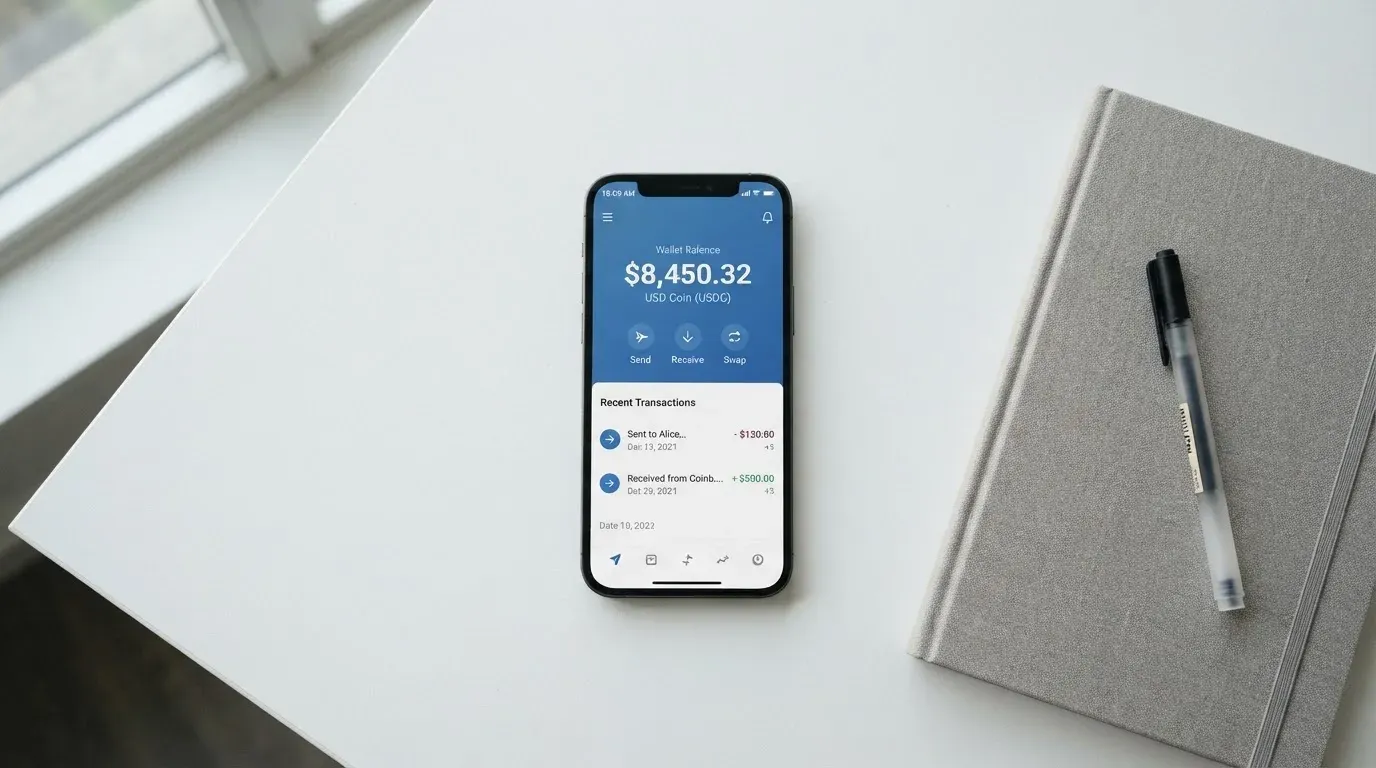
The unofficial side fills in two practical numbers: Basic charges 1.5% to top up, and Plus does not (per cryptocards.so, 2026). Beyond that, one important piece of information is missing — the networks the operator actually supports for each coin. Stablecoins in particular are issued on many chains (USDC natively on dozens of networks, USDT on Ethereum, Tron, Solana and others), and the wrong network can mean a lost deposit: blockchain transfers are typically irreversible, and a deposit sent to an unsupported address generally cannot be recovered without manual support and with no guarantee of success. On top of that, ERC-20 transfers need a small ETH balance to pay gas, so a wallet holding only USDT cannot send, and Tron uses its own resource model that often burns TRX.
The practical advice is to confirm the supported network for your chosen coin inside the app before you send anything meaningful, and to send a small test transfer first. If the supported network is not clearly stated, that is another question to put to support.
Paying with the card every day
In day-to-day use, the card behaves as a virtual Visa. Per third-party reporting, it can be added to Apple Pay and Google Pay, which is the main way to use it at a physical checkout, since there is no plastic card to tap or swipe. Online, the card number from the app is used like any other Visa number.
Several features common on competing cards are not part of the current experience. There is no cashback: the feature is listed as “Coming Soon” in third-party reports. There is no stated rewards or points programme. The only wallet add-on in scope is the two major mobile wallets.
The Android app, per third-party reviewers, holds a 4.6 rating on Google Play across 350-plus reviews, which is a decent score, but several reviewers describe the app as a website wrapper rather than a native client. That tends to make in-app navigation and notifications less smooth than a native app, although it does not by itself stop the card from working.
A final everyday-use concern is the merchant side. Card payments involve several parties — the network, the issuer and the operator that markets the card — and merchants can decline transactions when the card is prepaid, when the issuer country differs from the billing address, or when the merchant category is one the issuer has chosen to block. Some merchants, in the US, Canada and the UK in particular, also use Address Verification Service checks that are less available to foreign-issued cards and that can cause declines. A card issued by an unnamed institution in a country you do not live in will, to some merchants, look foreign. Apple Pay and Google Pay help in a physical store because the card number is replaced by a device-specific token, but online there is no such protection.
What can go wrong
The complaint themes reported on third-party sites give a fair picture of where the experience gets rough. None of these are from a Trustpilot or Reddit page specific to Kazawallet, and there is no official incident disclosure on the operator’s own pages, so the weight to put on each item is yours to judge. They are still useful as a checklist of things to test before you load a large balance.
- A declined purchase at a large merchant, with a slow support reply. A user report describes a virtual Visa being declined at Microsoft, followed by more than a week of support back-and-forth.
- An account suspension after a security incident. A separate report describes the account being suspended after what the user describes as a security incident, with limited clarity from support on the way back in.
- Telegram support that is fast for some, rude for others. Telegram is the unofficial support channel of choice; some reviewers call it fast and 24/7, others describe it as rude and unhelpful.
- AML freezes. A general theme of “AML freeze” complaints, in which funds are held pending documents the operator has not yet asked for in writing.
- An app that is a website wrapper. Several Android reviews describe the app as a website wrapper, with the usability issues that implies.
- Fee surprises. A general theme of complaints about fees, in particular from users who were not expecting the Basic top-up charge or the FX mark-up.
Two structural risks are worth naming in their own right, because they are not specific to Kazawallet. First, the crypto side of the product is custodial — the operator holds the credentials to the balance that funds the card — so the user is exposed to counterparty and hack risk in the same way as any custodial platform. The history of that category includes several large failures, and there is no public fund insurance or segregation commitment on Kazawallet’s pages. Second, the card side is supervised by an unnamed issuer, which makes it harder to confirm the programme is properly licensed and to know which regulator to approach if something goes wrong.
What to take instead
Kazawallet sits in a small but crowded part of the market: cards that fund from a multi-coin crypto balance, often virtual-only, often targeted at users in markets where ordinary banking is hard. Three alternatives come up most often. None of them is a direct replacement, and the differences in the table are real, but the table is also a reminder that every option in this space makes trade-offs you should know about in advance.
| Card | Score | Geographic pitch | Card form | Funding |
|---|---|---|---|---|
| Kazawallet | 6.1 / 10 | Worldwide per official FAQ; UK residents excluded (unofficial) | Virtual Visa only (unofficial) | 9+ coins, including BTC, ETH, SOL, USDT, USDC |
| Cardex | 5.6 / 10 | “200+ countries”, no exclusion list | Debit crypto card on VERVE, Visa, Mastercard and UnionPay; virtual and physical | USDT, USDC, BTC (networks not stated) |
| CardFlow | 4.9 / 10 | “Nigeria’s smartest fintech card platform”, aimed at Nigerians and global users | Virtual USD Mastercard, created in about 3 minutes | BTC, USDT, ETH or Naira bank transfer (networks not stated) |
| HyperCard | 4.7 / 10 | Acceptance in 176+ countries per the App Store; no country list for eligibility | Prepaid HyperCard, network not stated on the App Store page; balance in USD or EUR | USDT, BTC, ETH in the app, converted to USD or EUR |
Cardex is the most flexible of the three in form factor — virtual and physical, four networks including UnionPay and VERVE — and it claims an “AI-Powered Conversion Rate” that picks a favourable rate at the moment of payment, though no fee percentage is published. Its app store listing is Naira-focused, which is a signal about the audience it is built for.
CardFlow is more limited in scope: a virtual USD Mastercard aimed at Nigeria, free to create, funded from BTC, USDT, ETH or a Naira bank transfer. It is a smaller, more focused product than Kazawallet, with less geographic ambition and a smaller coin list.
HyperCard sits in between, with acceptance in 176-plus countries (which is where the card works, not who is eligible), a USD or EUR balance, and crypto funding in the app. Like the other two, the networks it accepts per coin are not stated publicly.
The honest summary is that none of these alternatives resolves the two main gaps at Kazawallet — the unnamed issuer and the unstated fee schedule. They do, however, offer different combinations of card currency, supported networks and physical form factor, and if any of those is decisive for you, the table gives you a quick read.
Who I would recommend the card to
Kazawallet is a reasonable card for a specific kind of user, and a poor one for several common ones. If you are weighing it today, the most useful question to ask yourself is whether the official materials actually tell you what you need to know — because in several places, they don’t.
A reasonable fit if you already hold a mix of BTC, ETH, SOL, USDT and USDC and want one card that will accept all of them; you are happy with a virtual card and Apple Pay or Google Pay; you spend mostly in the card’s own currency (USD on Basic, SGD on Plus), so the 2% FX mark-up is rare; you do not need cash from an ATM; and you are comfortable that the KYC steps, the fee schedule and the issuer are not stated on the operator’s own pages.
A poor fit if you need a physical card for a shop or an ATM; you want the issuer, the fee schedule and the KYC steps written down on the operator’s page before you sign up; you live in the UK and the unofficial exclusion is correct; you want cashback today; you plan to spend heavily at merchants known to be picky about foreign-issued or prepaid cards; or you want a regulated, named issuer you can look up on a register.
The 6.1 out of 10 reflects exactly that: a card that is well set up for a narrow reader and poorly documented for everyone else. The product itself is not bad, but the documentation gap is the first thing you should raise with support before you commit any meaningful balance. If the operator can answer those questions clearly, the score has room to move up; if it cannot, the alternatives above are a safer place to start.
Frequently asked questions
What is Kazawallet card?
Kazawallet is a payment card tied to a crypto balance inside the Kazawallet app. The operator describes it as a worldwide product with two tiers: Basic, which settles in USD, and Plus, which settles in SGD. Third-party reporting describes both tiers as a virtual Visa with no physical card option.
Is Kazawallet a bank?
No. Kazawallet is operated by KASROAD LTD in the UK (company no. 16721888) and by Kasroad FZ-LLC in the UAE. The licensed institution that actually issues the card is not named on the operator’s public pages, which means Kazawallet is best understood as a card programme manager rather than a bank or an e-money institution.
Who owns Kazawallet?
The operators are publicly identified as KASROAD LTD (UK) and Kasroad FZ-LLC (UAE). The wider ownership, any parent company and the issuing institution are not stated on the operator’s own pages, which is one of the main documentation gaps around the product.
How does Kazawallet card work?
You hold crypto inside the Kazawallet account, convert it into the card’s currency (USD for Basic, SGD for Plus), and the resulting balance is what the card spends. The card is a virtual Visa, which means it is added to Apple Pay or Google Pay for in-store payments and used as a card number online.
Does Kazawallet card require KYC?
The official pages do not describe the KYC steps. Third-party reporting says the Basic tier requires an email, a phone number, an ID document, proof of address and a selfie, and labels the tier “Full KYC (Level 4)”. You should expect to be asked for standard identity documents, but the exact list is not published by the operator.
How do I top up Kazawallet card?
You fund the card from a Kazawallet account using one of nine or more supported cryptocurrencies, including BTC, ETH, SOL, USDT and USDC. Third-party reporting puts the Basic top-up fee at 1.5% and the Plus top-up at free. The supported networks for each coin are not stated officially, so confirm in the app before sending.
How do I add Kazawallet card to Apple Wallet?
You add the virtual Visa to Apple Pay or Google Pay from inside the Kazawallet app, in the same way you would add any other Visa card. Because the card is virtual only, a mobile wallet is also the only way to use it at a physical checkout.
Where can I use Kazawallet card?
The card is a Visa, so it is accepted at any merchant that takes Visa and is not blocked by the operator. Some merchants, particularly those that run Address Verification Service checks or are sensitive to prepaid or foreign-issued cards, may decline the transaction. A user report describes a decline at Microsoft; in that case the path back was through support, and the resolution took more than a week.
Is Kazawallet card safe?
The card supports 3-D Secure for online payments, and the app can auto-hide card details. The crypto side of the product is custodial, which means Kazawallet holds the credentials to the balance that funds the card, and the user is exposed to the counterparty and hack risk that comes with any custodial platform. The unnamed issuer and the lack of a stated fund-segregation policy make it harder to confirm how the card side is supervised.
How do I delete my Kazawallet account?
The deletion flow is not described on the operator’s public pages. In practice, deletion requests on custodial crypto products typically go through in-app support or a help-desk ticket, and the operator may need to complete KYC and AML checks before closing the account and returning any remaining fiat balance. Crypto balances in the account are usually withdrawable to an external wallet before the account is closed.
Virtual card fees – cryptocardfacts
Content created by the «cryptocardfacts» team